- The paper demonstrates that conditional GANs achieve superior performance in low-SNR conditions, with higher SI-SDR and PESQ gains compared to other methods.
- It highlights that diffusion models are computationally intensive, requiring 60–100× more GMACs, making them less viable for fast, cost-effective speech enhancement.
- The study reveals that hallucination effects vary with SNR levels, suggesting discriminative approaches are preferable in moderate-to-high SNR settings for efficiency.
Comparative Analysis of Generative and Discriminative Methods for Speech Enhancement
Methodological Overview
The paper "A Comparison of Generative and Discriminative Methods for Speech Enhancement: Robustness, Complexity, and Hallucination" (2606.02913) conducts a comprehensive empirical study evaluating deep learning-based speech enhancement (SE) methods for noise reduction tasks. It contrasts generative models—covering diffusion-type methods, conditional flow matching (CFM), consistency models, and various conditional GANs—with classical discriminative approaches. The analysis incorporates objective and perceptual metrics, computational efficiency, training dynamics, robustness to dataset mismatches, and hallucination tendencies.
Generative methods operate either by iterative refinement (diffusion) or direct transformation (GANs, CFM, consistency). Diffusion models such as SGMSE+ and BBED employ stochastic reverse-time SDEs to denoise speech, while GANs (DisCoGAN, NoCoGAN, CMGAN, NCSN++ (GAN)) learn mappings via adversarial loss, potentially conditioned on latent discriminative features. CFM (FlowSE) and consistency models (SEBridge) offer alternatives that reduce reliance on multiple inference steps. Discriminative methods (DCCRN, GCRN, discriminatively trained NoCoGAN and NCSN++) treat enhancement as a regression problem, minimizing signal-level losses on noisy-to-clean transformations.
Experimental Design and Evaluation Metrics
All models are trained and tested across both matched (high- and low-SNR) and mismatched conditions, using the DNS Challenge dataset and custom low-SNR sets with diverse noise profiles. The evaluation encompasses intrusive (PESQ, SI-SDR, FwSegSNR) and non-intrusive (DNSMOS, SCOREQ) metrics for signal quality, alongside word error rate (WER), character error rate (CER), and Levenshtein phoneme similarity (LPS) to quantify hallucination. Model complexity is measured in giga MACs (GMACs) and parameter counts.
Signal Quality and Robustness Across SNR Regimes
Generative methods, especially conditional GANs, consistently outperform discriminative and diffusion models in low-SNR matched and mismatched settings—demonstrated by PESQ, SI-SDR, and FwSegSNR gains. Notably, NCSN++ (GAN) achieves both highest SI-SDR and FwSegSNR improvements in extreme low-SNR conditions, suggesting that conditional GANs are particularly effective under adverse noise. However, in high-SNR matched scenarios, discriminative and GAN-based models show competitive performance; diffusion models lag in PESQ, performing better in non-intrusive DNSMOS metrics, which ambiguously point to enhanced generative capabilities in perceptual quality estimation.
Data Efficiency and Training Convergence
GAN-based methods are substantially more data-efficient, converging to peak performance with minimal training samples and exhibiting faster convergence behavior despite typical GAN instabilities during training. Diffusion models, exemplified by BBED, require larger datasets and more iterations for comparable SI-SDR values and are less sensitive to small training volumes. The discriminative NCSN++ (D) model also converges rapidly but saturates at lower performance levels relative to GANs.
(Figure 1)
Figure 1: Training convergence in PESQ and SI-SDR for discriminative, GAN-based, and diffusion models demonstrates the rapid and data-efficient convergence of GANs.
Diffusion models are orders of magnitude more expensive than GANs and discriminative models, primarily due to the iterative reverse diffusion process, resulting in 60–100× more GMACs for comparable performance. Single-step GANs and discriminative regressors are considerably more efficient and, in the case of NCSN++ (GAN), achieve higher objective scores per unit of complexity. Light-weight diffusion variants (FlowSE, SEBridge) mitigate inference steps but remain computationally intensive due to backbone requirements.
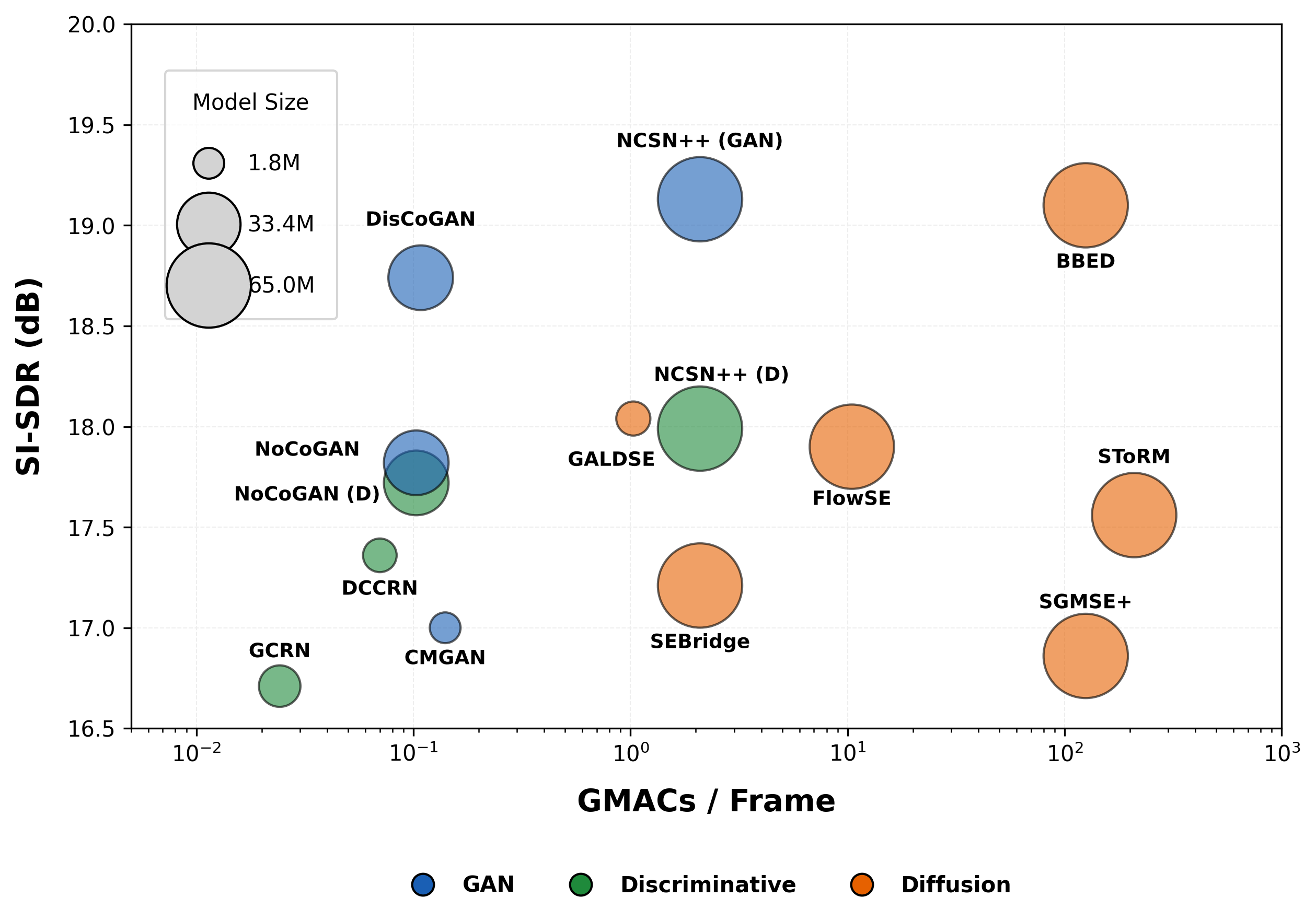
Figure 2: Comparison of model complexity between discriminative, GAN-based, and diffusion approaches in terms of GMACs and parameter count.
Hallucination Effects and Linguistic Integrity
All methods improve WER, CER, and LPS over noisy baselines, with GANs (DisCoGAN, NCSN++ (GAN)) attaining the best phoneme similarity and lowest hallucination metrics. While generative models generally impose limited hallucination under moderate-to-high SNR, scrutiny reveals significant degradation in extreme low-SNR regimes: spurious spectral artifacts and deteriorated linguistic scores emerge as the noisy input becomes nearly uninformative. Thus, the degree of hallucination is tightly coupled to SNR and the informativeness of the conditioning signal.
Generalization and Unseen Tasks
Empirical results on unseen SE tasks (blind bandwidth extension, codec post-filtering) show marginal or negative PESQ changes and positive SCOREQ shifts, indicating inconsistent generalization ability for both GAN-based and diffusion models. This underscores that the evaluated generative approaches, though effective in noise reduction, are not universally robust for broader signal restoration problems without retraining or adaptation.
Practical and Theoretical Implications
The findings delineate a robust empirical boundary: generative methods, particularly conditional GANs, are optimal for speech enhancement under severe noise, owing to their efficient, direct inference and superior denoising ability. Diffusion-type models, despite their theoretical generality and compositional capabilities, are impractical for SE tasks requiring fast inference and cost-effective deployment. The strong dependency of performance on SNR regime and conditional signal quality implies that generative approaches should be reserved for tasks where the input provides meaningful denoising cues. Conversely, discriminative methods remain preferable when computational efficiency is critical and input SNR is moderate or high.
Conclusion
This comparative study demonstrates that conditional GANs and discriminative models dominate diffusion-based methods for practical speech enhancement, excelling in both low-SNR robustness and computational efficiency. Diffusion approaches do not justify their complexity in SE under the evaluated paradigms. Future work should prioritize architectural innovations that balance generative power and efficiency, extend evaluation to more generative tasks, and further investigate neural methods' hallucination behavior under extreme input corruption.

