- The paper introduces transport keys that realign neural activations to recover up to 92% of lost task performance.
- It details experiments on both convolutional and transformer models, revealing that interface drift—not representational erasure—is the key issue in catastrophic forgetting.
- The approach, validated on tasks like split CIFAR-100 and domain transfers, paves the way for efficient continual learning with minimal anchor data.
Recovering Latent Task Knowledge in Continual Learning via Transport Keys
Introduction
The phenomenon of catastrophic forgetting in neural networks is traditionally conceptualized as the representational erasure of task-relevant features during sequential task learning, thereby limiting performance retention for earlier tasks. The paper "Forgetting is Not Erasure: Recovering Latent Knowledge via Transport Keys" (2606.02860) systematically interrogates this paradigm by proposing that much of what is labeled "forgetting" is not true loss but an access issue—arising from interface drift between network stages—rather than the wholesale destruction of useful representations. The work introduces transport keys as compact, data-driven alignment operators that re-enable access to latent computation otherwise inaccessible due to sequential training. Through extensive empirical analysis on both convolutional and transformer-based vision models, this study delivers a highly nuanced account of catastrophic forgetting and advances new directions in continual learning (CL).
Interface Drift Versus Representational Erasure
Catastrophic forgetting is often attributed to the overwriting of internal representations supporting prior tasks, consistent with longstanding hypotheses of a stability-plasticity tradeoff. The authors challenge this by decomposing neural networks into early (feature extraction) and late (classification/decoding) stages and observing that post-task-update representations frequently retain latent features necessary for prior tasks, but the interface—the handshake at internal boundaries—drifts, rendering these features unusable by the original downstream decoder.
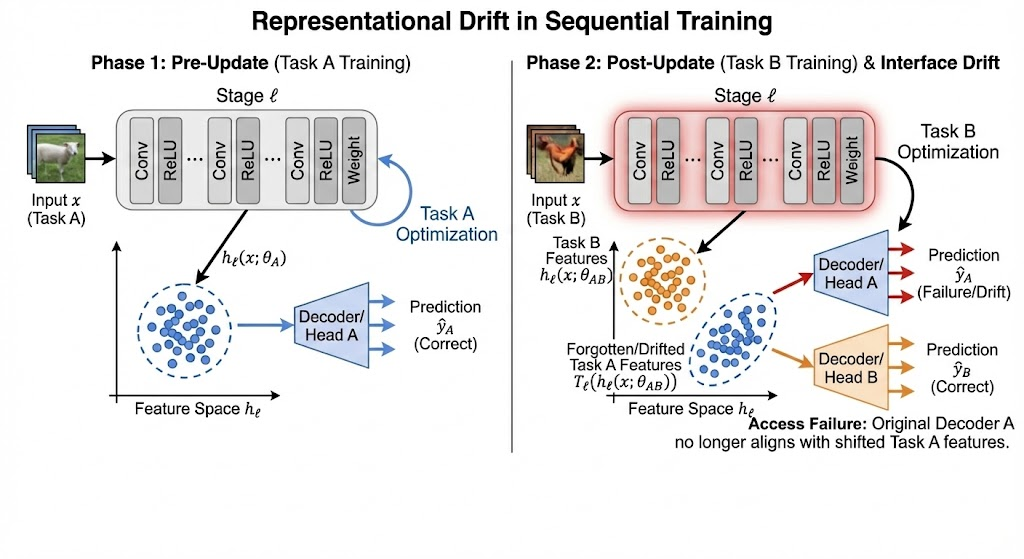
Figure 1: Illustration contrasting permanent representational erasure with interface drift between stages, the latter retaining latent knowledge inaccessible to the original task decoder.
Formally, for a model with parameters θA (pre-update) and θAB (post-update), they demonstrate that a simple transformation Tℓ at an intermediate layer ℓ can align the drifted activation hℓ(x;θAB) back into the Task A coordinate system, effectively recovering previous task performance. This reframes forgetting as an access problem—an inability for later network components to interpret task-relevant features due to interface drift.
Methodology: Transport Keys and Stitched Model Evaluation
Transport keys are introduced as task-specific, interface-level alignment operators estimated from a small, paired anchor set of activations across checkpoints. These keys do not involve retraining or label information, but instead exploit the existence of a low-dimensional, structured mapping between post-update and pre-update activation spaces.
The evaluation strategy is built upon model stitching: given a post-update early network, a pre-update late network, and a transport key, the stitched model is evaluated on prior tasks to assess the recoverability of latent computation.
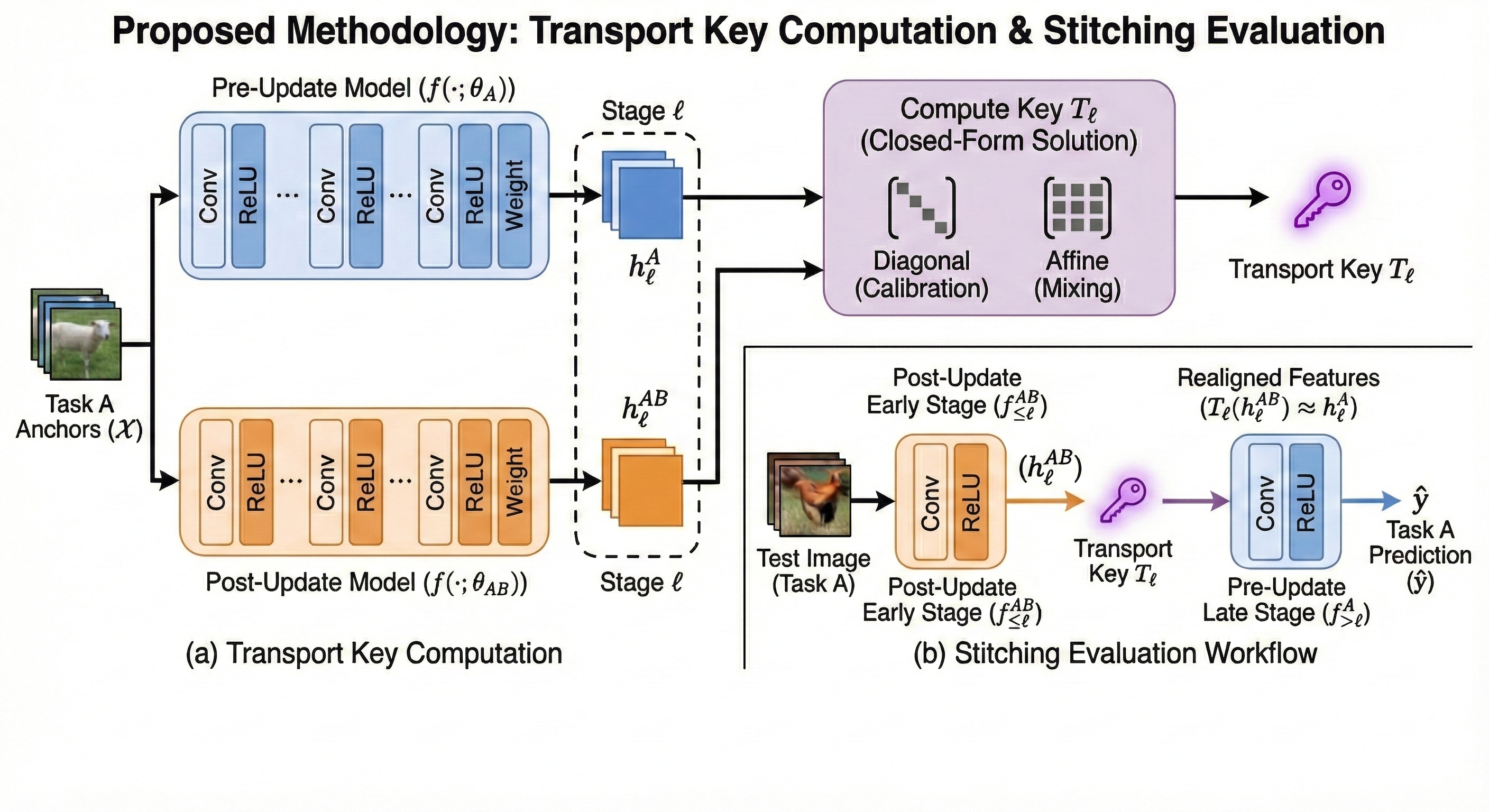
Figure 2: Workflow of transport-key generation and stitched evaluation, realigning internal activations via compact interface keys.
Two transport key families are considered:
- Channel-calibration keys: Correct per-channel scaling and shifting, effective when representation drift is predominantly calibration-based.
- Cross-channel alignment keys: Account for structured feature mixing between channels, necessary under broader basis transformation, as seen in domain shift scenarios.
Control experiments test various forms of disruption (e.g., channel permutation, correspondence breaking) to isolate the role of genuine interface alignment.
Empirical Results
Same-Domain Continual Learning
In the split CIFAR-100 scenario (two tasks, ResNet backbone), post-update accuracy on the first task drops from 75% to 39%, typifying severe forgetting. However, applying a transport key at the first stage recovers accuracy to 72%—a 92% recovery of lost performance—with only marginal additional gain from more expressive keys, indicating the drift is mostly low-dimensional channel calibration.
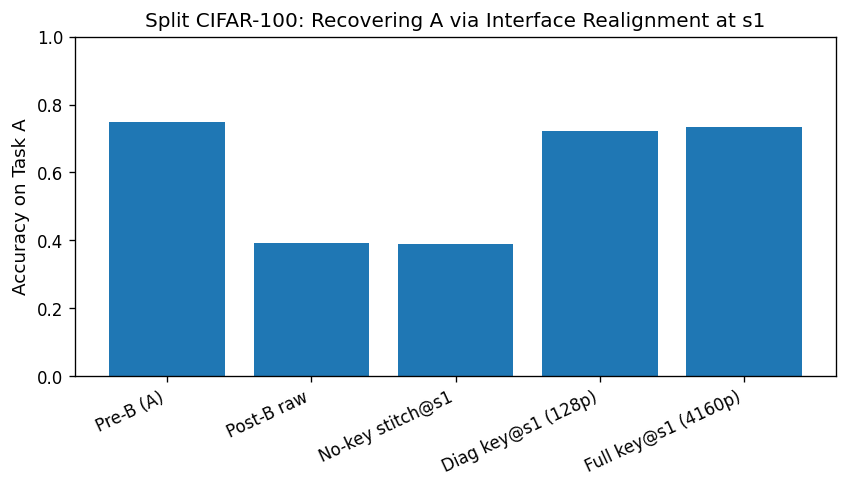
Figure 3: Split CIFAR-100: transport keys achieve 92% recovery of lost accuracy post-sequential training, demonstrating strong access recovery.
Anchor set analysis (number of paired samples for key estimation) shows that recovery saturates with very few examples, supporting the hypothesis that interface drift is low-dimensional and structured, rather than reflecting complex information loss.
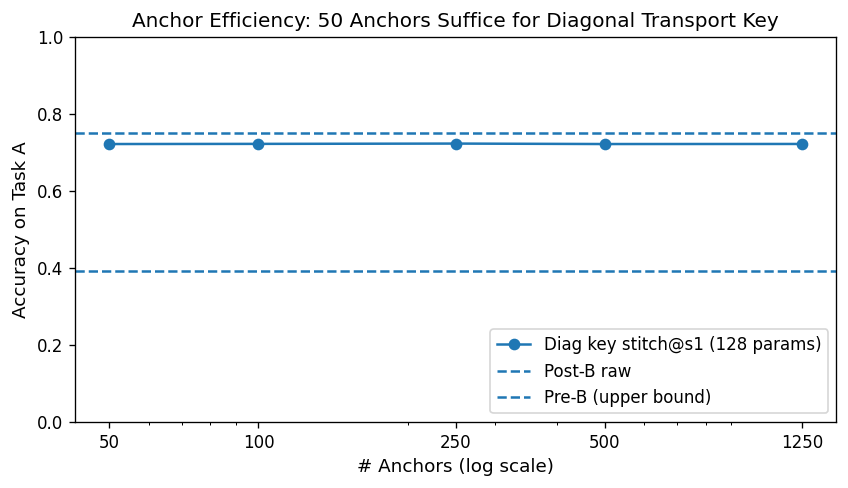
Figure 4: Anchor-efficiency curve for Split CIFAR-100: recovery plateaus with small anchor sets, indicating structured, low-dimensional drift.
Domain Shift
For the challenging CIFAR-10 to SVHN transfer (different domains), post-update Task A accuracy collapses from 88% to 15%. Stitched no-key evaluation at early stages already regains a substantial fraction (62%) of lost accuracy, and using a transport key further increases this to 75%. Control conditions confirm that the alignment is non-trivial: disrupting correspondence or channel identity markedly degrades recovery.
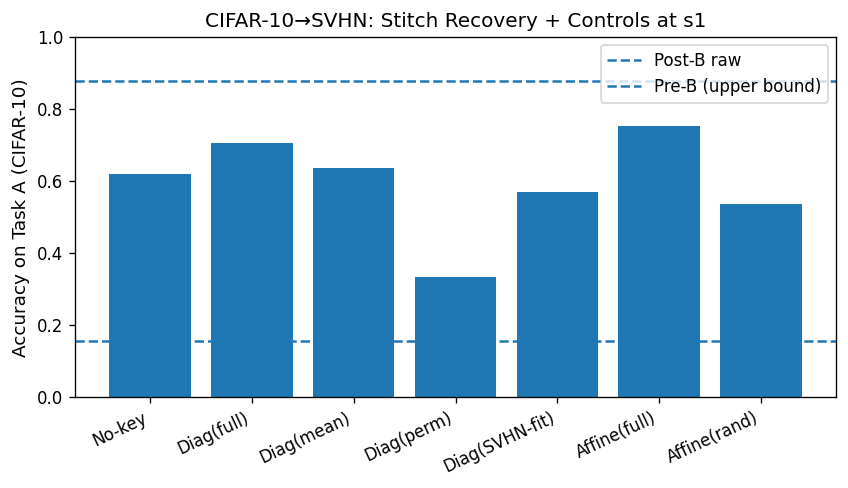
Figure 5: Control analyses for CIFAR-10 to SVHN: structure-preserving keys substantially boost recovery, while disruptive controls suppress it.
At later stages, keyed recovery remains effective, but further disruption collapses performance nearly to the post-update baseline, demonstrating that genuine interface correspondence, not generic adaptation, is required.
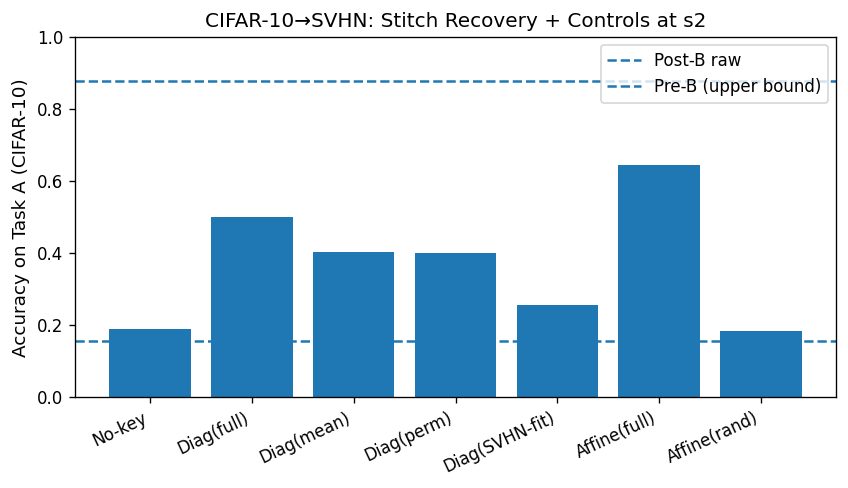
Figure 6: At deeper stages, correspondence-breaking controls sharply reduce the effectiveness of transport keys, confirming dependence on aligned internal structure.
Architectural Generality
Experiments on a mini vision transformer (ViT) architecture reveal that interface drift and latent recoverability are not specific to CNNs. Early blocks exhibit high compatibility after sequential training, with keyed and no-key stitching both providing up to 83% recovery, but later blocks experience more severe drift, necessitating transport keys for meaningful access.
Discussion and Implications
The central empirical finding is that catastrophic forgetting in major vision architectures is neither complete nor irreversible; instead, it is predominantly a manifestation of interface drift. Most lost task accuracy is recoverable via compact transport keys, highlighting that network plasticity and stability do not have to be mutually exclusive over moderate task sequences.
These results have significant theoretical and practical implications:
- Theoretical Shift: The study reframes CL challenges from representational erasure to interface alignment, suggesting that the solution space for CL can prioritize mechanisms for interface (re)indexing over strict weight preservation.
- Practical Applications: Future CL systems could maintain per-task interface keys, enabling lightweight realignment upon revisiting prior tasks, greatly reducing the memory and computational overhead associated with replay buffers or parameter isolation.
- Control and Safety Considerations: The ability to recover decommissioned capabilities by interface alignment introduces critical ethical considerations, emphasizing the need for careful policy and safety infrastructure when deploying such systems.
The authors note that limitations remain in the context of long task sequences (where drift may eventually become unrecoverable or highly non-linear) and in the requirement for access to pre-update checkpoints during key creation. Future research should target in-place recovery methods and online key estimation, making interface-based access mechanisms a viable deployment strategy in realistic CL settings.
Conclusion
This paper provides compelling evidence that much of the degradation observed in sequentially trained deep learning models is recoverable by re-aligning internal interfaces rather than by restoring erased features. Transport keys—a class of lightweight, activation-space operators—enable this recovery by bridging the representational drift incurred during task updates. This insight implicates access rather than encoding as the primary bottleneck in CL and opens a new axis of innovation for future continual learning algorithms that emphasize structured interface management over monolithic parameter retention.

