- The paper introduces novel homophily indices and measures that generalize traditional homophily to hypergraphs using hyperedge composition.
- It reveals how hyperedge size and combinatorial constraints influence observed mixing patterns, including sign reversals in homophily measures.
- The study synthesizes statistical models and computational methods, providing robust frameworks for analyzing higher-order interactions in complex networks.
Higher-Order Homophily in Hypergraphs: Measures, Models, and Implications
Introduction
The study "A Guide to Higher-Order Homophily" (2606.02537) addresses the structural regularities in social systems induced by mixing patterns—specifically homophily and heterophily—when these systems are described by hypergraphs, rather than traditional pairwise networks. The work systematically surveys and synthesizes both quantitative measures and modeling approaches that support the statistical description and theoretical understanding of higher-order mixing. The analysis is comprehensive, rigorously highlighting combinatorial constraints, conceptual divergences from pairwise settings, and methodological challenges intrinsic to the hypergraph framework.
Quantifying Higher-Order Homophily: Measures and Conceptual Foundations
Hypergraph Homophily Indices
The generalization of homophily to hypergraphs necessitates moving from binary within/between-group edge types to more involved characterizations based on hyperedge composition (i.e., types). Veldt, Benson, and Kleinberg’s extension defines a hierarchy of affinity and ratio-based homophily scores parametrized by hyperedge size, node attribute classes, and hyperedge type. These indices capture over- or under-representation of specific class configurations relative to explicit null models. The analysis in the paper exposes strong combinatorial constraints: certain extreme homophily patterns are strictly impossible in hypergraphs, in contradistinction to graphs, due to multinomial symmetries and minimal coloring constraints. These impossibility results set upper and lower limits on observed homophily patterns and must inform both empirical measurement and synthetic model design.
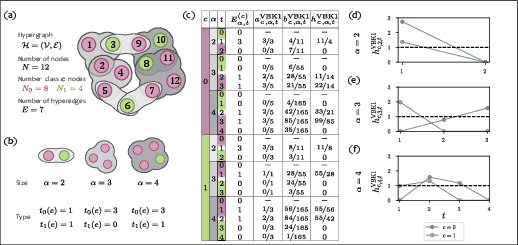
Figure 1: Hypergraph H with class membership illustrates breakdown of the pairwise within-/between-group dichotomy and necessity of hyperedge type-based measurement.
The perplexity-homophily index introduces an entropy-based, size-dependent quantification of attribute diversity within hyperedges, explicitly incorporating node degree bias in its null distribution. This measure possesses the beneficial property of collapsing to Newman's pairwise nominal assortativity for size-2 hyperedges, thus inheriting interpretability and comparability with classical network science.
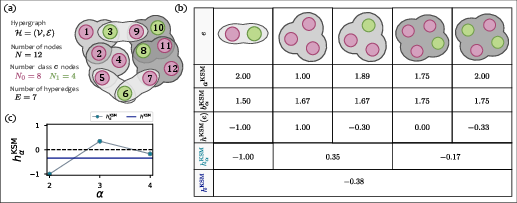
Figure 2: Size-dependent perplexity-homophily index reveals sign reversals in homophily as hyperedge size increases, highlighting distinct higher-order effects.
Simplicial and Nested Homophily
A subset of hypergraphs—those exhibiting downward closure (simplicial complexes)—require distinct treatment. Sarker, Northrup, and Jadbabaie’s simplicial homophily ratio corrects null-model expectations for such structures, quantifying how group-aligned larger-group interactions emerge conditioned on smaller-scale sub-interactions. The treatment is only appropriate when strict nestedness holds and demonstrates that conventional hypergraph homophily measures can spuriously overstate homophilous structure in such contexts.
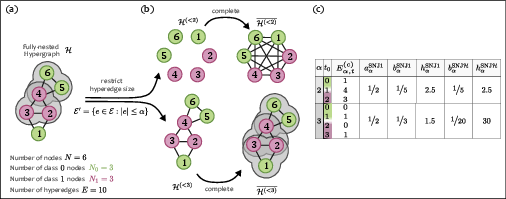
Figure 3: Fully-nested hypergraph example to illustrate the construction and effect of simplicial homophily versus traditional hypergraph homophily.
Learning-Theoretic and Dynamical Perspectives
Message passing neural network-derived homophily (MP homophily) provides a computational and localization-sensitive lens, generating node- and hyperedge-level homophily over multiple MPNN layers/iterations. Critically, these scores lack a calibrated null model, limiting across-graph or cross-group comparability and requiring careful interpretation. Furthermore, the random walk hypersegregation (RWHS) framework bridges dynamic processes with structural measurement, yielding node-centric measures of local mixing based on stochastic walk encounters.
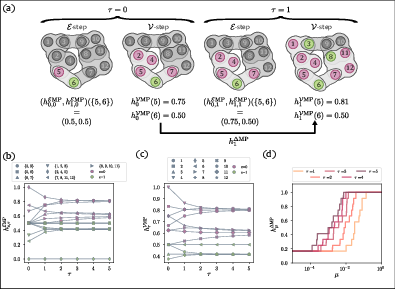
Figure 4: Iterative evolution and stabilization of MP homophily at the hyperedge and node levels illustrate network neighborhood effects.
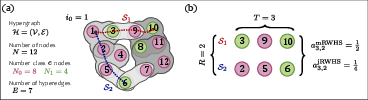
Figure 5: Random walk hypersegregation demonstrated by class-concordance along walk realizations on a sample hypergraph.
Assortativity and Modularity Extensions
Hypergraph assortativity extends pairwise Pearson/Spearman correlation to higher-order edges using user-specified pairing functions, enabling treatment for real or ordinal node attributes. However, such approaches necessarily reduce the intrinsically high-order information to bivariate statistics. Modularity generalization involves explicit baselining by expected within-type hyperedge counts under multinomial compositions, but normalization and inter-model comparability challenges persist.
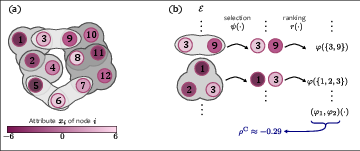
Figure 6: Example calculation of Chodrow's hypergraph assortativity from scalar node attributes selected per hyperedge.
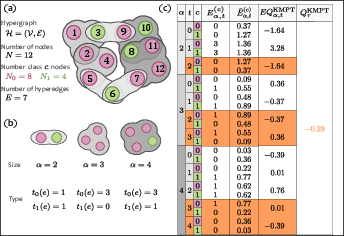
Figure 7: Modularity calculation in a two-group hypergraph; negative modularity underscores heterophilic structure relative to the null model.
Graphical Reductions and Limitations
The clique projection method collapses hypergraph data onto a simple graph, erasing higher-order compositional distinctions and, as shown by construction, can entirely mask strong scale-dependent homophily/heterophily signatures present in the original hypergraph instance.
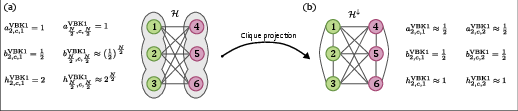
Figure 8: Loss of higher-order mixing distinctions in clique-projected graph, leading to erroneous inference of neutral mixing.
Statistical and Generative Hypergraph Models
Null and Baseline Models
The survey includes maximum-entropy (canonical and microcanonical) models, configuration models for degree sequences, and generalizations of the Chung-Lu randomization to hypergraphs. These models form the backbone for appropriately calibrated null distributions underlying most homophily measures.
Stochastic Block Models and Structured Generative Models
HSBM formulations parameterize the probability of hyperedges via symmetric tensors over class combinations, admitting both simple and degree-corrected generalizations. The majority of statistically-tractable models define hyperedge existence via independent Bernoulli (or Poisson for degrees) distributions, conditioned on class composition and (optionally) per-node affinity parameters.
Notably, in combinatorially-parameterized models, the number of free parameters grows rapidly with hyperedge size and number of classes, impeding both estimation and interpretability for large or complex datasets.
Geometric and Latent Position Hypergraph Models
For continuous node attributes, geometric models leverage latent Euclidean or hyperbolic coordinates, defining hyperedge probabilities via generalized distance or multi-linear forms. These models naturally encode gradual, rather than discrete, similarity and, depending on parameterization, support the emergence of complex mixing or core-periphery structure.
Mechanistic and Algorithmic Growth Procedures
Algorithmic hypergraph generators (e.g., hyperedge homophily-controlled growth, spatial or hyperbolic nearest-neighbor aggregation, preferential attachment with class bias) permit efficient construction of datasets with user-controlled mixing properties, but often lack a tractable underlying probability distribution. As such, they are most useful for validating or stress-testing measurement techniques, rather than statistical inference.
Key Theoretical Insights
- Combinatorial constraints unique to hypergraphs strictly limit the observable mixing patterns, with impossibility theorems constraining both strict monotonic and majority homophily across groups for certain hyperedge sizes.
- Choice of null model critically affects homophily measurement: downward closure, degree constraints, node attribute distribution, and local neighborhood structure all modulate the appropriate baseline.
- Size-dependence of homophily: Not only does mixing pattern vary across hyperedge sizes, but within a single hypergraph one can encounter a reversal of homophilous versus heterophilous tendencies as interaction scale varies.
Practical Implications and Future Directions
Measuring and modeling higher-order homophily is now essential for any substantive empirical or algorithmic study of social, biological, or information systems where group-based or multipartite interactions play a crucial structural or dynamical role. Rapid development of both theory and methodology is leading to a proliferation of measures, each adapted to specific data availability (full incidence, summary stats, heterogeneity), statistical constraints, and theoretical perspectives (entropy, spectral, block, geometric).
Open questions include:
- Robustness of measures under attribute class imbalance, high-degree nodes, and correlated attribute-degree distributions;
- Statistical inference and model selection for large multinomial or geometric parameter spaces in real-world, noisy hypergraph data;
- Development of normalized, size- and class-comparable versions of modularity and assortativity;
- Extension to multi-membership or fuzzy class-assignment settings;
- Systematic benchmarking across synthetic and real-world datasets for both measures and generative models.
More broadly, these frameworks and results are laying the foundation for higher-order graph representation learning, unsupervised structure discovery, and inference pipelines in domains ranging from computational social science to computational biology and higher-order AI systems.
Conclusion
The analysis in "A Guide to Higher-Order Homophily" rigorously advances both the conceptual and practical toolkit available for the measurement and theoretical modeling of homophilic and heterophilic mixing in hypergraphs. The paper's synthesis illuminates the subtleties arising from the combinatorics of higher-order interactions and demonstrates that robust characterization of mixing in such settings demands not only novel indices but also careful consideration of null models and generative assumptions. As higher-order representations become standard in downstream AI and network science workflows, these methodological advances will be central to empirically valid and theoretically meaningful analysis of complex relational data.