- The paper demonstrates that spatial and particle-particle entanglement in 1D quantum walks depends non-monotonically on the interaction strength (U/J) across various initial states.
- It employs Hubbard and Bose-Hubbard Hamiltonians with optimized Fock basis construction to model and measure entanglement for both distinguishable and indistinguishable bosonic particles.
- The numerical analysis supports experimental realizability in quantum optical lattices and photonic chips, offering insights into many-body dynamics and entanglement scaling.
Spatial and Particle-Particle Entanglement in 1D Quantum Walks of Bosonic Particles
Model Framework and Entanglement Measures
The study presents a thorough analysis of entanglement in one-dimensional continuous-time quantum walks (QWs) of two bosonic particles, focusing on both distinguishable and indistinguishable cases. The dynamics are governed by the Hubbard and Bose-Hubbard Hamiltonians for distinguishable and indistinguishable particles, respectively, on a lattice of size L, explicitly incorporating onsite repulsion (U) and nearest-neighbor hopping (J). The authors systematically construct the Fock basis for both particle types, exploiting number conservation in the indistinguishable case for optimized computational scaling.
For quantification, two central entanglement measures are implemented:
- Spatial (left-right) entanglement: Defined as the von Neumann entropy of coarse-grained sector probabilities pj for configurations with nL and nR particles on the left and right halves of the lattice, respectively, yielding ESLR=−∑jpjlnpj.
- Particle-particle entanglement: For distinguishable particles, the entropy derives from singular values of the time-evolved coefficient matrix in the Schmidt basis; for indistinguishable particles, the measure generalizes using the SVD of the symmetrized Fock-state coefficients to obtain Si=−∑k2∣ykS∣2ln(2∣ykS∣2).
Numerical Analysis: Distinguishable Particles
For two distinguishable walkers, the authors analyze three canonical initial states:
- Separable (adjacent, singly occupied sites): Shows rapid growth in spatial entanglement, with maximal values achieved around intermediate interaction strengths, while the particle-particle entropy remains zero for U=0 and exhibits a non-monotonic dependence on U/J for U0.
- Entangled (adjacent, spin-entangled): Maintains elevated particle-particle entanglement throughout, due to initial spin correlation, while spatial entanglement mirrors behavior seen in the separable case.
- Doubly occupied (both particles at same site): Initial spatial entanglement is suppressed, but evolves non-trivially depending on U1. Energy conservation maintains a preference for doubly occupied states at large U2, and the particle-particle entropy demonstrates a peak at intermediate U3 but ultimately diminishes for very strong interactions.
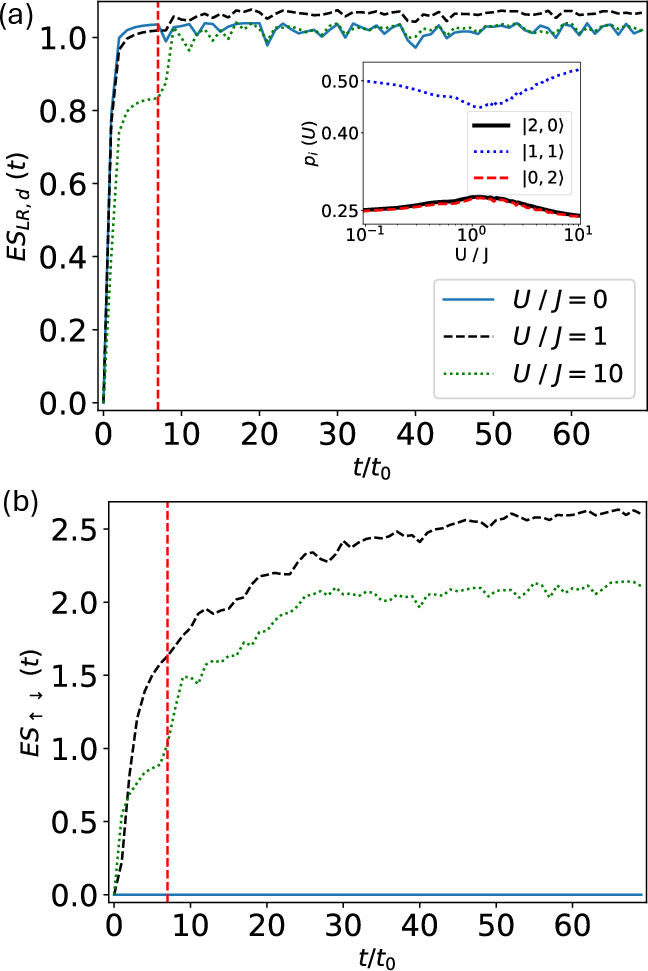
Figure 1: Left-right and up/down (spin) entanglement measures for two distinguishable particles, demonstrating distinct time evolution and interaction dependence for a separable initial state.
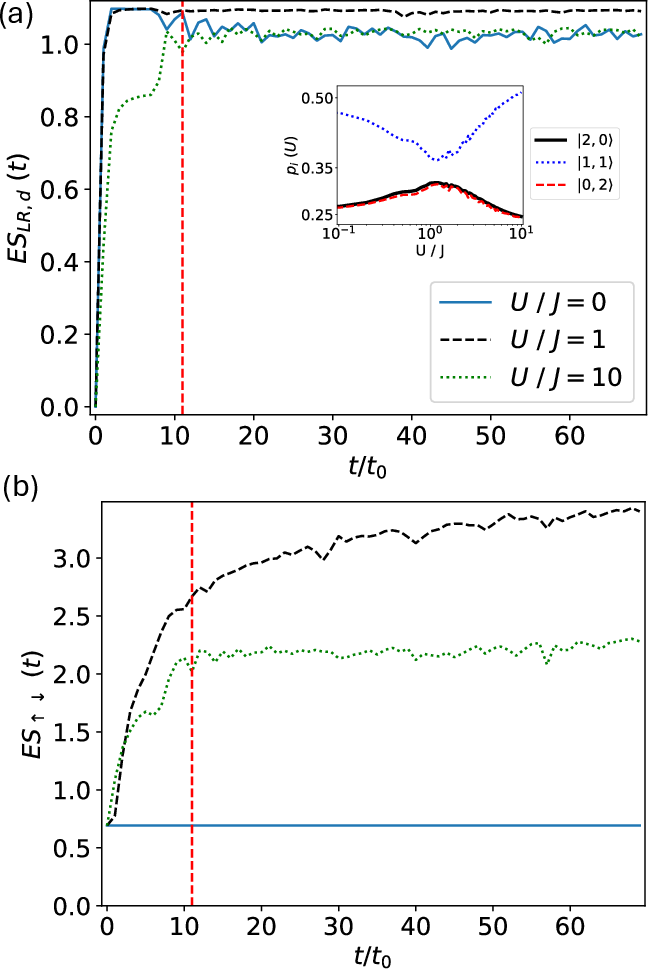
Figure 2: Quantitative evaluation of left-right and spin entanglement for the entangled initial state, highlighting the effect of initial spin correlations.
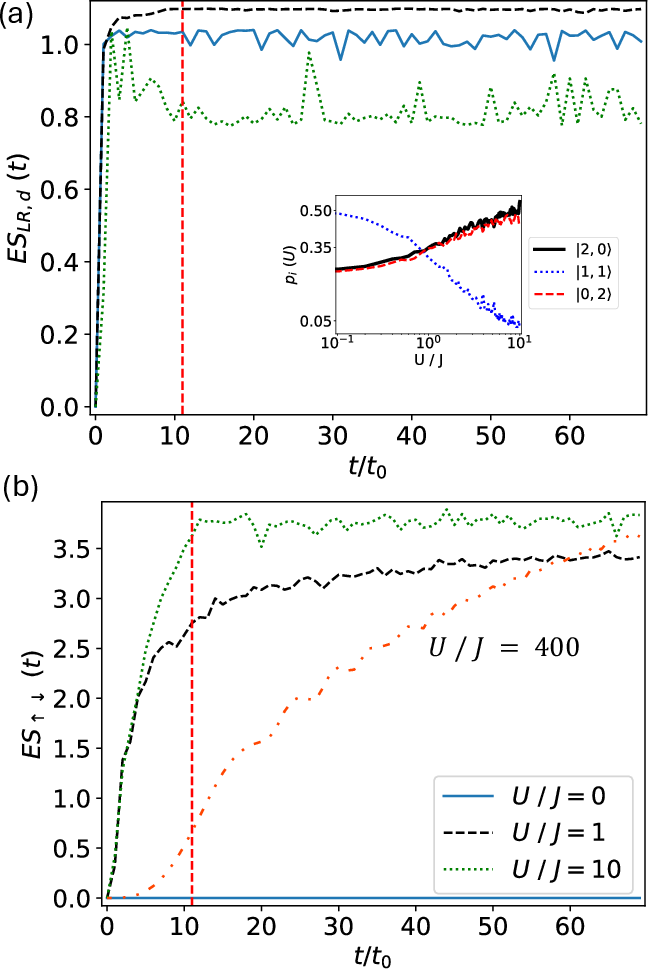
Figure 3: Entanglement profiles for the doubly occupied initial state, showing interplay of spatial distribution and interaction-induced correlation.
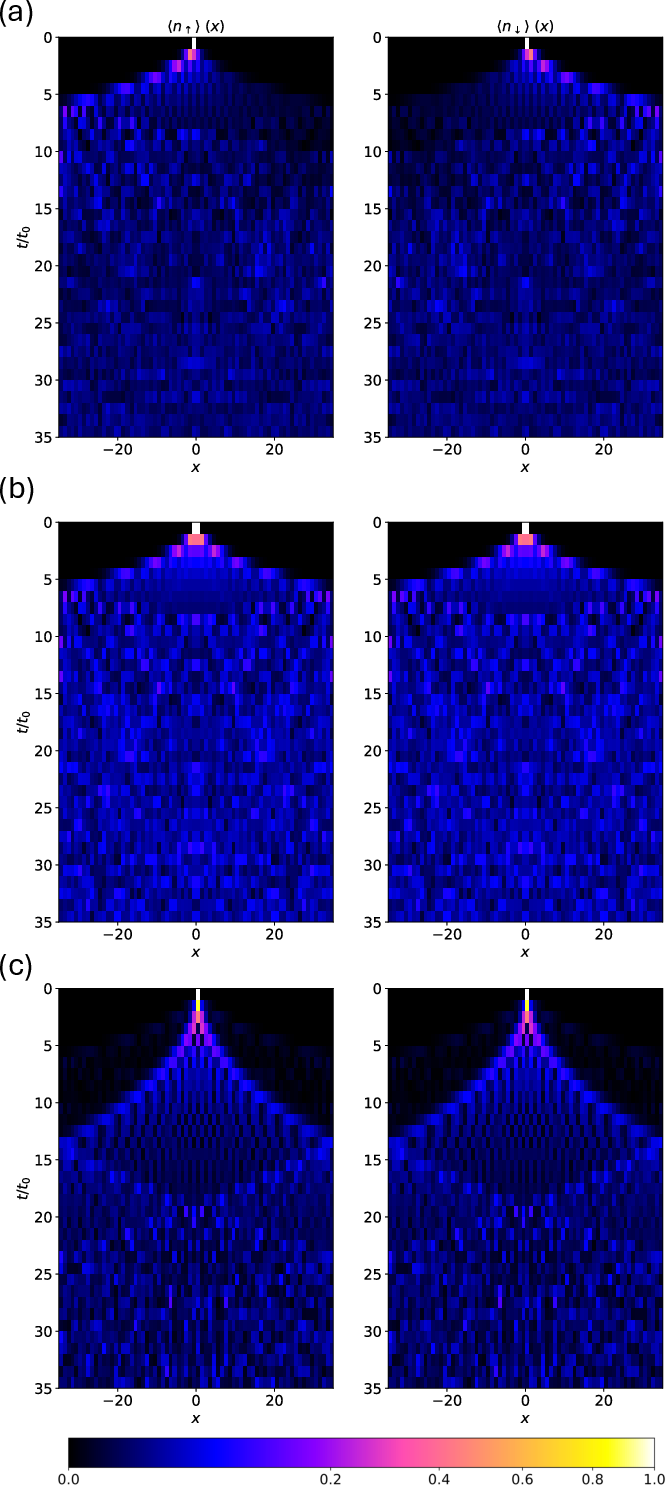
Figure 4: Time-evolved occupation numbers for each spin component, visualizing dynamics for all three initial states.
Numerical Analysis: Indistinguishable Particles
The indistinguishable case, realized as two bosons with symmetrized Fock states, exhibits key qualitative similarities to the distinguishable scenario. For adjacent singly occupied and doubly occupied initial states:
- Singly occupied (adjacent sites): Spatial entanglement grows rapidly for low and moderate U4, with maximal values near U5. Particle-particle entropy starts at U6 due to intrinsic bosonic correlation and is robust under time evolution.
- Doubly occupied: The left-right entropy attains a maximum at intermediate U7 but is substantially suppressed for strong interactions, reflecting the dominance of doubly occupied outcomes. Notably, the particle-particle entanglement remains zero for U8, as non-interacting dynamics preserve the structure of the initial Fock state.
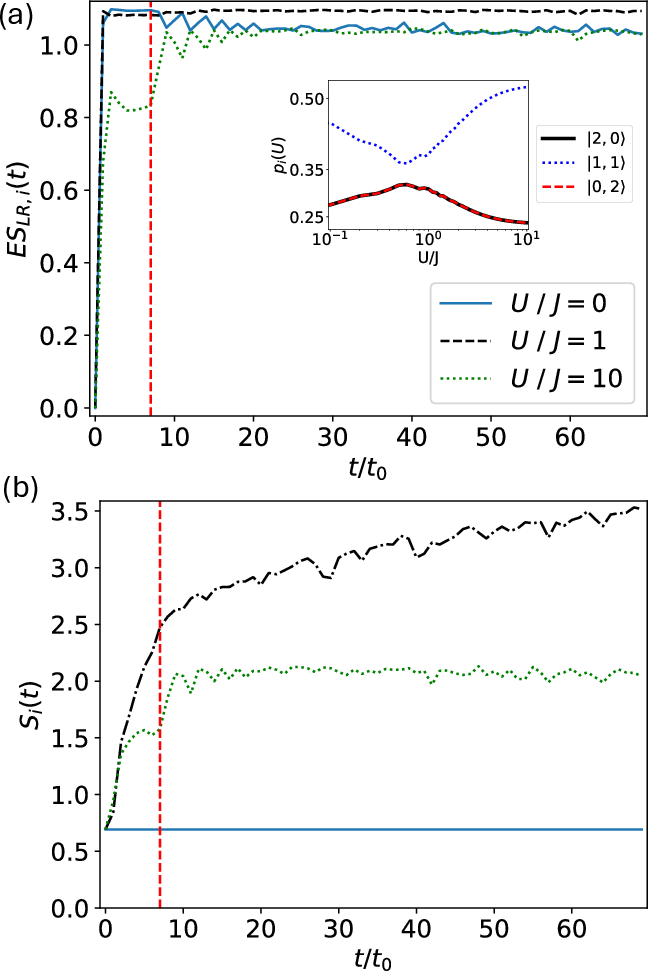
Figure 5: Left-right and particle-particle entanglement for two indistinguishable particles with an adjacent, singly occupied initial state, revealing similarities to the distinguishable entangled case.
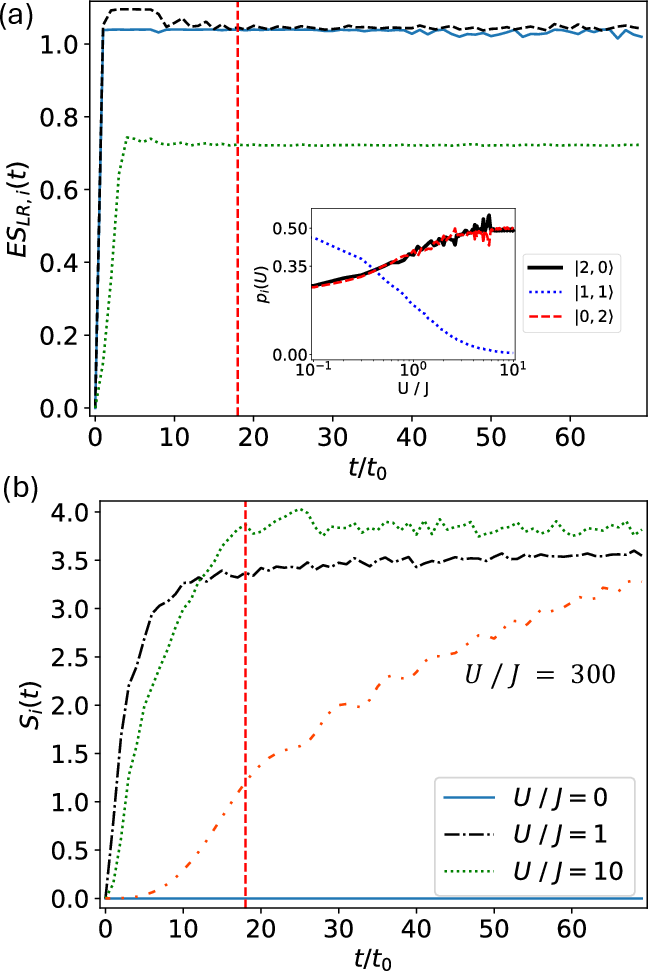
Figure 6: Results for the doubly occupied initial state, showing reduced spatial entanglement at large U9 and time-evolution profiles for particle-particle correlations.
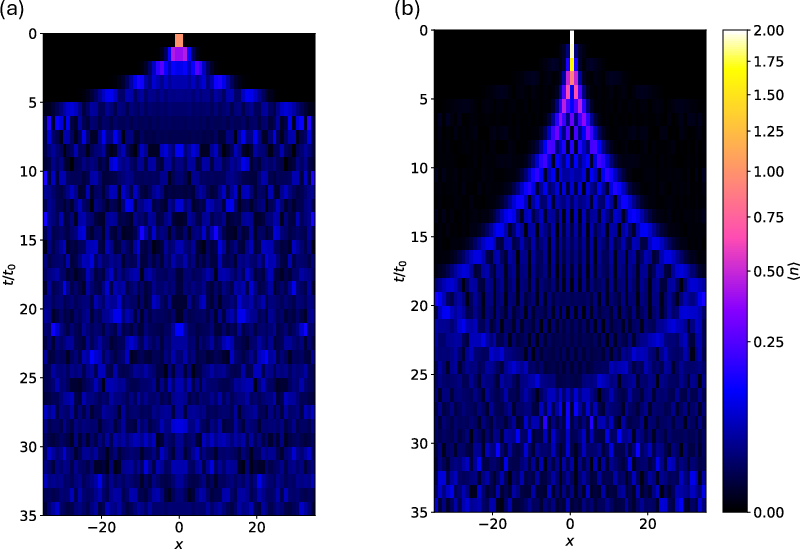
Figure 7: Occupation number dynamics for two indistinguishable particles, contrasting the spread for adjacent and doubly occupied initial conditions.
Comparative Insights and Theoretical Implications
A central result is the non-monotonic dependence of long-time entanglement on the interaction parameter J0, robust across both particle types and various initial states. The study demonstrates that indistinguishable bosons with adjacent, singly occupied initial configuration mimic the entangled distinguishable case in their spatial and particle-particle entanglement characteristics, supporting the generalizability of the employed measures.
The analysis confirms that quantum dynamics, governed by energy conservation and the interplay of kinetic and interaction energies, crucially shape entanglement generation and saturation. For both bosonic species, the entanglement measures capture intricate time-dependent correlations that can now be directly probed in experimental setups, including quantum optical lattices and photonic chips.
The techniques are extensible to other statistics, including fermionic systems, with adaptations to account for antisymmetrization and the Pauli exclusion principle. Additionally, the spatial coarse-graining approach circumvents issues inherent to partial trace-based measures for indistinguishable particles, offering a unified framework for entanglement quantification.
Experimental Realizability and Prospects
Advances in quantum state tomography and reconstruction methods facilitate practical extraction of these entanglement measures in real-world quantum walk experiments. The measures are relevant for foundational studies in quantum computation, quantum simulation, and probing many-body quantum dynamics.
Future work may address:
- Scaling behavior with larger particle numbers and longer-range interactions,
- Real-time control protocols to maximize entanglement for quantum technologies,
- Extensions to network structures and higher-dimensional lattices.
Conclusion
This study provides a technically rigorous and numerically robust characterization of entanglement in 1D quantum walks of two bosonic particles, emphasizing the significance of spatial and particle-particle correlations as functions of interaction strength and initial state. The findings elucidate general principles applicable to a broad class of quantum dynamical systems and establish methodological foundations for further exploration of multi-particle entanglement in both theoretical and experimental contexts.