- The paper introduces an extended Information Causality principle that yields tighter bounds on nonlocal correlations than the original formulation in Bell scenarios.
- It derives new quantum Bell inequalities and improved analytical bounds for the Collins-Gisin I_nn22 family, clarifying the quantum boundary in higher-dimensional setups.
- The study establishes theory-independent optimal bounds for entanglement-assisted random access codes, highlighting the scenario-dependent limitations of input correlations.
Introduction and Background
The paper "Bounds on Nonlocality and Random Access Codes from Extended Information Causality Principle" (2606.02416) advances the study of physical principles that delineate the structure of nonlocal correlations, particularly within quantum theory and its operational boundary relative to generalized non-signaling theories. The Information Causality (IC) principle stands out as an operational constraint that supplements the non-signaling condition, aiming to explain quantum nonlocality and exclude post-quantum correlations. The paper introduces an extension of IC, accommodating correlations among the inputs of the communicating party ("Alice"), and demonstrates that this extended principle systematically yields tighter bounds on allowed correlations than the original IC formulation. The work encompasses generalizations to higher-dimensional Bell scenarios and random access coding tasks, providing new families of quantum Bell inequalities, improved analytical bounds on the Collins-Gisin Inn22 inequalities, and theory-independent bounds on entanglement-assisted random access codes (EARACs).
Bell Scenarios and Communication Games
The core scenario involves Alice, who receives a string of n dits (a0,…,an−1) from a finite alphabet and Bob, who receives an index b∈[n] and aims to guess ab. They share a non-signaling box with conditional probabilities P(AB∣αβ) and may communicate over a noisy classical channel. In Bell test language, scenarios are denoted by mAmBnAnB, indicating the settings and outcomes for each party.
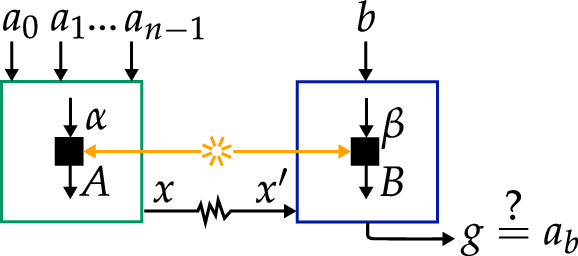
Figure 1: The communication scenario: Alice receives a string of dits (a0,…,an−1), Bob receives an index b; their task is to guess ab leveraging shared non-signaling resources and classical communication.
The extended IC principle generalizes the mutual information constraint to incorporate conditional dependencies among Alice's inputs. The resulting inequalities are stronger and, in specific slices of the correlation space, coincide with Tsirelson-Landau-Masanes (TLM) inequalities, thereby partially recovering the quantum boundary.
Tighter Quantum Bell Inequalities
n0 Scenario
The paper derives a new family of quantum Bell inequalities for the n1 scenario (each party has n2 measurement settings and binary outcomes), using the extended IC principle. The mutual information decomposition and van Dam encoding protocol facilitate extraction of quadratic constraints. Notably, the analytic bound on the Collins-Gisin n3 family is improved as follows:
n4
This upper bound strictly separates the quantum set from the non-signaling set for large n5, empirically outperforming previous bounds derived from the original IC statement.
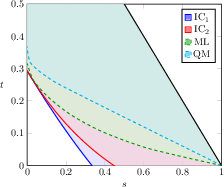
Figure 2: A comparison of the inequalities from the original (n6) and extended (n7) IC formulations in a n8 (n9) scenario, analyzed across a correlation slice.
(a0,…,an−1)0 Scenario
For the (a0,…,an−1)1 scenario (Alice: (a0,…,an−1)2 settings and (a0,…,an−1)3 outcomes; Bob: 2 settings and (a0,…,an−1)4 outcomes), the derived inequalities depend on both the non-signaling box parameters and the input distribution/channel parameters, unlike prior formulations whose inequalities are only a function of NS-box biases.
Correlations among Alice's inputs yield strictly stronger bounds in certain correlation slices, as demonstrated in Figure 2. However, for particular slices the extended IC inequalities are dominated by those imposed by Macroscopic Locality (ML) or the (a0,…,an−1)5 level of the Navascués-Pironio-Acín (NPA) hierarchy. This underscores that the comparative power of IC versus ML is sensitive to scenario and protocol choices.
Analytical Bounds on Random Access Codes
The analysis of EARACs, where classical communication is supplemented with shared entanglement, yields theory-independent bounds on the winning probability for (a0,…,an−1)6 RACs. The maximal winning probability obtained is
(a0,…,an−1)7
This aligns with the best-known theory-independent QRAC bounds for these scenarios and is not tight for all QRAC settings, but saturates the optimality for EARACs with binary inputs. For isotropic NS-box families, the paper proves that correlations among Alice's inputs do not improve the IC-derived bounds on winning probability, establishing their optimality under extended IC.
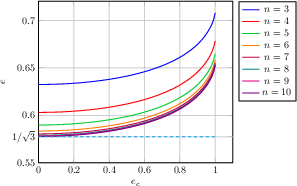
Figure 3: Critical values of the winning bias (a0,…,an−1)8 as a function of channel parameter (a0,…,an−1)9 for b∈[n]0; maximum occurs in the zero-capacity limit, matching the quadratic constraints.
Theoretical and Practical Implications
The work rigorously demonstrates that the extended IC principle imposes stronger, and sometimes strictly tighter, constraints on nonlocal correlations and communication protocols. Importantly, the extended IC principle improves quantum bounds in Bell scenarios without necessarily relying on correlated inputs, offering new analytical inequalities and separating quantum from general no-signaling correlations.
For random access codes, the optimality of the IC-derived bounds implies that, within the class of isotropic boxes and symmetric channels, further improvements cannot be achieved via input correlations, highlighting a scenario-dependent limitation to the power of the extended principle.
The results reinforce the utility of information-theoretic principles in delineating the quantum boundary, particularly in scenarios beyond binary inputs and outcomes. The methodology is highly general, not predicated on Hilbert-space formalism, and yields mathematically tractable bounds.
Open Questions and Future Directions
Key open directions include:
- Exhaustive characterization of input distributions/channel parameters that maximize the power of extended IC in b∈[n]1 and more general Bell scenarios.
- Development of techniques to extract analytical or polynomial inequalities from IC at nonzero channel capacity, where constraints may be tighter.
- Extension to b∈[n]2 random access codes and more general tasks, potentially leading to new theory-independent bounds or clarifying the hierarchy of quantum versus entanglement-assisted or almost-quantum protocols.
Conclusion
This work systematically advances operational principles for constraining nonlocal correlations. The extended Information Causality principle yields strictly tighter bounds in certain Bell and communication scenarios, notably improving analytical quantum bounds for the Collins-Gisin family of Bell inequalities and establishing optimal bounds for EARACs. The extended IC constraints are scenario-dependent and do not universally outperform all prior operational principles (e.g., Macroscopic Locality), but provide a fundamental, theory-independent approach to bounding nonlocality. Further research is needed to fully elucidate the interplay of input correlations, channel structure, and the tightness of operational principles in nonlocal quantum scenarios.