Black Bounce via Gravitational Tension Screening Acting as an Analogue of Schwinger Corrections
Published 1 Jun 2026 in gr-qc and hep-th | (2606.02393v1)
Abstract: We provide a novel geometric regularization mechanism for black bounce spacetimes based on an effective gravitational tension screening inspired by Schwinger like saturation effects. The construction assumes that the gravitational tension associated with the vacuum geometry does not grow indefinitely in high curvature and short scales regimes, but dynamically approaches a finite critical value. As a result, the scale function acquires tension dependent corrections, giving rise to a regular bounce structure without introducing ad hoc regular cores. The mechanism generates regular geometries with spherical, planar, and hyperbolic transverse sections, describing regular black holes (RBHs), extremal RBHs, and traversable wormholes. A key result is that the bounce location emerges dynamically from the interplay between gravitational tension and geometric screening. Depending on the regime, the bounce may remain associated with short distance scales or be displaced toward larger finite scale regions, indicating that saturation effects can modify not only the inner structure of compact objects at short scales but also their global geometry. Hiperbolic and planar RBHs may satisfy the standard energy conditions near the bounce. Moreover, the hyperbolic geometry exhibits distinctive features, including regular negative mass configurations and a strong dependence of the energy conditions on the system parameters. In contrast, the matter sources supporting wormhole geometries, as expected, violate the energy conditions near the throat.
The paper introduces a new geometric regularization mechanism by screening gravitational tension analogous to Schwinger corrections, ensuring finite curvature at the bounce.
It demonstrates that tension screening can yield regular black holes, extremal cases, and traversable wormholes across spherical, planar, and hyperbolic topologies.
Energy condition analyses reveal that non-exotic matter may suffice for regular black holes in certain configurations, contrasting with conventional singularity resolutions.
Black Bounce via Gravitational Tension Screening as an Analogue of Schwinger Corrections
Introduction and Conceptual Foundation
This paper introduces an effective geometric regularization mechanism for black-bounce spacetimes, leveraging gravitational tension screening inspired by an analogy to Schwinger-like saturation corrections. The central premise is that, in high-curvature and short-scale regimes, the gravitational tension associated with the vacuum geometry is dynamically screened and approaches a finite critical value, rather than diverging. This saturating behavior directly modifies the geometry by inducing tension-dependent corrections to the scale function, resulting in regular bounce structures. These structures encompass regular black holes (RBHs), extremal RBHs, and traversable wormholes, across spherical, planar, and hyperbolic topologies.
The proposed mechanism is motivated by the formal similarity between the exponential screening factor in the Dymnikova model of regular black holes and the pair-production rate in the Schwinger effect of QED. Specifically, the gravitational tension, associated with the curvature scale, is dynamically screened via a Schwinger-like factor, Γ∼exp(−Fc/F), with Fc representing a critical gravitational tension. This screening bounds curvature invariants and prevents singularities at short distances.
Geometric Construction and Schwinger-Like Screening
The formalism generalizes to static, pseudo-spherically symmetric spacetimes with constant-curvature two-dimensional transverse sections. The metric is taken as
ds2=−A(R(l))dt2+A(R(l))dl2+R(l)2dsT−k2,
with dsT−k2 representing the metric of a sphere, plane, or hyperboloid depending on the sign of k.
The gravitational tension, proportional to the root of the Kretschmann scalar K, is F∼Kvacuum∼Mˉ/l3. The Schwinger-inspired geometric screening factor leads to an effective tension,
Feff=F(1−e−Fc/F),
dynamically saturating in the l→0 regime to Fc and vanishing asymptotically.
This correction is incorporated into the scale function as
Fc0
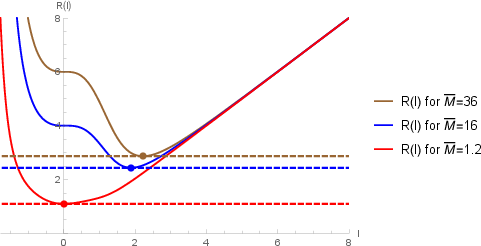
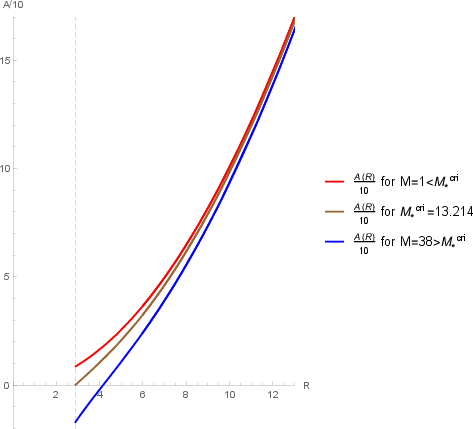
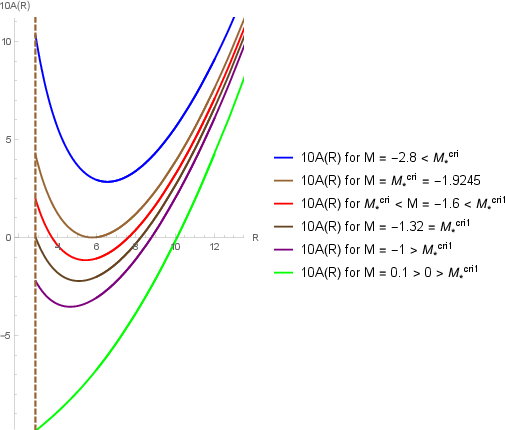
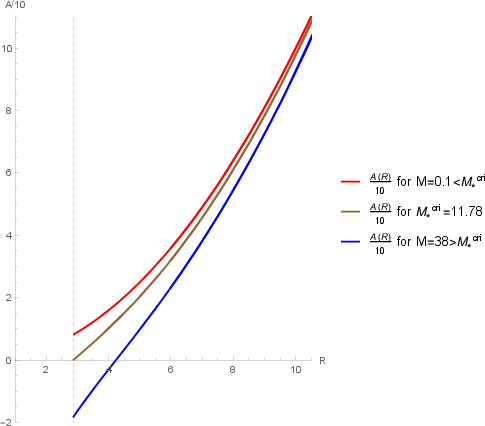
giving rise to bounce behavior at finite scales. Notably, the location of the bounce, where Fc1, is not fixed a priori but emerges from the interplay of tension and its screening. For increasing mass parameters, the bounce can be dynamically displaced to larger Fc2, modifying not only the core but potentially the global spacetime structure as well.
Figure 1: Fc3 as a function of Fc4 for different values of Fc5, indicating the dynamic displacement of the bounce.
Parameter Space and Global Structure
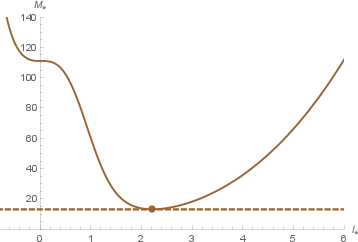
The analytic expressions for the mass parameter at the horizon,
Fc6
permit explicit exploration of the parameter space dictating regular black holes, extremal black holes, and traversable wormholes in each topology.
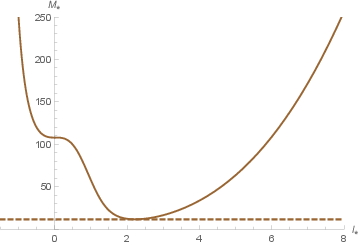
For the spherically symmetric case (Fc7), the model recovers configurations with:
Two horizons: Non-extremal RBH, with inner and outer event horizons enclosing the bounce.
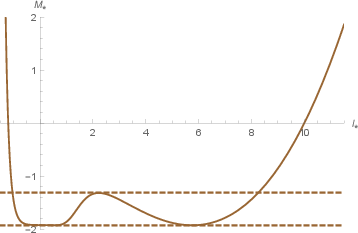
Coincident horizon: Extremal RBH, where the horizon is located at the bounce.
No horizon: Traversable wormhole, bounce is unshielded.
Figure 2: Mass parameter Fc8 as a function of bounce location Fc9, showing existence and properties of extremal points.
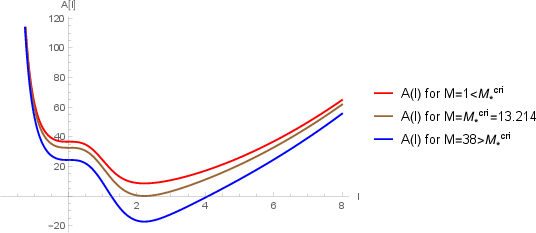
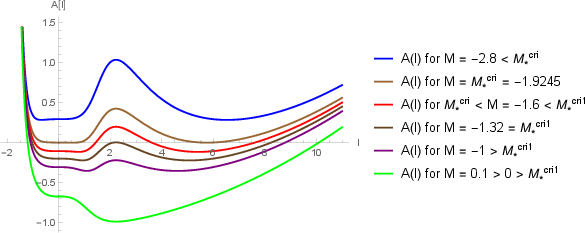
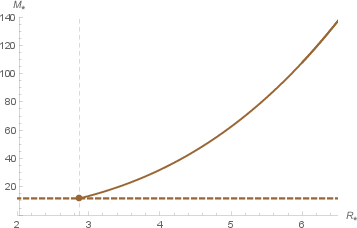
Figure 3: ds2=−A(R(l))dt2+A(R(l))dl2+R(l)2dsT−k2,0 versus ds2=−A(R(l))dt2+A(R(l))dl2+R(l)2dsT−k2,1 at the horizon, with the critical extremal point corresponding to the bounce.
Analogous classifications extend to planar (ds2=−A(R(l))dt2+A(R(l))dl2+R(l)2dsT−k2,2) and hyperbolic (ds2=−A(R(l))dt2+A(R(l))dl2+R(l)2dsT−k2,3) geometries. The hyperbolic case exhibits a richer structure including regular negative-mass black holes, and the number and nature of horizons are sensitive to the mass parameter, resulting in unique causal properties absent in other topologies.
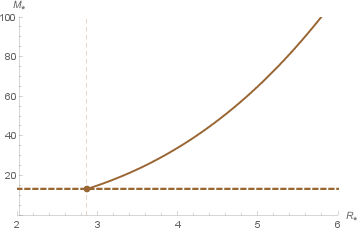
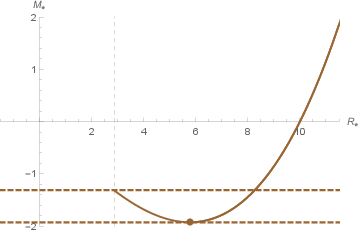
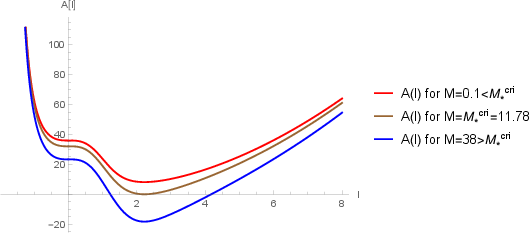
Figure 4: Mass parameter ds2=−A(R(l))dt2+A(R(l))dl2+R(l)2dsT−k2,4 as a function of ds2=−A(R(l))dt2+A(R(l))dl2+R(l)2dsT−k2,5 for the planar case, displaying the extremal and non-extremal boundary.
Figure 5: ds2=−A(R(l))dt2+A(R(l))dl2+R(l)2dsT−k2,6 as a function of ds2=−A(R(l))dt2+A(R(l))dl2+R(l)2dsT−k2,7 in the planar topology.
Figure 6: ds2=−A(R(l))dt2+A(R(l))dl2+R(l)2dsT−k2,8 as a function of ds2=−A(R(l))dt2+A(R(l))dl2+R(l)2dsT−k2,9 for the hyperbolic case, illustrating multiple horizon structures and negative-mass regimes.
Figure 7: dsT−k20 as a function of dsT−k21 for the hyperbolic geometry.
Regularity and Energy Conditions
Calculation of the Kretschmann scalar across all geometric cases verifies the absence of curvature singularities. The scale function dsT−k22 attains a finite, non-vanishing minimum at the bounce, and dsT−k23 and its derivatives remain nonsingular, ensuring regularity everywhere.
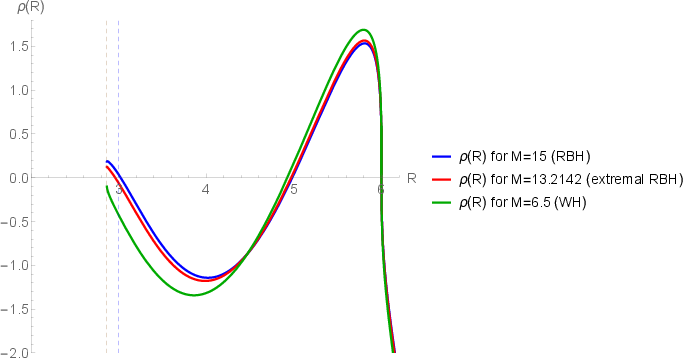
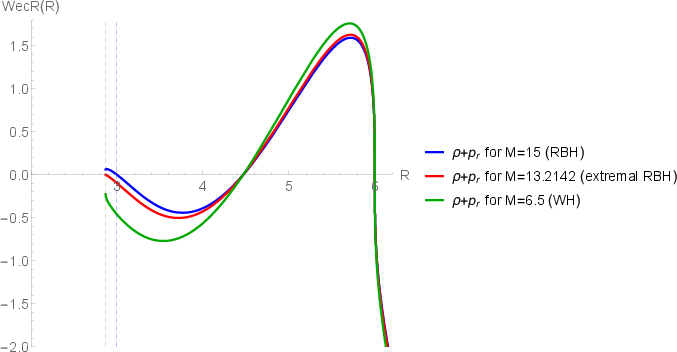
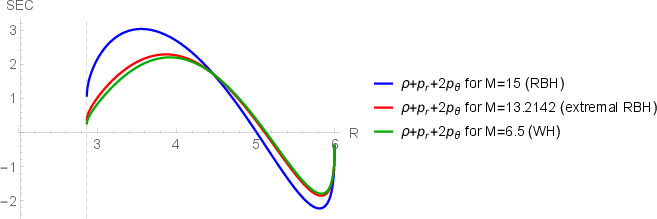
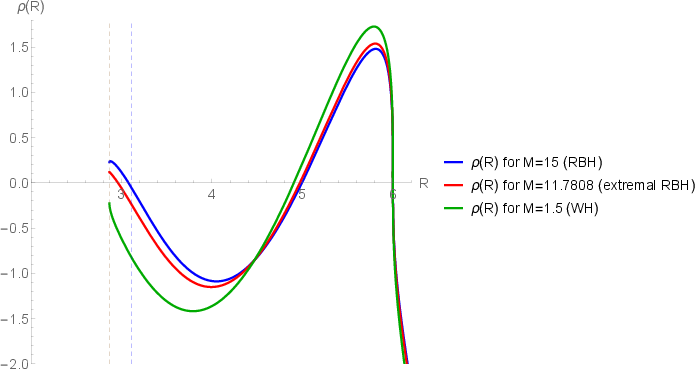
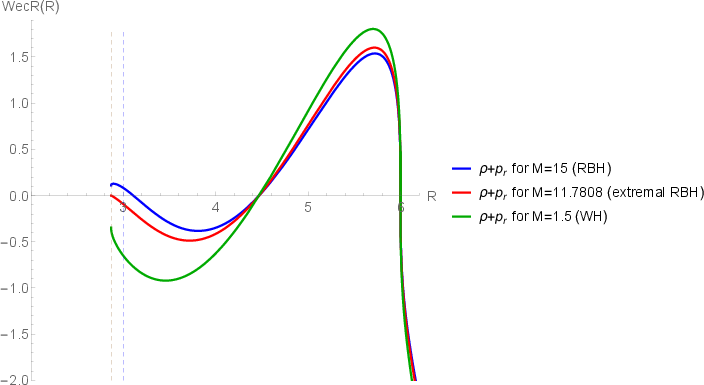
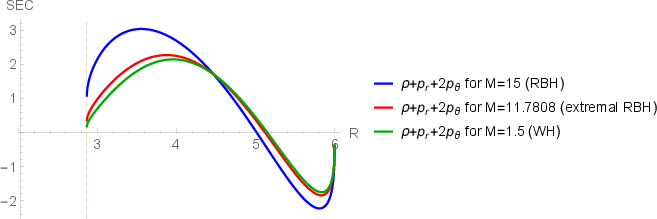
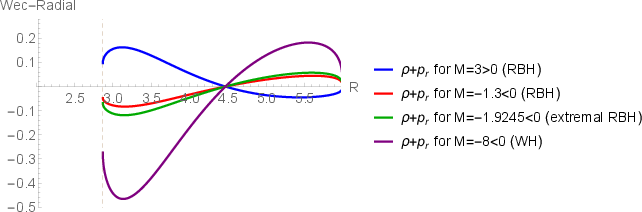
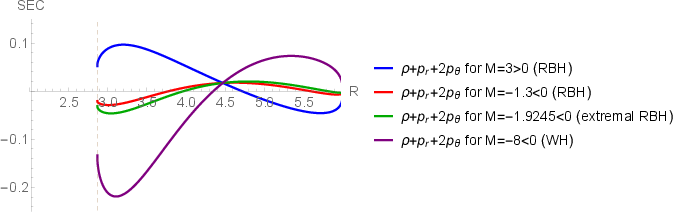
Energy-momentum tensor components are derived in terms of the geometric functions. Energy conditions—specifically the Weak (WEC), Null (NEC), and Strong (SEC) Energy Conditions—are tested via direct computation of dsT−k24, dsT−k25, and dsT−k26.
For regular black holes in both spherical and planar topologies, the WEC, NEC, and SEC are satisfied near the bounce and at the event horizon, in contrast with conventional expectations that RBH regularity requires significant exotic matter. In traversable wormhole solutions, WEC and NEC violations are consistently observed in the vicinity of the throat, consistent with standard wormhole physics.
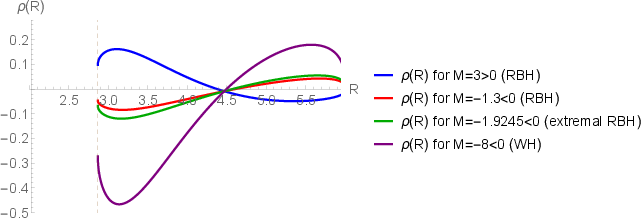
The hyperbolic case exhibits regime-dependent behavior: energy conditions can be satisfied near the bounce for positive-mass RBHs but are violated for negative-mass cases and wormholes, indicating subtle, topology-dependent distinctions in the requirements for regularization.
Figure 8: Energy conditions for spherical topology: WEC, NEC, and SEC as functions of dsT−k27.
Figure 9: Planar topology energy conditions, displaying analogous behaviors to the spherical case.
Figure 10: Hyperbolic case shows parameter-dependent energy condition satisfaction, particularly for positive-mass RBHs.
Implications and Theoretical Significance
This geometric regularization model offers a unified framework interpolating between regular black holes, extremal cases, and traversable wormholes, governed by universal saturation dynamics of gravitational tension. Unlike models relying on ad hoc regular cores or de Sitter centers, regularity arises as an emergent feature from the interplay of quantum-inspired tension screening and classical geometry.
The flexibility to support regular black holes with non-exotic matter sources near the bounce in certain topologies suggests that singularity resolution may not universally require exotic physics—opening a channel for further exploration of regularization within semiclassical or effective field theory treatments of gravity. Moreover, the intricate dependence of horizon and energy condition structures on the topology of the transverse section highlights the need for explicit geometric specification when constructing or interpreting regularized spacetimes.
The analogy with Schwinger corrections invites potential generalizations from effective field theory, where backreaction and pair-production physics are encapsulated via phenomenological screening. This could prove a valuable bridge between quantum gravity phenomenology and high-curvature classical gravity.
Conclusion
This work establishes a dynamic, tension-based regularization mechanism for black-bounce spacetimes, resulting in a spectrum of regular black holes and traversable wormholes across spherical, planar, and hyperbolic topologies. By drawing on analogies to Schwinger-like saturation, the model introduces a self-consistent method for achieving curvature regularity without ad hoc modifications or the universal need for exotic matter. The framework's ability to shift the bounce locus, unify geometric classes, and admit non-trivial horizon and energy condition structures contingent on topology, positions it as a compelling approach for effective descriptions of regular black holes and quantum-gravitational corrections in compact objects. Future studies may further elucidate its links to quantum gravity, stability, and observable signatures in high-curvature regimes.