- The paper demonstrates that using windows longer than the underlying Markov order is necessary to reduce generative process uncertainty in global and foundation models.
- It introduces a modular model design that decouples generative process identification from conditional forecasting to reduce inference costs.
- Empirical evidence shows that both contiguous and non-contiguous context improve forecasting accuracy by addressing process heterogeneity.
Detailed Analysis of "Why Do Time Series Models Need Long Context Windows?" (2606.01999)
The paper systematically investigates the underlying reasons why modern time series forecasting models, especially global and foundation models, depend heavily on long context windows. The main thesis is that accurate forecasting over heterogeneous sets of time series entails not only modeling temporal dependencies for prediction, but also implicitly performing Generative Process Identification (GPI)—that is, inferring which generative process produced the observed input. As a result, optimal prediction, even in simple Markovian systems, can require more context than the memory length of the underlying process.
The work frames time series forecasting as learning over a collection of time series D={x0:Tii}, where each individual series may be drawn from distinct—potentially unknown—generative processes.
- In the global (multi-series) regime, a model F(⋅;Θ) is trained to predict future values for all members of D.
- In foundation model settings, this is generalized to the inductive case, where the model is expected to forecast on unseen series sampled from the same or broader generative class.
The central point is that, unlike local models optimized for a single (known) series, global/foundation models must contend with uncertainty over the process parameters ϕn, inducing two core prediction tasks:
- GPI (Generative Process Identification): Inferring process identity (p(ϕn∣xt−W:tn)).
- CF (Conditional Forecasting): Exploiting temporal dependencies for next-step or horizon prediction, given the process.
Theoretical Insights: The Role of GPI in Window Size
A key mathematical result establishes that even for P-th order Markov processes, where xt depends only on the previous P values given process parameters, window sizes strictly larger than P are necessary for global models to achieve the minimum attainable error over a random mixture of processes:
- The minimum error achievable by a model with window size W is
F(⋅;Θ)0
- For global models, unless the process can be uniquely identified with F(⋅;Θ)1 observations, the first term is greater than zero for F(⋅;Θ)2.
- Theorem: F(⋅;Θ)3 is required to reduce posterior uncertainty about process identity sufficiently for optimal prediction.
Empirical simulations on synthetic nonlinear autoregressive (NAR) processes confirm this analytic result: local models (or global models with known process ID) achieve irreducible noise error with F(⋅;Θ)4, while global models trained over process mixtures require substantially longer windows to close the gap—even when the added context is temporally distant (thus not needed for classical prediction dependencies).
Empirical Evidence: Real-World Foundation and Global Models
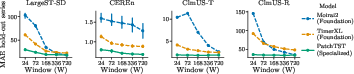
The hypothesis is further validated on real-world datasets using contemporary foundation models (e.g., Moirai2, TimerXL):
The Cost of GPI and Heterogeneity
An important implication highlighted is the performance-cost tradeoff for foundation models pretrained over highly heterogeneous datasets versus domain-specific global models (Figure 2):
- Foundation models require much longer context windows to match the error of domain-specific global models when evaluated on a fixed target domain.
- This overhead is attributed to the broader support and variance of the prior over generative processes seen during pretraining, increasing the need for context to resolve process uncertainty.
- Specialization (narrower pretraining/finetuning) or efficient modularization of the GPI can mitigate this cost.
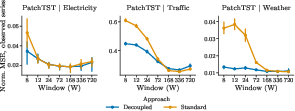
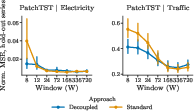
Figure 2: Foundation models (dashed) require substantially longer windows than domain-specific models (solid) for equivalent inductive forecasting error (transductive setting).
Methodological Proposals and Model Design Implications
The authors propose model designs that explicitly decouple GPI and CF stages:
- Employ an architecture F(⋅;Θ)6 (embedding): infer a latent process representation from broader, possibly non-contiguous, context.
- Use F(⋅;Θ)7 for main forecasting: keep the computational cost of prediction low by only reading short recent windows, conditioned on a cached process embedding (F(⋅;Θ)8).
- Empirical results demonstrate that this design achieves comparable or superior accuracy compared to monolithic models with long context windows, but with substantially lower inference cost and memory requirements, enabling scalable deployment in data-rich applications.
Implications and Future Perspectives
Practical Implications
- In multi-domain or inductive forecasting, context window size is crucial not just for modeling temporal dependencies but for reducing ambiguity about the time series’ generative process.
- Computational cost can be drastically reduced by amortizing GPI and efficiently reusing process embeddings, establishing a clear case for modular foundation architectures that disentangle GPI from CF.
- Domain-specific models remain advantageous in narrow settings due to their lower context window and capacity requirements.
Theoretical Significance
- The work formalizes the Bayesian posterior averaging mechanism at inference time in global/foundation forecasting, grounding the need for long context in process-level epistemic uncertainty, not just temporal dependency.
- It provides a principled explanation for recent empirical findings that non-sequential (meta) context, covariates, or descriptors can improve global forecasting: these inputs facilitate GPI more than classical prediction.
Future Research Directions
- Dynamic or adaptive windowing: Methods to dynamically select context/subsequences that best reduce process uncertainty, rather than relying on fixed-length windows.
- Better GPI mechanisms: Learning process representations using metadata, relational information, or exogenous covariates.
- Metalearning for process adaptation: Incorporating ideas from meta-learning/adaptive initialization to minimize GPI overhead for new series with few observations.
Conclusion
This paper provides a rigorous theoretical and empirical account for the prominent role of long context windows in global and foundation time series forecasting models. It establishes that the principal benefit of longer context is often in generative process identification, rather than in modeling strictly long-range temporal dependencies. The proposed framework supports new directions in the design of scalable, efficient, and adaptive time series models via explicit disentanglement of GPI and CF.