- The paper establishes a uniform asymptotic expansion for the focusing mKdV equation that integrates finite-gap algebro-geometric background with discrete spectrum contributions.
- It employs the nonlinear steepest descent method and a Painlevé XXXIV parametrix to resolve critical coalescence of stationary phase points and branch cut endpoints.
- The results reveal universal transition behavior with significant implications for nonlinear dispersive PDEs in quasi-periodic media.
Painlevé XXXIV Asymptotics for the Focusing mKdV Equation with Finite-Genus Background and Discrete Spectrum
This paper develops a rigorous asymptotic analysis of the Cauchy problem for the focusing modified Korteweg–de Vries (mKdV) equation, specified by
ut+uxxx+6u2ux=0,
with quasi-periodic, finite-genus, algebro-geometric initial data and discrete spectral components (breathers). The principal focus is the critical regime where complex stationary phase points associated with the Riemann–Hilbert (RH) problem coalesce with branch points of the underlying algebro-geometric background, yielding a transition region typified by Painlevé XXXIV asymptotics.
Key components of the analysis include the nonlinear steepest descent method (Deift–Zhou) applied to the associated RH problem, systematic utilization of algebro-geometric (finite-gap) solutions as background, and a local Painlevé XXXIV parametrix to resolve the critical regime where complex stationary points and endpoints interact.
Algebro-Geometric Background, Scattering, and the Riemann–Hilbert Problem
The background solutions are constructed using the finite-gap (algebro-geometric) formalism—explicitly, Riemann theta functions on a hyperelliptic curve determined by the branch points {Ej,Eˉj}j=0n⊂C∖R, subject to complex conjugation and symmetry constraints. The spectral parameter z lives on the corresponding Riemann surface R. The algebro-geometric solution u(alg)(x,t) encodes phase and amplitude modulation governed by the underlying finite-gap structure and is expressible via theta function quotients with explicit Abel maps and divisors.
The analysis begins by reformulating the Cauchy problem as an RH problem for a 2×2 matrix N(z), whose jumps are supported on a complicated set Σ0 in the complex plane. This set decomposes several analytic arcs, including the real axis, branch cuts (corresponding to the algebro-geometric background), and additional curves arising from the condition Imp(z)=0. The corresponding "signature table" divides C into regions {Ej,Eˉj}j=0n⊂C∖R0 with definite sign of {Ej,Eˉj}j=0n⊂C∖R1, as visualized in the figures below.
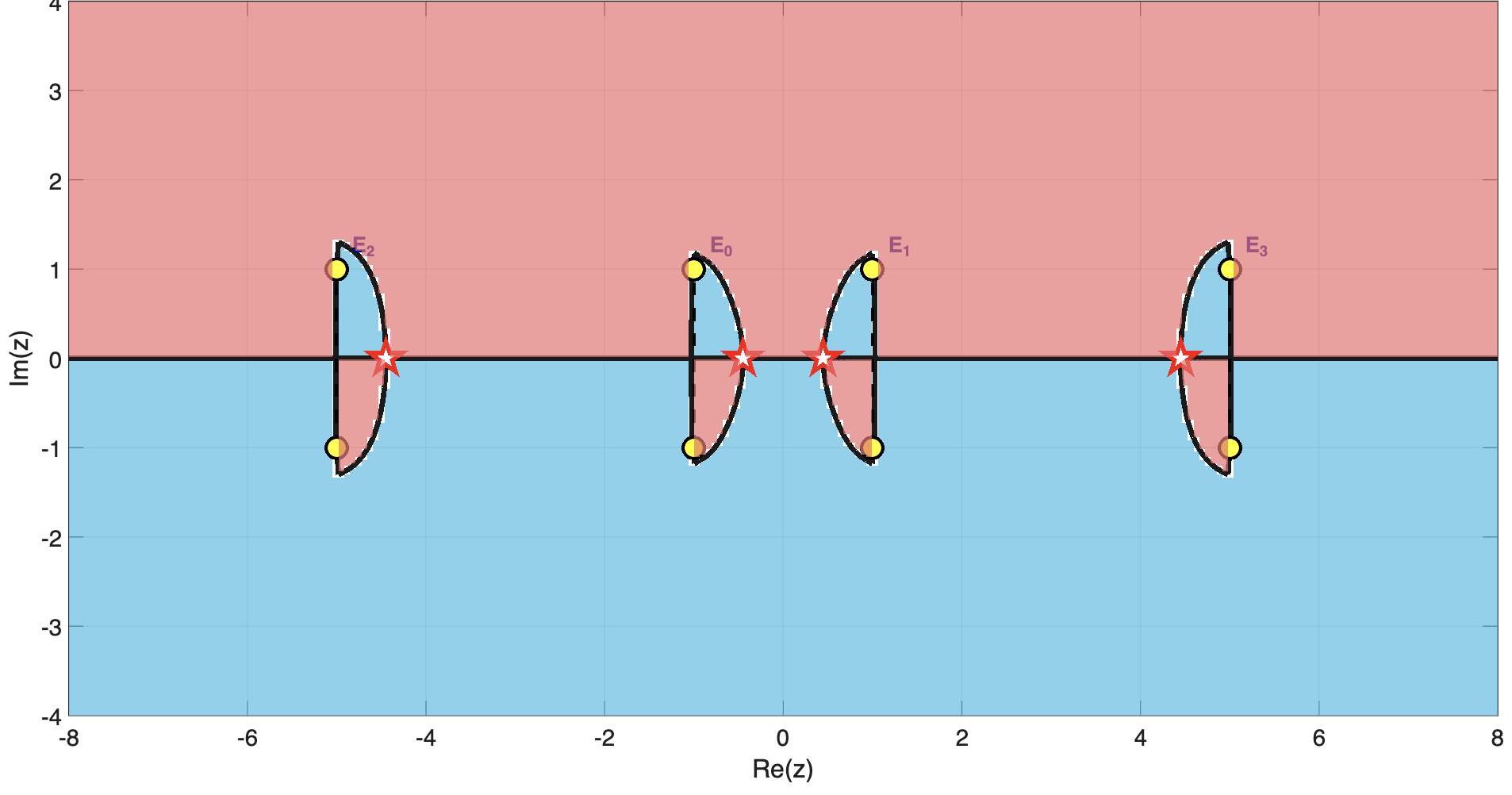
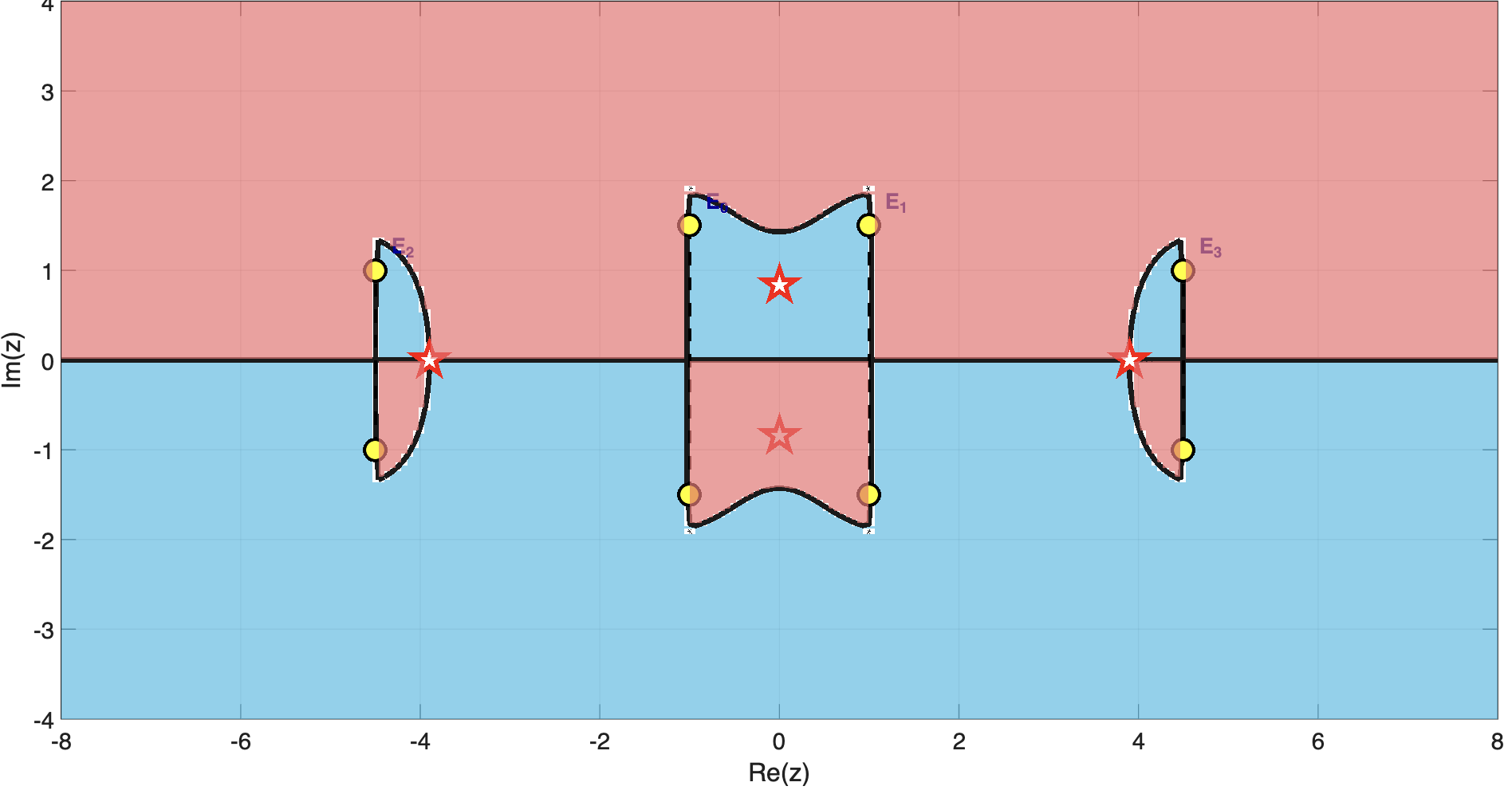
Figure 1: The set {Ej,Eˉj}j=0n⊂C∖R2 and regions {Ej,Eˉj}j=0n⊂C∖R3 in the complex plane for genus {Ej,Eˉj}j=0n⊂C∖R4, with {Ej,Eˉj}j=0n⊂C∖R5 (red) and {Ej,Eˉj}j=0n⊂C∖R6 (blue): separation of analytic domains for steepest descent deformations.
Complex (breather-type) discrete spectrum is accommodated by poles of the scattering data away from the continuous spectrum ({Ej,Eˉj}j=0n⊂C∖R7). The resulting jump matrices exhibit both oscillatory and exponentially decaying/growing terms, necessitating delicate contour deformations and the introduction of local model problems where critical points coalesce.
Stationary Phase Structure and Contour Geometry
Key to the steepest descent analysis is the structure of stationary phase points—the zeros of the derivative of the phase {Ej,Eˉj}j=0n⊂C∖R8, i.e., solutions to {Ej,Eˉj}j=0n⊂C∖R9. The locus, type, and dynamics of these stationary points as the self-similar parameter z0 varies govern the asymptotic structure of the solution. Of particular interest is the critical regime where quadruples of complex stationary points collide with endpoints of the branch cuts—leading to a "Painlevé zone" and corresponding phase transitions in the RH analysis.
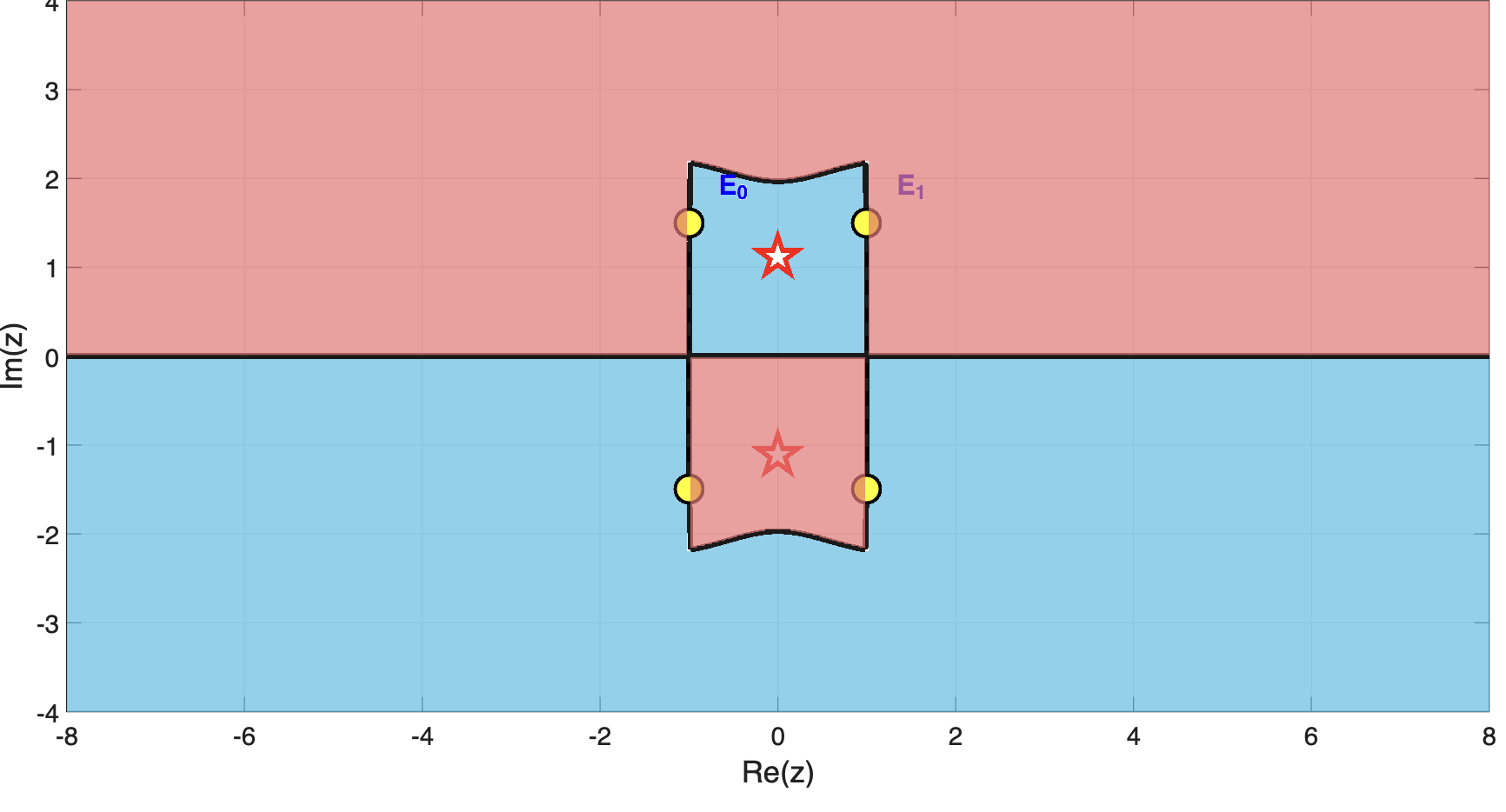
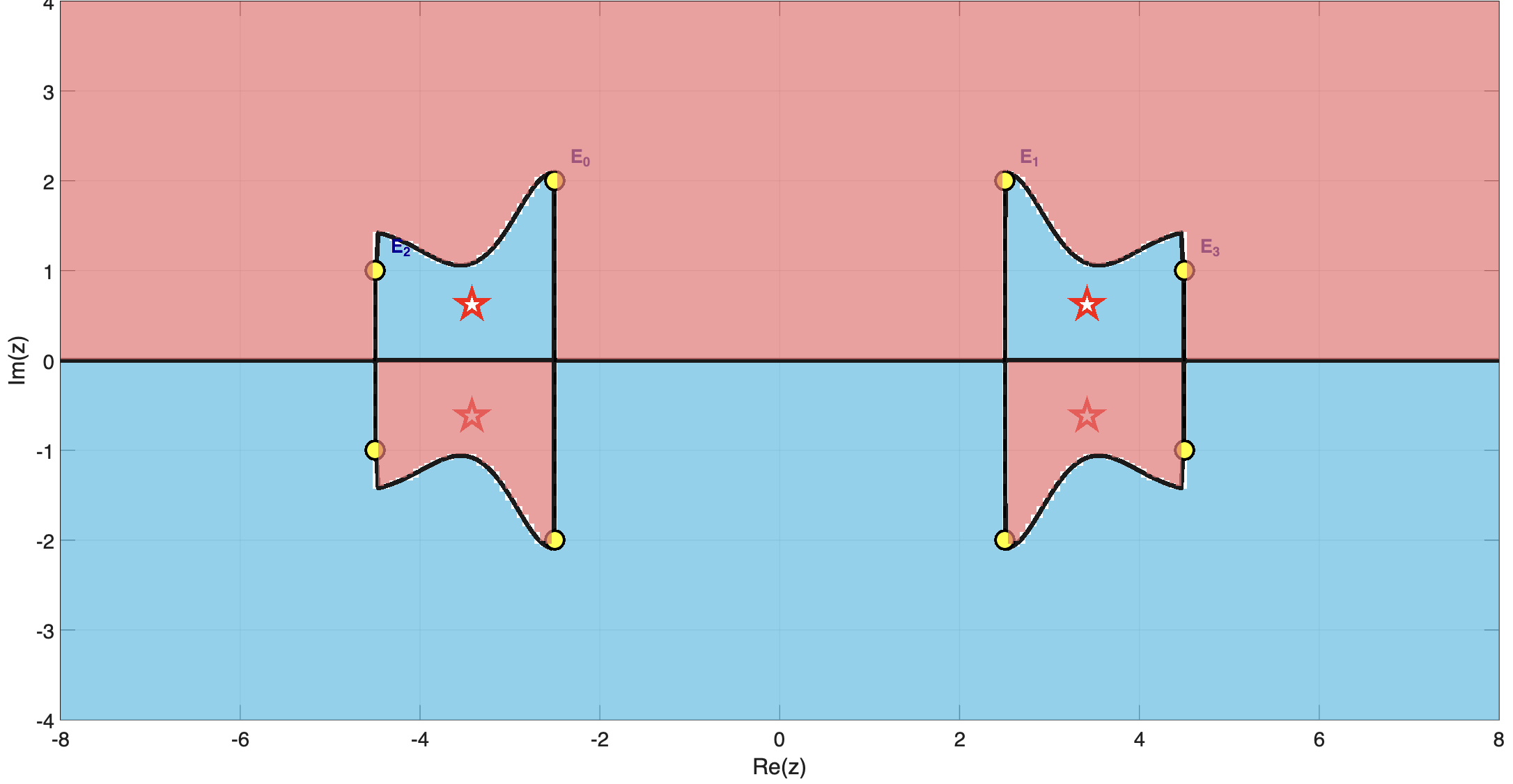
Figure 2: Configurations of z1 and z2 for genus one (left) and genus three (right), indicating how the analytic pattern changes with genus.
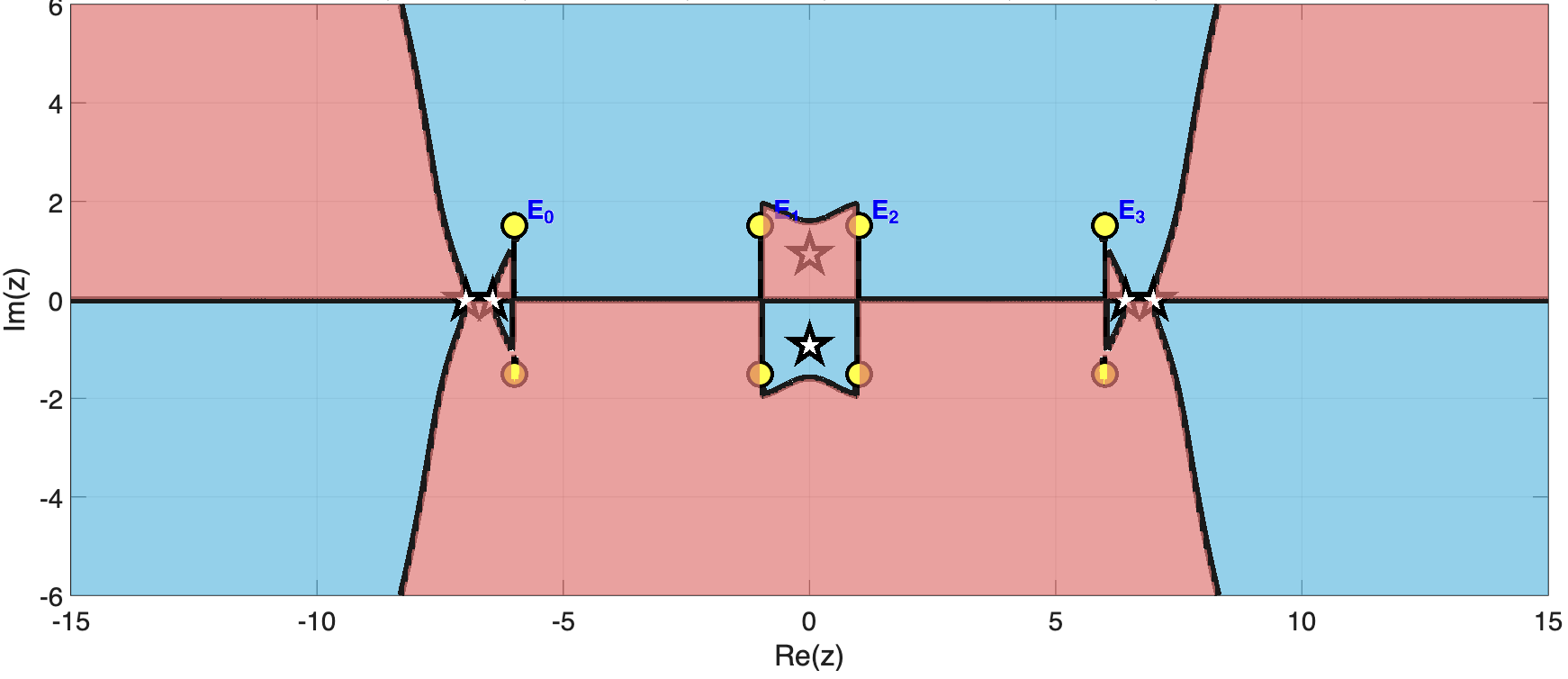
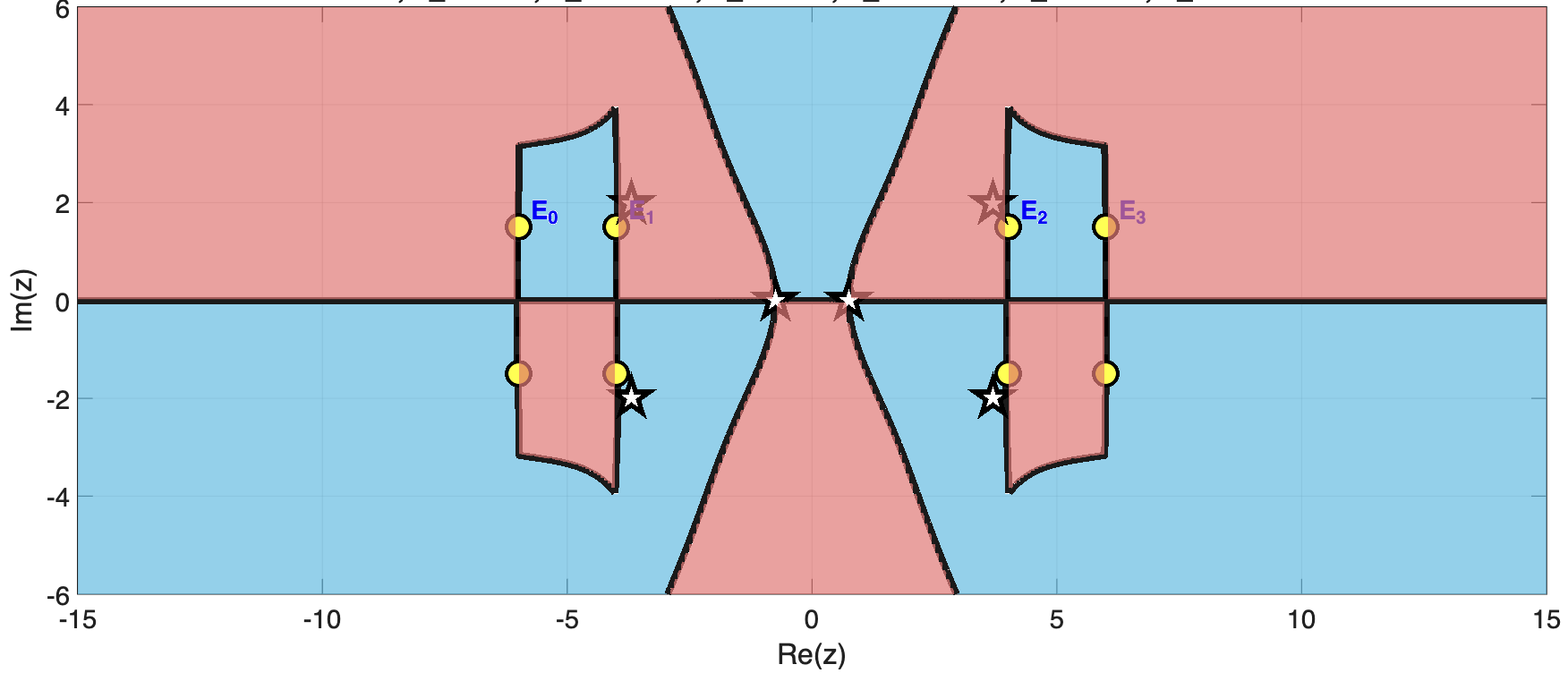
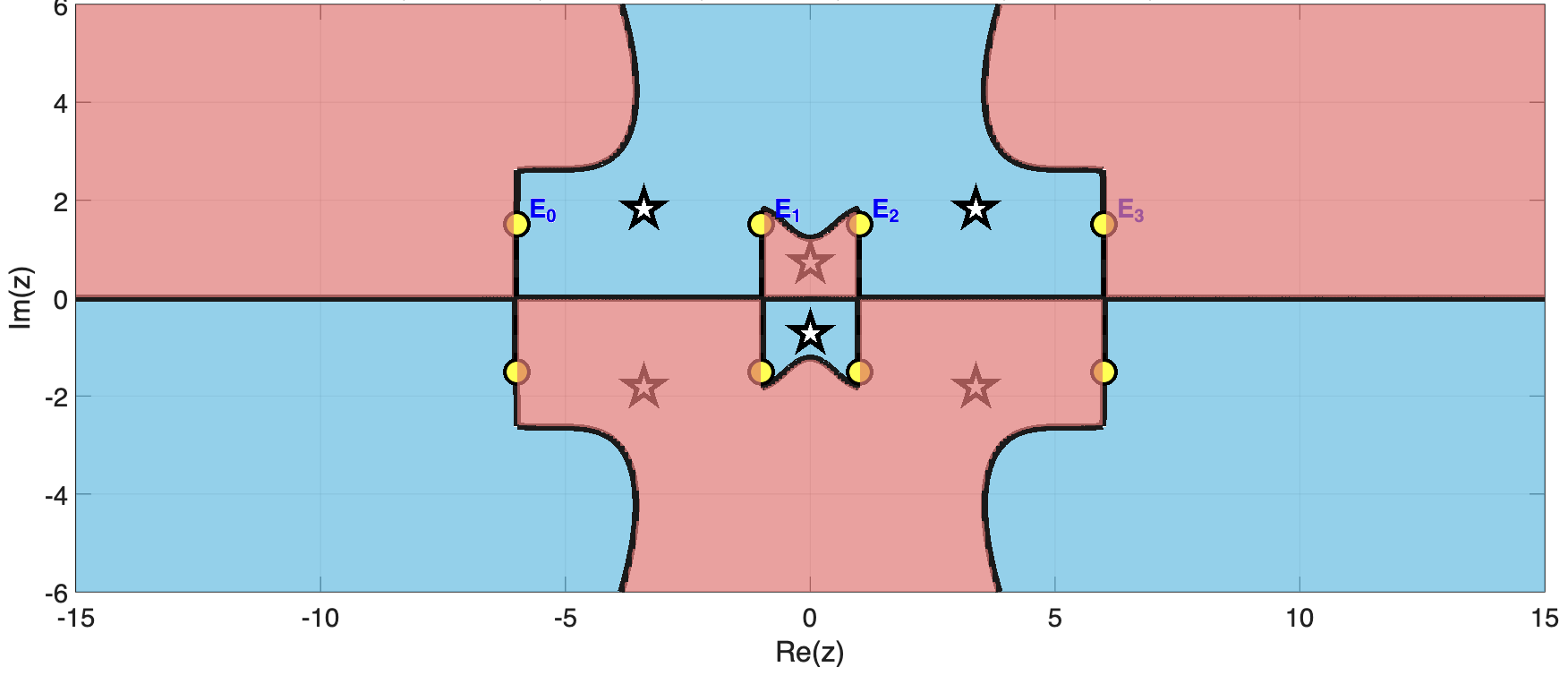
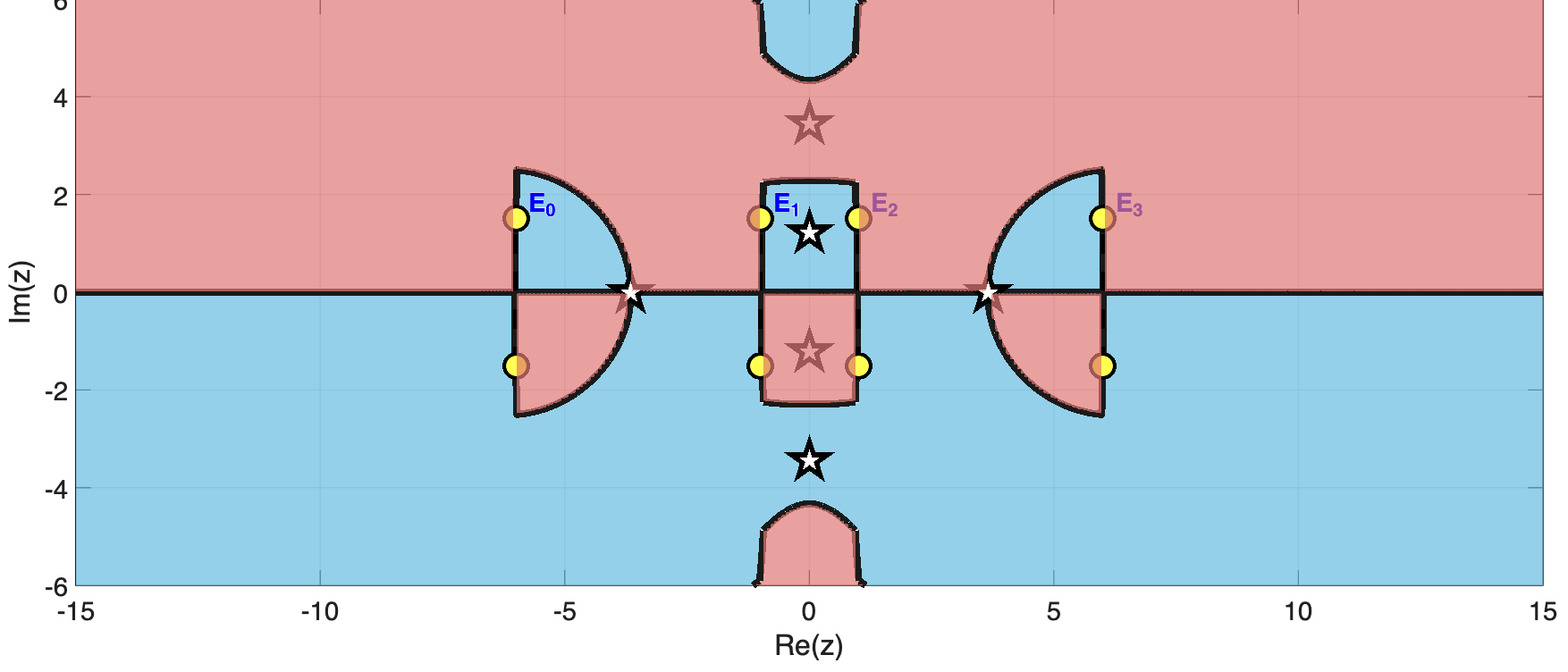
Figure 3: Collision scenarios (pre-collision and post-collision) between complex stationary phase points and endpoints in genus 3, illustrating the mechanism of the critical transition.
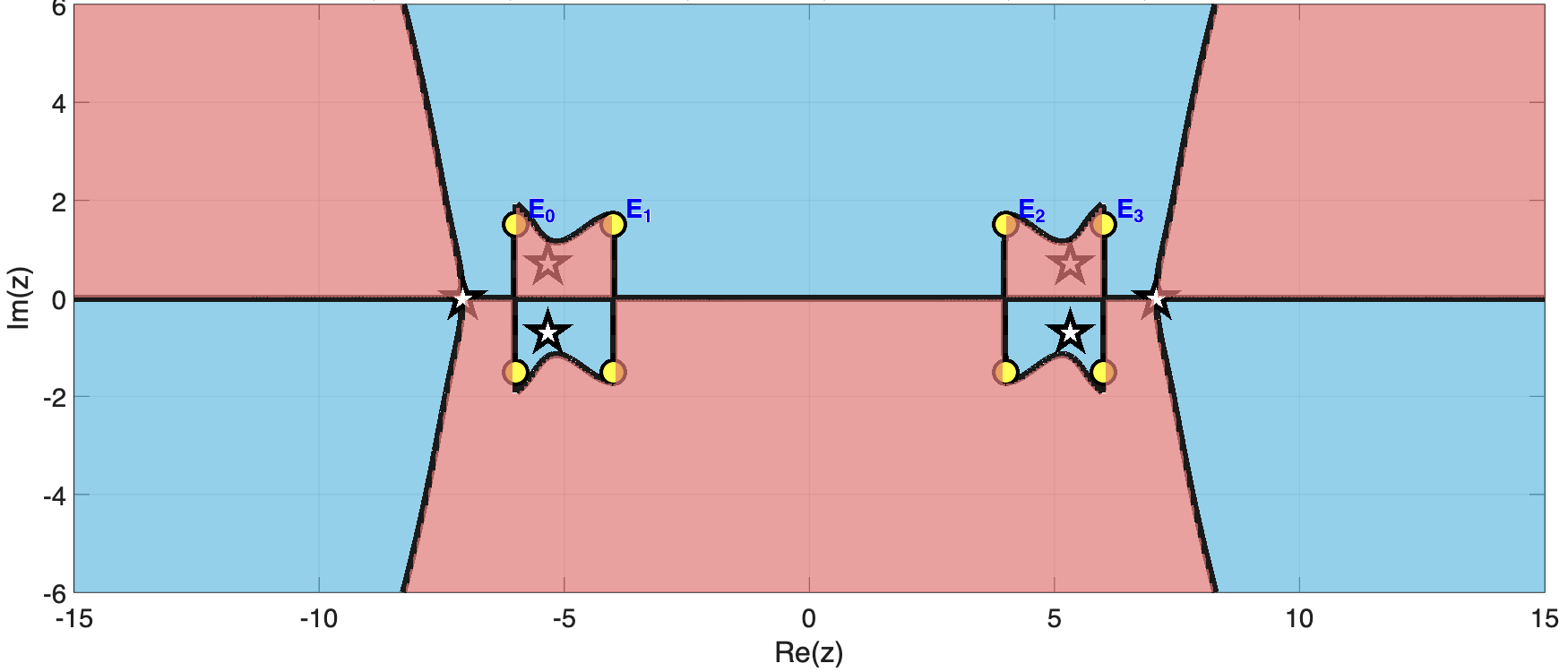
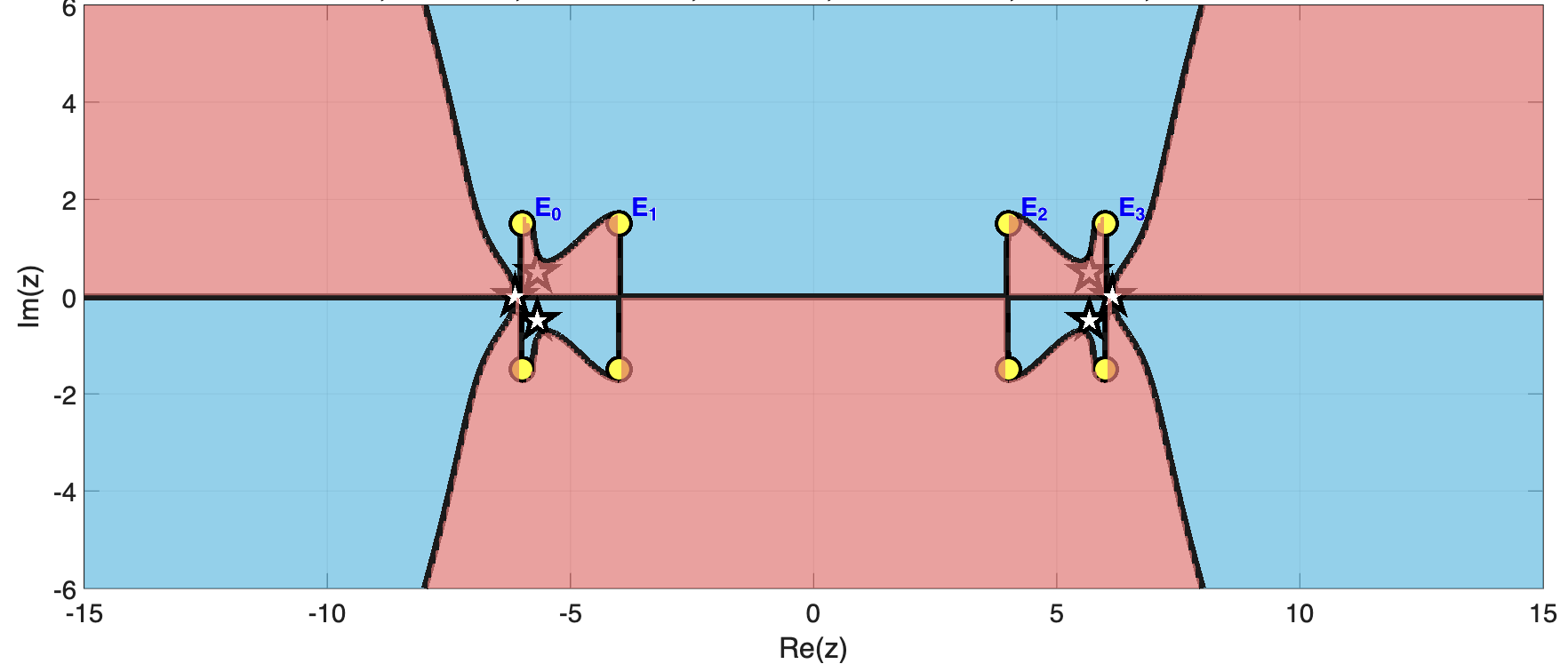
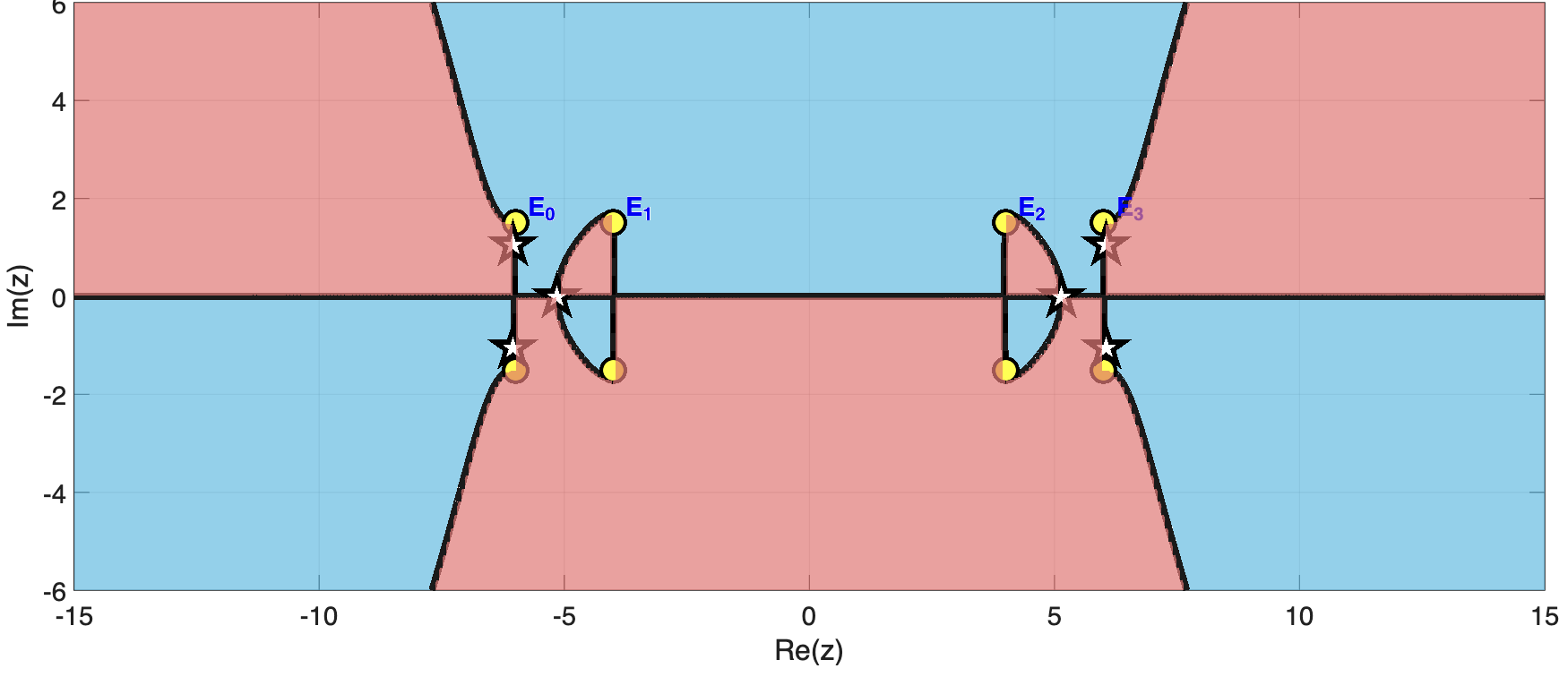
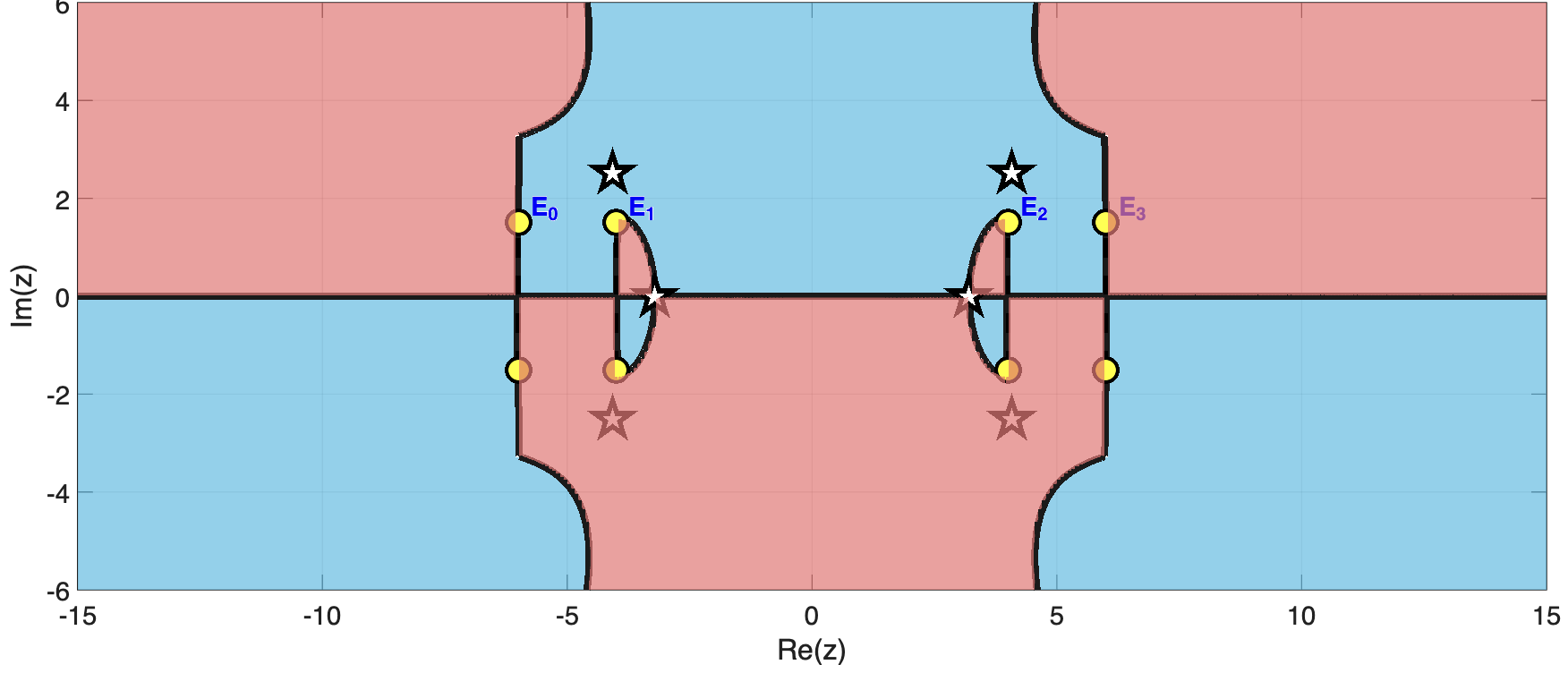
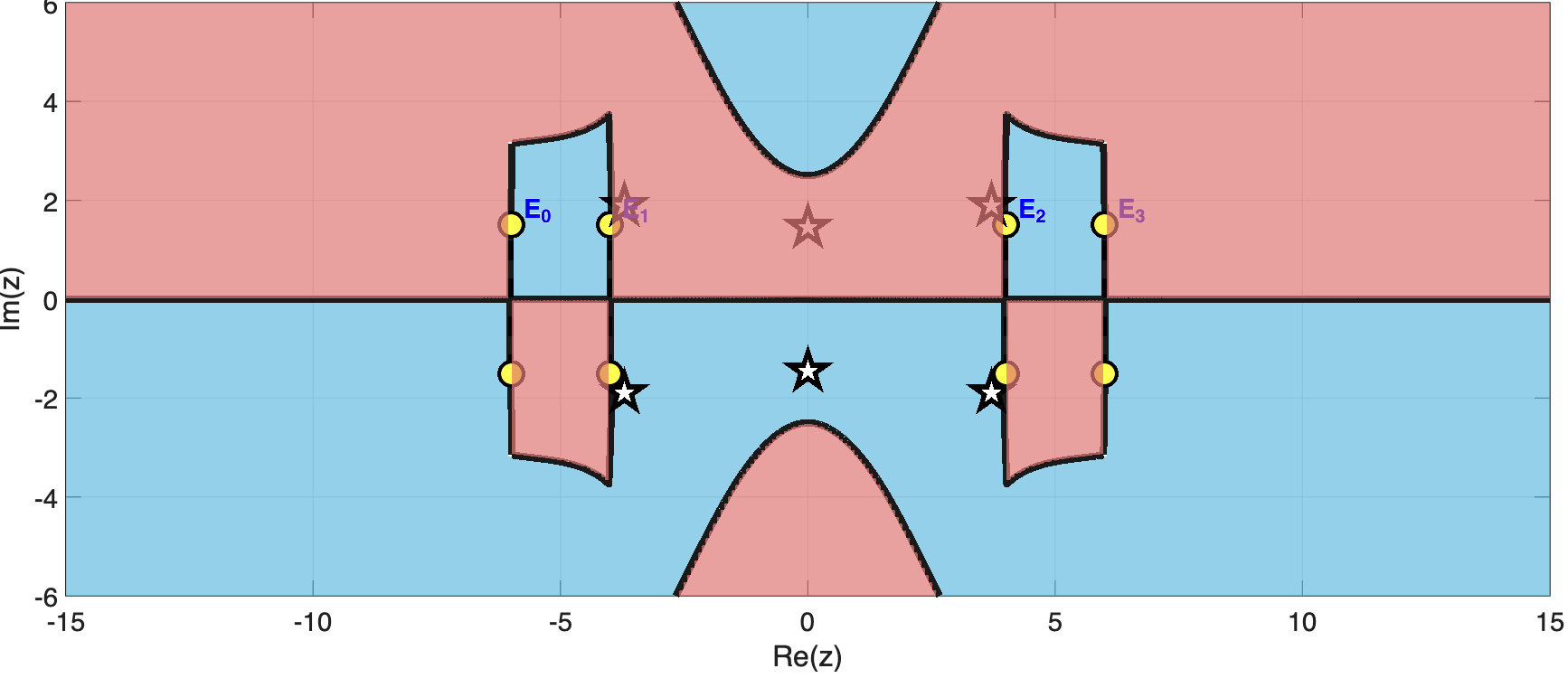
Figure 4: Detailed depiction of various collisional arrangements in genus 3, including multiple collisions and contour arrangements accompanying coalescence.
Nonlinear Steepest Descent, Local and Global Parametrix Construction
The main analytic approach is a Deift–Zhou steepest descent deformation applied to the RH problem. Globally, outside small neighborhoods of branch points and stationary phase points, the problem is well-approximated by a global parametrix built from the algebro-geometric solution (the theta function background) and rational (soliton/breather) corrections. The discrete spectrum (breathers) embeds as poles in the meromorphic sectoral ansatz. Within local disks around the critical endpoints, the standard Bessel or parabolic cylinder parametrices are insufficient; instead, one constructs a parametrix built out of solutions to the Painlevé XXXIV equation.
The jump structure in the transition region supports nontrivial monodromy, and the connection to Painlevé transcendents is implemented via matching local models to the global parametrix. This matching is facilitated by uniformization via conformal mappings z3 tuned to the local expansion of the phase.
Main Result: Explicit Painlevé XXXIV Asymptotics in the Critical Region
The paper’s central result is a uniform, high-precision asymptotic description for z4 as z5 in the transition (Painlevé) regime z6 (with z7), where the aforementioned collision occurs. The explicit expansion is:
z8
where:
- z9: finite-genus algebro-geometric background (theta function solution),
- R0: discrete spectrum contribution (breathers localized on the phase transition),
- R1: classical solution to the Painlevé XXXIV ODE, with R2 a local conformal parameter depending on the stationary phase structure,
- R3, R4: explicit phase and amplitude modulations from the global parametrix,
- R5: explicit coefficients computable from the local model,
- R6: Hessian-type coefficient arising from the third-order expansion of the phase at the critical point.
The Painlevé XXXIV function R7 arises universally in this coalescence regime, and via the RH analysis, its boundary conditions and parameters are explicitly related to the original spectral data for the mKdV problem.
Critically, the expansion is uniform up to an error of order R8, demonstrating both the robustness of the nonlinear steepest descent method and the suitability of the Painlevé parametrix in capturing the transition.
Theoretical and Practical Implications
The results demonstrate that nonlinear superposition of finite-gap backgrounds and breathers yields nontrivial modulation patterns, with phase transitions governed by special function solutions (Painlevé transcendents) at critical coalescence points. This regime cannot be adequately captured by naive perturbative or soliton-resolution conjectures, as the collision of stationary points with branch cuts produces local universality classes not reducible to previously analyzed asymptotics.
The methodology and results expand the scope of integrable asymptotics by fully incorporating finite-genus backgrounds and mixed-initial data (both continuous and discrete spectral components). Practically, these findings have implications for nonlinear wave propagation in periodic or quasi-periodic media, for the design of robust dispersive waveguides, and in mathematical physics contexts including modulated solutions, rogue waves, and universality questions in random matrix models and integrable statistical mechanics.
On a theoretical level, the appearance of the Painlevé XXXIV equation as a universal scaling limit in this transition persists across a variety of integrable hierarchies (e.g., NLS, KdV, etc.), indicating a broad class of critical phenomena governed by such transcendents—particularly in the presence of nontrivial spectral geometry (finite-gap vs. pure solitonic or purely radiative).
Directions for Future Research
Potential extensions include:
- Analysis of multi-component/matrix mKdV and focusing NLS hierarchies with higher-genus or more exotic spectral data,
- Numerical computation and explicit evaluation of the connection coefficients R9 in the presence of general initial data,
- Extension to non-integrable perturbations—how the universality of Painlevé transcendents survives small non-integrable deformations,
- Investigation of related critical phenomena (beyond Painlevé XXXIV), where saddle-point collisions produce other universal behaviors (e.g., higher Painlevé equations),
- Applications to physical models with nontrivial periodic or quasi-periodic backgrounds, where phase transitions akin to those described herein play a dominant role in the solution morphology.
Conclusion
The paper provides a comprehensive and rigorous framework for analyzing the long-time behavior of the focusing mKdV equation with intricate algebro-geometric initial data and discrete spectrum. The uniform and explicit Painlevé XXXIV asymptotics in the genus u(alg)(x,t)0 critical transition regime represent a significant technical advance, synthesizing algebro-geometric spectral methods, RH analysis, and special function asymptotics. The techniques and structures uncovered here have implications well beyond the specific model, informing the study of nonlinear dispersive PDEs, integrable systems under finite-gap modulation, and universal critical phenomena across mathematical physics.