Published 31 May 2026 in quant-ph | (2606.01403v1)
Abstract: Many-body quantum systems with effective nonlinearities have been shown to speed up quantum search on the complete graph, \textit{i.e.}, the combinatorial version of Grover's algorithm, at the expense of the number of particles needed for the effective nonlinearity to hold. Physically, however, data may not be arranged in an all-to-all network, and the task of searching incomplete graphs is the spatial search problem. We explore spatial search using a continuous-time nonlinear quantum walk on a variety of graphs. First, we consider incomplete graphs that are ``sufficiently complete'' so as to asymptotically search like the complete graph under a continuous-time (linear) quantum walk, which includes strongly regular graphs such as Paley graphs, regular graphs such as hypercubes, and irregular graphs such as complete bipartite graphs. For these sufficiently complete graphs, we analytically prove nonlinear speedups for Paley graphs and for complete bipartite graphs whose two partite sets both have size $Θ(N)$, for suitable cubic and cubic-quintic nonlinearities, and we give numerical evidence for stronger nonlinearities and for hypercubes. Second, we explore arbitrary-dimensional cubic lattices, and we numerically show that certain nonlinearities speed up search on sufficiently high dimensional lattices. Thus, nonlinear quantum search can remain viable even when the underlying graph is incomplete.
The paper demonstrates that nonlinear quantum evolutions can reduce the spatial search runtime below the linear O(√N) regime on sufficiently complete graphs.
It shows that cubic and cubic-quintic nonlinearities, with appropriately scaled parameters, can achieve dramatic speedups, even reaching O(1) runtime in high-dimensional settings.
The study uses rigorous analytic and numerical methods, including Duhamel's formula and Grönwall-type arguments, to delineate threshold dimensions and graph conditions necessary for quantum speedup.
Spatial Search by Nonlinear Quantum Walk: An Expert Overview
Background and Motivation
This paper examines the effect of nonlinear evolution, specifically modeled by nonlinear Schrödinger equations, on the spatial quantum search problem over various graph structures. Prior work established that nonlinear quantum dynamics, motivated by effective many-body physics (e.g., in Bose-Einstein condensates), permit algorithmic speedups for search on the complete graph—realizing parallelization advantages unavailable in linear quantum walks. However, practical quantum search often occurs on incomplete, spatially-constrained graphs. The central question analyzed is whether the superlinear speedup conferred by nonlinear quantum walks on the complete graph generalizes to more realistic, incomplete graphs.
Sufficiently Complete Graphs and Analytical Results
The authors introduce the notion of sufficiently complete graphs: these are graphs on which the continuous-time (linear) quantum walk-based search algorithm asymptotically mimics the dynamics observed on the complete graph as N→∞. Illustrative families include Paley graphs, high-dimensional hypercubes, and complete bipartite graphs.
In linear settings, these graphs admit quantum search in O(N) time via a critical choice of the hopping parameter, with system dynamics compressible to low-dimensional invariant subspaces indexed by symmetry classes. This equivalence holds despite stark differences in edge density and regularity properties.
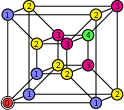
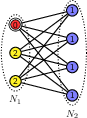
Figure 1: Examples of sufficiently complete graphs—complete, Paley, hypercube, and bipartite—used to analyze the spatial search problem.
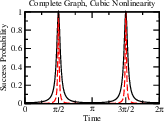
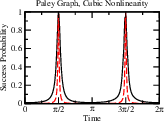
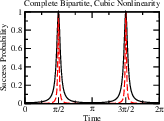
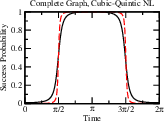
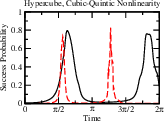
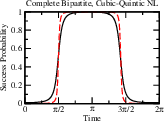
Crucially, the paper rigorously establishes that several families (Paley graphs and complete bipartite graphs with both parts Θ(N) in size) also support nonlinear speedups. For cubic (f(p)=p) and cubic-quintic (f(p)=p−p2) nonlinearities, analytical techniques derive bounds showing that, for moderate nonlinearity strength g≪N, the search runtime can be made arbitrarily lower than the linear O(N) regime, consistent with the rescaling heuristics established in the complete graph analysis. For instance, with an appropriate scaling of g, the runtime transitions to O(1), maintaining high success probability.
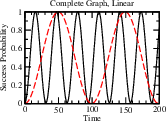
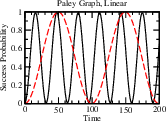
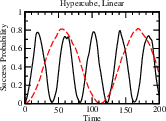
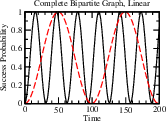
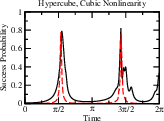
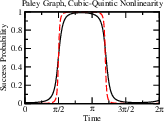
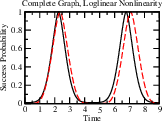
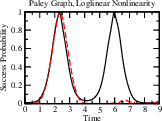
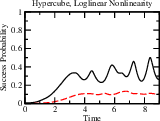
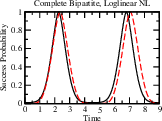
Figure 2: Success probability for quantum search, as a function of time, on sufficiently complete graphs under linear and various nonlinear evolutions.
Analytical methods combine Duhamel's formula, Grönwall-type arguments, and perturbation bounds on the evolution in the reduced invariant subspaces. A core technical achievement is the precise quantification—via operator norms—of the accumulated effect of off-diagonal "remainder" terms arising from incomplete graph symmetry. For Paley graphs, a tighter analysis proves that strong nonlinearities g=N−1 still yield time-optimal evolution up to vanishing error for large O(N)0.
Empirical validation complements the analytic work for hypercubes (where analytical control is hampered by the slow growth of certain symmetry classes) and regimes where stronger nonlinearities are numerically tested.
Loglinear Nonlinearity and Sufficiently Complete Graphs
For the loglinear nonlinearity (O(N)1), direct analytical extension is obstructed by the need for relative (not absolute) control on the sitewise amplitudes—pointwise bounds on amplitude ratios are subtler than additive differences. Nonetheless, detailed simulations indicate that Paley and complete bipartite graphs support comparable speedup with O(N)2, while hypercubes do not admit an analogous regime for this nonlinearity.
Quantum Search in Periodic Lattices
Practical quantum search is often constrained to regular lattices (e.g., in physical hardware or real-world data layouts). The study systematically explores O(N)3-dimensional periodic cubic lattices, which are known to admit only polynomial or suboptimal speedups in the linear case for O(N)4. The authors numerically simulate the search protocol with nonlinear evolution and critical time-dependent hopping rates, as for sufficiently complete graphs.
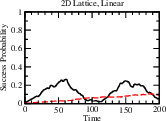
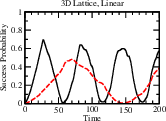
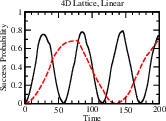
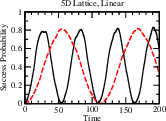
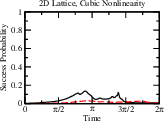
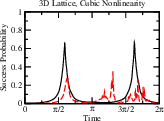
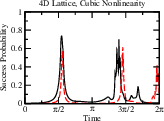
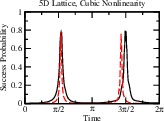
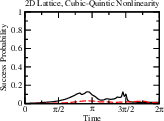
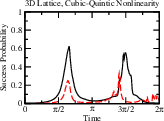
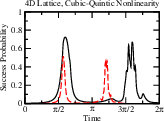
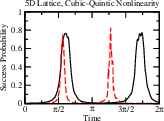
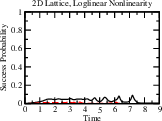
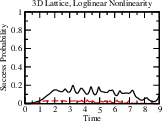
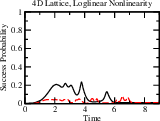
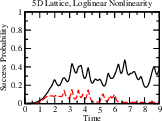
Figure 3: Success probability versus time for quantum search on periodic lattices in 2D, 3D, 4D, and 5D with various nonlinearities.
Results demonstrate:
For O(N)5, nonlinear evolutions (cubic, cubic-quintic, loglinear) do not improve success probability or runtime—often impairing performance.
For O(N)6, both cubic and cubic-quintic nonlinearities realize dramatically higher success probabilities and compression of the runtime near the constant-time regime, implying a threshold dimension at which spatial connectivity becomes sufficient for nonlinearity-induced speedup. No speedup is observed for the loglinear nonlinearity in any dimension.
The empirical finding that nonlinear search becomes viable only in sufficiently high-dimension lattices further sharpens the understanding of the interplay between graph structure and algorithmic speedup in nonlinear quantum walks.
Implications and Future Prospects
These findings have important implications for both quantum algorithm theory and physical quantum architectures:
Algorithmic landscape: The extension of nonlinear quantum speedups from the complete graph to structurally diverse “sufficiently complete" graphs opens up search algorithms over broad classes of expander-like, high-symmetry, and regular graphs, provided that effective nonlinear dynamics are physically accessible (e.g., via many-body effects or engineered nonlinearities).
Physical implementation: The nontrivial dependence of the speedup on underlying spatial dimension and graph connectivity highlights the challenge of translating speedups from idealized models to experimental platforms, especially where local geometry limits connectivity (as in low-dimensional lattices).
Complexity separation: The results emphasize a fundamental use case where nonlinear quantum amplitudes, arising in many-body quantum systems, yield computational complexity gaps for search tasks over natural data topologies not previously known to admit superlinear quantum speedup.
Theoretical boundaries: The analysis also raises questions on the tightness of sufficient conditions, optimal scaling of nonlinearity parameter O(N)7, and the potential for more sophisticated, possibly adaptive, hopping rate schedules or alternative nonlinearities.
Conclusion
This work systematically establishes the conditions under which nonlinear quantum walks yield superlinear speedups for spatial search over incomplete graphs. By combining rigorous analytical techniques with detailed numerical experiments, it delineates the classes of graphs (notably, Paley, certain bipartite, and high-dimensional lattices) and the forms of nonlinearity that allow for such speedup. The interplay among graph spectral properties, symmetry, and the robustness of nonlinear evolution is elucidated, with practical hardware and algorithm development implications. Future research directions include extending the analytical theory to less symmetric graphs, exploring alternative nonlinear dynamics, and integrating these search protocols into composite quantum algorithms.
“Emergent Mind helps me see which AI papers have caught fire online.”
Philip
Creator, AI Explained on YouTube
Sign up for free to explore the frontiers of research
Discover trending papers, chat with arXiv, and track the latest research shaping the future of science and technology.Discover trending papers, chat with arXiv, and more.