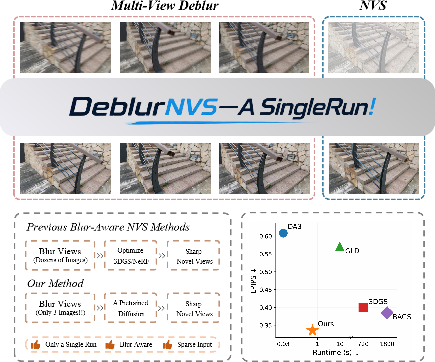
- The paper introduces a multi-stage geometric latent diffusion framework that restores sharp geometric latents from motion-blurred inputs and synthesizes novel views without per-scene optimization.
- It leverages large-scale blur-aware training on the DL3DV-10K-Blur dataset and incorporates camera conditioning to enhance multi-view geometric consistency.
- The method outperforms generalizable baselines on perceptual metrics like LPIPS and FID while mitigating artifacts inherent in cascaded 2D deblurring approaches.
DeblurNVS: Geometric Latent Diffusion for Novel View Synthesis from Sparse Motion-Blurred Images
Novel view synthesis (NVS) from multi-view images has been advanced by the emergence of neural scene representations such as NeRF, 3D Gaussian Splatting (3DGS), and diffusion-based generative models. However, a fundamental limitation remains: these methods assume clean, sharp observations, and their geometric reasoning is severely impaired when input images are corrupted by motion blur—whether resulting from camera shake, object motion, or exposure integration. Extensive per-scene optimization schemes can partially address blur by explicit image formation modeling but are computationally prohibitive and not generalizable. The practical challenge is to robustly synthesize photorealistic, structurally consistent novel views directly from a sparse set of motion-blurred images in a generalizable manner, without per-scene optimization.
DeblurNVS Framework Overview
DeblurNVS introduces a multi-stage geometric latent diffusion workflow (Figure 1) to address the ill-posed NVS-from-blur regime by operating in a geometry-aware latent space. The framework is driven by several critical design choices:
Construction of Motion-Blurred NVS Dataset
To provide scene-level supervision for end-to-end learning, the DL3DV-10K-Blur dataset is constructed by synthesizing finite-exposure motion blur: frames are interpolated and temporally averaged to simulate the integration during camera exposure (Figure 2). Window sizes and interpolation rates are randomized for blur diversity, facilitating the model’s robustness.
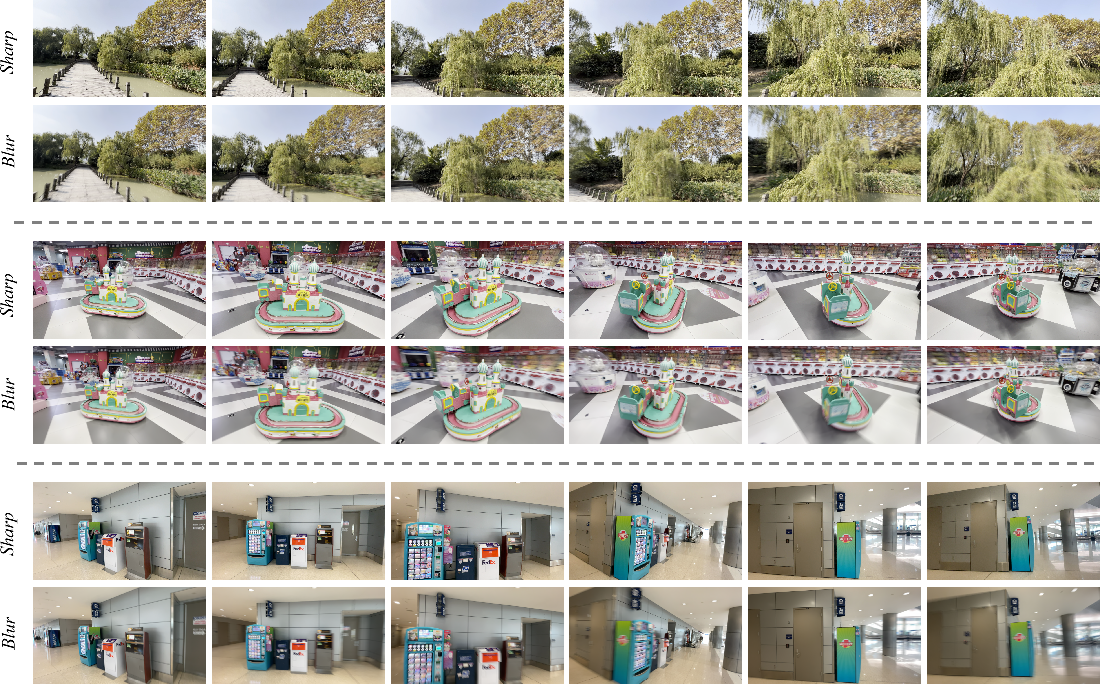
Figure 2: Examples of sharp–blur image pairs from DL3DV-10K-Blur, visualizing the difficulty imposed by diverse, realistic blur types.
Geometric Latent Diffusion Architecture
DeblurNVS builds on the Geometric Latent Diffusion (GLD) paradigm, which utilizes the feature space of geometric foundation models (specifically Depth Anything 3, DA3) for consistent multi-view reasoning. However, unlike the vanilla GLD, DeblurNVS adapts GLD and the DA3 backbone for robustness to blur via:
- Context Latent Restoration: A student DA3 encoder (LoRA-adapted) and a context latent diffusion module jointly restore sharp context latents from blurred inputs, independent of camera geometry.
- Target Latent Synthesis: Conditioned on restored context latents and camera embedding, a target-view latent diffusion model synthesizes the representation of the novel viewpoint.
- Shared Color Decoder: The decoded sharp image is produced from the joint latents.
This decomposition (Figure 3) enables separation of appearance restoration and geometry-aware synthesis, alleviating inconsistencies introduced by cascaded 2D deblurring and naive multi-view processing.
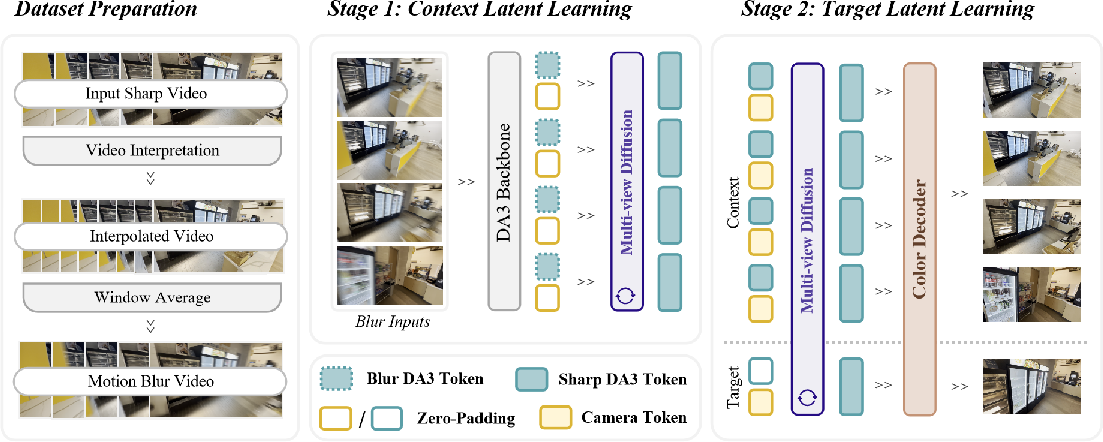
Figure 3: Pipeline of DeblurNVS: large-scale synthetic blur dataset creation, context restoration in latent space, camera-conditioned target synthesis, and shared color decoding.
Comparative and Experimental Evaluation
DeblurNVS was evaluated exhaustively across DL3DV-Bench, DeblurNeRF-Blender, DeblurNeRF-Real, and other challenging blurred benchmarks. Scene-specific methods (3DGS, BAGS) achieve higher PSNR/SSIM due to per-scene tuning but are computationally expensive. Generalizable methods like DA3 and GLD fail under motion blur, suffering from geometric misalignment and hallucinated correspondence. DeblurNVS, in contrast, outperforms all generalizable baselines on perceptual and feature-space metrics (LPIPS, DISTS, FID) and yields strong qualitative visual realism across synthetic and real-world domains, as clearly illustrated in Figures 4–6.
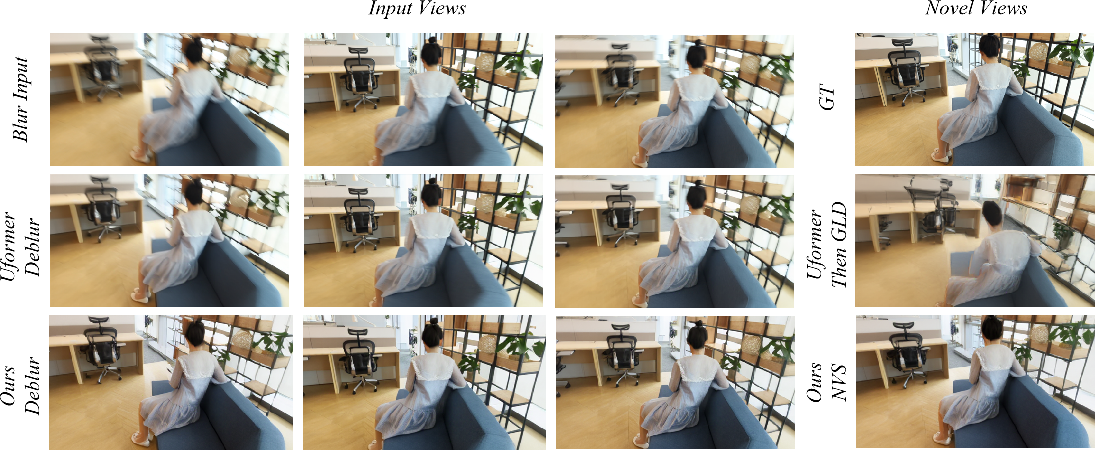
Figure 4: Comparison with 2D cascaded baseline—independent 2D deblurring causes multi-view inconsistency, degrading synthesis, unlike the coherent restoration in DeblurNVS.
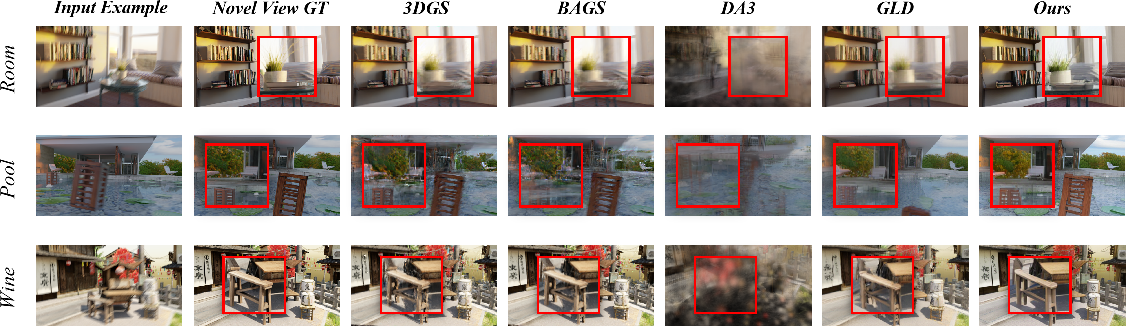
Figure 5: On DeblurNeRF-Blender, DeblurNVS restores sharper details and higher visual fidelity versus other methods, especially under significant blur.
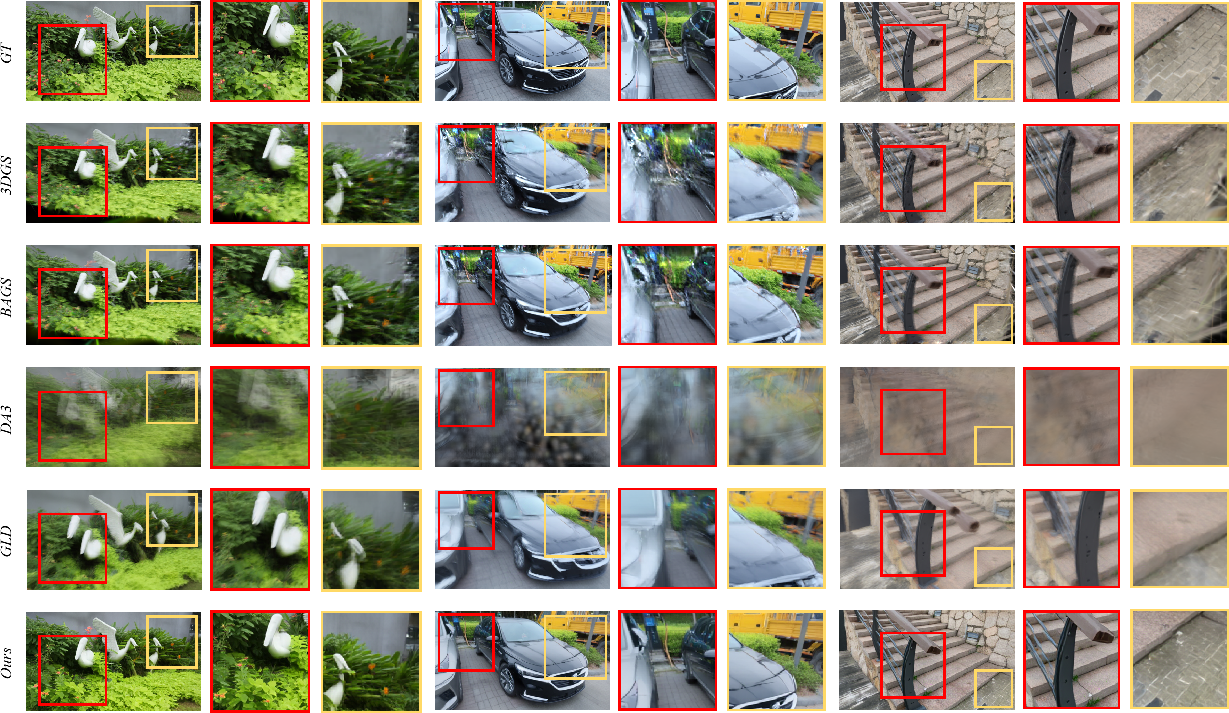
Figure 6: On DeblurNeRF-Real, DeblurNVS achieves superior perceptual sharpness and stability in complex, real image blur scenarios.
Runtime analysis further demonstrates efficient inference without scene-dependent optimization: DeblurNVS is significantly faster than cascaded diffusion models and per-scene optimizers but naturally slower than fully feed-forward models.
Ablation and Architectural Analysis
Critical design components are validated by ablation. Removing context latent restoration or LoRA adaptation leads to marked reduction in geometric and perceptual fidelity; this is supported quantitatively and demonstrated via geometric misalignment and artifact emergence (Figure 7). Comparison with cascaded 2D deblurring (Uformer + GLD) reveals major gaps: independent deblurring fails to preserve multi-view consistency, producing artifacts and preventing reliable geometric reasoning.

Figure 7: Ablation of key components demonstrates that LoRA adaptation and context latent restoration are necessary for maintaining robust geometric structure under blur.
Implications, Limitations, and Future Directions
DeblurNVS establishes a scalable, generalizable foundation for blur-robust NVS by decoupling image restoration and geometry synthesis in the latent domain. Practical implications include real-time scene reconstruction with minimal capture constraints, robust 3D content generation for dynamic or low-light environments, and a unified approach to degraded-input NVS without the optimization overhead of prior solutions.
However, as a latent diffusion-based approach, DeblurNVS introduces computational overhead from sequential denoising steps and remains slower than feed-forward models. Furthermore, under severe blur, high sparsity, or large viewpoint deltas, generative priors may hallucinate details not strictly adherent to input content, especially in highly ambiguous or occluded regions. These limitations highlight the need for future work on efficiency improvements, tighter geometric constraints, and enhanced handling of extreme input degradation.
Conclusion
DeblurNVS advances the state-of-the-art for NVS from sparse, motion-blurred images by introducing latent domain geometric restoration and synthesis supervised on a large-scale synthetic blur dataset. Its decomposition into context and target latent learning is shown to be crucial for mitigating blur-induced degeneracies and preserving structural consistency. The results support DeblurNVS as a robust baseline for realistic, blur-aware 3D scene understanding and generation, and motivate further integration of geometric priors and real-time optimization.