- The paper demonstrates a 24+ fold amplification of third-order Kerr nonlinearity by breaking propagation symmetry via wave mixing.
- The authors use a five-level ultracold Rydberg EIT configuration with adiabatic elimination and RDME truncation to model nonlinear dynamics.
- Implications include enhanced atomic magnetometry and quantum information processing through stronger photon-photon interactions.
Giant Magneto-Optical Rotation in a Rydberg Atomic Gas via Symmetry-Breaking Wave Mixing
Introduction and Motivation
Nonlinear magneto-optical rotation (NMOR) in ultracold Rydberg atomic systems has critical utility for both precision magnetometry and all-optical quantum technologies. In conventional NMOR protocols utilizing single-beam or inverted-Y atomic configurations, spatial amplification of nonlinear polarization is fundamentally obstructed by an intrinsic energy-symmetry-induced propagation blockade. This blockade arises from the symmetric evolution of the left- and right-circular polarization pathways, stymieing differential nonlinear propagation and limiting Kerr nonlinearity enhancement. The investigated work introduces a counterpropagating, far-detuned wave-mixing (WM) field as a mechanism to break this propagation symmetry in a five-level Rydberg EIT atomic system. The central outcome is a dramatic enhancement—by more than a factor of 24—in the third-order nonlinear rotation angle, demonstrating efficient deployment of nonlocal Rydberg Kerr effects and robust prospects for ultrasensitive atomic magnetometry and polaritonic quantum information processing (2606.01030).
Physical Model: Atomic System and Wave-Mixing Symmetry Breaking
The target system comprises an ultracold 85Rb ensemble engineered into an extended five-level inverted-Y configuration, combining two Zeeman-split ground states, an intermediate state, a high-lying Rydberg state, and an auxiliary state for WM coupling.
The pump-probe architecture includes:
- Weak probe field (Ωp1,Ωp2): Left/right circular polarizations address two distinct ground–excited state channels.
- Strong control field (Ωc): Resonantly drives the intermediate–Rydberg transition, facilitating dual-channel EIT.
- Far-detuned WM field (ΩWM1,ΩWM2): Couples both ground states to the auxiliary D1 excited state with large detuning (Δ5≫Γ5), establishing robust ground-state Raman coherence.
The geometry and polarization selectivity are chosen to ensure Doppler-free conditions for the Raman process. Importantly, the WM field does not drive significant real transitions but acts as a symmetry-breaking dressing channel for the probe's polarization propagation.
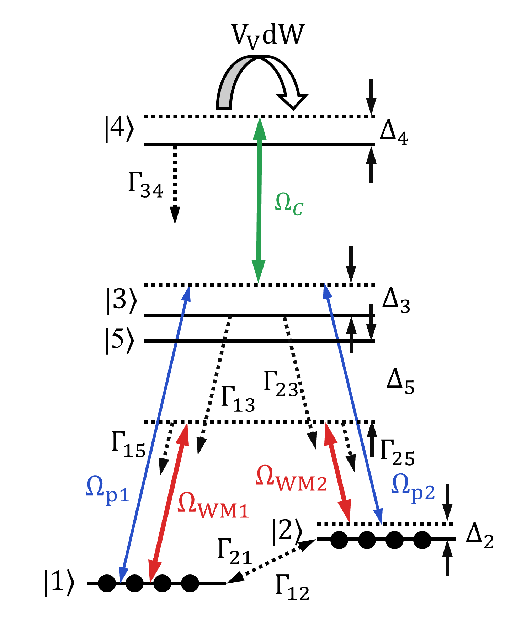
Figure 1: Excitation scheme of the multi-level cold atomic system combining a WM field and long-range Rydberg interactions.
Analytical Framework: Adiabatic Elimination, Symmetry Analysis, and Many-Body Expansion
Adiabatic Elimination of the WM Field
The analysis applies steady-state adiabatic elimination to the auxiliary D1 state, leveraging the large detuning of the WM field so that only effective AC Stark shifts and cross-ground-state Raman coherence terms (ΩC12,ΩC21) survive in the low-energy subspace. This collapses the dynamics onto an effective four-level system containing asymmetric Zeeman coupling, realized as background Raman coherence ρ21(0)=0 even in the absence of the probe field. As a result, the system's symmetry is explicitly broken: the left- and right-circular probe components accrue distinct refractive and absorptive responses throughout propagation, overriding the energy-symmetry blockade.
Nonlocal Many-Body Response: RDME Truncation
To resolve the nonlocal interaction-induced nonlinearities mediated by Rydberg–Rydberg van der Waals coupling, the authors proceed beyond mean-field and ground-state approximations. A perturbative reduced density matrix expansion (RDME) is employed, truncating the BBGKY hierarchy at the two-body level with a nonlinear integral equation for long-range polarization. This permits closed-form calculation of the nonlocal third-order Kerr response and its spatial accumulation across the medium under symmetry-broken excitation.
Numerical Results: Symmetry-Breaking Amplification, Nonlinear Phase Shift, and Physical Regimes
Amplification Mechanism
Numerical integration (with RK4) of the coupled Maxwell–Bloch equations over a realistic medium (L=15 mm, Na=8×10¹⁶ m−3) yields a direct comparison of output polarization rotation for four extreme excitation cases. Without the WM field, the pure third-order many-body Kerr phase shift remains suppressed at Ωp1,Ωp20 owing to symmetry blockade. Combining the WM field with Rydberg interactions breaks this blockade, amplifying the nonlinear rotation angle to Ωp1,Ωp21—a more than 24-fold enhancement.
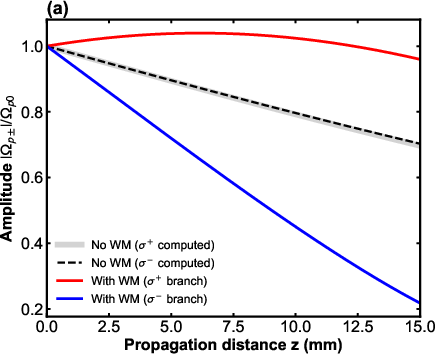
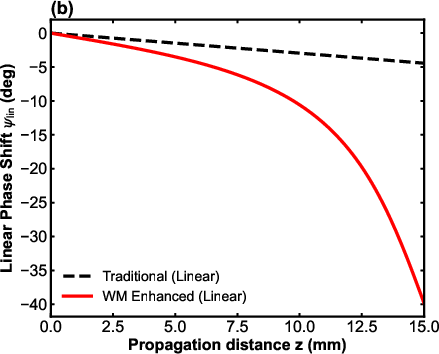
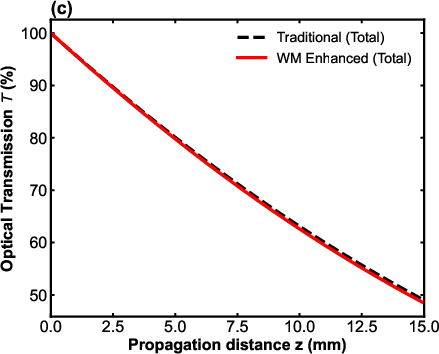
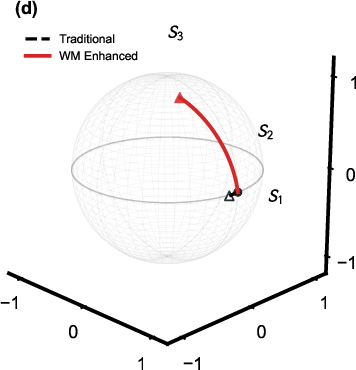
Figure 2: Energy symmetry breaking and macroscopic polarization dynamics, including polarization amplitude evolution and Poincaré sphere trajectory under symmetry-breaking WM field.
Nonlocal Kerr Accumulation
Spatial evolution of the pure third-order nonlinear rotation angle (Ωp1,Ωp22) evidences exponential-like growth under the broken-symmetry regime, in contrast to the sublinear behavior (and effective stalling) in symmetric conditions. This validates the critical role of breaking energy symmetry for leveraging long-range Rydberg feedback to generate macroscopic nonlinear effects.
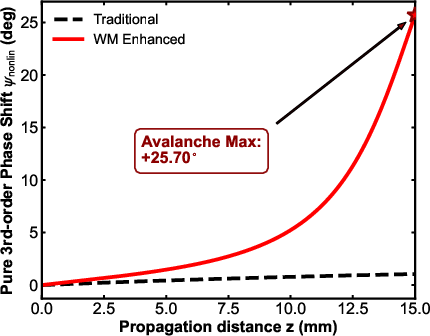
Figure 3: Spatial avalanche of the pure third-order many-body nonlocal Kerr phase shift, showing dramatic growth upon WM-induced symmetry breaking.
Dependence on Drive Strength and Polarization Asymmetry
The amplification factor is shown to decrease with increasing probe Rabi frequency Ωp1,Ωp23, due to nonlinear absorption saturation and bleaching. This is linked directly to the controllable degree of polarization amplitude asymmetry generated by the symmetry-breaking configuration, as evidenced by the evolution of Ωp1,Ωp24 through the medium.
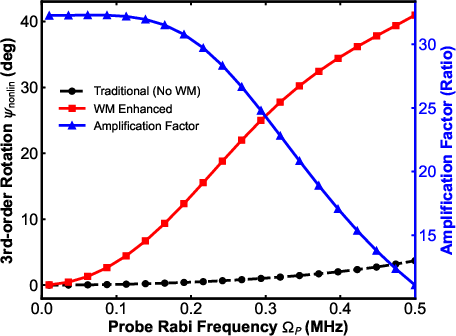
Figure 4: Dependence of third-order nonlinear rotation angle and amplification factor on the probe field intensity.
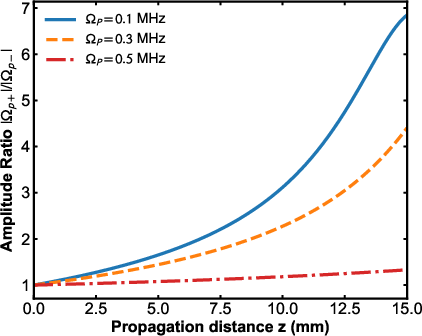
Figure 5: Spatial evolution of the local amplitude ratio between circular polarization components for varying probe field strengths.
Polarization State Evolution
Poincaré sphere mapping reveals mutual spiral transformation of the polarization state vector—simultaneous rotation (longitude) and ellipticity (latitude) evolution—reflecting the joint action of linear and nonlinear birefringence with pronounced dichroism. The practical implication is that the phase-sensitive detection remains feasible even under strong amplitude depletion, with homodyne and polarimetric readout recovering the nonlinear phase with high signal-to-noise.
Implications, Limitations, and Outlook
The demonstrated mechanism provides an efficient pathway to bypass the energy-symmetry-induced limitation in nonlinear magneto-optical systems, unlocking the full nonlocal nonlinear response of Rydberg gases. This has direct implications for ultrasensitive, broadband, and low-intensity atomic magnetometry, as well as for the design of all-optical Kerr switches and quantum polarization processors leveraging giant photon-photon interaction strengths. Theoretical extension to the strong-driving regime requires treating higher-order nonlinearities and potential nonperturbative effects, as discussed in the limitations of perturbation-based expansions. Experimentally, the utilized geometry and parameter regime are compatible with established cold-atom platforms (2606.01030), facilitating immediate translational prospects.
Conclusion
Introducing a far-detuned, symmetry-breaking wave-mixing field in a five-level ultracold Rydberg system lifts the inherent energy-symmetry blockade for polarization propagation and magnifies the pure third-order magneto-optical Kerr nonlinearity to experimentally relevant macroscopic levels. This is enabled by embedding an effective ground-state Raman coherence into the system's steady-state, activating nonlocal many-body van der Waals feedback, as self-consistently computed via the RDME approach. These results provide a robust blueprint for realizing ultrasensitive optical rotation devices and strongly nonlinear quantum photonic elements in cold-atom platforms.

