- The paper introduces FRAMES, which integrates Moreau envelope smoothing with the Frank-Wolfe method for effective projection-free optimization in nonsmooth, nonconvex settings.
- It establishes quantifiable finite-time convergence rates and explicit gap-based stationarity guarantees under various convex and weakly convex constraints.
- Empirical validations on matrix factorization and feasibility problems demonstrate optimal polynomial decay and highlight trade-offs in parameter tuning.
Frank-Wolfe with Moreau Envelope Smoothing for Nonsmooth Nonconvex Problems
Introduction and Motivation
Classical Frank-Wolfe (FW) algorithms and extensions are fundamental first-order, projection-free methods for constrained smooth optimization. However, many relevant problems in high-dimensional statistical learning, signal recovery, and matrix factorization require handling composite objectives with nonsmooth nonconvex or weakly convex regularizers and potentially multiple constraints. Existing theory for applying projected or conditional gradient schemes in this regime is quite limited—most analyses either focus on smooth or convex settings, or provide only asymptotic results for specific composite forms.
This work presents a rigorous framework for projection-free minimization of general constrained nonsmooth nonconvex objectives by combining FW with Moreau envelope smoothing, resulting in the FRAMES algorithm. The method is justified by explicit computable gap-based stationarity guarantees for both the smooth surrogate and the original nonsmooth problem, covering multiple cases: convex constraints, weakly convex and nonconvex regularizers, and inconsistent feasibility systems. The paper emphasizes the subtleties in how progress on smoothed FW gaps translates to nonsmooth problem stationarity, and establishes finite-time convergence rates under open-loop parameter schedules.
Algorithmic Framework and Problem Structure
The fundamental objective template is
x∈C⊂Rnminf(x)+g(Tx)
where C is convex, compact, and admits an efficient LMO; f is L-smooth, possibly nonconvex; T is linear; and g is either a (weakly) convex/nonsmooth penalty or an indicator for additional constraints.
The key methodological advance is applying the FW update not directly to the nonsmooth term, but to an auxiliary sequence of surrogates where g is replaced by its Moreau envelope gβk, with βk→0 as k increases. At each iteration:
- The surrogate C0 is optimized by a single FW step over C1.
- Parameters C2 are decreased (typically polynomially) to ensure the surrogate sequence converges to the original, and step sizes C3 are chosen accordingly for optimal convergence rate balance.
This surrogate preserves LMO-accessible updates (requiring only proximal access to C4), extends to weakly convex/nonconvex C5, and decouples the computational requirements from the structure of C6 and C7.
Theoretical Results and Analysis
Convergence Guarantees for the Smoothed Gap
The main analytic innovation is an explicit nonasymptotic convergence rate for the best and average smoothed Frank-Wolfe gap over C8 iterations: C9
for open-loop step and smoothing schedules f0, f1 with appropriate f2. It is highlighted that f3 and f4 is optimal for ensuring stationarity transfer to the original problem. Selecting f5 too small (decaying f6 too slowly) leads to faster surrogate convergence but suboptimal guarantees for the original nonsmooth problem.
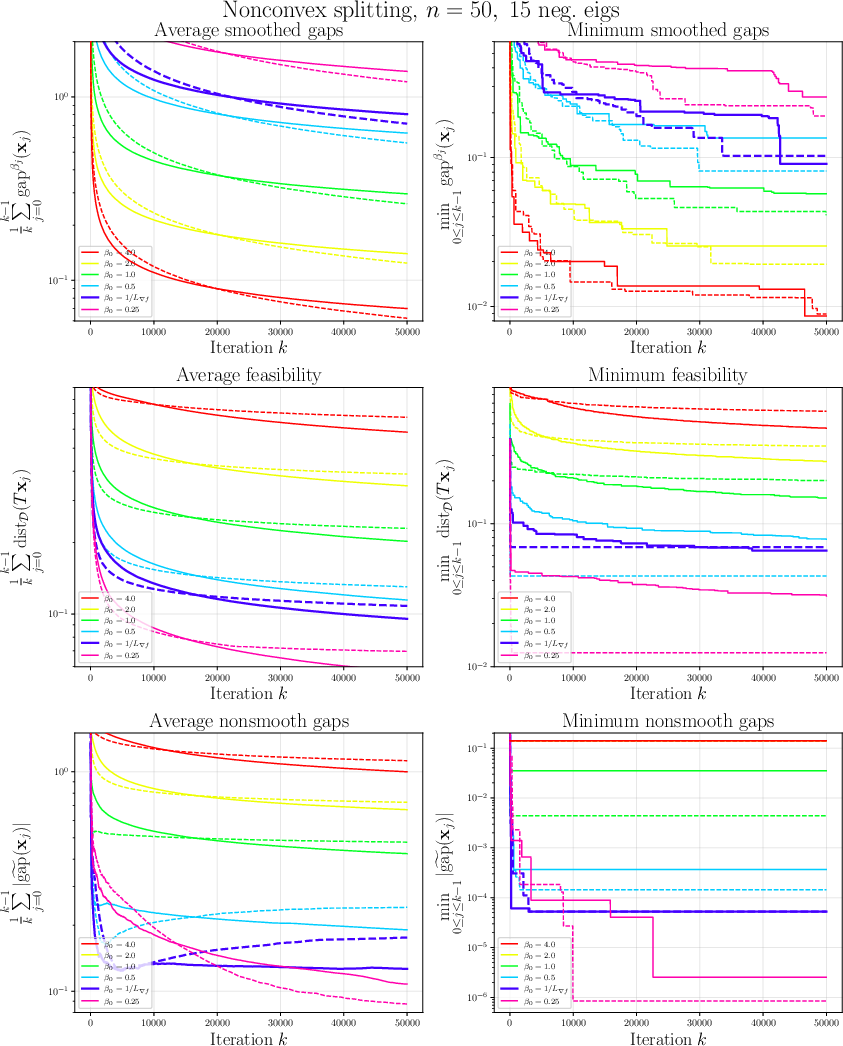
Figure 1: Smoothed gap decay for various smoothing schedules; power-law decay outperforms logarithmic schedules, consistent with theoretical rates.
The established f7 rate matches and generalizes the best-known FW rates for nonconvex smooth objectives, and crucially, these rates are carried through even when f8 is a nonsmooth indicator or weakly convex penalty.
Stationarity Guarantees for the Nonsmooth Problem
A central technical contribution is a rigorous transfer principle from smoothed FW gap convergence to (generalized) stationarity of the original nonsmooth problem. Two primary forms are covered:
- Convex Indicator f9 (splitting/feasibility): The smoothed gap controls feasibility violation and stationarity over L0 via explicit error bounds. The iterates satisfy
L1
for appropriate step and smoothing choices, independently of global convexity.
- Lipschitz Weakly Convex L2: When L3 is weakly convex and admits a tractable prox, the transfer relies on a lifting property: for every L4, the point L5 with L6 is controlled. The subgradient gap at L7 again decays as L8.
In both cases, any cluster point of a vanishing smoothed-gap subsequence is a stationary point for the nonsmooth, constrained composite objective. The extension to inconsistent systems (when L9) recovers relaxed best-approximation results: limit points minimize the objective over the closest feasible set.
Numerical Validation and Practical Trade-offs
Empirical results across nonnegative matrix factorization (NMF), trend-filtered matrix factorization, and quadratic splitting illustrate the impact of the smoothing schedule, the sensitivity to the initial T0 parameter, and the precise matching of theoretical and observed convergence behaviors.
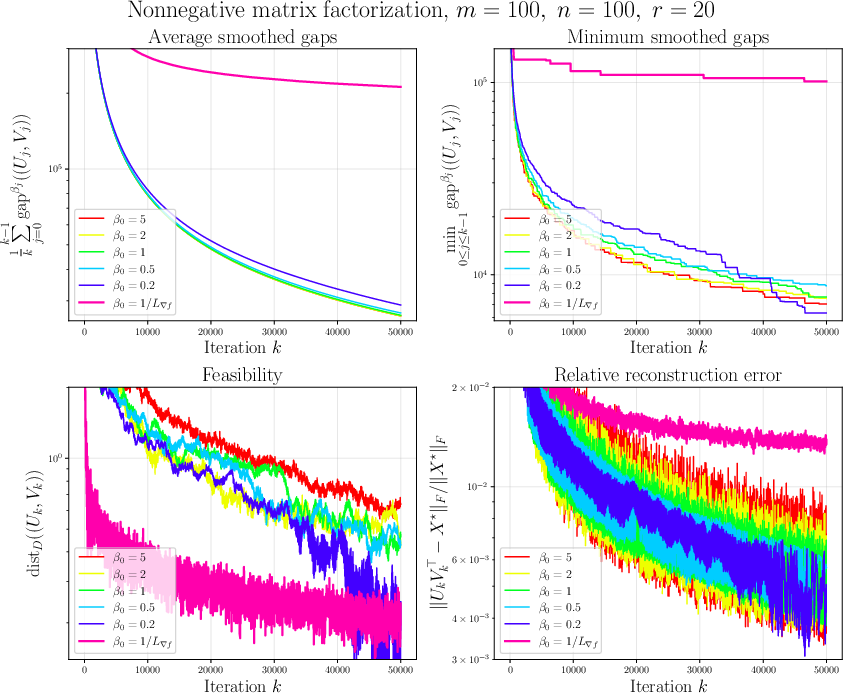
Figure 2: Convergence of smoothed and signed gaps, and feasibility error for FRAMES applied to nonnegative matrix factorization. Lower T1 leads to better feasibility at the cost of slower objective improvement.
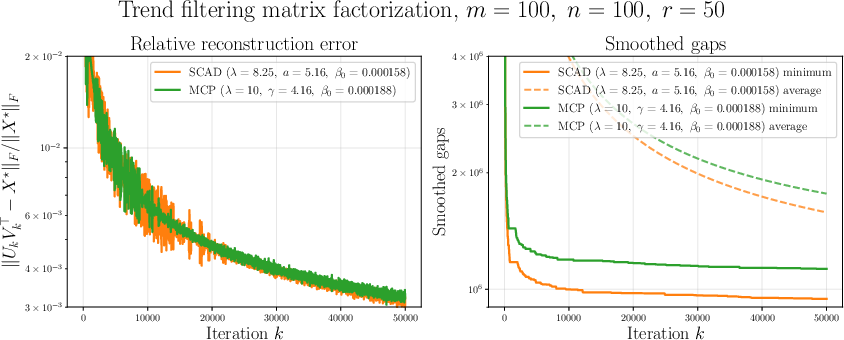
Figure 3: FRAMES applied to trend-filtered matrix factorization with weakly convex (SCAD/MCP) penalties. Both reconstruction error and smoothed gap exhibit optimal polynomial decay.
In particular:
- The polynomial smoothing schedule outperforms logarithmic decay, both in theory and practical nonsmooth gap convergence.
- The parameter T2 must balance between rapidly achieving feasibility (with smaller values) and maintaining favorable smoothness constants, as smaller T3 worsens the conditioning of the surrogate problem.
- For inconsistent quadratic splitting problems, iterates converge to the set of best approximations and secondary optimality is achieved.
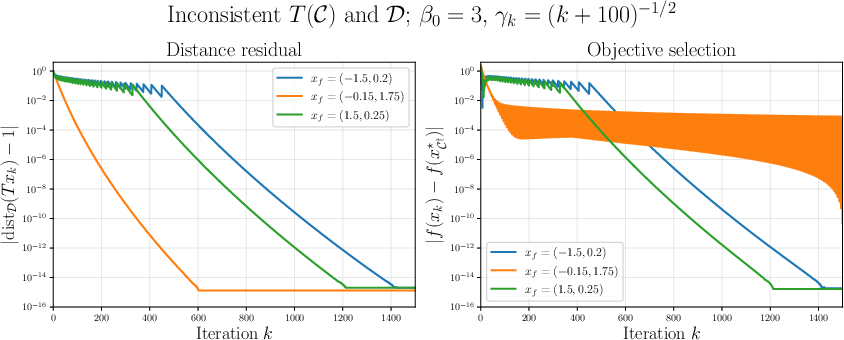
Figure 4: Trajectories for FRAMES applied to an inconsistent feasibility problem, converging toward the best-approximate face and achieving secondary minimization.
Implications and Future Directions
The FRAMES methodology establishes a principled, projection-free framework with verifiable gap-based convergence for an essential class of nonsmooth, nonconvex, and potentially inconsistent constrained problems. The approach enables leveraging existing highly efficient Frank-Wolfe infrastructure for a new universe of problems otherwise inaccessible to standard projection-based or subgradient variants.
On the theoretical front, the analysis reveals that step size and smoothing schedules must be tuned in concert for optimal nonsmooth stationarity certification—a direct contradiction to earlier smoothing analyses that prioritize only surrogate progress. This insight suggests the applicability of similar methods in other variational inequalities, composite optimization, and structured nonconvex regularization regimes in machine learning.
Practical extension avenues include:
- Removing or weakening the proximal-lifting assumption for weakly convex T4,
- Developing two-sided convergence guarantees without requiring subsequence extraction,
- Adaptation to large-scale and stochastic frameworks, especially for deep learning or adversarially constrained architectures requiring only LMO-access,
- Application to unconstrained analogs and implicit Frank-Wolfe-type methods.
The approach lays technical groundwork for integrating truly nontrivial nonsmooth constraints and regularizers into large-scale, interpretable AI systems with theoretical convergence certifications.
Conclusion
Through Moreau envelope smoothing and careful step-size/schedule tuning, FRAMES extends the Frank-Wolfe paradigm to broad classes of nonsmooth, nonconvex, and composite-constrained optimization problems. The paper provides quantifiable, explicit convergence rates for meaningful stationarity certificates of both the surrogate and original objectives, validated by comprehensive empirical results. These advances facilitate rigorous and practical optimization for structured learning and signal processing applications where nonsmoothness and complex constraints are pervasive (2606.00853).

