- The paper introduces comprehensive 3D RMHD simulations of high-redshift AGN jets, demonstrating inverse-Compton scattering of CMB photons as the main driver of enhanced X-ray emission.
- It employs an advanced hybrid Eulerian–Lagrangian particle radiation module to capture detailed jet dynamics, particle acceleration, and spectral evolution.
- Simulations reveal that increasing (1+z)^4 CMB energy density leads to steep radio spectral indices and a rising X-ray-to-radio luminosity ratio in evolving jets.
Numerical Modeling of the Radio–X-ray Correlation in High-Redshift AGN Jets
Introduction and Motivation
The enhanced X-ray emission observed in high-redshift (z≳4) radio-loud AGN jets poses a fundamental question regarding the interplay of jet physics and cosmological radiative environments. The underlying theoretical expectation is that the increasing energy density of the cosmic microwave background (CMB), scaling as (1+z)4, should elevate the role of inverse-Compton (IC) scattering in the large-scale jets relative to synchrotron processes, thus altering the broadband emission characteristics. However, the quantitative dynamics of this transition, as well as its dependence on jet kinematics, energetics, and evolutionary stage, have remained poorly constrained due to computational and modeling limitations.
The study "The Radio--X-ray Correlation of High-Redshift AGN: A Numerical Study of Inverse-Compton Scattering of the CMB Photons in Relativistic Jets" (2606.00721) presents a comprehensive suite of fully three-dimensional relativistic magnetohydrodynamic (RMHD) simulations, using advanced hybrid Eulerian–Lagrangian particle radiation modules, to investigate the essential mechanisms shaping the multiwavelength output of powerful jets at high redshift. The analyses incorporate particle acceleration, Klein–Nishina (KN) corrections, and redshift-dependent radiation fields, and produce spatially resolved synthetic observations directly comparable with state-of-the-art data.
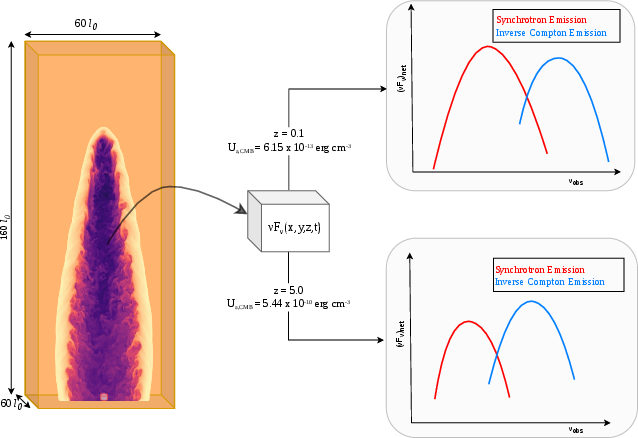
Figure 1: The simulation setup, demonstrating the injection of a relativistic, magnetized jet into a uniform ambient medium; the panels highlight the transition from synchrotron-dominated to IC/CMB-dominated SEDs with increasing redshift.
Simulation Framework and Physical Model
The numerical experiment employs the PLUTO code with an integrated particle module capable of tracking the spectral and spatial evolution of nonthermal electrons in the jet flow. Two classes of jet models are considered, characterized by Lorentz factors Γc,j=5 (Rg5) and Γc,j=2 (Rg2), both propagating into a fixed ambient medium with canonical pressure and density appropriate for high-redshift environments.
The simulations inject rotating, magnetized jets across a 60l0×60l0×160l0 Cartesian grid, where l0=0.1kpc is the fiducial jet radius. All hydrodynamic and emission variables are normalized appropriately, and the electron injection population follows a power-law N(γ)∝γ−α distribution with specified Lorentz factor cutoffs and fixed electron-to-magnetic energy ratios.
Key methodological advancements include the full implementation of the IC/CMB emissivity, with proper treatment of Lorentz invariance, relativistic beaming (via the Doppler factor), and KN suppression, allowing for physically robust X-ray predictions across the spectrum.
Jet Evolution and Morphological Signatures
The dynamical evolution elucidates the morphological transition of jets as a function of Lorentz factor, environmental backflow, and instabilities. The Rg5 (fast) jets remain better collimated and advance more rapidly, while Rg2 (slower) counterparts develop broader cocoons, more prominent Kelvin-Helmholtz-driven turbulence, and undergo stronger interaction with the external medium.
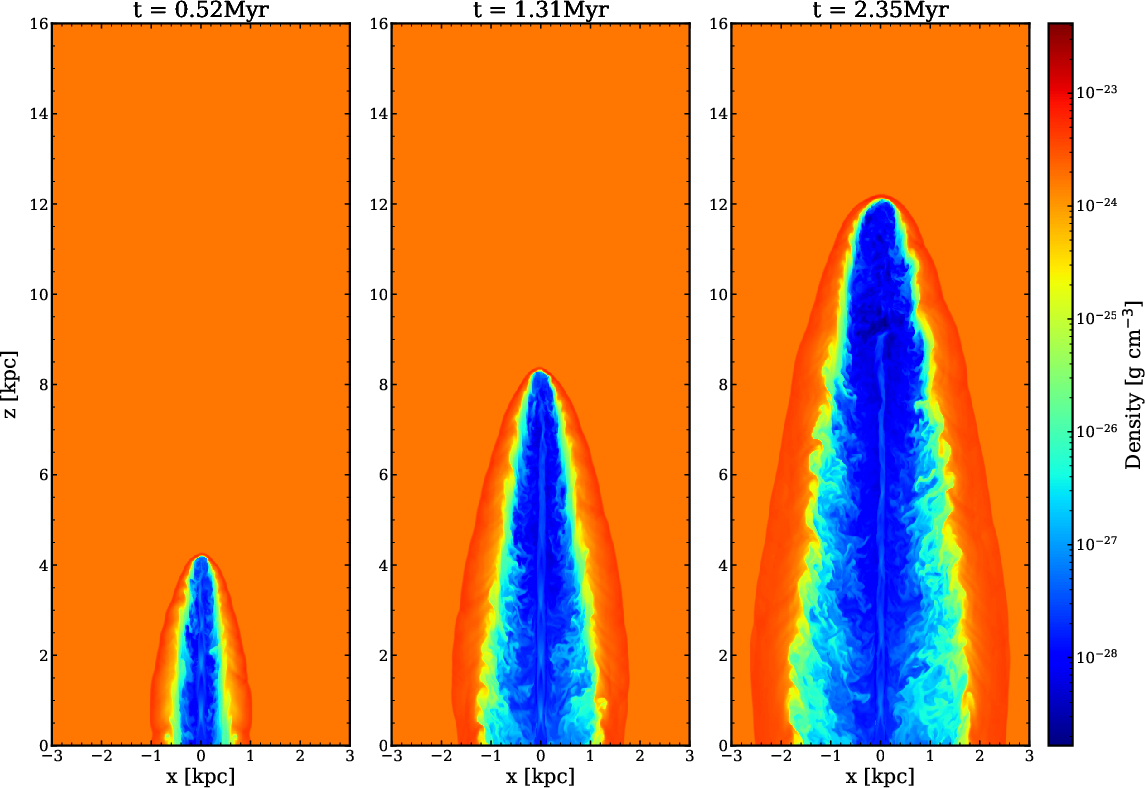
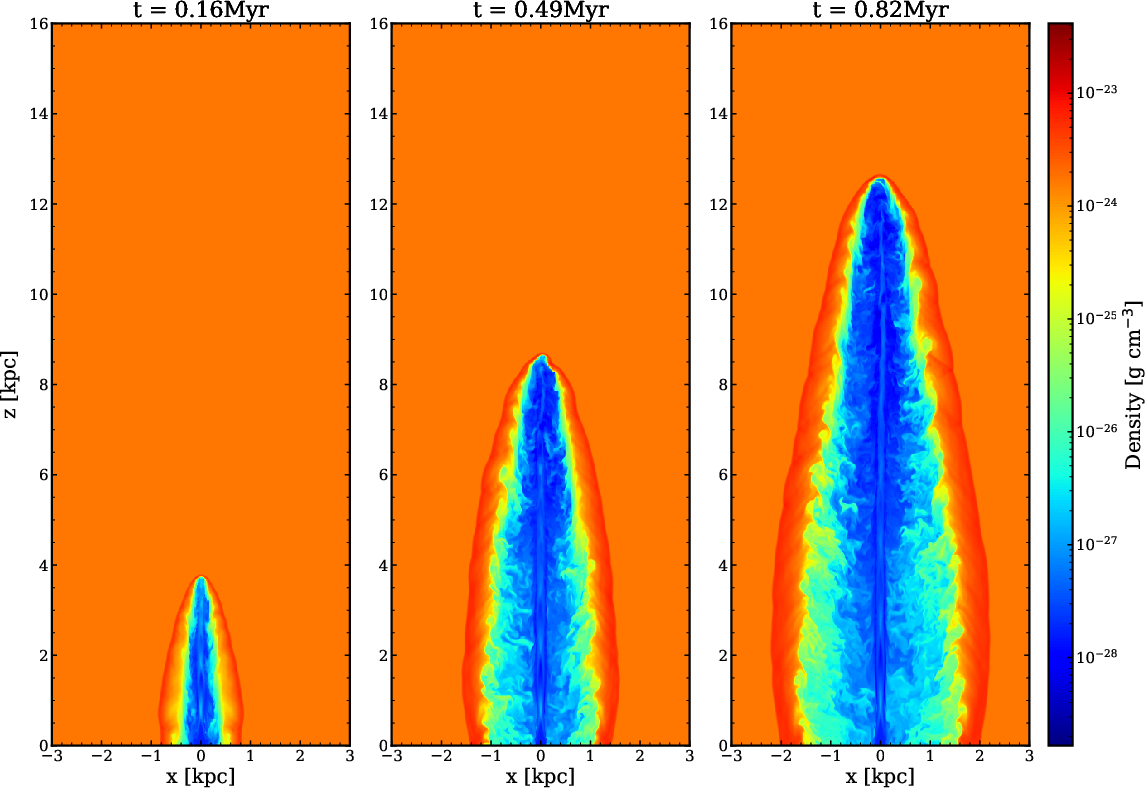
Figure 2: Jet density evolution in the x–z plane for Rg2 (top) and Rg5 (bottom); the Rg2 jet exhibits more pronounced lateral expansion and instability-driven structure than the more collimated Rg5 jet.
Synthetic Multiwavelength Emission: Spatial and Spectral Characteristics
The multiwavelength signature of the jet is dissected via synthetic two-dimensional intensity maps and spatially integrated SEDs computed at various evolutionary stages and redshifts.
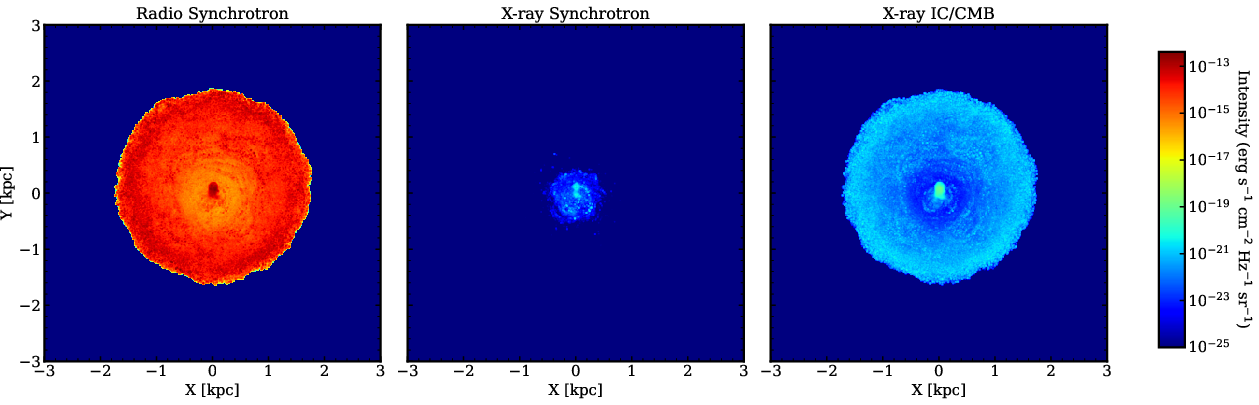
Figure 3: Synthetic intensity maps for Rg5z5 at 0.82 Myr and 1∘ viewing angle—left: radio synchrotron (500 MHz), center: X-ray synchrotron (1 keV), right: X-ray IC/CMB (1 keV). The spatial extension of the X-ray IC/CMB surpasses that of synchrotron X-rays, probing the larger-scale, lower-energy electron population.
The SEDs reveal pronounced temporal and redshift-dependent evolution. At fixed jet dynamical parameters, the X-ray regime transitions from synchrotron dominance in youthful, compact jets to IC/CMB dominance as the system evolves and (1+z)40 increases. The CMB's scaling drives a rapid suppression of the high-energy electron tail through enhanced radiative cooling, thus reducing synchrotron X-rays while amplifying the IC/CMB signature.
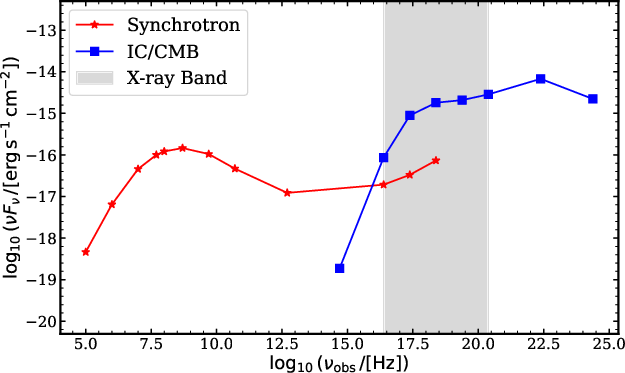
Figure 4: SED for Rg5z5 at (1+z)41 Myr, showing the classic double-humped structure; IC/CMB (blue) dominates synchrotron (red) in the X-ray band at high (1+z)42 and evolved stage.
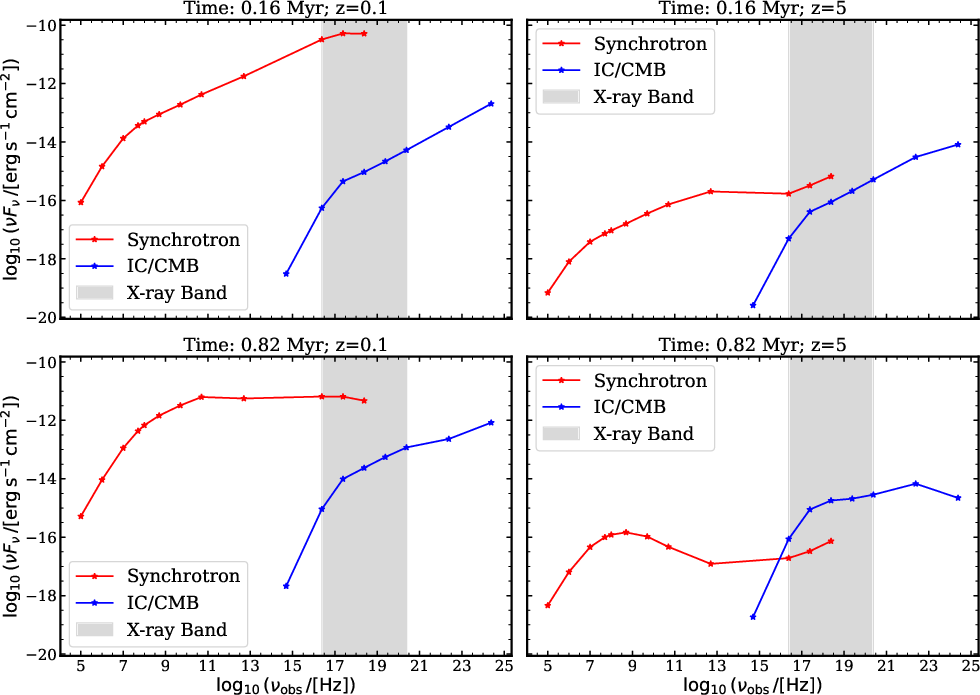
Figure 5: Temporal and redshift grid of SEDs for Rg5, locating the transition between synchrotron- and IC/CMB-dominated X-rays; synchrotron X-rays fade with radiative ageing and increasing redshift, while IC/CMB rises steeply.
Evolution of the Radio Spectral Index and the (1+z)43–(1+z)44 Relation
The simulations reproduce the steepening of the radio spectral index (1+z)45 with redshift, a key observed feature in powerful radio sources. This is traced to the preferential loss of high-energy electrons through IC/CMB cooling at high (1+z)46, leading to steep optically thin spectra in evolved systems. The effect is subdued in young jets, resolving previously reported weak (1+z)47–(1+z)48 trends for compact high-redshift quasars.
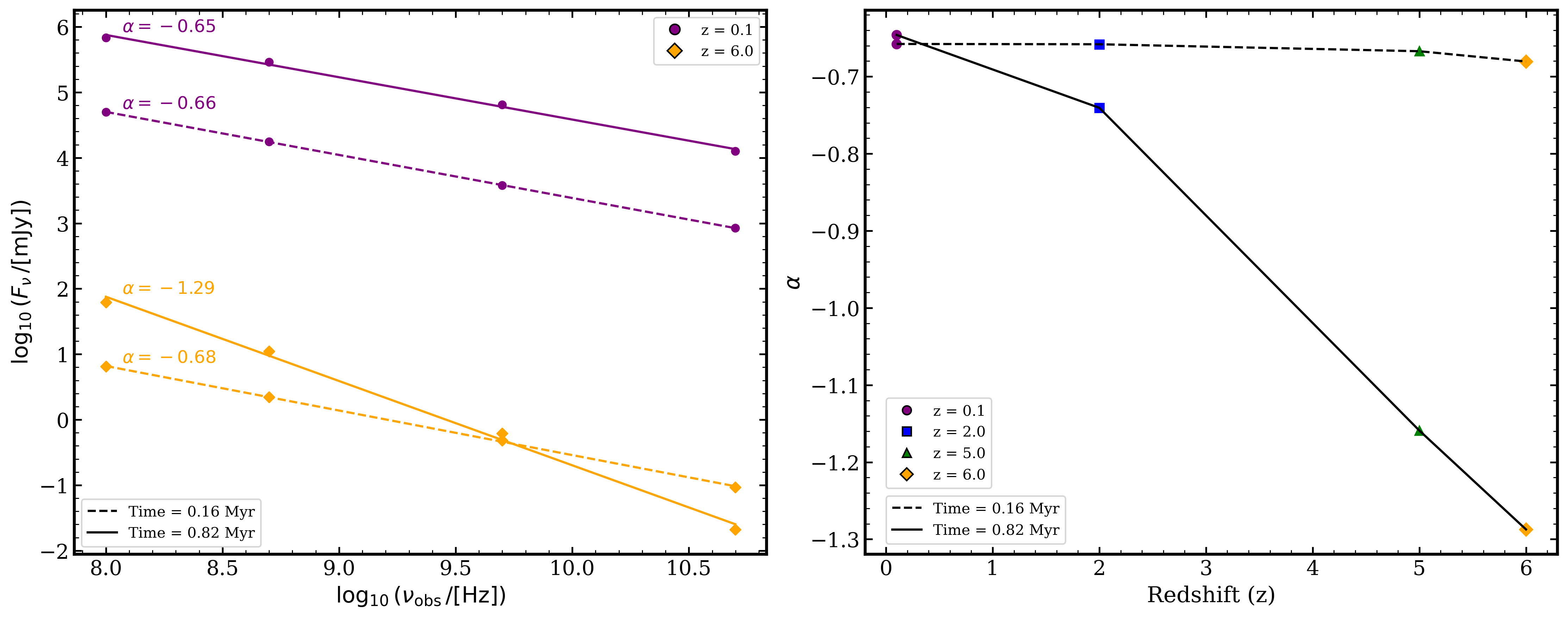
Figure 6: Left—Log-log radio spectra at two epochs and redshifts for Rg5; spectral steepening with time and (1+z)49 is prominent. Right—Spectral index Γc,j=50 versus redshift, demonstrating accelerated steepening in later evolutionary stages.
Redshift-Dependent Radio and X-ray Luminosity Trends
Comparisons to observational data confirm the weakly decreasing radio luminosity and strongly increasing X-ray luminosity for jets of fixed length as Γc,j=51 increases. The simulations demonstrate that, for Γc,j=52, X-rays become overwhelmingly dominated by IC/CMB, exhibiting the expected Γc,j=53 scaling.
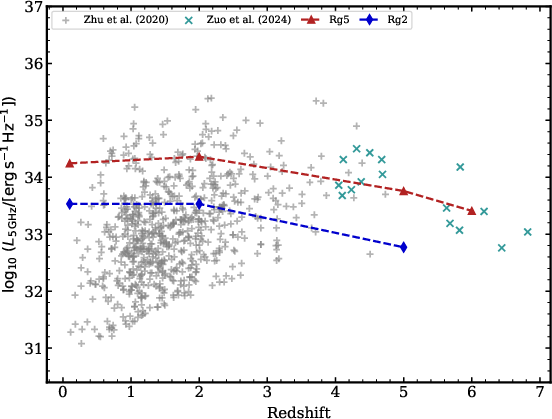
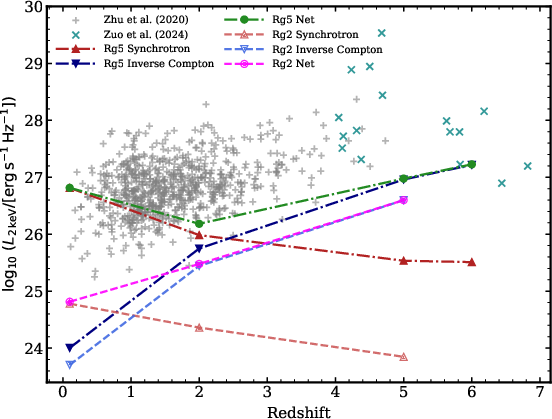
Figure 7: Left—Simulated and observed 5 GHz radio luminosity; Right—Simulated and observed 2 keV X-ray luminosity, partitioned into synchrotron, IC/CMB, and net components.
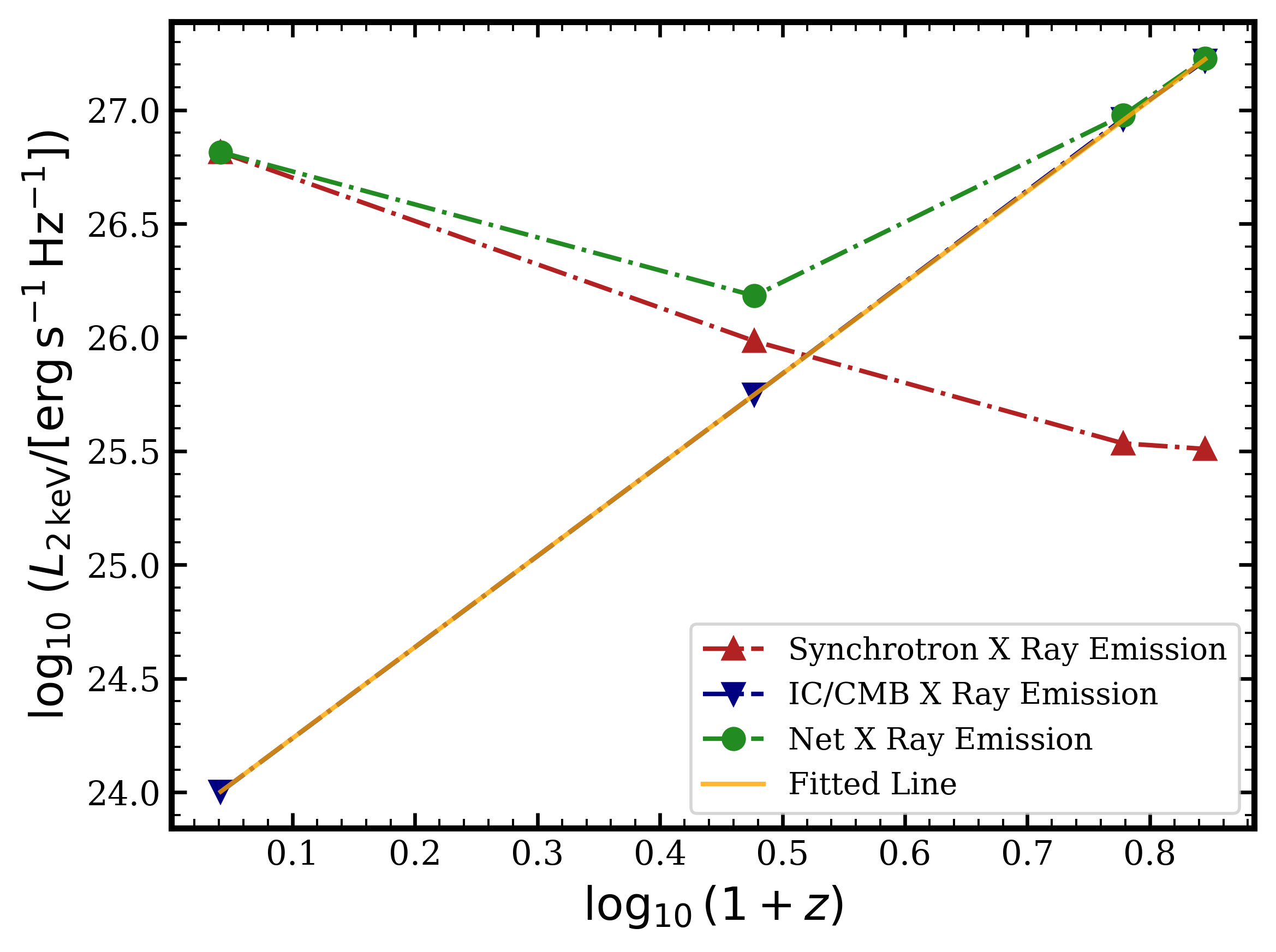
Figure 8: Demonstration of Γc,j=54 scaling for X-ray luminosity via the IC/CMB pathway in the Rg5 jet at 0.82 Myr.
The increasing X-ray-to-radio flux ratio with redshift is systematically recovered and matches observed values, especially for slowly propagating (low Lorentz factor) jets, which accumulate more severe radiative losses.
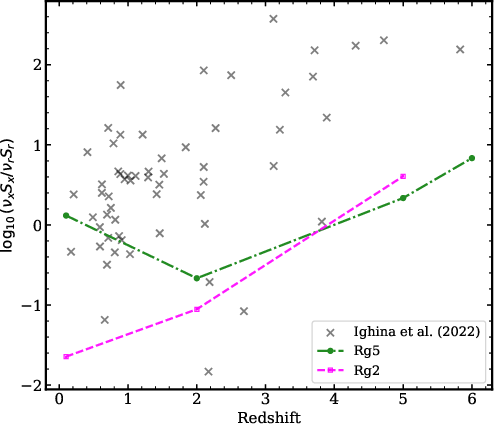
Figure 9: X-ray to radio flux ratio as a function of redshift for Rg5 and Rg2; both models reproduce observed trends, with a steeper ratio evolution for slower jets.
Low-Frequency Radio Spectral Turnover
Simulated radio spectra display intrinsic low-frequency turnover at rest-frame frequencies Γc,j=55 MHz, primarily a consequence of evolved particle distribution (lowering of Γc,j=56) rather than synchrotron self-absorption or free-free absorption (not included). This turnover aligns with observations of high-Γc,j=57 compact radio sources, suggesting that radiative electron evolution alone can drive such features in appropriate contexts.
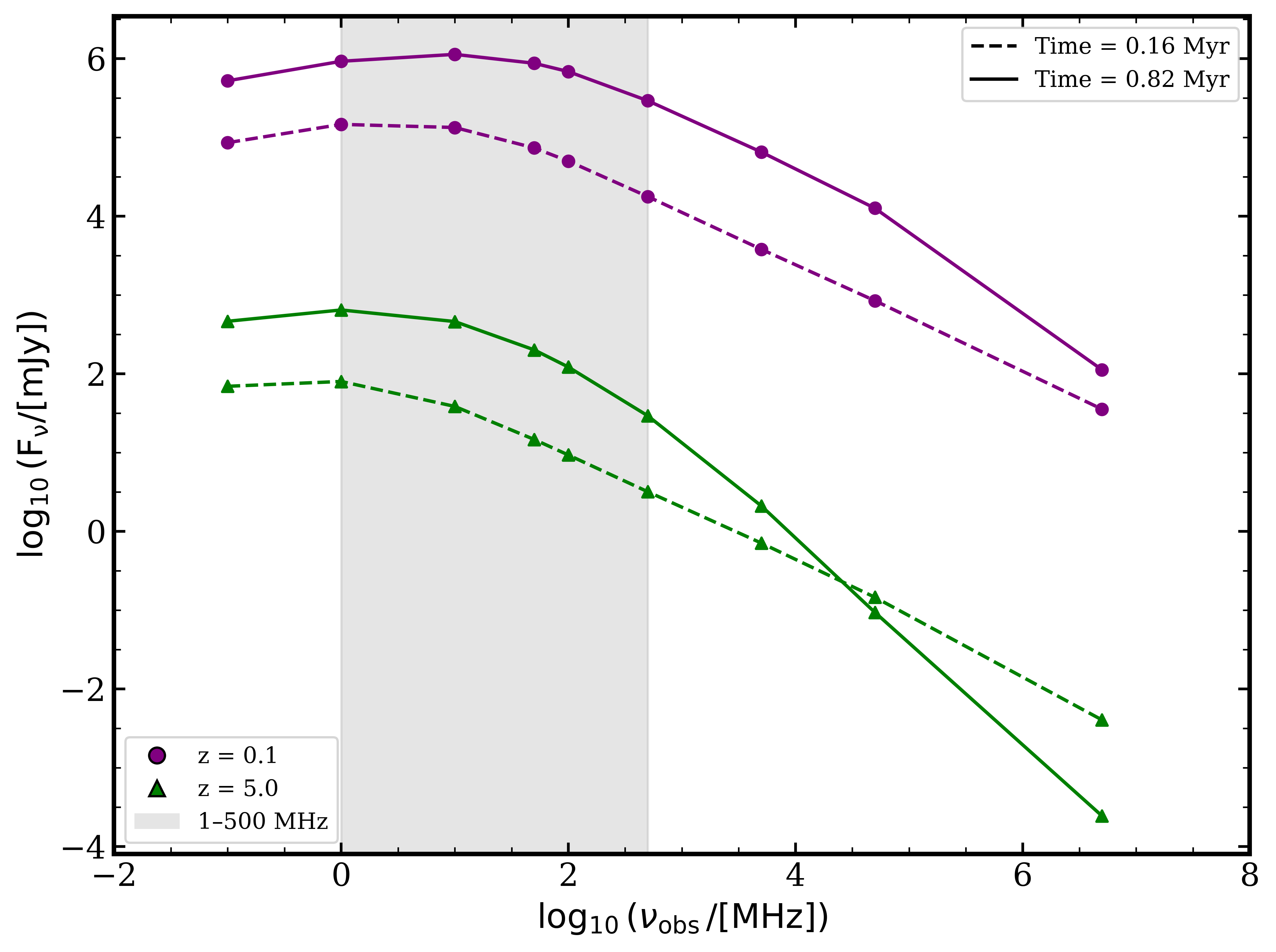
Figure 10: Radio flux density as a function of frequency at early (dashed) and late (solid) times for distinct redshifts, highlighting the sub-500 MHz spectral turnover and its evolution.
Validation and Module Benchmarking
The radiation modules are validated against the AGNpy package in one-zone scenarios, demonstrating consistency and confirming the reliability of emission calculations across the full range of physical scales and conditions addressed.
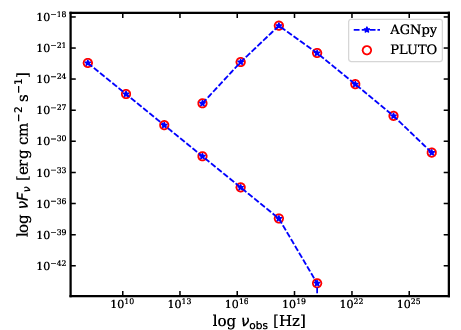
Figure 11: Comparison of SEDs generated by PLUTO and AGNpy; the close match (<2% relative error) attests to the accuracy of the updated particle radiation module.
Implications and Prospects
This study constitutes a definitive numerical demonstration that the observed X-ray amplification in high-redshift AGN jets, and the accompanying evolution of the broadband SED and radio spectral index, can be explained through the combined effects of CMB-induced IC/CMB cooling and jet dynamical evolution, given fixed jet and environmental properties. The X-ray-to-radio luminosity ratio and the Γc,j=58–Γc,j=59 relation both emerge as robust diagnostics for the jet's evolutionary state and the dominant cooling regime.
The results imply that future X-ray and radio surveys (including the SKA and next-generation X-ray observatories) are well-positioned to trace the properties and evolution of AGN jets into the epoch of reionization. Detailed modelling of absorption processes and environmental heterogeneity can further constrain the microphysics of jet–medium interaction.
Conclusion
By merging state-of-the-art RMHD simulations with advanced, physically consistent radiation modeling, the paper provides a coherent explanation for the key observed features of high-redshift AGN jets, specifically the transition to IC/CMB-dominated X-ray emission and the evolution of the radio spectral index. These insights are achieved without necessitating changes in intrinsic jet launching conditions or invoking additional environmental evolution. The framework established sets a high standard for future studies examining jet feedback, radiative losses, and their cosmological consequences in the early universe.