- The paper demonstrates that strong intralayer exciton resonance induces a visible excitonic Reststrahlen band in (PEA)₂PbI₄ slabs, leading to negative real permittivity.
- It utilizes low-temperature transmission, photoluminescence, and transfer-matrix modeling to reveal thickness-dependent spectral regimes and a model-derived Rabi splitting near the ultrastrong-coupling threshold.
- The findings offer practical insights for designing tunable photonic devices and cavity-free polaritonic materials based on intrinsic excitonic electrodynamics.
Introduction
The investigation of exciton-driven optical phenomena in layered halide perovskites, particularly (PEA)2PbI4 (PEPI), has significant implications for cavity-free photonic applications in the visible regime. This paper critically addresses the open question of whether bare PEPI slabs manifest a negative real permittivity in the visible due to their strong intralayer excitonic resonances—forming an excitonic Reststrahlen band analogous to phonon-induced stop bands in the infrared. The study combines low-temperature transmission experiments, photoluminescence (PL), and a transfer-matrix modeling framework incorporating an effective Lorentz-oscillator dielectric response. Through systematic thickness- and temperature-dependent analysis, it is demonstrated that the strong exciton oscillator strength in PEPI is sufficient to induce a slab-coupled stop band in the visible, with a model-derived Rabi splitting that approaches the ultrastrong-coupling regime.
Experimental Observations and Spectral Regimes
The experimental transmittance and photoluminescence spectra establish the key energy scales and spectral signatures of exciton-related features in PEPI slabs. Thin slabs display a Lorentzian excitonic absorption dip located at the intralayer-exciton resonance (∼2.34 eV), which evolves with increasing thickness into a broad, near-zero-transmission plateau—a stop-band structure—accompanied by compressed Fabry–Pérot-like fringes at lower energies.
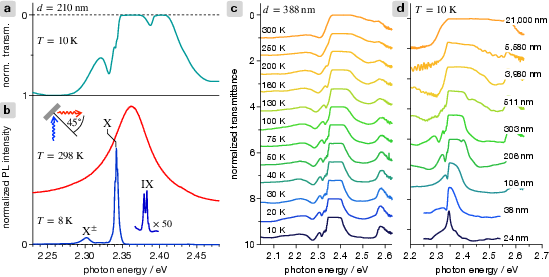
Figure 1: Excitonic energy scales and thickness-dependent transmission regimes in PEPI slabs, highlighting the transition from excitonic absorption to a broad stop band and the resolution of excitonic PL features at low temperature.
Temperature-dependent measurements confirm that the stop-band response, while attenuated at higher temperatures, persists up to at least 160 K. The broadening of the stop band and suppressed Fabry–Pérot fringes with increasing temperature are consistent with the reduction and damping of the excitonic response. The PL spectra resolve distinct intralayer and weak interlayer excitonic features, with the interlayer manifold manifesting as a doublet at higher energies.
Transfer-Matrix Analysis and Permittivity Reconstruction
The measured thickness-dependent spectra are modeled using transfer-matrix propagation based on a frequency-dependent, scalar Lorentz-oscillator dielectric function. The model accurately reproduces the crossover from absorption-dominated to propagation-dominated regime across all thicknesses, establishing the sufficiency of an exciton-dominated dielectric response in describing the observed phenomena.
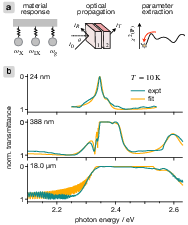
Figure 2: Transfer-matrix model workflow and fits to representative experimental transmittance spectra at low temperature for several slab thicknesses.
The parameterized dielectric function allows the extraction of a complex permittivity ε(E) from experimental data. For slabs in the stop-band regime, Re(ε) becomes negative over a finite spectral interval, directly linking the suppressed transmittance to an intrinsic material property—an excitonic Reststrahlen band.
Polaritonic Dispersion and Ultrastrong Coupling
From the reconstructed dielectric response, the bulk-like polaritonic dispersion is derived for representative slabs. Comparison with the experimental transmittance confirms that transmission maxima on the low-energy side of the stop band track dispersive slab polariton branches. The energy splitting between upper and lower polariton branches, ℏΩR, is calculated and yields values on the order of $0.5$ eV, implying g/ωX≈0.1—near the threshold for the ultrastrong-coupling regime.
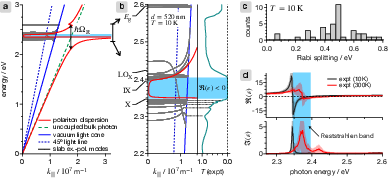
Figure 3: (a) Bulk-like polariton dispersion and calculated slab-mode structure for a 40 nm slab, indicating a Rabi splitting approaching the ultrastrong-coupling limit; (b) median reconstructed dielectric functions; (c) histogram of extracted Rabi splittings; (d) comparison of real and imaginary permittivity at different temperatures.
The model-derived Rabi splitting in this context reflects the collective oscillator strength of the slab-scale exciton manifold, differing conceptually from microcavity Rabi splittings that reference single cavity and exciton mode coupling.
Field Distributions and Slab-Electrodynamics
Calculations of 41-polarized internal field distributions reveal a suppression of the in-plane (tangential) electric field component within the stop-band region and the emergence of a driven longitudinal field near the high-energy (42) band edge. This is consistent with a Berreman-like thin-film response, where the excitation of longitudinal optical (LO) band-edge modes in the slab is governed by the dielectric function and slab geometry rather than bulk 43 alone. The out-of-plane field enhancement and the strongly suppressed in-plane field quantitatively confirm the Reststrahlen band’s physical electrodynamic origin.
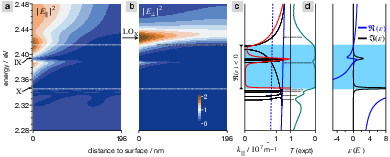
Figure 4: Calculated 44-polarized field intensity distributions and mode structure for a 45 nm PEPI slab, showing strong suppression of in-plane fields and a slab-spanning longitudinal field near the stop-band upper edge.
The observed weak interlayer-exciton features in PL correlate with subtle structure in the calculated field distributions and support the secondary dielectric contribution from interlayer excitons.
Implications and Future Directions
The results establish that PEPI slabs, absent any external microcavity or photonic structuring, intrinsically host a visible-wavelength Reststrahlen band arising from the strong intralayer-exciton oscillator strength. This regime is marked by:
- A finite spectral window of negative real permittivity accessible at low, and to a weaker extent, at room temperature
- A model-derived Rabi splitting 46, near the ultrastrong-coupling boundary for light-matter interaction
- Suppressed transmission, field exclusion, and Fabry–Pérot mode compression strictly due to excitonic electrodynamics
The theoretical and experimental framework developed here has practical implications for the design of tunable visible photonic devices, including polaritonics, low-loss reflectors, and dynamic reconfigurable elements, without reliance on extrinsic cavities. The results also highlight interpretive challenges for optical spectra in layered perovskites, since slab-optical and polaritonic effects can spectrally mimic excitonic fine structure; careful distinction is warranted in future analyses.
Open questions include the complete vectorial electrodynamics of the slab—requiring angle- and polarization-resolved ellipsometry for full anisotropic dielectric modeling—and the precise role of interlayer excitons or structural disorder in modulating the stop-band regime. The development of anisotropic modeling informed by recent ellipsometry and hyperbolic dispersion insights is a promising path forward.
Conclusion
This work demonstrates that (PEA)47PbI48 slabs intrinsically realize a visible-frequency excitonic Reststrahlen band due to their strong intralayer-exciton resonance, with negative real permittivity, a tunable stop band, and a large, slab-scale Rabi splitting. The transition from excitonic absorption in thin slabs to a propagation-dominated stop band in thicker ones is governed by slab electrodynamics, as captured by a Lorentz-oscillator transfer-matrix model. These findings underscore the capacity of self-hybridized 2D perovskites to serve as cavity-free polaritonic materials and establish a concrete experimental platform for exploring ultrastrong exciton-photon coupling at optical frequencies (2606.00682).