- The paper establishes a strict hierarchy among k-bandwidth NFAs, showing that each increase in k enhances language expressivity.
- It demonstrates that any finite language can be encoded by a 2-bandwidth NFA using alternating read and skip paths.
- The minimization problem for k-bandwidth NFAs is shown to be NP-complete for k ≥2, underscoring computational limits in molecular programming.
Bandwidth Constraints in Nondeterministic Finite Automata: Hierarchical Language Expressivity and Splicing Applications
Motivation and Background
The paper investigates k-bandwidth nondeterministic finite automata (NFA), motivated by applications in programmable co-transcriptional splicing of RNA sequences from DNA templates. Co-transcriptional splicing, depicted in (Figure 1), involves local, greedy deletions of hairpin structures as an RNA strand is synthesized, enabling specific subsequence removal according to programmable rules. The encoding of regular languages into DNA templates using NFAs requires careful control over transition locality—biological systems favor interactions between neighboring regions, so mapping state transitions onto linear templates demands bounded transition distances.
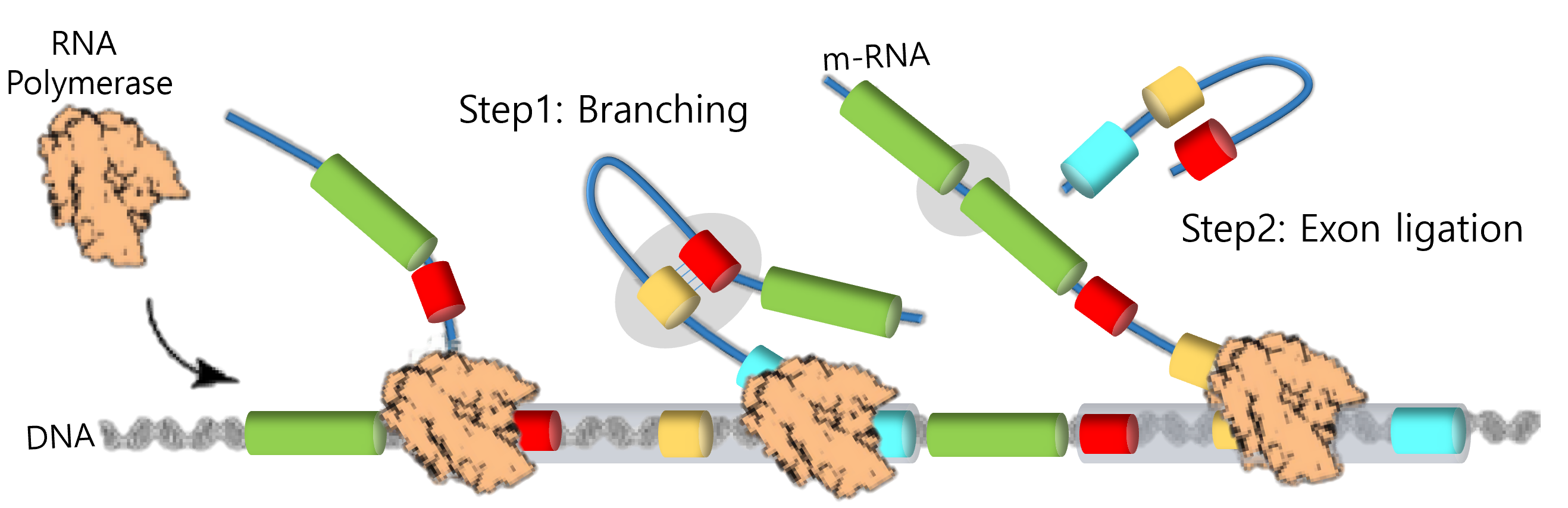
Figure 1: Co-transcriptional splicing, where hairpins are formed locally and excised during RNA transcription, modeling state transitions and deletions.
Definition of k-Bandwidth NFAs and Linearization Problems
A k-bandwidth NFA restricts transitions between states such that the source and target states are at most k segments apart in an ordered template. Formally, for indexed states Q={q0,…,qn−1}, a transition qj∈δ(qi,a) is permissible only if 0<(j−i)modn≤k. The central algorithmic question is: given a regular language L and integer k, does there exist a k-BW-NFA k0 with k1? This problem is pivotal for both infinite regular languages and finite languages relevant to molecular programming.
Hierarchy and Expressivity of k2-Bandwidth NFAs
The authors establish a strict infinite hierarchy among language classes k3 recognized by k4-BW-NFAs: for each k5, k6. This is demonstrated via explicit language constructions, e.g., k7 can be accepted by a k8-BW-NFA but not by any k9-BW-NFA (Figure 2).
(Figure 2)
Figure 2: The proper inclusion hierarchy among the classes k0 and the finite class k1.
This result underscores the correlation between increased bandwidth and increased expressiveness, i.e. molecular systems permitting larger hairpin deletions can simulate richer classes of regular languages.
Finite Languages: Bandwidth Bound and Algorithmic Decidability
A constructive result shows that any finite language k2 can be accepted by a k3-BW-NFA. The encoding exploits alternating read and skip paths, ensuring that each word is accepted with transitions that span at most two segments (see Figure 3 for a base step in this construction).
(Figure 3)
Figure 3: Structure of a 2-bandwidth NFA accepting a singleton finite language using alternating paths for input and k4 skips.
This bound is tight: for k5, not all finite languages can be accepted (e.g., k6). A complete structural characterization of k7-BW-NFAs accepting finite languages is provided, with a polynomial time (in explicit word list representation) decision algorithm for existence (running time k8 for k9).
Computational Hardness of Bandwidth Minimization
The minimization problem—does there exist an k0-state k1-BW-NFA for a finite language k2?—is NP-complete for fixed k3 (specifically, k4). The hardness proof is via reduction from the biclique cover problem in bipartite graphs. The automata construction maps bicliques to gadgets in the NFA, with state counts reflecting the covering number. This complexity result sets boundaries for efficient design of minimal encodings in molecular systems.
Practical and Theoretical Implications
These results have direct implications for the design of molecular information systems and synthetic biology constructs. The ability to encode finite languages with bounded bandwidth NFAs ensures the feasibility of stable, cost-effective DNA templates for programmable RNA output. The strict hierarchy informs the limitations imposed by local interaction constraints. The intractability of minimization for k5 suggests reliance on heuristic or approximate methods in practical template optimization.
Theoretically, k6-BW-NFA hierarchy opens questions about structural decompositions of regular languages, characterization of expressible classes for general k7, and the interplay between automata ordering/linearization and classical automata minimization. Decision procedures extend to explicit lists but not efficiently for arbitrary automaton representations.
Future Directions
Future work includes:
- Characterizing non-finite regular languages in k8 and efficient decision algorithms when the input is an NFA/DFA.
- Exploring the impact of bounded alphabets on NP-hardness results.
- Investigating approximate coverings and "safe" acceptance in situations where some unwanted words are tolerable, mirroring biological error tolerance.
- Quantitative studies of template size and stability versus bandwidth in experimental settings.
Conclusion
This paper establishes the theoretical landscape of bandwidth constraints in NFAs as motivated by local deletions in co-transcriptional splicing. A strict infinite hierarchy of expressible language classes, a tight bound (k9) for finite language acceptance, and NP-completeness for bandwidth minimization are laid out. These findings provide both guidance and limitations for molecular programming tasks and inform the broader theory of automata ordering and expressivity.