Spacetime torsion signatures in neutrino oscillation physics
Published 30 May 2026 in hep-th | (2606.00617v1)
Abstract: We report on recent results concerning neutrino oscillation in the presence of background torsion. In the context of Einstein-Cartan theory, we find new oscillation formulas for constant torsion and linearly time-dependent torsion. The oscillation formulas obtained depend on the orientation of the spin.
The paper presents a QFT analysis showing that spacetime torsion modulates neutrino oscillation frequencies via spin-dependent corrections.
It derives modified oscillation formulas using the torsion-Dirac equation and Bogoliubov transformations, highlighting significant deviations at low neutrino momenta.
Numerical simulations indicate that torsion effects vanish at high energies, suggesting low-energy experiments could probe torsion-induced modifications and flavor vacuum structure.
Spacetime Torsion Effects on Neutrino Oscillations in the Einstein-Cartan Framework
Overview and Motivation
This paper presents a detailed quantum field theoretical (QFT) analysis of neutrino oscillations in the presence of spacetime torsion, specifically within the Einstein-Cartan theory. The interplay between spinor fields and torsion is explored in flat spacetime for both constant and time-dependent torsion backgrounds, leading to a novel derivation of neutrino oscillation formulas that exhibit explicit spin dependence in both oscillation frequencies and amplitudes. The theoretical foundation is grounded in the axially coupled torsion-Dirac equation, with an emphasis on physical scenarios where torsion constitutes a background field generated by ambient spin densities.
Theoretical Formulation
The approach employs Dirac fields minimally coupled to an external torsion four-vector, such that the standard free Dirac equation acquires an additional axial-vector coupling:
iγμ∂μΨ=mΨ−23Tργργ5Ψ,
with Tμ describing the torsion background. In the case of constant torsion along the z-axis, the energy eigenvalues of the Dirac solutions depend linearly on the spin orientation:
m±=m±23T3,
introducing a spin-dependent splitting in the neutrino dispersion relation. In the more general scenario of linearly time-dependent torsion, the paper provides an explicit construction for the spinor solutions, highlighting the emergence of t2-dependent phase factors and modified mass terms.
The canonical quantization and mixing formalism is extended to torsion backgrounds, utilizing time-dependent Bogoliubov transformations. The QFT description retains the fundamental plane-wave structure but systematically incorporates torsion-induced modifications in the mode expansions and the flavor-mixing generator.
Neutrino Oscillation Phenomenology with Torsion
By evaluating flavor-current charges in the Heisenberg picture, the transition (survival) probabilities for neutrinos are computed, explicitly revealing dependence on spin state, torsion magnitude, and the detailed structure of the Bogoliubov coefficients. The oscillation probability formulae generalize the Pontecorvo-Maki-Nakagawa-Sakata (PMNS) structure, introducing additional terms from torsion-induced spin-energy splitting and flavor vacuum modifications. These dependencies are most pronounced at low neutrino momenta.
Illustrative results, obtained for representative neutrino mass and mixing parameters, demonstrate that:
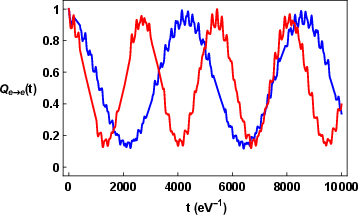
Spin-up and spin-down neutrino states exhibit distinct oscillation patterns in both amplitude and frequency under background torsion.
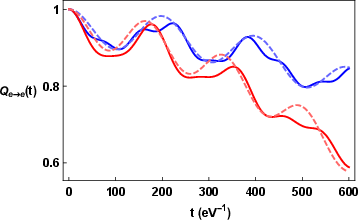
In both constant and linearly time-dependent torsion cases, the deviation from standard quantum mechanical (QM) oscillation probabilities is significant, especially for low-momentum neutrinos.
The quantum field corrections and torsion effects vanish in the ultrarelativistic limit, reducing to the standard QM formalism.
The results are visualized in terms of the time-evolution of the electron neutrino survival probability, displaying clear separation between spin states and significant deviation from the purely quantum mechanical prediction for low-momentum scenarios.
Figure 2: Transition probability for linearly time-dependent torsion. Left: spin-up (blue) and spin-down (red). Right: comparison with QM results (dashed).
CP Violation and Vacuum Structure
The paper extends the analysis to CP-violation in neutrino oscillations, deriving spin-dependent CP-asymmetry expressions as a function of the Dirac phase and torsion parameters. The condensation structure of the flavor vacuum in the presence of torsion is found to be nontrivial and spin-dependent, with possible contributions to the cosmological dark sector posited via torsion-induced condensate densities. This effect emerges from the modified vacuum expectation values of number operators, where spin up and spin down sectors are unequally populated due to the underlying torsion background.
Numerical Results and Experimental Implications
With parameter choices consistent with current oscillation data (Δm122≈7.56×10⁻⁵eV2, Δm232≈2.5×10⁻³eV2, Tμ0), the numerical simulations highlight:
Large spin-dependent modifications in transition probabilities for Tμ1.
Close agreement between QFT and QM formulas at high energy, but pronounced divergence at low momenta.
The possibility that low-energy neutrino experiments (e.g., PTOLEMY) could be sensitive to QFT torsion signatures, while high-energy facilities (e.g., DUNE) are likely insensitive.
Theoretical and Practical Implications
The theoretical results reinforce the necessity of QFT treatments in describing neutrino phenomena in exotic backgrounds—here, specifically, those with nonvanishing spacetime torsion. The explicit spin-dependence of oscillation formulas marks a sharp departure from standard QM approaches, suggesting that new physics might manifest in spin-resolved, low-momentum neutrino experiments. The impact on the flavor vacuum's structure also raises questions for cosmological models, including potential contributions to dark energy and dark matter from torsion-induced spinor condensates.
Future work could extend these results to curved spacetime or more realistic cosmological backgrounds, consider higher-order interactions, or investigate flavor-mixing in scenarios with dynamical torsion fields.
Conclusion
This paper rigorously establishes that static and time-dependent torsion backgrounds within the Einstein-Cartan framework induce substantial spin-dependent corrections to neutrino oscillation probabilities and flavor vacuum structure at low momenta. The results imply that experimental searches for torsion-induced effects should prioritize low-energy, spin-resolving measurements, and that QFT approaches are imperative for accurately modeling flavor oscillations in nontrivial spacetime geometries. The findings also hint at deeper connections between torsion, neutrino physics, and the cosmological dark sector, meriting further theoretical and experimental investigation.