- The paper introduces nonlinear feedback mechanisms (tilt and latitude quenching) that narrow the solar surface flux transport parameter space.
- Methodology involves 3D optimization over meridional flow, diffusivity, and decay timescales, highlighting latitude quenching as the dominant factor.
- The findings emphasize that incorporating nonlinear quenching is vital for aligning model outcomes with observed solar magnetic field dynamics.
Nonlinear Feedbacks and the Constriction of Solar Surface Flux Transport Parameter Space
Introduction
The Surface Flux Transport (SFT) model is central to decoding the temporal dynamics of the Sun's large-scale magnetic field, underpinning predictions of solar cycle variability and constraints on dynamo theory. Historically, linear transport processes—advection by meridional flow, surface diffusion, and source emergence—have formed the core of SFT optimizations, but this approach neglects critical nonlinear feedbacks such as tilt quenching (TQ) and latitude quenching (LQ), as well as phenomenological flux loss mechanisms. The article "Narrowing the solar surface flux transport parameter space through nonlinear feedbacks" (2606.00441) revises this paradigm by explicitly integrating nonlinear quenching mechanisms and flux decay into a three-dimensional optimization of the SFT parameter domain. This essay details the analytical framework, results, and implications.
Nonlinear Feedbacks in SFT Modeling
The authors extend prior SFT optimization frameworks by incorporating analytic prescriptions for both TQ and LQ in the statistical source term, alongside a tunable decay timescale τ. TQ is implemented as a reduction in the Joy's law tilt with increasing cycle strength, while LQ modulates the mean latitude of flux emergence as a function of cycle amplitude, both empirically parameterized. These modifications directly impact the spatiotemporal characteristics of emergent bipoles, revising the efficiency of axial dipole moment generation—explicitly addressing limitations highlighted by dynamo and SFT studies that identified anti-correlations between sunspot cycle amplitude, tilt, and latitude statistics.
Meridional flow speed (u0), surface diffusivity (η), and decay time (τ) span a dense, structured grid in the optimization, using a statistically representative, cycle-averaged flux emergence profile. Admissible solutions are defined via their agreement with empirically motivated constraints: polar field reversal timing (Trev), minimum-to-extremum amplitude ratio (Rpol), and polar cap boundary latitude (λcap), in addition to global dipole moment diagnostics.
Quantitative Restructuring of the Admissible Parameter Space
Without nonlinear quenching, the admissible (u0,η) space is relatively broad and may include multiple, disjoint allowed regions. The impact of each quenching mechanism is assessed independently and in combination, at several values of the decay timescale τ. Comparative analyses demonstrate that TQ alone only modestly reduces the admissible domain, whereas LQ has a more pronounced effect. When both TQ and LQ operate simultaneously, the contraction is substantial, and the admissible region condenses to a narrow band of parameter values, demonstrating a clear "ceiling" on dipole field amplification.
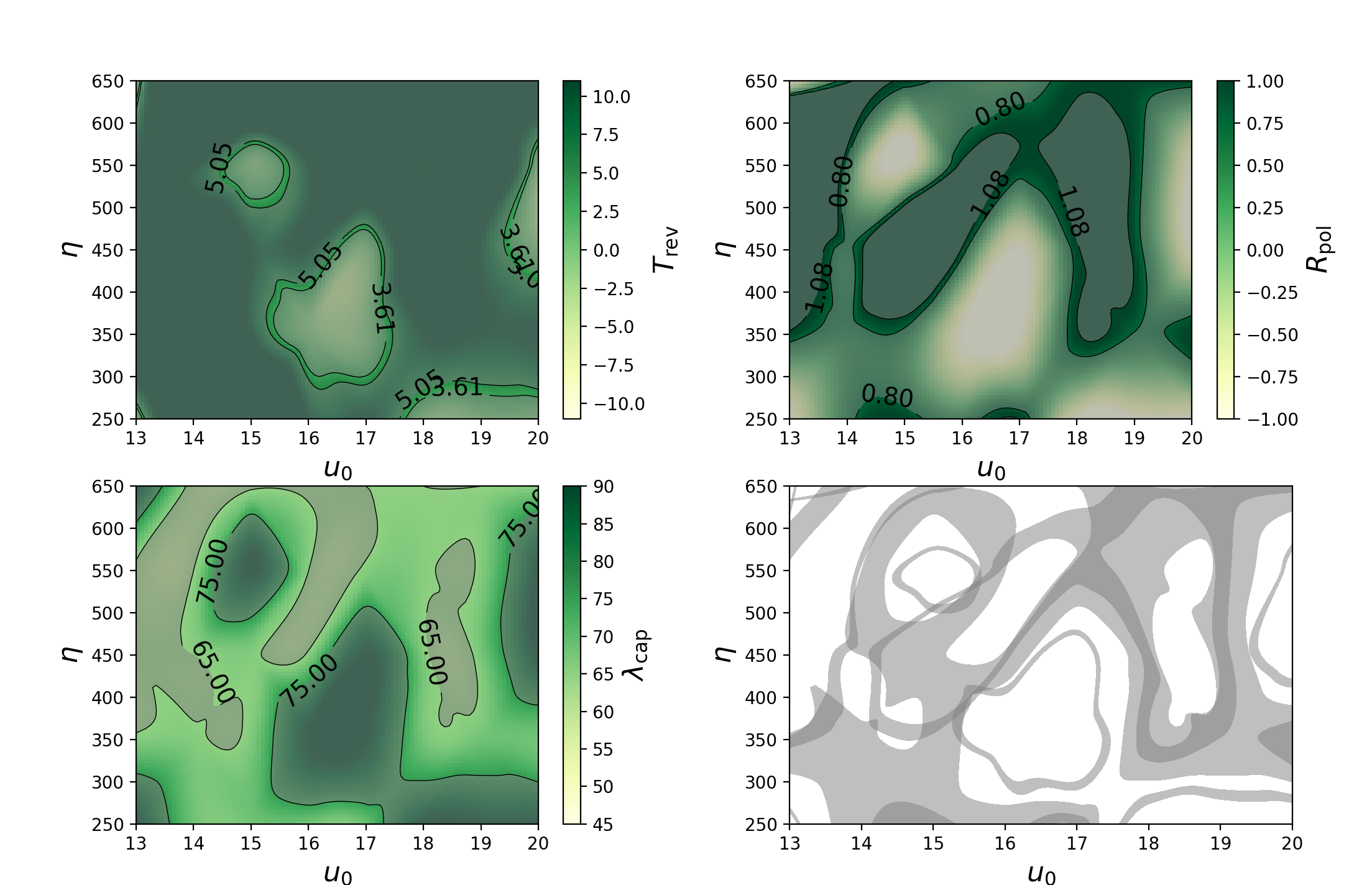
Figure 1: Admissible domains in the (u0,η) parameter space for the linear (no-quenching) case, with decay timescale u00 yr.
This restriction becomes even more stringent when a finite decay timescale (u01--10 yr) is enforced, with the admissible islands collapsing to narrow ridges. In the limit u02, corresponding to negligible radial flux loss, the admissible parameter space expands significantly, but this regime yields unrealistically persistent dipole configurations and delayed reversals, contradicting solar observations.
The coupled impact of TQ, LQ, and u03 leads to highly correlated admissible regions in u04 space: shorter decay timescales force even narrower ranges in u05 and u06, while only a narrow range of flow speeds can counterbalance the quenching-induced suppression for a given u07.
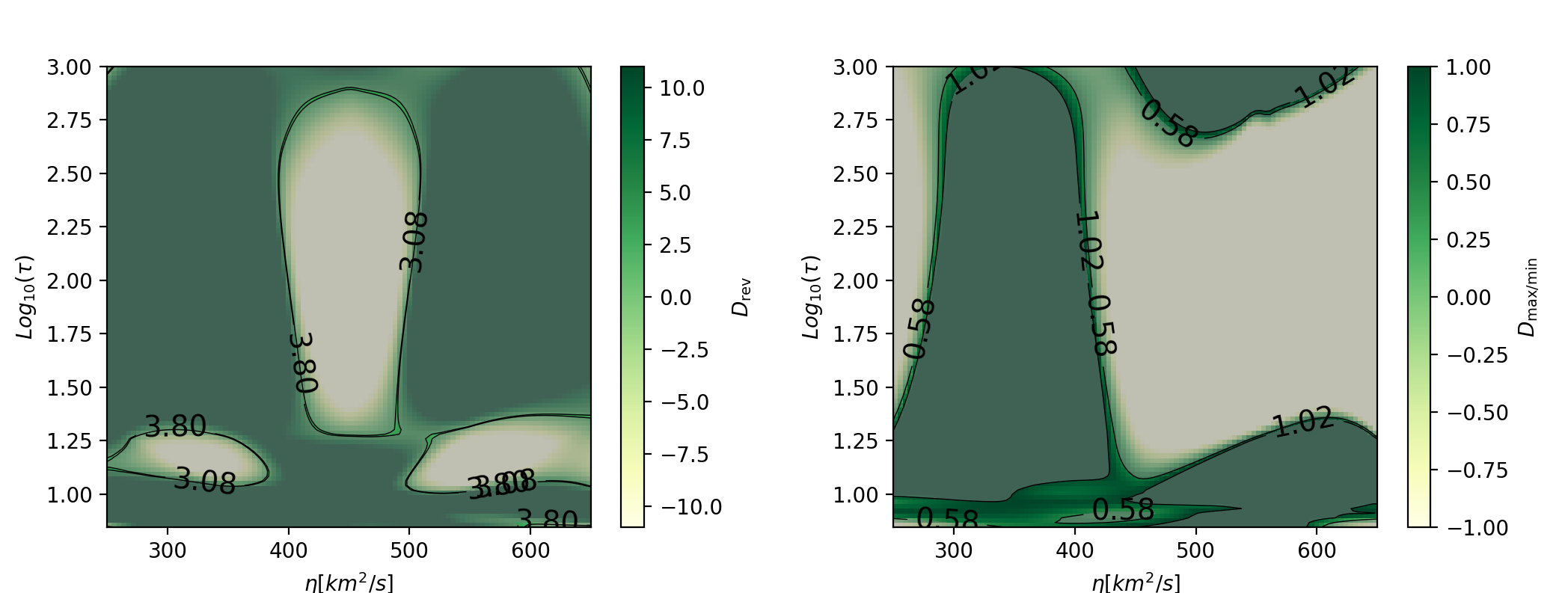
Figure 2: Dependence of the admissible parameter domain on the decay timescale, u08, versus diffusivity u09 when both TQ and LQ are active, showing suppression of admissibility at short η0.
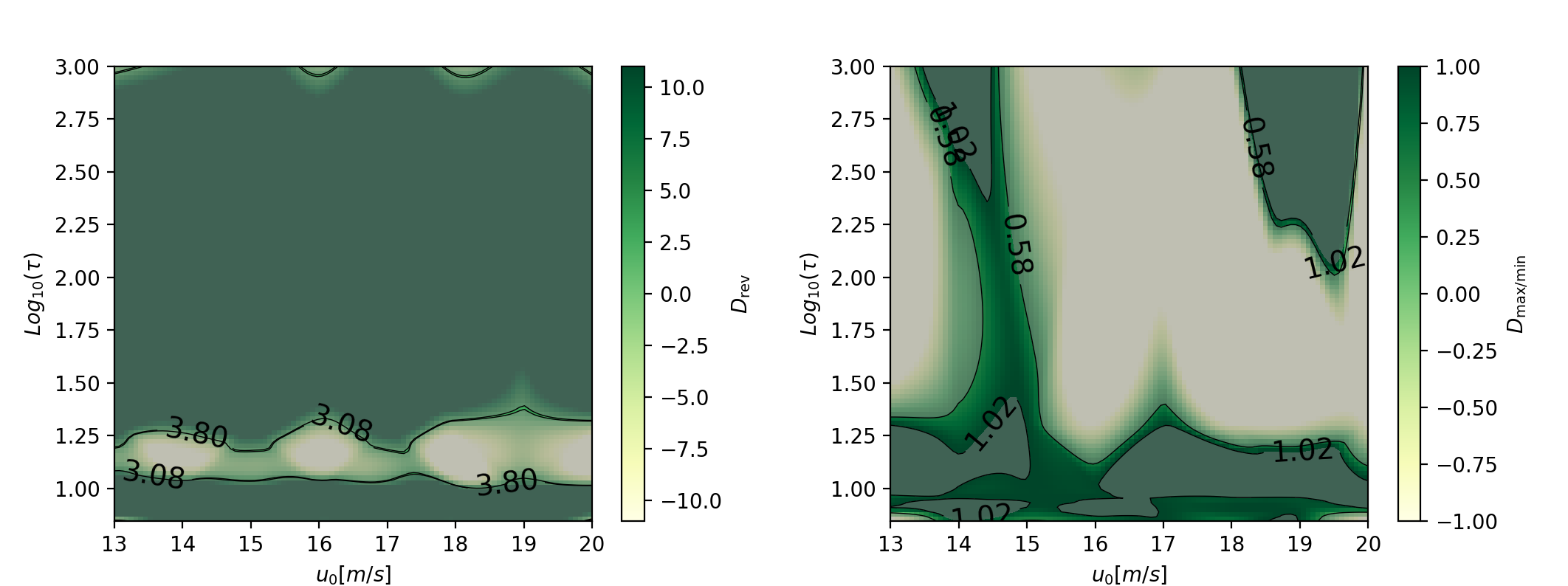
Figure 3: Same as Figure 2, but versus η1 at fixed η2, illustrating that lower decay timescales necessitate slower meridional flow for model admissibility.
The numerical results unambiguously demonstrate that latitude quenching dominates in restricting the parameter space, with TQ providing only secondary restriction. The authors report that the optimal admissible η3 for reproducing observed polar field amplitude and reversal timing lies within η4--η5 years, consistent with previous optimization efforts but now in the context of active nonlinear feedbacks.
Physical Interpretation and Implications
The enforced narrowing of SFT parameters suggests that the solar surface operates near a marginally stable, self-limiting nonlinear regime, where quenching feedbacks act to saturate the buildup of the polar field. This is physically interpretable as the dynamical manifestation of observationally established anti-correlations between magnetic activity indicators and the properties of active region emergence.
The requirement for a finite decay term within parameterized, statistically averaged SFT models stems from the necessity to counterbalance the tendency for dipole persistence and late reversal in linear or weakly nonlinear regimes. Notably, simulations that directly assimilate observed active region emergence profiles have outperformed parameterized models and can eliminate the need for explicit radial decay terms, highlighting the strong model-dependence and phenomenological nature of η6 [Athalathil et al. 2026; Wang et al. 2025].
Furthermore, these results lend theoretical support to the role of surface inflows and latitude-dependent flux loss—physical mechanisms inferred from Doppler and helioseismic measurements—as integral components of solar cycle saturation. The SFT regime defined here approaches a condition in which solar cycle predictability is fundamentally limited: small fluctuations in transport parameters or flux emergence statistics can drive disproportionately large excursions in polar field amplitude, a critical consideration for cycle forecasting.
Theoretical and Practical Implications for Solar and Stellar Dynamo Modeling
The results integrate nonlinear feedback physics, previously established or hypothesized in full dynamo simulations, into the surface transport paradigm. The emergence and nature of the "ceiling" on dipole amplification through feedbacks suggest that the Sun, and potentially other late-type stars with convective envelopes, operate within a weakly nonlinear dynamo system where saturation emerges from surface processes.
This has twofold practical implication: (1) it provides a more restrictive and physically consistent set of admissible parameter combinations for SFT-based prediction and inversion algorithms, and (2) it suggests that data assimilation approaches, which directly model observed emergence and surface dynamics, may ultimately provide superior predictive skill and eliminate some of the tuning arbitrariness inherent in parameterized source models.
The explicitly demonstrated coupling between advection, diffusion, and nonlinear quenching makes it clear that improvements in empirical constraint of η7, η8, and active-region statistics will have immediate impact on SFT model accuracy and solar cycle prediction uncertainty. Future work may integrate physics-informed machine learning approaches, such as physics-informed neural networks (PINNs), to further optimize and potentially generalize these parameter constraints [Athalathil et al. 2026].
Conclusion
By systematically incorporating observable nonlinear quenching feedbacks and parameterized flux decay, this work demonstrates that the admissible SFT parameter space shrinks to narrow ridges, especially when latitude quenching is included. The analysis reaffirms that TQ exerts only modest narrowing, while LQ, particularly in tandem with realistic decay, produces a pronounced saturation of dipole amplitude consistent with observed polar field modulation. The enforceable decay timescale (η9--10 yr) aligns with both dynamical and observational constraints, but recent data-assimilative SFT results suggest that explicit decay may be unnecessary outside of parameterized source frameworks.
These findings have direct consequences for both physical modeling of the solar cycle and for predictive approaches, pointing toward an inherently self-limited solar activity regime where nonlinear surface processes set fundamental limits on long-term cycle prediction. Future developments should emphasize direct data assimilation, extension to stellar cases, and integration of detailed observational constraints on nonlinear emergence statistics to further constrain the physics of dynamo saturation.