- The paper demonstrates that electronic screening via the Thomas-Fermi approach reduces friction for protons and water in metallic CNTs, aligning with experimental observations.
- The study employs analytical models in both planar and cylindrical geometries to quantify how conduction electron density influences screening length and transport resistance.
- Results show that phonon-induced friction dominates over electronic friction, offering critical insights for designing efficient nanofluidic devices.
Electronic Screening of Friction in Ion and Water Flow through Narrow Carbon Nanotubes
Introduction
This study develops a theoretical framework for interpreting the observed differences in the flow of protons, water molecules, and ions through sub-nanometer diameter metallic and semiconducting carbon nanotubes (CNTs), focusing on the role of electronic screening by conduction electrons. Motivated by experimental results demonstrating enhanced mobility for protons and water in metallic CNTs, but not for ions such as K+, the authors systematically dissect the mechanisms underlying these transport differences and provide a quantitative analysis based on Thomas-Fermi (TF) screening in both planar and cylindrical geometries.
Overview of Experimental Phenomena
The experimental work primarily considered differentiates proton, water, and ion transport in CNTs using a variety of driving forces—osmotic pressure for water, pH gradient for protons (via the Nernst-Einstein relation), and electric fields for ions. The methodology relies on carefully engineered systems, with lipid membranes incorporating CNTs as selective conduits, and the monitoring of pH or current to infer mobility. Crucially, the experiments ensure conditions under which the electric field inside the tube vanishes (equipotential condition), thus isolating friction effects originating from interactions between the transported species and the CNT wall.
Protons and water molecules experience different friction forces in metallic versus semiconducting CNTs due to the degree of electronic screening. Ions, once inside the equipotential region of the CNT, diffuse mainly via collisional processes with entering ions, leading to approximately conductivity-independent mobility. The majority of friction for water appears to originate from the tube ends, not the interior, but subtle differences tied to CNT conduction can be observed.
Thomas-Fermi Screening: Planar and Cylindrical Geometries
The theoretical analysis of electronic screening starts with the TF approximation for high-density electron systems, adapted first to a planar 2D electron gas and subsequently to the surface of a cylinder, mirroring the topology of a CNT wall. The induced charge from a mobile species modifies the local potential, leading to a screened interaction characterized by a screening length λTF, which is inversely proportional to the CNT's electronic density of states at the Fermi level.
For a point charge near the wall, TF screening yields a potential that, for large distances parallel to the wall, decays as r∣∣−3 rather than exponentially as in 3D. The cylindrical solution involves modified Bessel functions and, at the tube center, simplifies to forms that highlight the reduction of the interaction potential with shorter λTF (metallic case).
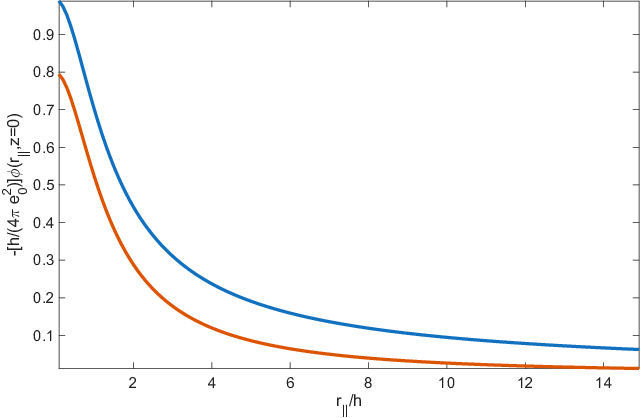
Figure 1: The screened and unscreened potential −ϕ(r∣∣,z=0) as a function of r∣∣/h for different screening parameters, showing stronger screening (lower potential) for small λTF/h.
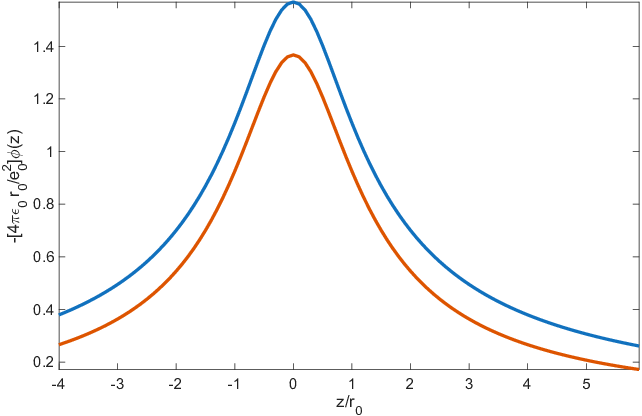
Figure 2: The variation of −ϕ(z) along the tube axis with z/r0, indicating attenuation of the potential with stronger electronic screening for smaller λTF/r0.
The qualitative trend is robust: metallic CNTs (small or zero bandgap, high carrier density) exhibit much stronger screening (shorter λTF0), leading to a weaker interaction between transported species and CNT walls, and therefore reduced friction. In contrast, semiconducting CNTs, with a finite bandgap and exponentially suppressed carrier density at low temperatures, furnish a much weaker screening response, leading to higher friction.
In the case of significant doping, screening can be drastically enhanced even for otherwise semiconducting CNTs, as demonstrated by analytical expressions for λTF1 and λTF2.
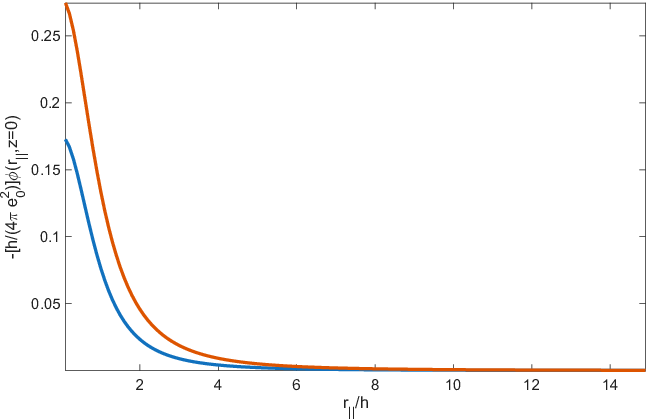
Figure 3: Drastic reduction in the potential with increased doping (decreased λTF3), confirming the tunability of screening effects.
Electronic vs. Phononic Friction
The calculations show that electronic friction stemming from energy transfer to conduction electrons is significantly smaller than friction due to phonon excitations, especially for metallic CNTs—a consequence of strong TF screening and reduced coupling between the moving charges and the conduction band. The explicit expressions for electronic friction, evaluated using standard golden-rule approaches and experimentally extracted conductivities, yield friction forces orders of magnitude below those from phonon drag.
A similar conclusion pertains to the "image charge" friction—dragging the electron image with a moving ion—which remains negligible relative to phonon-induced friction even for minimal 2D conductivities. The result justifies the dominant role of phonon-induced friction and the pronounced difference between metallic and semiconducting tubes.
Energetics of Ion and Proton Translocation
The effective polarization interaction between ions (or protons) and the CNT wall, estimated via the wall's polarizability, is sufficient (λTF40.0385 eV) to offset the dehydration penalty required for entry into the subnanometer channels, thus rationalizing their stable presence inside such confined environments. This aligns with prior simulations indicating that both ions and protons can reside within CNTs due to the substantial polarization-related energy gain.
Water Structure, Proton Conduction, and Defect Dynamics
The observed proton conduction in narrow CNTs is interpreted as evidence for the persistence of hydrogen-bonded water wires, facilitating Grotthuss-type proton transport, as opposed to random, non-hydrogen-bonded chains. The measured proton conductance in experiments supports this interpretation, with substantially higher values for narrow (0.81 nm) tubes than for wider ones, underscoring the quantum-confined nature of water within the channel.
Charged defects, such as hydronium or hydroxide, exhibit high mobility relative to the water wire, enabling scenarios where they decouple ("fall behind") from the bulk water motion under pressure-driven flow, especially in the dry-friction regime. This effect is sensitive to details of the relative defect and wire mobility and the sign and distribution of defects within the water wire.
Practical and Theoretical Implications
The analysis provides a comprehensive picture of the interplay between CNT electronic structure, screening effects, and nano-confined transport. Practically, these results indicate that the design of selective nano-fluidic devices—such as proton-conducting membranes, desalination channels, or ion filters—can leverage the conduction properties of the CNT to tune friction and thus transport selectivity and efficiency.
Theoretically, the study demonstrates the need for explicit inclusion of wall electronic structure (screening) for accurate modeling of molecular and ionic mobility in low-dimensional fluidic systems. It also contributes insight into the transition between phononic and electronic friction regimes as a function of band structure and doping, providing a tractable model amenable to molecular simulations and experimental validation.
Future efforts could address the effects of defect states, doping inhomogeneity, or excitonic effects in low-dimensional conductors, and extend the framework to include collective modes or hydrodynamic correlations in ultranarrow geometries.
Conclusion
Through a TF-based analytical model, supplemented by assessments of electronic and phononic friction, this work elucidates the mechanisms by which electronic screening in metallic versus semiconducting CNTs modulates the friction acting on ions, protons, and water molecules during transport. The study provides clear, quantitative rationalization of experimental findings, especially the enhanced proton and water mobility in metallic CNTs. The insights have direct implications for nanofluidic device design and deepen the understanding of transport under quantum-confinement and strong coupling conditions.