- The paper establishes that the causal propagator’s eigenvalue scaling mirrors a Lorentzian version of Weyl's law, providing key insights into null geodesic phase space.
- It combines analytic conjectures with numerical simulations on causal sets in 1+1, 2+1, and 3+1 Minkowski spacetimes to validate the spectral density asymptotics.
- The work offers a novel framework for state selection in covariant quantum field theory and improves regularization techniques in approaches to quantum gravity.
Spectral Density of the Causal Propagator: Asymptotics, Geometry, and Quantum Fields
Introduction
The causal propagator, or Pauli-Jordan function, Δ(x,x′)=GR(x,x′)−GA(x,x′) for a scalar field, forms a cornerstone in both algebraic quantum field theory and contemporary approaches to quantum gravity. As the commutator kernel of the quantum field, iΔ(x,x′)=[ϕ(x),ϕ(x′)], it encodes full information about the space of solutions to the field equation and directly informs causal order, null propagation, and the nonlocal structure of states. The spectral properties of iΔ not only structure the Sorkin-Johnston (SJ) prescription for covariant quantum field construction but also underpin regularization schemes in causal set theory and emerging Lorentzian spectral geometry. This paper investigates the asymptotics of the spectral density of iΔ, culminating in a conjecture that analogizes Weyl's law from Riemannian to Lorentzian geometry.
Operator-Theoretic and Geometric Context
The causal propagator Δ arises as the difference between retarded and advanced Green functions for the scalar d'Alembertian, directly linking to the null structure of the spacetime and acting as a bridge between the field's dynamical content and the causal geometry. As an operator, iΔ is antisymmetric and self-adjoint, with nonzero real eigenvalues appearing in ± pairs. The spectrum of iΔ informs several critical constructions:
- Sorkin-Johnston State: The Wightman function WSJ(x,x′)=pos(iΔ) selects a "distinguished" vacuum in arbitrary regions and backgrounds, encoding frame invariance at the quantum level and serving as a foundation for QFT on causal sets and curved spacetimes.
- Entanglement Entropy: The spectral structure of iΔ facilitates manifestly covariant regularization for entropy calculations in Gaussian states through the generalized eigenproblem between iΔ(x,x′)=[ϕ(x),ϕ(x′)]0 and iΔ(x,x′)=[ϕ(x),ϕ(x′)]1.
- Lorentzian Spectral Geometry: Knowledge of the asymptotics and density of eigenvalues allows for the development of spectral geometric methods aimed at Lorentzian manifolds, in analogy to the rich framework provided by the Laplacian spectrum in Euclidean geometry.
Explicit Computations in Low Dimensions
Detailed analysis starts with the classic case of a massless scalar in a causal diamond of iΔ(x,x′)=[ϕ(x),ϕ(x′)]2 dimensional Minkowski spacetime. In lightcone coordinates, eigenfunctions fall into two families with eigenvalues iΔ(x,x′)=[ϕ(x),ϕ(x′)]3, implying an asymptotic scaling for the spectral density as iΔ(x,x′)=[ϕ(x),ϕ(x′)]4. This power-law scaling is robust: it can be directly observed both in the continuum and on large random causal sets faithfully embedded in the diamond.
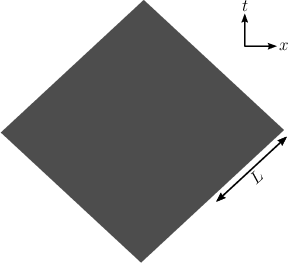
Figure 1: The causal diamond region in iΔ(x,x′)=[ϕ(x),ϕ(x′)]5 dimensional Minkowski spacetime.
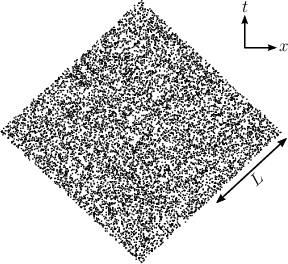
Figure 2: Embedded iΔ(x,x′)=[ϕ(x),ϕ(x′)]6 dimensional causal set diamond, used for numerical spectral analysis.
The eigenvalue power-law is confirmed numerically for causal sets of size up to iΔ(x,x′)=[ϕ(x),ϕ(x′)]7 elements, where the largest iΔ(x,x′)=[ϕ(x),ϕ(x′)]8 eigenvalues display clear asymptotic agreement with analytic predictions.
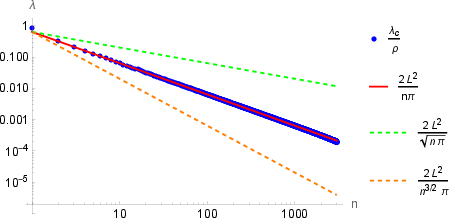
Figure 3: Log-log scaling plot of the largest iΔ(x,x′)=[ϕ(x),ϕ(x′)]9 positive eigenvalues of iΔ0 in a causal set, demonstrating the iΔ1 decay and demonstrating spectral density asymptotics.
Generalized Conjecture: Spectral Density via Null Phase Space
The main theoretical development of the paper is an explicit conjecture for the UV (large iΔ2, small iΔ3) asymptotics of the spectral density for iΔ4 in arbitrary dimension and spacetime region, formulated as:
Conjecture:
Asymptotically, each eigenfunction of iΔ5 corresponds to a semiclassical volume on the phase space of null geodesics (with momentum) iΔ6, equipped with the Liouville measure. The counting function iΔ7 for eigenvalues exceeding iΔ8 is given by integrating the semiclassical measure over regions of phase space where the associated geodesic integral for iΔ9 exceeds the given value.
This leads to the spectral density
iΔ0
where the integral spans the space of null geodesics with momentum, and the eigenvalue map is given by the affine length along iΔ1.
Scaling in Higher Dimensions and Causal Sets
Explicit calculations are performed for causal diamonds in iΔ2 and iΔ3 Minkowski spacetimes, both in analytic phase space approximation and via large-scale causal set numerics.
In iΔ4 dimensions, the spectral density is shown to scale as iΔ5, reproducing the observed decay of eigenvalues as iΔ6. In iΔ7, the spectral density falls off as iΔ8, giving iΔ9. For both, agreement between analytic conjecture and simulation is demonstrated, with minor discrepancies at the smallest eigenvalues reflecting the discreteness scale.
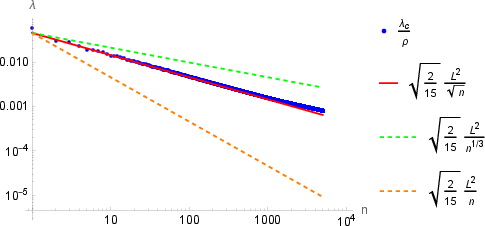
Figure 4: Asymptotic scaling for largest Δ0 positive eigenvalues of Δ1 in a Δ2 dimensional causal set, confirming the predicted Δ3 decay.
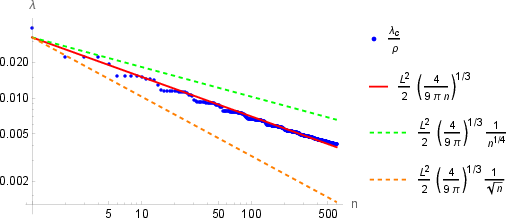
Figure 5: Scaling of Δ4 largest positive eigenvalues of Δ5 for a Δ6 dimensional causal set, illustrating agreement with the Δ7 asymptotics as the continuum limit is approached.
Lorentzian Weyl Law and Implications
The conjecture and its supporting calculations provide a Lorentzian counterpart of Weyl's asymptotic law for the Laplacian eigenvalues in Riemannian manifolds. Where the Laplacian counts spatial oscillations (momentum modes) spectrally, the causal propagator's spectrum counts null geodesic "degrees of freedom," encoding information about Lorentzian causal structure rather than spatial geometry. The formula proposed establishes a direct bridge between phase space geometry of null rays and the eigenvalue distribution, providing a new tool for:
- Covariant QFT state selection: The SJ prescription can now be equipped with sharp spectral expectations in higher dimensions and curved backgrounds.
- Regularization in causal set theory: Insights into the cutoff procedure for entropy and state definitions, as ultraviolet-regulated spectra can be directly monitored.
- Spectral geometry of Lorentzian manifolds: Opens the way to new invariants and the possibility of Lorentzian spectral geometry paralleling the Riemannian case.
Conclusion
The spectral analysis of the causal propagator, and in particular the conjecture relating its spectral density to null geodesic phase space, establishes foundational control over Lorentzian spectral data—extending the power of spectral geometry from the Riemannian to the causal setting. Numerics on causal sets confirm the analytic predictions, including strong evidence for the scaling exponents and the utility of the conjectured framework. This provides essential groundwork for further advances in covariant quantum field theory, causal set quantum gravity, and Lorentzian spectral geometry, with potential for generalization to curved and dynamically fluctuating backgrounds.
(2606.00311)