- The paper demonstrates that the triple information I3 is the key indicator that bounds all four-party multi-entropy measures in holography.
- It employs rigorous geometric decompositions and RT surface analysis to establish strict bounds on multi-entropy signals.
- The work reveals that residual entropy may remain finite at phase transitions, highlighting limitations of I3 in capturing all entanglement.
Constraints on Four-Party Entanglement in Holography
Overview
This work systematically investigates multipartite entanglement in holographic settings, focusing on constraints governing four-party entanglement in pure time-reflection-symmetric holographic states. Through rigorous geometric arguments grounded in holographic entropy constructs, the authors demonstrate that all known four-party entanglement signals—specifically those derived from multi-entropy and the residual entropy Q4—vanish unless the triple information I3 is nonzero. The results establish I3 as the principal quantitative indicator for quadripartite entanglement in holographic systems, tightly bounding the entire class of multi-entropy based entanglement measures, while revealing the nuanced role of residual entropy.
Holographic Measures of Multiparty Entanglement
Holographic entanglement entropy for a boundary region is determined by the area of a minimal bulk surface homologous to that region, as prescribed by the Ryu-Takayanagi (RT) formula. Multi-party entanglement indicators, including the triple information I3, multi-entropy measures, and residual entropy Q4, are defined via combinations of RT and minimal brane-web surfaces within the bulk.
The triple information,
I3=SA+SB+SC+SD−SAB−SAC−SBC,
is a key four-party invariant, previously ascertained to be non-positive for holographic states due to the monogamy of mutual information. Multi-entropy signals utilize minimal brane-webs—collections of interconnected surfaces in the bulk that reflect multipartite separations of boundary regions (Figure 1).
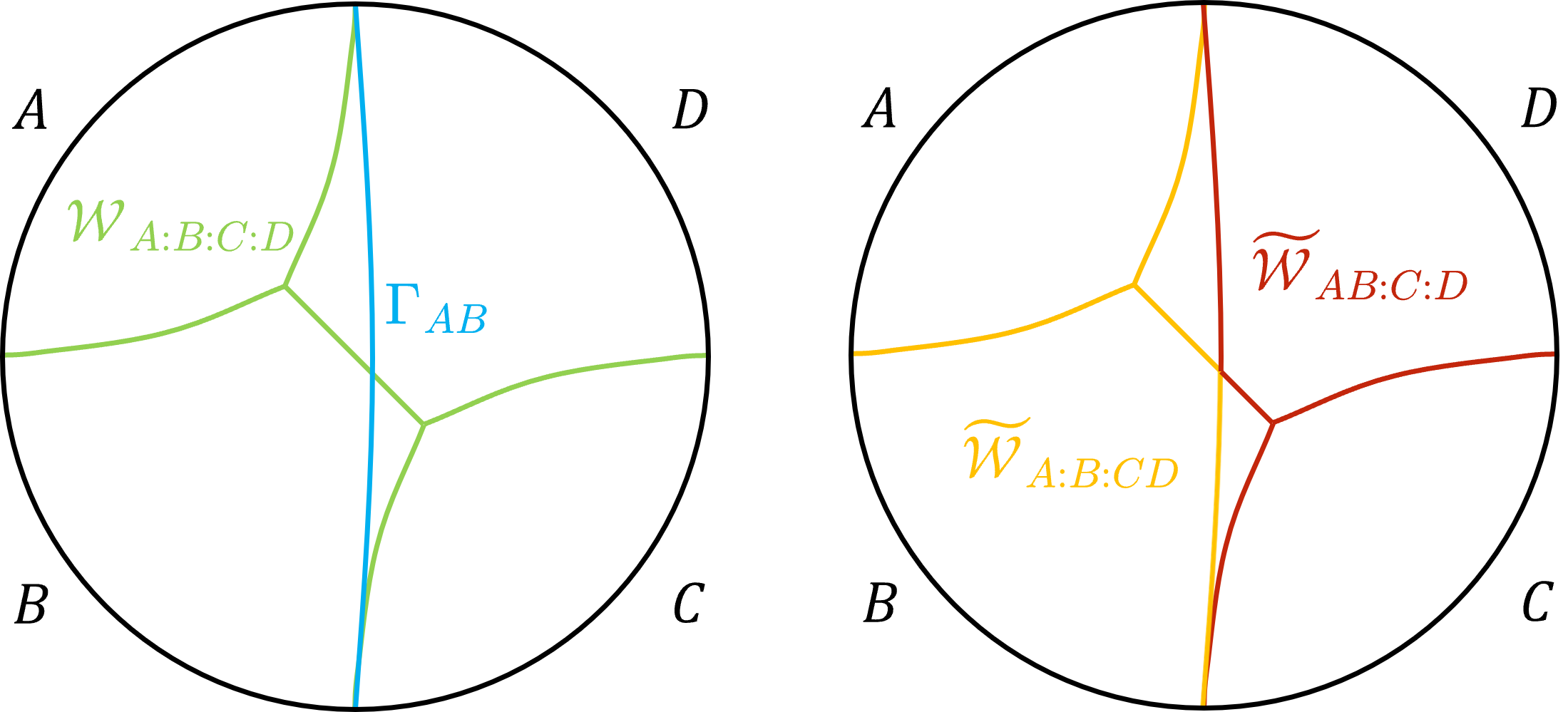
Figure 1: The brane-web W encapsulates multipartite entanglement structure among four boundary regions in the bulk.
Residual entropy Q4 is constructed using a sequence of canonical purifications, isolating contributions unique to genuine four-party entanglement via differences between minimal separating surfaces (Figure 2).
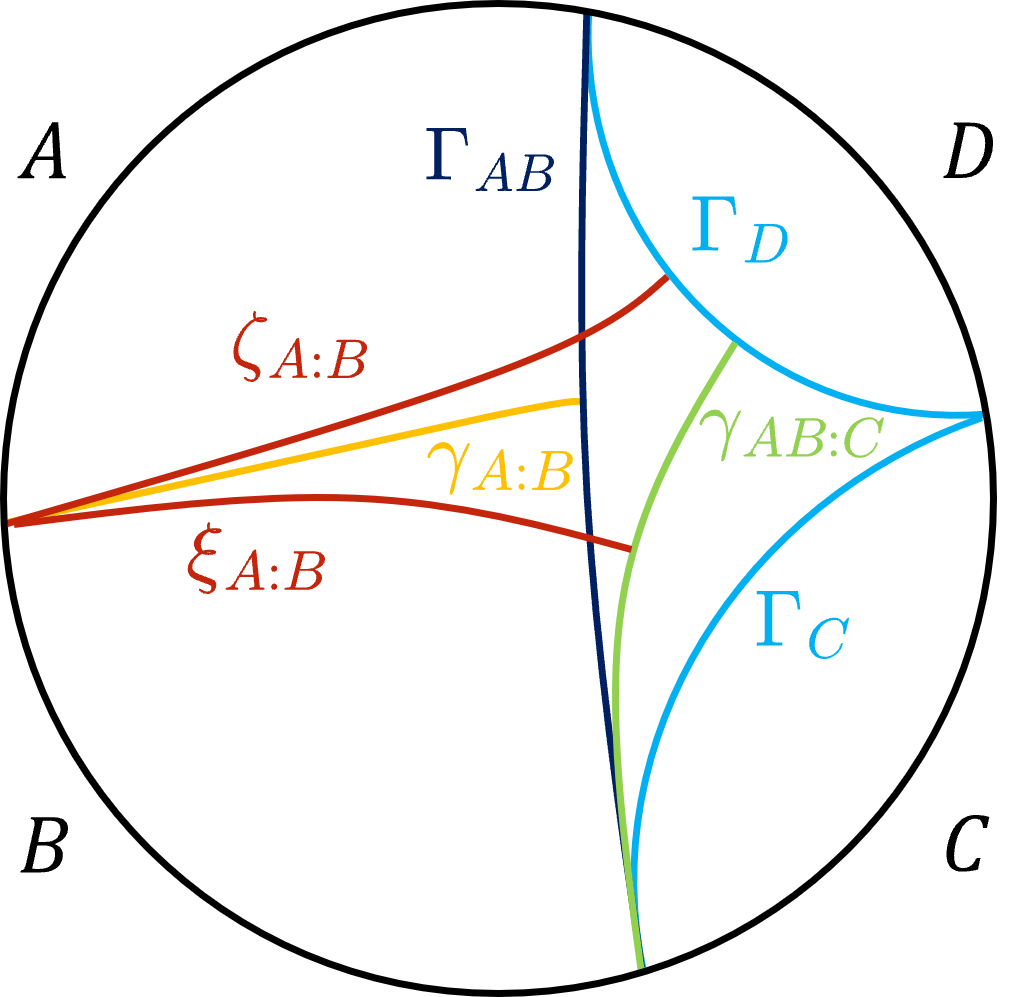
Figure 2: Minimal surfaces for the reflected entropy SR(A:B), the residual entropy Q(4)(A:B), and the holographic upper bound I30.
Main Technical Results
Bounds for Multi-Entropy Signals
The central result is the derivation of strict bounds for all multi-entropy-based four-party entanglement signals in holographic states:
I31
where I32 denotes a specific linear combination of multi-entropies and RT entropies across partitions of the four regions, and the same bounds extend to the symmetrized quantity I33 (genuine four-party multi-entropy) by virtue of its dependence on the I34. The proofs build on geometric decompositions in the bulk, segmenting joint brane-webs and minimal surfaces to extract non-negativity and monotonicity properties (see Figure 3).
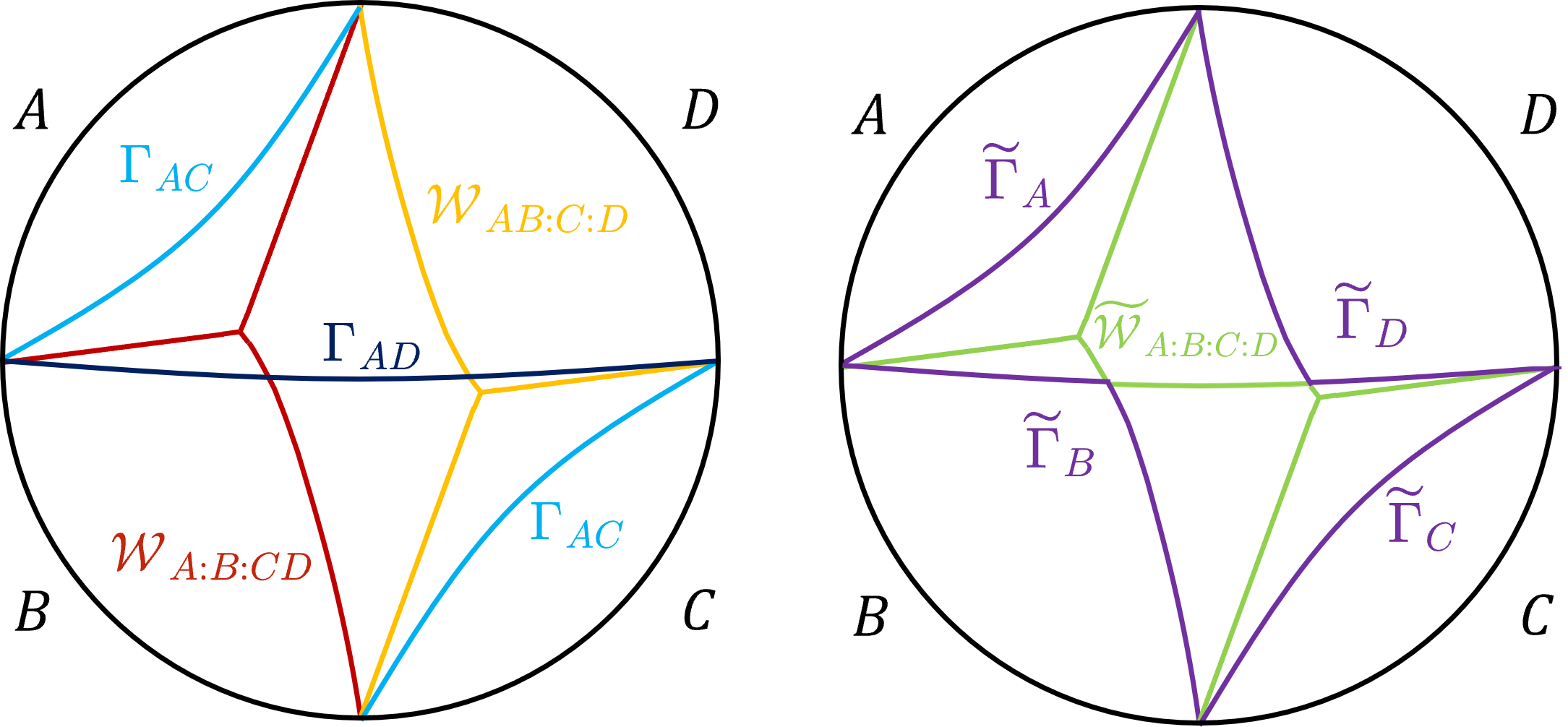
Figure 3: Decomposition of minimal surfaces according to the upper bound for I35, revealing the extended brane-web structure separating all subregions.
These inequalities are shown to hold exclusively in holographic settings, relying essentially on the geometric constraints imposed by the bulk RT framework. In contrast, non-holographic states—such as the four-party GHZ state—can explicitly violate these bounds.
Behavior and Independence of Residual Entropy
Although I36 is also a diagnostic for four-party entanglement, the analysis reveals that I37 ensures I38 (and analogously for the holographic upper bound I39) almost everywhere in parameter space, but no general upper bound exists relating I30 to I31 when both are nonzero. This is established by an explicit holographic construction in vacuum AdSI32 (Figure 4), where I33 can be made arbitrarily small at phase transitions while I34 and I35 remain finite, invalidating any inequality of the form I36.
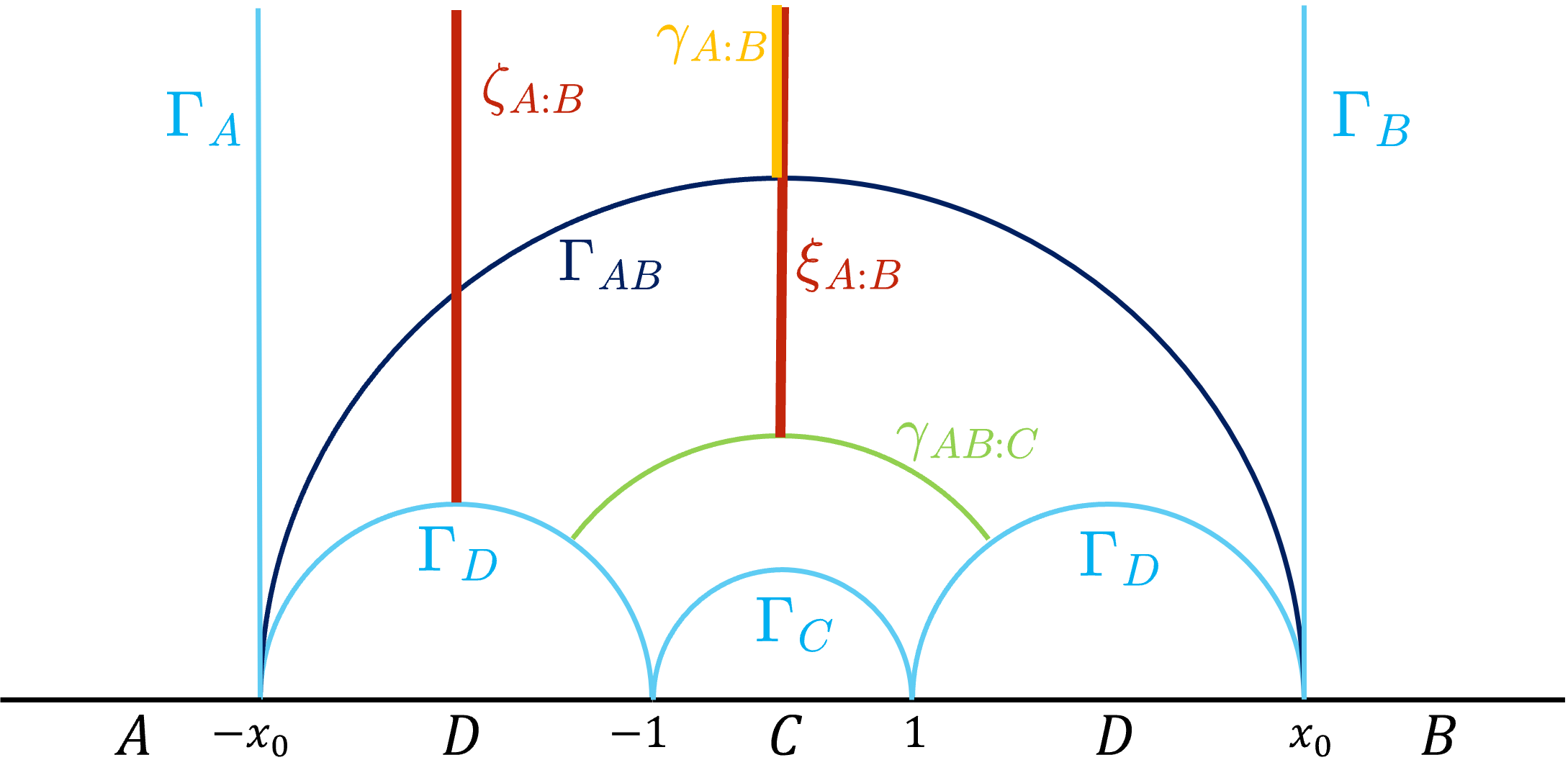
Figure 4: An upper half-plane realization showing that residual entropies I37 and I38 can be nonzero even as I39 approaches zero, indicating the lack of a quantitative bound.
This demonstrates the intrinsic difference between the information captured by multi-entropy and residual entropy: while I30 tightly constrains all known multi-entropy signals, there exist scenarios where genuine four-party entanglement survives even as I31, manifested in discontinuous transitions of I32.
Implications and Future Directions
The results provide a precise hierarchical structure for multipartite entanglement diagnostics in holography: I33 emerges as the necessary and sufficient (within the known class) signal for four-party correlations, and all multi-entropy-based diagnostics are quantitatively subordinate to it. The inability to bound residual entropy by I34 suggests additional nonlocal or topological information encoded in the bulk that is invisible to I35, motivating further development of multipartite entanglement measures beyond multi-entropy constructions.
These insights may inform the program of classifying admissible entanglement structures in quantum systems admitting geometric duals, as well as clarifying the bulk reconstruction and error-correcting architectures in AdS/CFT. The discontinuous behavior of residual entropies at phase transitions prompts deeper investigation into the entanglement wedge structure and its relation to RT surface topology changes and entanglement phase transitions. Extensions to higher-party settings could reveal whether similar hierarchies persist or new invariants emerge, and the explicit construction of holographic states saturating or violating these bounds remains an open line of inquiry.
Conclusion
Through analytic and geometric techniques, this study demonstrates that the triple information I36 quantitatively governs all known four-party multi-entropy measures in time-reflection-symmetric holographic states and acts as a necessary condition for the presence of genuine quadripartite entanglement. However, residual entanglement can exhibit phase-transition-induced features not captured by I37, highlighting a distinctive aspect of holographic multipartite structure. These results impose strong new constraints on the entanglement architecture of quantum states with holographic duals and delineate avenues for the discovery of more refined multipartite diagnostics.