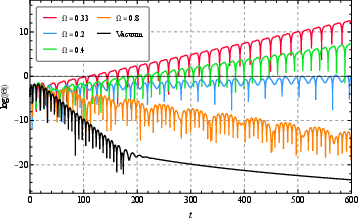
- The paper demonstrates that coupling between an oscillating environmental field and dCS scalar modes triggers parametric resonance, causing exponential growth in scalar perturbations.
- It employs an effective field theory framework and numerical simulations to identify cavity-dependent resonance conditions and a dynamical threshold for instability.
- The cascading amplification leads to delayed secondary bursts in gravitational wave signals, offering distinct spectral fingerprints that may signal deviations from general relativity.
Cascading Amplification of Gravitational Waves via Environmental Parametric Resonance in Dynamical Chern-Simons Gravity
Introduction and Motivation
The paper addresses the mechanism and phenomenology of environment-driven, cascading amplification of gravitational waves (GWs) in the context of dynamical Chern-Simons (dCS) gravity. While gravitational waveform observations have so far found agreement with GR, constraining modified gravity theories such as dCS to very weak couplings, the authors argue that astrophysical environments can induce distinctive instability and amplification channels, potentially making the suppressed effects observable.
A key feature of dCS gravity is the introduction of a pseudoscalar field ϑ that couples to the Pontryagin density, acting as a probe of gravitational parity violation. In standard vacuum scenarios with ultraweak couplings, dCS-induced modifications to GW signals are heavily suppressed. However, the coupling between the dCS scalar and an oscillating environmental field χ is shown to drive parametric resonance, leading to exponential amplification of scalar modes and, through mode coupling, secondary bursts in the GW channel. This identifies a previously overlooked route for observable non-GR features in realistic black hole (BH) environments.
The authors formalize the model within an EFT framework, including the standard dCS action and a localized, external, real field χ. Here, χ is not a fundamental field but an effective degree of freedom modeling the environmental matter distribution (e.g., a dark matter cloud or plasma shell). The central interaction, Lint=−λχϑ2, induces a spacetime-dependent effective mass for ϑ. The environmental field is modeled as a spherically symmetric, localized, oscillating Gaussian shell:
χ(0)(t,r)=χ0exp[−σ2(r−r0)2]cos(Ωt).
Crucially, the combination of the black hole's Regge-Wheeler potential barrier and the oscillating shell acts as a resonant cavity for the dCS scalar. The scalar evolution equation includes a periodically modulated mass term, leading to a Mathieu (parametrically driven) instability. The relevant regime is one of ultraweak dCS coupling but potentially appreciable environmental driving amplitude and frequency.
Scalar Mode Instability: Numerical Results and Resonance Channel Selection
Time-domain simulations of the scalar evolution under periodic environmental driving reveal a clear regime of exponential growth, with the maximal gain occurring at a well-defined resonant frequency. The key findings are:
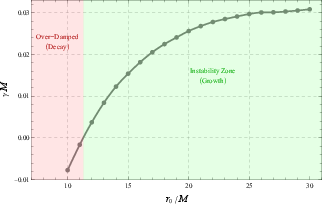
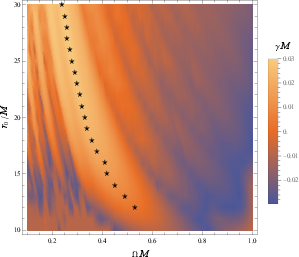
Figure 1: Two-dimensional phase diagram of parametric resonance and profile of the maximum Lyapunov exponent along the optimal frequency slice as a function of χ1.
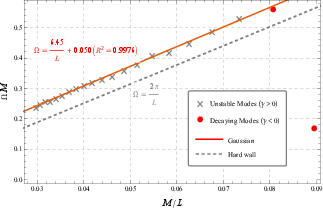
Figure 2: Quantitative verification of the resonant geometric law: the optimal resonance frequency χ2 scales linearly with the inverse cavity length.
Spectral Fingerprints: Distinct Floquet Sidebands in Scalar and Gravitational Channels
The parametric instability is evidenced in the response spectra. Unlike forced oscillation, the dominant frequency of the scalar response tracks χ3; additional Floquet sidebands spaced by χ4 confirm the nature of parametric resonance.
- In the scalar sector, the Fourier spectra during growth display discrete peaks at harmonics predicted by Floquet theory, most notably pronounced for well-tuned cavity–environmental couplings (Figure 4).
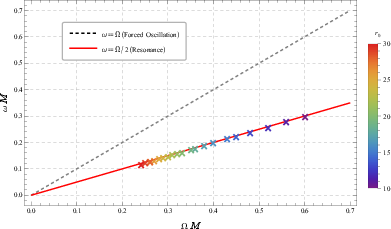
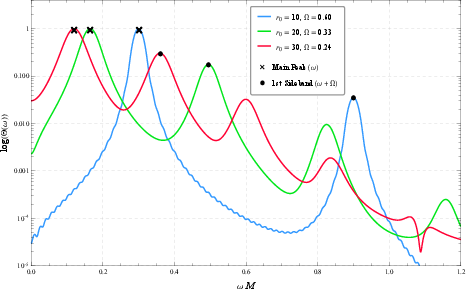
Figure 4: Parametric resonance fingerprints and Floquet sidebands in the spectra of scalar perturbations; the main resonance response appears at χ5.
A crucial theoretical prediction is that the exponentially growing scalar mode can, even with suppressed dCS coupling, drive a delayed, secondary burst in the GW signal—a phenomenon absent in standard GR or static-environment scenarios.
- Mode evolution: Initially, GW ringdown follows standard quasinormal decay. However, once the amplified scalar's source term χ6 overtakes the decaying tensor mode, GW amplitude exhibits a marked upturn, leading to an observable secondary burst (Figures 5).
- Critical crossing: The delayed onset is controlled by the smallness of the coupling χ7 and the resonance-induced Lyapunov exponent χ8, resulting in logarithmically delayed but robust secondary signals even for tiny coupling.
- Detuning effects: Off-resonance driving substantially delays or suppresses the secondary burst, establishing the specificity of the instability mechanism.
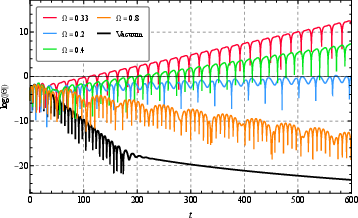
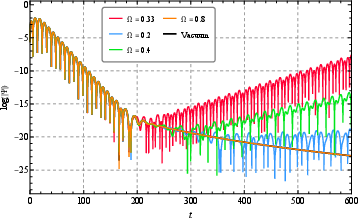
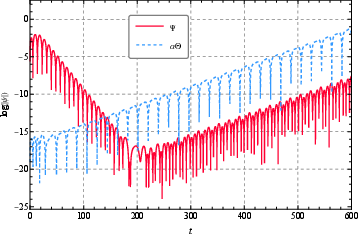
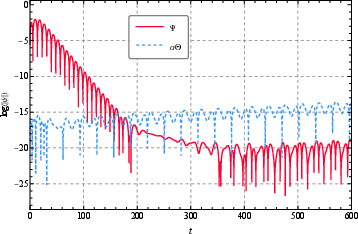
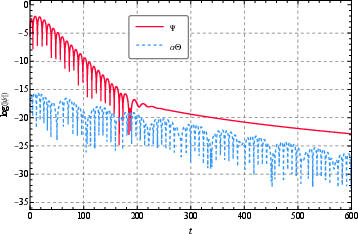
Figure 5: Panels (a) and (b) present the dynamical evolutions governed by the fully coupled perturbation equations; secondary GW bursts emerge after initial ringdown decay only at (near)-resonant driving.
Universality and Robustness: Higher-Order Interactions
To test the universality of cavity-driven parametric resonance, the authors extend the analysis to four-point interactions, χ9. While the instability is significantly weaker (often overdamped), the parametric resonance ridge persists, but now aligns with the second harmonic of the cavity (χ0), and the spectral structure is modified (Figures 7 and 8).
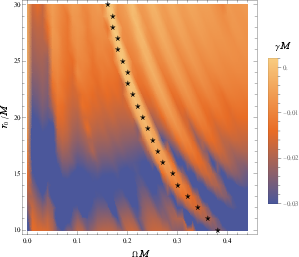
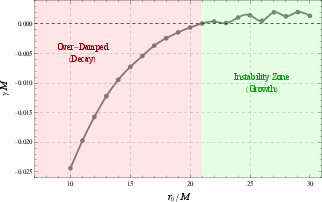
Figure 6: Phase diagram and ridge exponent for the four-point interaction; the resonance occurs at the χ1 cavity mode due to the doubled oscillation frequency in the coupling.
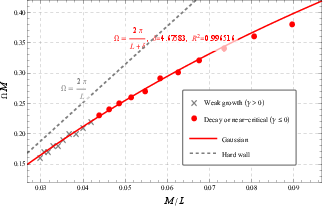
Figure 7: Verification of the cavity scaling for the four-point interaction; the resonance branch follows the predicted χ2 harmonic cavity law.
Implications and Theoretical Outlook
This analysis demonstrates a concrete, parameter-selective path toward large, observable, nonperturbative deviations from GR in GW signals—even with dCS couplings several orders below current bounds—as long as realistic dynamical environments are considered. The practical detection of these effects requires not just increased GW detector sensitivity but an improved understanding and modeling of astrophysical environments. The spectral fingerprints uncovered offer clear observables for future GW data analysis.
Several theoretical conclusions follow:
- Parametric resonance in realistic BH environments provides a novel instability and amplification channel, distinct from superradiant or standard echo mechanisms, with signatures tightly controlled by the geometry and scale of the environment.
- Delayed secondary bursts in GW signals arising from cumulative scalar amplification are a generic prediction, with Floquet sidebands offering spectral diagnostics.
- Thresholds determined by competition between parametric pumping and horizon leakage establish a dynamical selection of effective environmental configurations for instability.
- Astrophysical implications are strong: only environmental shells sufficiently far from the horizon act as sustainable energy sources, providing a spatial ‘filter’ for observable GW signatures.
- These results apply within the spherically symmetric (Schwarzschild) setting; extension to Kerr backgrounds is expected to introduce only moderate corrections in the slow-rotation regime.
Conclusion
The paper systematically characterizes the cascading amplification of GWs triggered by dynamical environmental effects in dCS gravity, elucidating both parametric resonance-induced scalar instabilities and their subsequent impact on the GW sector. The selection rules, thresholds, spectral fingerprints, and delayed secondary bursts identified here collectively redefine the landscape for potential signals of parity-violating gravity in precision GW astronomy. Future directions include treatment of nonlinear backreaction, numerical relativity simulations in the fully coupled nonperturbative regime, and exploration of environments naturally realized in astrophysical systems.