- The paper introduces the Locally Heralded Distribution (LHD) protocol, which improves entanglement link success rates in noisy, memory-limited networks.
- It employs analytical models and simulations to compare BS, GHD, and LHD, showing that LHD reduces classical coordination delays and resource consumption.
- Quantitative analysis reveals that LHD achieves a superior throughput-fidelity trade-off, extending operational network distances under imperfect conditions.
Entanglement Distribution Protocols under Imperfect Fidelity and Quantum Memory Constraints
Introduction
Scalable quantum networks demand robust entanglement distribution over extended distances, enabling quantum communication, distributed quantum computation, and networked quantum sensing. The principal difficulty lies in the intrinsic fragility of photonic qubits transmitted via optical fiber due to exponential loss and decoherence, as well as degradation during storage in quantum memories. This paper performs a rigorous comparative analysis of entanglement distribution protocols under realistic noise conditions, integrating both fiber-induced and memory-induced decoherence and loss. A notable contribution is the Locally Heralded Distribution (LHD) protocol, which is benchmarked against Blind Swapping (BS) and Globally Heralded Distribution (GHD) through both theoretical analysis and simulation.
Physical Model and Imperfect Component Analysis
The system model considers a segmented chain of quantum network nodes separated by optical fiber, as illustrated below.
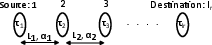
Figure 1: Schematic of an entanglement distribution path, defining segment distances Li, fiber loss coefficients αi, and memory lifetimes τi.
Photon transmission loss in standard telecommunication fiber is modeled via exponential attenuation, with typical values α∗=0.14dB/km. Quantum memories are similarly treated as imperfect: each memory is characterized by a finite coherence lifetime τi and an exponential survival probability. Crucially, both channel and memory noise impact the resulting fidelity of the distributed Bell states, affecting not only the link establishment probability but also the usability of the shared entanglement for downstream tasks. The relevant fidelity decay is described by a memory and fiber time-dependent generalization of the Werner-state model.
Entanglement Distribution Protocols
Blind Swapping (BS)
The BS protocol operates without inter-node communication, performing immediate swapping at every intermediary node. Each time slot consists of simultaneous entanglement attempts across all links, followed by unconditional swapping, leading to minimal latency but lacking adaptivity to successful link establishment events in other path segments.
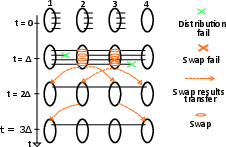
Figure 2: Blind Swapping across four nodes, each generating n=4 entangled pairs per round, proceeding without heralding at swap locations.
The end-to-end success probability aggregates the independent probabilities of survival for each entangled photon through transmission and memory storage, combined with multiplicative swapping success probabilities. This model exposes the severe exponential penalty for increasing path length.
Globally Heralded Distribution (GHD)
GHD incorporates global communication: swapping at intermediate nodes is conditioned on successful confirmation of link establishment across all path segments. This minimal swapping strategy reduces unnecessary consumption of resources but introduces additional delay due to the time needed for classical signals to coordinate swaps, causing extended storage of quantum states and further fidelity loss.
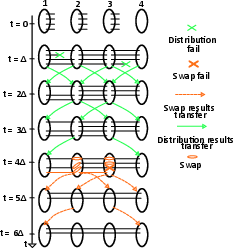
Figure 3: Globally Heralded Swapping coordinates swap operations globally across four nodes based on minimum successful local entanglement attempts.
While more resource-efficient, GHD suffers from protocol durations that scale linearly with route length, degrading both success probability and fidelity in protocols with limited quantum memory coherence times.
Locally Heralded Distribution (LHD)
The LHD protocol advances the state-of-the-art by enabling swaps to be conditioned only on local, nearest-neighbor information. At each node, swapping decisions only require knowledge from immediate neighbors, dramatically reducing the duration for classical coordination. Each decision is thus locally minimal, balancing resource use with minimization of storage time-induced decoherence.
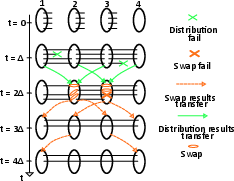
Figure 4: Locally Heralded Swapping uses only neighbor-to-neighbor classical communication for swapping, reducing classical coordination overhead for four nodes.
This establishes superior scaling behavior as route length increases, while maintaining high link success probabilities.
Protocol performance is analyzed both analytically and via simulation. The primary metrics are: (i) link success probability, quantifying the probability of establishing at least one high-fidelity ebit across the path, and (ii) link fidelity, quantifying the purity of the distributed entanglement. Simulations use relevant physical parameters (e.g., τ=200 ms, L=50 km, α=0.14 dB/km).
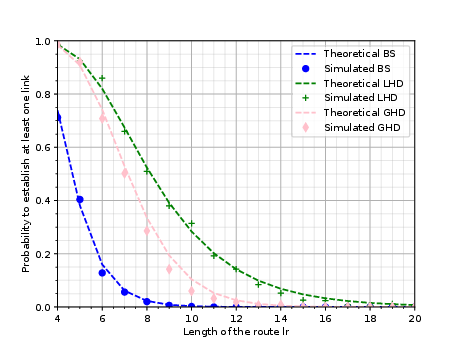
Figure 5: Probability of link establishment versus route length for the three protocols with n=20 generations per link. LHD maintains nonzero probability at substantially longer distances.
Results highlight the rapid decay of BS and, particularly, GHD as the number of hops increases, primarily due to excessive quantum memory holding times in GHD. In contrast, LHD maintains a significantly higher probable operational range.
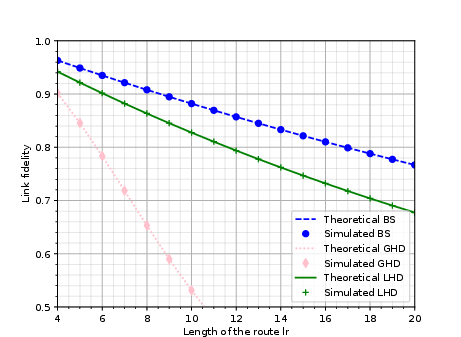
Figure 6: Output link fidelity as a function of route length for αi0 ms. LHD achieves fidelity retention similar to BS while outperforming GHD.
Fidelity analysis reveals that, while BS achieves slightly higher fidelity (due to shortest protocol duration), LHD provides a superior throughput/fidelity tradeoff, as establishing a comparable link success probability with BS requires orders of magnitude more entanglement resources.
Discussion and Implications
This work quantitatively elucidates the trade-offs between protocol resource efficiency, coordination complexity, and robustness against realistic memory and channel noise. The LHD protocol demonstrates that locality in classical coordination enables mitigating the most severe exponential decays imposed by imperfect memories. The reduction in classical communication delay comes at a marginal cost to end-to-end fidelity but produces a protocol with enhanced success probability over longer routes and with imperfect devices.
The analytical framework presented here, expressing both link success rates and fidelity as explicit functions of physical device parameters and protocol timing, is directly applicable to protocol selection and resource planning in large-scale quantum repeater networks. In the context of quantum internet stack design, these results will inform routing policies and link-layer scheduling algorithms. Moreover, higher link generation rates in LHD open practical prospects for employing multi-round purification protocols, further improving final link fidelity beyond what is achievable with BS or GHD under similar physical constraints. The approach also provides a benchmark for the development of future adaptive hybrid strategies integrating local and global knowledge in quantum network protocols.
Conclusion
The introduction and analysis of the LHD protocol establishes a new standard for efficient entanglement distribution in realistic quantum repeater networks. LHD outperforms prior protocols in the presence of imperfect quantum memories, extending the practical operational range of quantum links. The theoretical analysis rigorously accounts for all dominant sources of fidelity and loss degradation and is corroborated by numerical simulations. This provides a compelling methodology and useful prescriptions for quantum network protocol design as quantum hardware and network scale and heterogeneity increase.
(2605.31347)