- The paper introduces EPA, a unified framework that estimates target error, explains feature shifts, and adapts models under distribution shift.
- It employs entropic projections and moment matching to optimize alignment with provable variance control and computational efficiency.
- Empirical results demonstrate a 30–70% reduction in error estimation inaccuracy and superior performance over state-of-the-art baselines in tabular data.
Entropic Projection Alignment for Model Evaluation and Adaptation Under Distribution Shift
Overview and Motivation
"Entropic Projection Alignment: Estimating, Explaining, and Improving Model Performance Under Distribution Shift" (2605.31250) introduces Entropic Projection Alignment (EPA), a unified methodology for tackling three interconnected challenges in distribution shift: (1) estimating model performance on an unlabeled target domain, (2) explaining the shift by feature attribution, and (3) adapting the model to reduce target-domain error. EPA is grounded in entropic projections, matching carefully selected moments between the labeled source and unlabeled target domains while minimizing KL divergence to control weight variance and optimize computational feasibility.
Distinct from prior approaches—most notably SEES and kernel mean matching (KMM)—EPA circumvents explicit density ratio estimation by directly solving for reweightings that minimize divergence under alignment constraints. This framework admits a closed-form solution and provable variance control, with theoretical guarantees established using domain adaptation theory. Empirically, EPA demonstrates consistent outperformance of state-of-the-art baselines on tabular data, achieving lower target error estimation inaccuracies, sharper feature explanations, and improved adaptation, alongside substantial computational advantage.
EPA Methodology
Entropic Projection and Moment Matching
EPA transforms the empirical source distribution via entropic projection: for a suitable feature map Φ:X→Rk, it seeks the distribution closest in KL divergence to the empirical source, subject to matching target-domain feature moments. For empirical source samples (X1,Y1),...,(Xn,Yn) and unlabeled target features X1t,...,Xmt, the EPA weights λi are given by
λi=∑j=1nexp{ξ⊤Φ(Xj)}exp{ξ⊤Φ(Xi)}
where ξ minimizes a strictly convex objective ensuring EP⋆[Φ(X)]=EQ[Φ(X)].
By restricting adaptation to feature statistics sufficient for the downstream loss and model class, EPA sidesteps the need for full density ratio recovery. Alignment is critical; when Φ spans the disagreement space for the hypothesis/loss pair, moment matching is provably sufficient for accurate error transfer.
Variance Control and Computational Efficiency
KL minimization induces maximum-entropy weights, which sharply penalize high variance and weight concentration. This results in implicit variance regulation and increased effective sample size, addressing instability and degeneracy typical in estimator-based methods such as KMM. Computationally, EPA's optimization scales with the feature dimension k (controlled by the dimension and binning granularity of Φ) rather than the total number of samples (X1,Y1),...,(Xn,Yn)0.
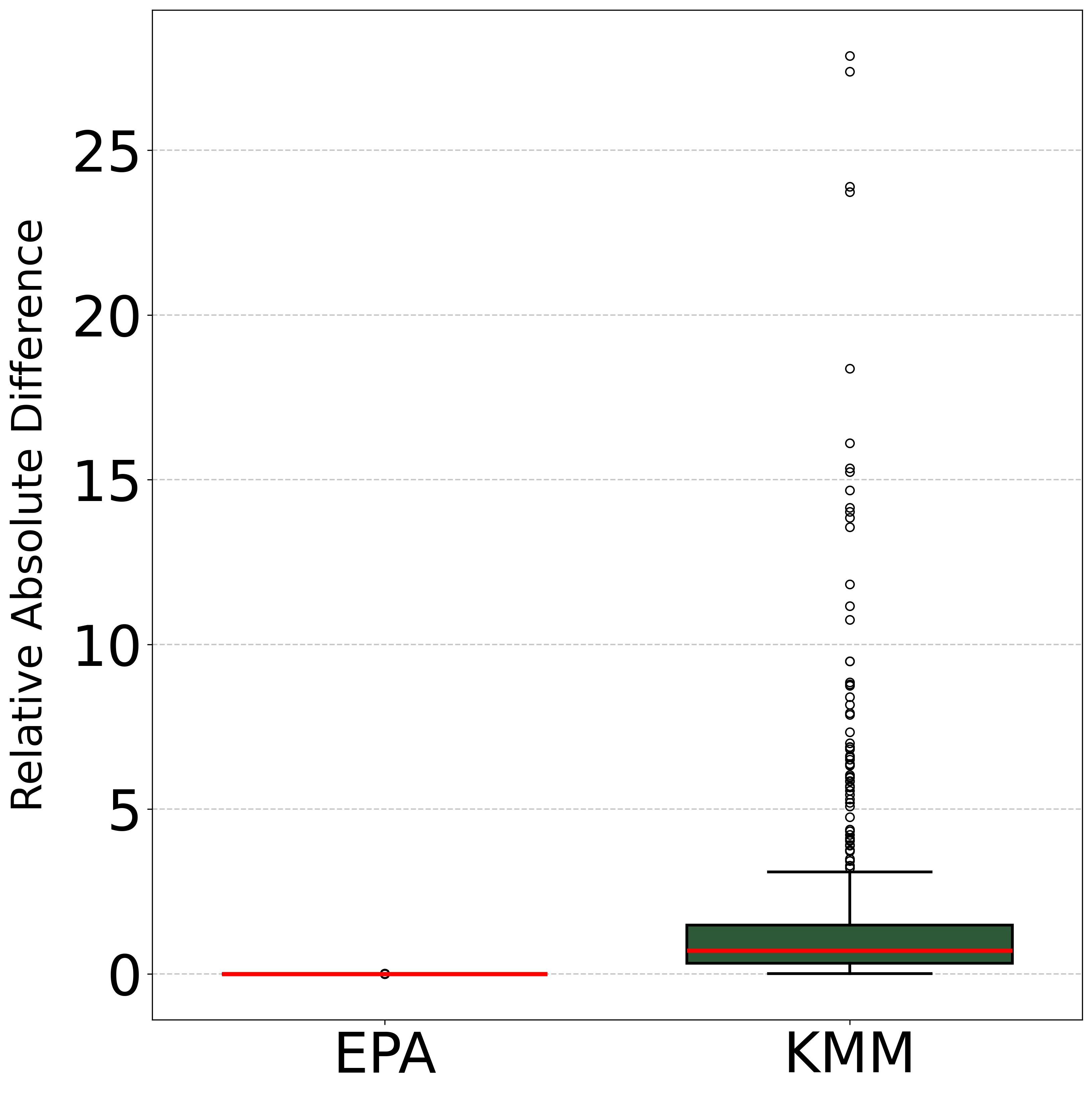
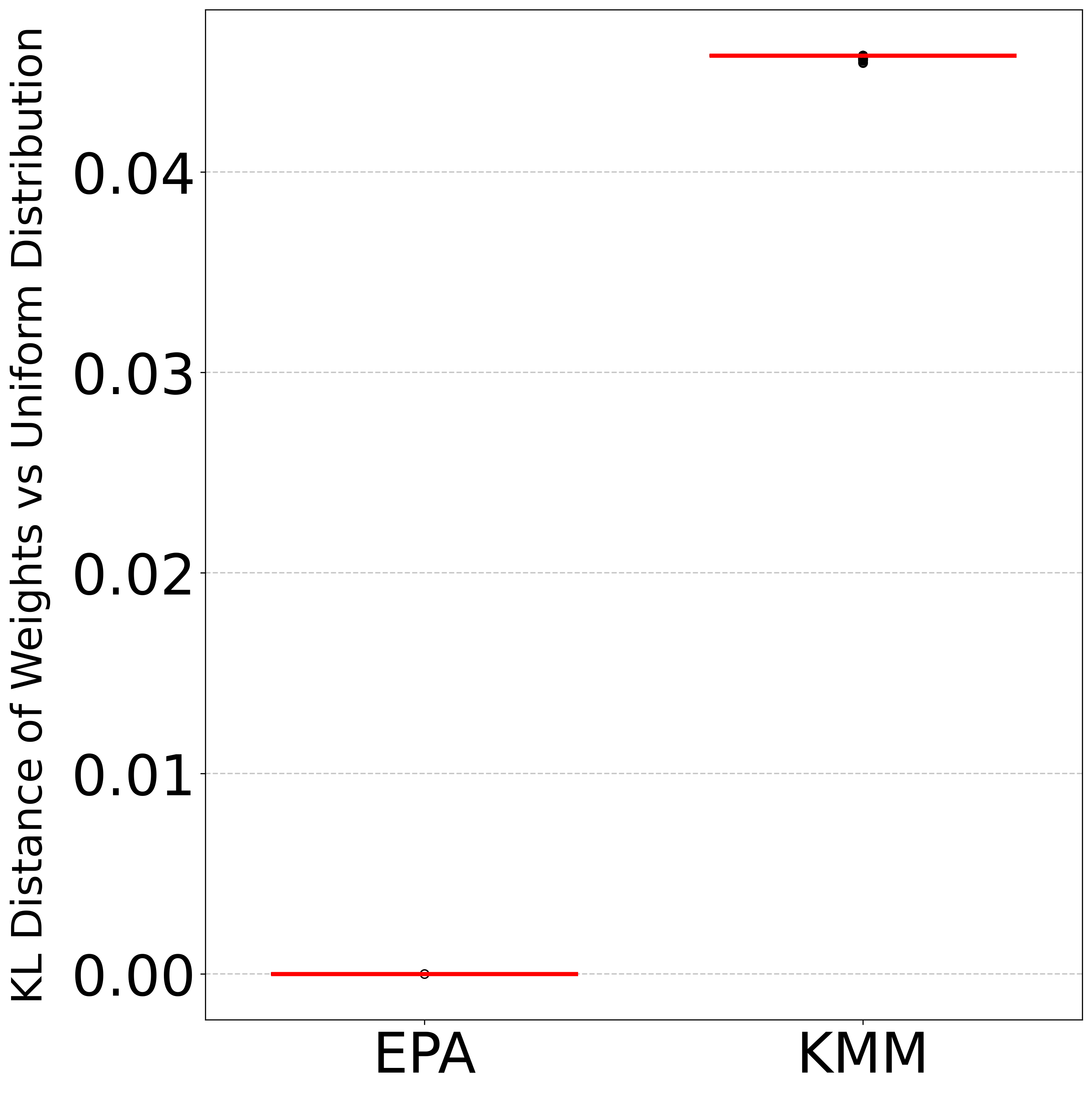
Figure 1: Comparison of mean squared error (MSE) between reweighted models and the true model; EPA produces negligible variance, whereas KMM's results exhibit high variance.
Theoretical Guarantees
EPA's theoretical analysis draws from domain adaptation and exponential family theory. The main results can be summarized as:
- Discrepancy control: If (X1,Y1),...,(Xn,Yn)1 is aligned with the hypothesis class (X1,Y1),...,(Xn,Yn)2 and loss (X1,Y1),...,(Xn,Yn)3, the estimation gap (X1,Y1),...,(Xn,Yn)4 is upper bounded by the alignment residual and irreducible shared error.
- Zero discrepancy via alignment: Perfect alignment (i.e., (X1,Y1),...,(Xn,Yn)5) yields zero estimation gap except for the shared-good-hypothesis term.
- Variance minimization: The variance of the importance-weighted estimator is explicitly minimized among all feasible weights by EPA's entropy regularization.
- Sample complexity and finite-sample concentration: The EPA estimator's error is controlled via moment concentration bounds; no explicit distributional modeling or parametric assumptions are required.
The framework provides analysis for both exact moment matching and approximate scenarios, including constructive alignment for structured model classes (e.g., axis-aligned histograms for trees, polynomial features for linear models).
Estimation, Explanation, and Adaptation
Target Error Estimation
EPA estimates the risk on the (unlabeled) target domain by applying the weighted loss over the reweighted source. Empirically, EPA accurately detects and quantifies increases in error due to harmful shifts across a spectrum of synthetic and naturally occurring variations in tabular datasets.
Feature Attribution Under Shift
EPA implements feature attribution for distribution shifts via iterative matching/reweighting over candidate feature subsets. The method identifies minimal (or approximately minimal) feature sets responsible for observed shifts by selecting the subset whose corresponding reweighting best matches the target distribution, as measured by histogram-based KL divergence.
Model Improvement
To adapt models under shift, EPA recommends boosting a correction function onto the original model using the derived importance weights. This procedure leverages the base model and iteratively reduces the weighted risk under (X1,Y1),...,(Xn,Yn)6, transferring improvements to the target domain per established discrepancy bounds. The adaptation procedure is provably beneficial whenever the observed improvement on the reweighted source exceeds the error transfer bound.
Empirical Results
Across multiple benchmarks—encompassing sparse covariate shift, sparse joint feature/label shift, and real demography/period-based shifts—EPA yields:
- 30-70% reduction in estimation inaccuracy for harmful shifts over leading baselines (SEES, KMM, domain classifier weighting). EPA maintains accuracy and power even as shift severity increases.
- Higher feature attribution rates for identifying the causal set of features driving performance degradation, notably achieving up to 60% accuracy improvement in sparse joint shifts.
- Greater model adaptation gains under both well-specified and especially under misspecified model regimes, at or near the performance ceiling set by an oracle model fine-tuned on labeled target data.
- Order-of-magnitude faster computational performance, scaling efficiently to high-dimensional tabular datasets.
Scalability and Stability
EPA demonstrates substantial runtime advantage due to its closed-form solution and parameter space dependence on feature dimension rather than data size. Ablation studies substantiate its stability with negligible weight variance—contrasting sharply with KMM's high variance and degenerate weighting.
Implications and Future Directions
EPA delivers a unified, theoretically grounded, and computationally tractable approach for model performance auditing and adaptation under distribution shift. Notably, it provides robust error estimation, interpretable shift explanations, and principled adaptation while circumventing density ratio estimation—a fundamental bottleneck in prior methods.
Practically, EPA is deployable for proactive model monitoring and automated domain shift detection in high-stakes tabular data applications (e.g., finance, healthcare). From a theoretical perspective, the key notion is that perfect or approximate alignment obviates the need for full domain modeling, emphasizing the choice of (X1,Y1),...,(Xn,Yn)7 as the critical locus for both transferability and interpretability.
Future avenues include extending EPA to unstructured data (e.g., leveraging learned representations in deep networks), developing automated strategies for feature map alignment in compositional/heterogeneous data, and integrating hypothesis-specific discrepancy measures to further tighten bounds and adaptation efficacy. There is also considerable scope for EPA-based shift explanations to inform causal inference and automated intervention pipelines.
Conclusion
The EPA framework marks a substantive advancement in the robust handling of distribution shift for machine learning models. By integrating estimation, explanation, and adaptation within a single entropic projection principle—and demonstrating strong empirical and theoretical performance—EPA establishes itself as an effective standard for post-hoc domain adaptation and performance monitoring, especially in tabular domains where reweighting and interpretability are both paramount.