- The paper introduces a novel architecture that implements free-space photonic circuits using structured light and LCMSs, replacing traditional beam splitter networks.
- It employs near-field geometric phase elements and far-field patterned metasurfaces to achieve controlled spin-orbit transformations in a four-dimensional Hilbert space.
- Experimental results reveal high fidelity and efficiency, maintaining robust performance under parameter noise and enabling scalable extension to higher dimensions.
Universal Free-Space Photonic Circuits for Polarized Structured Light
Introduction and Motivation
Linear optical circuits, traditionally realized via interferometric meshes of beam splitters and phase shifters, underpin universal photonic transformations in integrated platforms. However, the canonical mesh paradigm faces scaling and flexibility constraints in integrated settings and, in free-space implementations, suffers from complexity as the number of modes grows. The work in "Universal free-space photonic circuits for polarized structured light" (2605.31216) introduces a distinct architecture: a universal, scalable, and efficient photonic circuit that operates directly in free space on both spatial and polarization degrees of freedom. Central to the approach is the use of structured light (spin-orbit modes) and structured photonic materials (liquid-crystal metasurfaces, LCMSs) to implement optical gates, replacing discrete networks of beam splitters and phase shifters with planar optics engineered for specific spin-orbit interactions.
Architecture and Theoretical Framework
The proposed circuit manipulates optical modes comprising quantized transverse momentum and polarization (spin-orbit modes), building a Hilbert space suitable for universal SU($2n$) unitaries. The photonic circuit comprises core units—each with a near-field structured element (GP and waveplate) followed by a far-field patterned LCMS, with spatial transformations realized by Fourier optics in the lens system.
The GPs serve as mode-dependent beam splitters with tunable coupling strengths (via birefringence modulation), and the far-field metasurfaces introduce programmable, mode-dependent phase shifts. This composition emulates the mesh-like architecture of classic photonic circuits but in copropagating mode space and with all polarization and path manipulation accomplished by inhomogeneous, patterned optics rather than spatially separated beams.
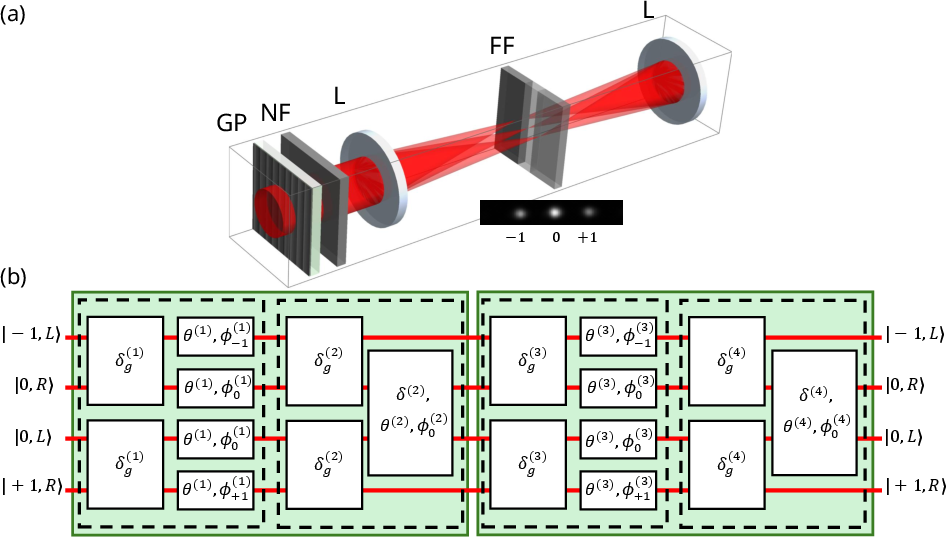
Figure 1: The architecture of the spin-orbit interferometer; (a) depicts a single circuit layer with patterned LCMSs, GPs, and Fourier optics, and (b) shows the equivalent circuit representation for SU(4) operations.
Each two-layer "block" acts as the building unit for scaling to higher even dimensions; cascading n such blocks realizes SU($2n$) universality. Notably, the phase relations required for universal transformation are maintained by optimizing the optic-axis settings and birefringence parameters across the metasurfaces.
Numerical Demonstration of Universality
To empirically support universality, the authors optimized the circuit parameters for 1000 Haar-random SU(4) unitaries. The numerical fidelity achieved was exceptionally high, with an average infidelity of 3.5×10⁻¹⁴. The robustness of the setup to experimental noise is notable: for up to 5% Gaussian parameter errors, fidelity and efficiency remain above 0.95 and 0.9, respectively; even at 10% error, the fidelity only drops to $0.76$.
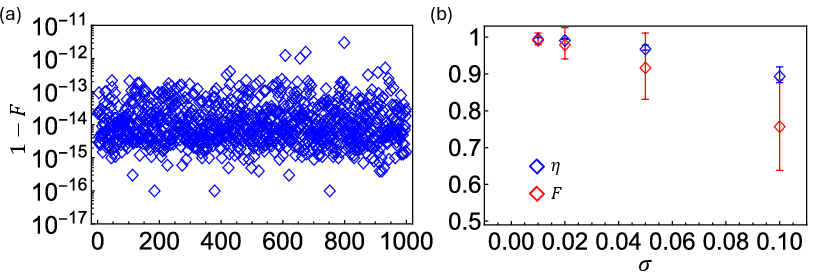
Figure 2: (a) Infidelity $1-F$ over 1000 Haar-random SU(4) targets, and (b) average efficiency/fidelity versus parameter noise level.
This parameterization and robustness directly enable the scaling of analogous interferometers to higher-dimensional (even-dimensional) Hilbert spaces through additional layers, as the mapping to classic mesh decompositions remains intact.
Experimental Realization and Characterization
The experimental platform uses a 633 nm He-Ne laser expanded to millimeter-scale spatial modes. The system prepares all logical basis states through QWP and GP manipulations, and the four-layer photonic circuit executes the desired transformations via the patterned LCMSs.
The authors demonstrate the action of Hadamard, T ("magic"), and CNOT gates, which together with single-qubit Clifford and non-Clifford elements constitute a known universal set for qubit quantum logic. For each gate, output probability distributions were measured for all four logical inputs.
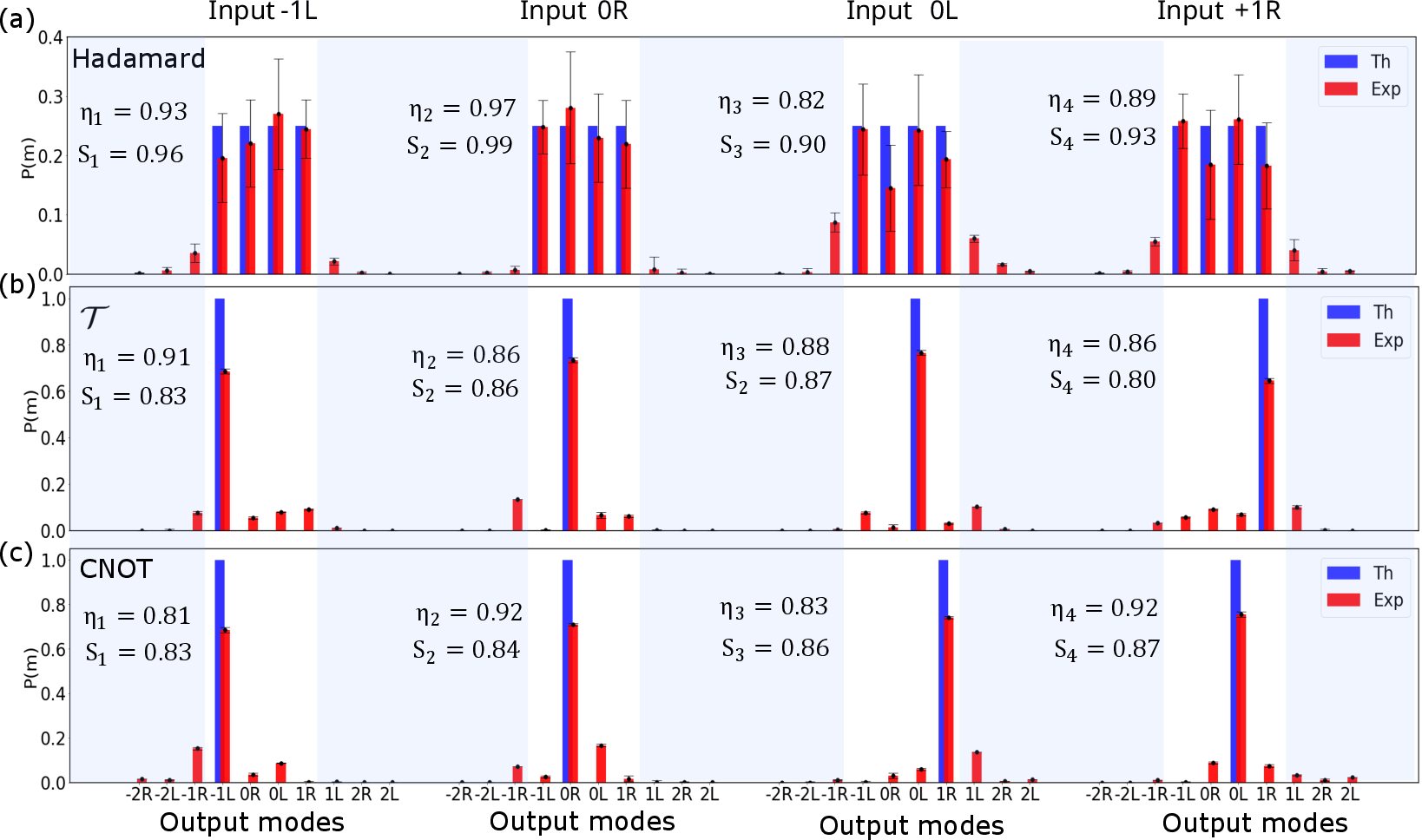
Figure 3: Experimental probability distributions (red) for Hadamard, T, and CNOT gates; blue indicates theoretical values and extraneous mode leakage regions.
Despite the ideal circuit being lossless, fabrication defects and thermal fluctuations lead to some power leakage to extraneous modes, but the efficiency n0 for the target four-dimensional logic gates remains high (0.87–0.90). The measured similarities between experimental and theoretical distributions are 0.84–0.95. Post-selection and renormalization over the logical Hilbert subspace yield highly accurate conditional transformations.
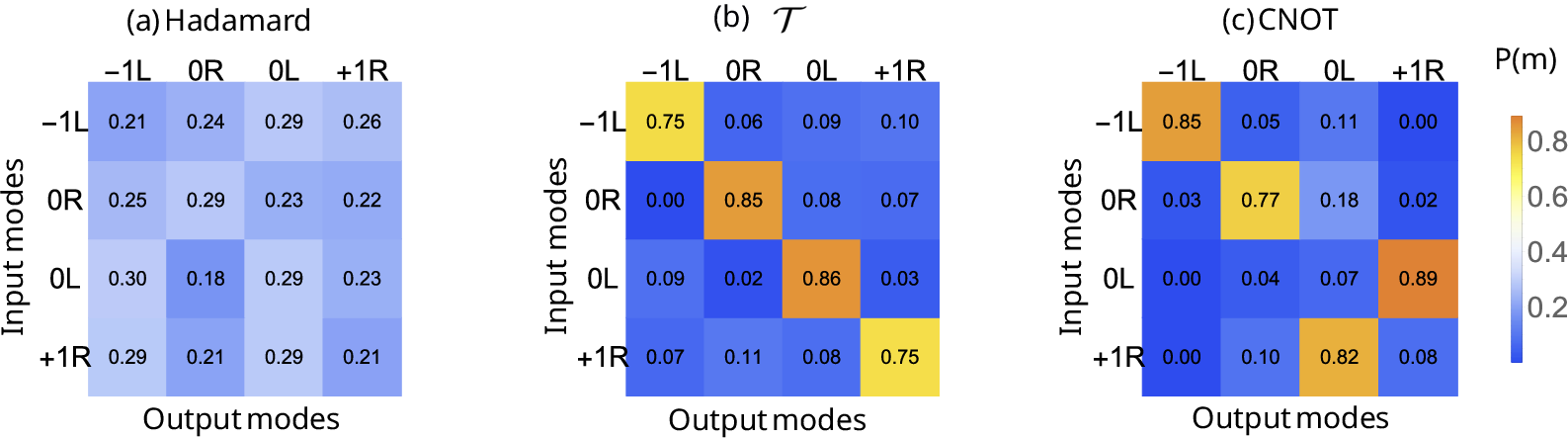
Figure 4: Conditional (subspace-renormalized) experimental probability matrices for Hadamard, n1, and CNOT gates.
Fabrication Details and Optimization Protocol
LCMSs are fabricated through photoalignment: ITO-coated glass substrates spin-coated with photoactive dyes are photopatterned using polarized laser writing and subsequently filled with nematic liquid crystal mixtures. This method yields arbitrary micro-patterned distribution of the optic axis for fine spatial control of spin-orbit coupling.
The optimization of gate parameters combines local and global optimization strategies, converging to sub-10n2 cost function values across random unitary targets. This workflow guarantees that solutions are both efficient and practical for experimental realization.
Implications and Future Directions
This universal free-space circuit paradigm demonstrates that structured light and matter can implement arbitrary unitary photonic logic with high fidelity and scalability in both classical and quantum domains. The architecture is inherently compatible with large modal counts—limited primarily by optical losses and alignment tolerances rather than discrete path complexity—and can be realized with a linear scaling in the number of patterned elements.
Practically, these results offer a path toward programmable vectorial photonic processors, high-dimensional quantum information protocols, and advanced free-space optical neural computing. The extension to two-dimensional mode grids, multiplexing, non-unitary (loss-engineered) operators, and Haar-measure sampling are all suggested as natural evolutions. The approach is compatible with advanced optical materials, including dielectric metasurfaces and meta-optical elements, and can interface with high-speed, spatially resolved single-photon detection.
Conclusion
By demonstrating a universal, free-space, spin-orbit photonic circuit operating in the four-dimensional structured-light Hilbert space, the authors have established a viable and scalable alternative to mesh-based integrated architectures for both classical and quantum photonic processing. The experimental validation of high-efficiency, high-fidelity gates directly supports the feasibility of this approach, while the scalability and extensibility of the framework position it for further research in high-dimensional photonic quantum technologies and reconfigurable optical circuit design.

