Fixed-Point Masked Generative Modeling
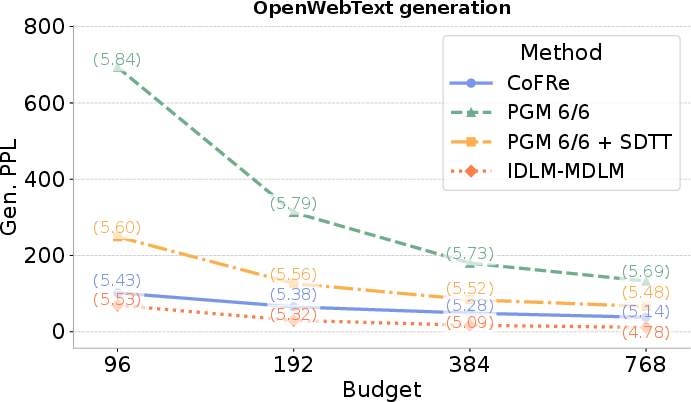
Abstract: Masked Generative Models (MGMs) enable parallel decoding and achieve strong performance across modalities, but require full-sequence bidirectional transformers at every step, making training costly and degrading quality under low sampling budgets. Existing work improves efficiency via better samplers or cheaper fixed-depth denoisers, but they still allocate a fixed amount of denoiser computation to each refinement step. We introduce Fixed-Point Masked Generative Models (FP-MGMs), which replace part of the denoiser with a fixed-point solver over shared attention layers to enable adaptive depth with fewer parameters. To make it more effective for masked generation, we first introduce a cross-step consistency loss, which aligns hidden representations at neighboring denoising steps and, second, three-state reuse (3SR) which warm-starts the solver using the previous solution by treating differently unchanged, still-masked, and newly revealed tokens respectively. Together, these components define our complete training-to-inference framework for fixed-point masked generation, \emph{CoFRe}. We also show that pre-trained MGMs can be converted into FP-MGMs with short fine-tuning, avoiding full retraining. Across modalities, CoFRe improves the quality and cost trade-off. On OpenWebText, CoFRe reduces parameters by 38.8\%, training time by 11.5\%, and VRAM by 16.9\%, while improving generative perplexity from 830.8 to 101.8 at a budget of $96$ transformer-block forward passes, compared to MDLM. In ImageNette, CoFRe reduces training time by 48.6\% and VRAM by 50.7\%, while improving FID in all sample budgets tested. Overall, CoFRe offers a practical framework for cheaper training and stronger low-budget masked generation.





Paper Prompts
Sign up for free to create and run prompts on this paper using GPT-5.
Top Community Prompts
Explain it Like I'm 14
What is this paper about?
This paper shows a new way to make “fill-in-the-blanks” AI models faster, smaller, and better when you give them a tight compute budget. These models, called masked generative models, create text or images by starting with a lot of blank or “masked” spots and then repeatedly guessing what should go there. The authors replace part of the usual transformer network with a clever “fixed-point” loop that reuses the same block over and over until the answers settle down. They also add two practical tricks so the loop starts in a good place and stays stable across steps. Their full recipe is called CoFRe.
They test this on:
- Text (OpenWebText) with a model called MDLM
- Images (ImageNette) with a model called MaskGIT
Across both, they get better quality with less memory and training time, especially when you can only afford a few refinement passes.
What questions did the researchers ask?
In simple terms:
- Can we make masked generative models use less compute and memory without hurting quality?
- Can we let the model “choose” how much work to do at each step (more when it’s hard, less when it’s easy) without increasing the number of parameters?
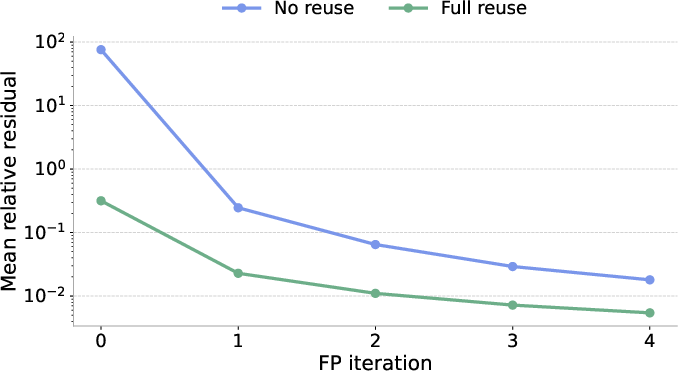
- Can we keep the model’s internal thoughts stable from one refinement step to the next, so it doesn’t waste time recomputing everything?
- Can we turn existing models into this new, faster style without training them from scratch?
How did they approach it?
To understand their approach, it helps to know how masked generative models work.
Masked generative models in plain words
- Imagine a puzzle with many missing pieces.
- The model fills in the blanks in several rounds, each time using what it already filled to make better guesses.
- Two popular examples are:
- MDLM (for text): thinks about all words at once and fills in masked tokens step by step.
- MaskGIT (for images): works on image tokens (like tiny tiles) and reveals confident tiles quickly.
The problem: each round usually runs a full transformer over the entire sequence, which is expensive. If you only have a small “budget” of passes, quality drops.
The new idea: a “fixed-point” denoiser
- Think of a fixed point as a stable solution: you keep applying the same tool until nothing changes anymore.
- Instead of stacking many different transformer layers, the authors reuse one shared block several times in a loop. The number of loop iterations acts like “how deep” the network is.
- This has two big benefits:
- Fewer parameters (because the same block is reused).
- Adjustable depth at inference time (do more iterations if you need more polishing, fewer if you’re rushed).
Analogy: Instead of hiring 12 different editors to review an essay once each, you hire 1 excellent editor and let them do several quick passes—stop when the text looks good.
Two extra tricks that make it work well
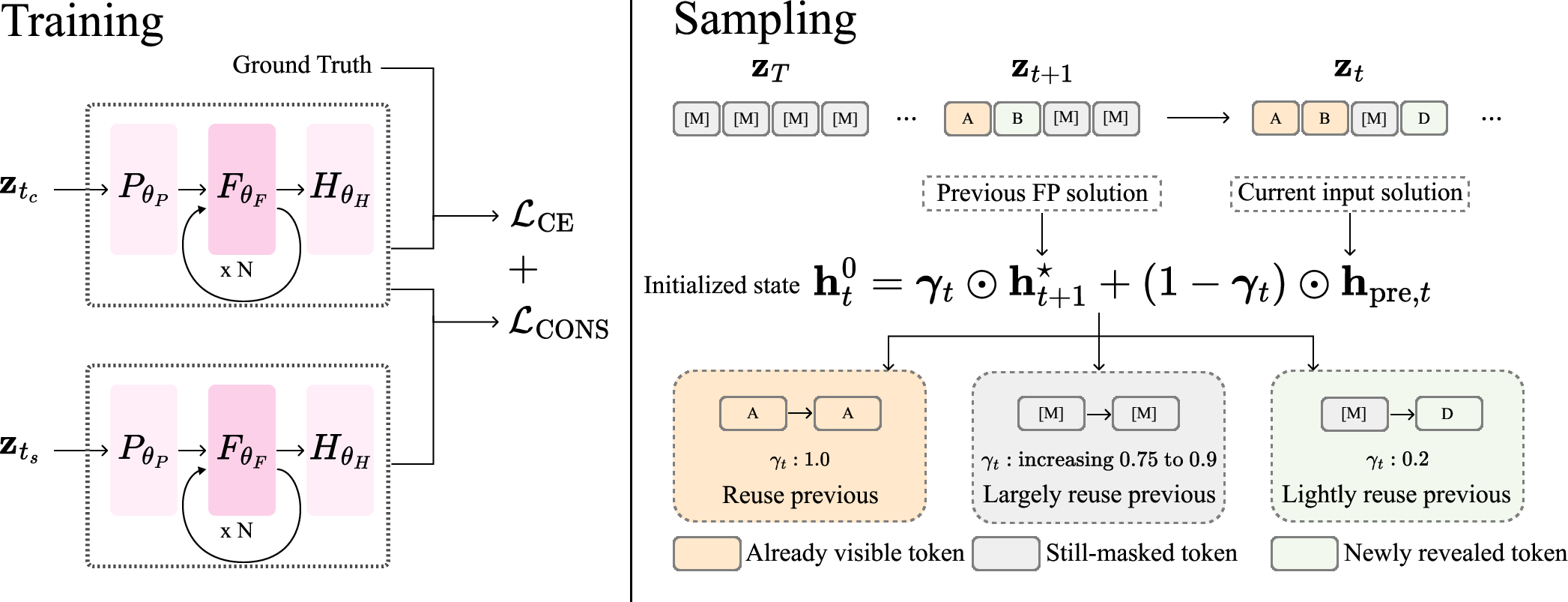
- Cross-step consistency
- Problem: when you go from a noisier step to a cleaner step, the model’s internal representations can jump around, especially under low compute. That makes it hard to reuse work.
- Solution: add a training loss that nudges the model’s hidden representations at a noisier step to be similar to those at a cleaner step on the same example.
- Analogy: aligning your rough draft’s outline with your near-final outline, so revisions stay steady instead of zig-zagging.
- Three-state reuse (3SR)
- Problem: not all tokens change the same way between steps. Some tokens stay visible, some stay masked, and some just got revealed. Reusing last step’s solution equally everywhere doesn’t make sense.
- Solution: initialize the next loop differently per token:
- Unchanged visible tokens: reuse a lot (they didn’t change).
- Still-masked tokens: reuse somewhat (their context changed a bit).
- Newly revealed tokens: reuse less (they changed the most).
- Analogy: when updating a group project, you keep most of the work that didn’t change, lightly update in-progress sections, and redo the parts you just rewrote.
Training and conversion from existing models
- Training trick: they combine no-gradient and with-gradient loop iterations to save memory but still learn well.
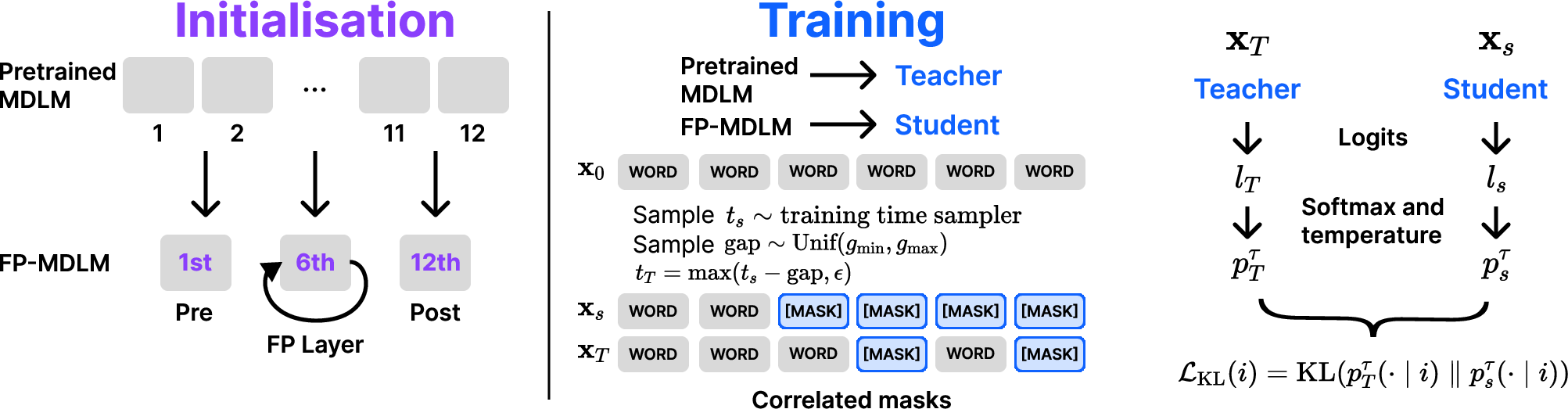
- Model conversion: you don’t need to start from zero. You can take a pretrained masked model and “convert” it into this fixed-point style, then fine-tune briefly. That transfers its knowledge but gives you the new benefits.
What did they find, and why is it important?
First, two terms:
- Budget: how many forward passes through transformer blocks you can afford during generation. Lower budgets = faster but usually worse quality. This work aims to keep quality high even at low budgets.
- Perplexity (text): lower is better; it means the model predicts words more confidently and correctly.
- FID (images): lower is better; it means the generated images look more realistic and closer to real data.
Key results:
- Text (OpenWebText, with MDLM):
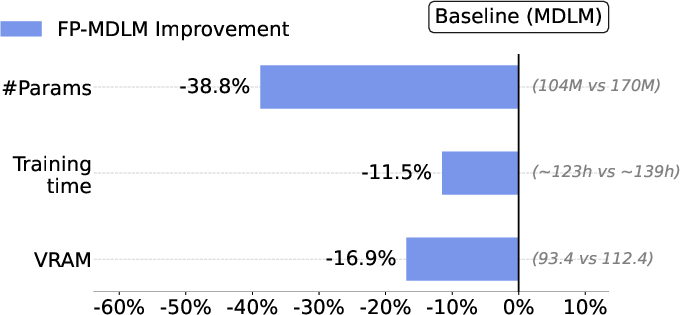
- Fewer resources: about 38.8% fewer parameters, 11.5% less training time, and 16.9% less VRAM.
- Better quality at the same compute:
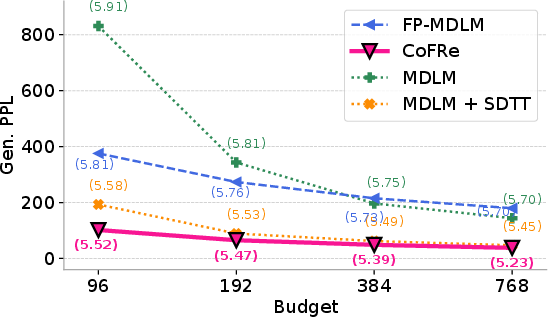
- At a small budget (96 passes): generative perplexity improved a lot (for example, compared to a strong baseline with extra distillation, from about 193 down to about 102).
- At a larger budget (768 passes): from about 47 down to about 38.
- Together, the fixed-point loop, cross-step consistency, and three-state reuse gave the best low-budget text generation.
- Images (ImageNette, with MaskGIT):
- Less training cost: training time roughly cut in half; VRAM about cut in half.
- Better image quality at all tested budgets:
- For example, at a small budget (48 passes), FID dropped from about 174 to about 97.
- At a larger budget (384 passes), FID dropped from about 30 to about 23.
- Converting existing models:
- They showed you can convert a pretrained MDLM to a fixed-point version and fine-tune briefly (about 4% of original training steps). This already improves quality and makes the “reuse” trick work better.
Why it matters:
- You get better results when you can’t afford many passes (useful for phones, edge devices, or fast interactive tools).
- You save training time and memory, making research and deployment cheaper.
- You can upgrade existing models to this faster style without starting over.
What’s the bigger impact?
- Smarter compute use: The model can spend more effort when a step is hard and less when it’s easy, without growing in size.
- More accessible AI: Lower memory and training time help labs and companies with smaller budgets.
- Faster, better user experiences: Low-latency generation with higher quality is great for chat apps, creative tools, and on-device AI.
- A general recipe: CoFRe works across different data types (text and images) and can likely extend to video, audio, and multimodal tasks.
In short, this paper shows a practical path to cheaper, flexible, and stronger masked generation by reusing a shared block in a fixed-point loop, stabilizing the model across steps, and smartly reusing previous work at the token level.
Knowledge Gaps
Unresolved gaps, limitations, and open questions
Below is a consolidated, concrete list of what remains missing, uncertain, or unexplored, framed to be actionable for future research:
- Theoretical guarantees: no proof that the fixed-point map used in masked denoisers is contractive or even admits a unique equilibrium under discrete, token-wise state changes; conditions ensuring convergence (with or without 3SR) are not established.
- Solver choices: only simple unrolled iterations with SJFB are explored; no head-to-head comparisons against Anderson acceleration, Broyden’s method, or implicit differentiation for accuracy–stability–cost trade-offs.
- Adaptive iteration/stopping: the number of fixed-point iterations is preset (and scheduled globally); there is no residual-based or learned early-stopping criterion per sequence or per token.
- Learned reuse policy: 3SR uses hand-tuned coefficients; no investigation of learning token-wise reuse gates (e.g., via confidence, attention, or a small controller) or meta-learning reuse policies that generalize across datasets and schedulers.
- Beyond three states: reuse only distinguishes unchanged-visible, still-masked, and newly revealed tokens; it remains open to model finer-grained states (confidence bands, semantic groups, or uncertainty estimates) and to test their impact.
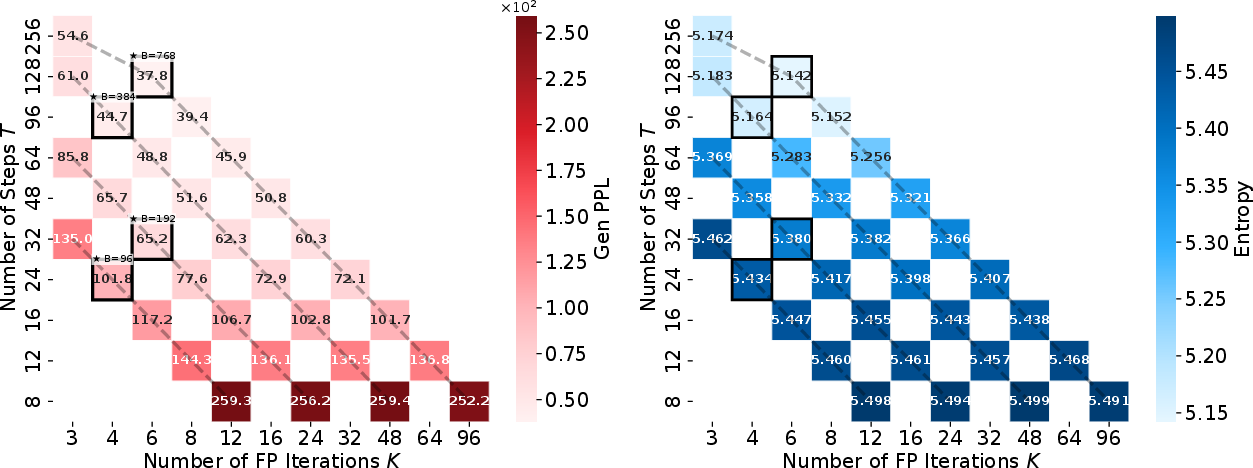
- Budget allocation policy: step/iteration allocations are scheduled by grid search; learning a dynamic allocation policy conditioned on the current denoising state is not attempted.
- Scalability: results are limited to OWT and ImageNette; behavior at larger scales (C4/OWT2/ImageNet, higher resolutions, longer contexts ≥4k tokens, and ≥1B-parameter models) is unknown.
- Modalities: generality to audio, video, and multimodal MGMs is untested; whether 3SR and cross-step consistency transfer to these domains is open.
- Compatibility with advanced samplers: interaction with improved unmasking/token-order policies, discrete solvers, PGM (mask-free generative models), or CDLM (consistency + caching) is not systematically studied for additive or interfering gains.
- KV caching and attention patterns: while FP-MGM keeps bidirectional attention, there is no exploration of cacheable attention variants (e.g., blockwise causal or hybrid schemes) within the fixed-point architecture.
- Conversion/adaptation breadth: checkpoint conversion is shown for one MDLM; how layer mapping quality, teacher temperature, and adaptation length scale across architectures, datasets, and domains is not explored.
- Consistency loss design: only an MSE-in-hidden-states (and KL for adaptation) is tried; comparisons to layer-wise, cosine, contrastive, or logit-space objectives, as well as EMA- or multi-step teachers, are missing.
- Calibration and uncertainty: cross-step consistency sharpens logits, but effects on calibration (ECE, Brier score) and selective prediction are not measured; potential overconfidence is unassessed.
- Diversity and coverage: text diversity is proxied by unigram entropy only; richer text metrics (distinct-n, self-BLEU, MAUVE) and image precision–recall/FJD/CLIP-based measures are missing to rule out mode collapse.
- Human evaluation: reliance on GPT-2-based “generative perplexity” lacks validation against human judgments for fluency, coherence, and faithfulness; alignment to human preference is unknown.
- Robustness: sensitivity to noise schedules, correlated-mask construction, unmasking policies, and iteration schedules is only partially ablated; OOD robustness and adversarial stability are untested.
- Hyperparameter sensitivity: no systematic sensitivity analysis for 3SR coefficients, SJFB iteration counts, K_pre/K_fp/K_post split, or solver tolerances; reproducible tuning guidance is limited.
- Inference latency and throughput: language results report “budget” (forward-pass counts) but not wall-clock latency/throughput across hardware; real-time impacts vs. explicit deep stacks remain unclear.
- Inference memory footprint: memory use during sampling (e.g., storing and reusing equilibrium states for long contexts) is not quantified; scalability under memory constraints is uncertain.
- FLOPs/energy accounting: comparisons normalize by “transformer-block forward passes,” not by total FLOPs/energy; efficiency claims could shift under rigorous accounting of softmax/projections and weight sharing.
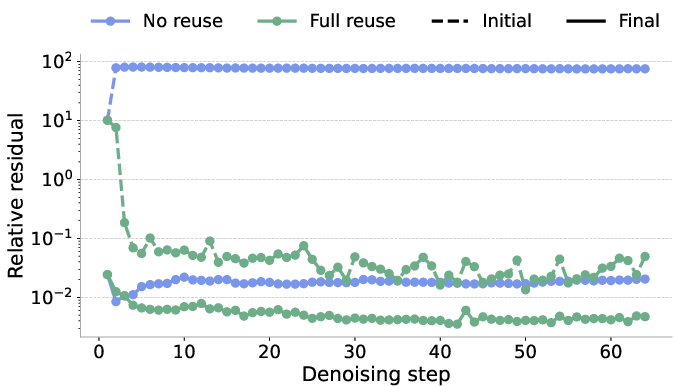
- Failure modes of reuse: baseline reuse can hurt at higher budgets before adaptation; conditions causing detrimental reuse, and safeguards (e.g., confidence gating), are not characterized.
- Relationship to AR depth and universal transformers: no analysis of how FP-MGMs approximate deep explicit stacks or relate to universal/looped transformers; theoretical or empirical mapping remains open.
- Conditional generation: applications to conditioned tasks (prompted text, class-conditional or text-conditional image generation, seq2seq) and how to inject conditions into the FP block are not evaluated.
- Tokenizer/codebook dependence: image results depend on a specific VQ tokenizer; sensitivity to tokenizer choice, codebook size, and codebook drift (and their interaction with fixed-point dynamics) is unknown.
- Learning to mask/unmask: the framework assumes exogenous unmasking schedules; jointly learning unmasking policies with the FP denoiser (e.g., via RL or differentiable relaxation) is unexplored.
- Per-token early exit: convergence is managed globally per step; mechanisms to detect token-level convergence and allocate per-position compute are not investigated.
- Safety and bias: impacts on harmful content, demographic bias, and representational harms (and whether consistency amplifies spurious correlations) are not studied.
- Reproducibility detail: complete training curves, seeds, and hyperparameter grids for all variants (especially 3SR schedules and iteration allocations) are not fully documented, limiting replicability.
Practical Applications
Overview
This paper introduces Fixed-Point Masked Generative Models (FP-MGMs) and the CoFRe framework, which combine a fixed-point denoiser (shared layers with adaptive solver iterations), cross-step consistency regularization, and three-state reuse (3SR) for token-aware warm starts. Compared to standard masked generative models (MGMs) such as MDLM (text) and MaskGIT (images), CoFRe reduces parameters, VRAM, and training time while substantially improving few-step (low-budget) generation quality. It also provides a practical recipe to convert existing MGM checkpoints to FP-MGMs via short adaptation.
Below are actionable applications organized by time horizon, with sector links, potential tools/workflows, and feasibility notes.
Immediate Applications
The following can be deployed now with modest engineering effort, primarily in cloud or on-prem GPU environments that already run MGMs.
Software/AI infrastructure
- Cost-efficient masked generative services (text and image)
- Use case: Replace MDLM/MaskGIT backbones with FP-MGM denoisers to cut training/inference VRAM, reduce iteration time, and maintain or improve quality at low budgets.
- Sectors: Software, ML platforms, cloud AI services.
- Tools/workflows:
- Training recipe using SJFB for fixed-point layers to reduce activation storage.
- Inference runtime with a decreasing fixed-point iteration schedule and 3SR.
- Model conversion tool: short adaptation (teacher–student) to convert existing MGMs to FP-MGMs.
- Assumptions/dependencies: Requires masked generative backbones (e.g., MDLM/MaskGIT), access to the paper’s codebase, and tuning of 3SR coefficients; quality/efficiency gains are demonstrated on OWT and ImageNette and may require domain retuning.
- Latency/throughput optimization under fixed compute budgets
- Use case: Serve parallel masked decoding (e.g., inpainting, masked completion) with higher quality at tight forward-pass budgets; dynamically allocate solver iterations early vs late steps.
- Sectors: SaaS, enterprise ML platforms.
- Tools/workflows:
- Budget-aware schedulers that trade denoising steps vs fixed-point iterations per request.
- SLA-driven adaptive compute allocation using model confidence/entropy.
- Assumptions/dependencies: Benefits depend on masked-generation workloads; requires modest telemetry (e.g., entropy) to guide iteration schedules.
Media and creative industries
- Faster image inpainting and refinement pipelines
- Use case: Interactive image editing (fill, replace, refine) with lower latency and compute cost using FP-MaskGIT + 3SR for warm-started refinement.
- Sectors: Creative software, ads/marketing content, design tooling.
- Tools/workflows:
- Integrate FP-MaskGIT in existing VQ-tokenizer-based pipelines.
- User-adjustable “quality vs speed” slider mapped to forward-pass budgets.
- Assumptions/dependencies: Requires VQ tokenizer (e.g., ImageFolder VQ-4096/XQGAN-4096) and modest grid search for reuse coefficients.
- Batch content generation at scale with lower GPU footprint
- Use case: Scaling A/B content iterations (thumbnails, product images, banners) with improved FID at the same or lower compute budget.
- Sectors: E-commerce, media production.
- Tools/workflows:
- Orchestrators that schedule low-budget bulk generation via FP-MGMs.
- Assumptions/dependencies: Domain shift from ImageNette to production data may require finetuning.
Education
- Fill-in-the-blank text generation and assisted writing
- Use case: Parallel masked completion to generate alternatives for cloze tasks, grammar feedback, or draft rewriting with lower latency under budget constraints.
- Sectors: EdTech, language learning apps.
- Tools/workflows:
- FP-MDLM-backed APIs for multi-suggestion generation at fixed budgets.
- Assumptions/dependencies: Requires tokenizer alignment and domain adaptation for educational text.
Enterprise and finance
- Document redaction/denoising and field imputation
- Use case: Masked completion for missing or anonymized fields in structured/unstructured documents; parallel decoding improves throughput.
- Sectors: Finance, insurance, legal.
- Tools/workflows:
- FP-MDLM deployed on-prem for compliance; consistency loss post-training for stronger few-step predictions.
- Assumptions/dependencies: Must align to domain vocabularies and ensure compliance; masked generation must be carefully validated for accuracy.
- Cost-aware batch inference for document processing
- Use case: Process large archives with strict compute budgets (fixed GPU-hours) by adjusting solver iteration schedules.
- Sectors: Enterprise ML ops.
- Tools/workflows:
- MLOps dashboards to monitor quality (e.g., entropy) vs forward-pass budgets; dynamic policy to re-run a small fraction at higher budgets.
- Assumptions/dependencies: Requires budget–quality calibration on in-domain data.
Research and academia
- Efficient MGM baselines and ablations across modalities
- Use case: Researchers can train/evaluate masked models with fewer parameters and memory; quickly test low-budget generation hypotheses.
- Sectors: Academia, industrial research labs.
- Tools/workflows:
- Plug-in FP-block for existing MGM repos; post-training cross-step consistency module; conversion scripts for pretrained models.
- Assumptions/dependencies: Familiarity with SJFB, implicit layers, and correlated mask sampling.
- Short adaptation of existing masked models to fixed-point variants
- Use case: Convert prior MGMs into FP-MGMs to reduce cost and enable adaptive depth, avoiding full retraining.
- Sectors: All research users of MGMs.
- Tools/workflows:
- Teacher–student distillation with correlated masks and temperature-scaled KL on masked positions.
- Assumptions/dependencies: Access to teacher checkpoints and data for short adaptation; careful layer mapping.
Policy and sustainability
- Immediate energy/cost savings in masked generation workloads
- Use case: Reduce carbon and cost per sample by cutting per-step compute via weight sharing, 3SR warm starts, and low-budget sampling improvements.
- Sectors: Corporate sustainability, ML governance.
- Tools/workflows:
- Emissions accounting that includes “forward-pass budget per sample” as a reportable efficiency metric.
- Assumptions/dependencies: Organizational willingness to adopt new efficiency metrics and certify model changes.
Daily life (cloud-backed features)
- Faster, richer autocomplete and editing
- Use case: Document/email editors using masked completion and global in-place edits with improved speed/quality on server.
- Sectors: Productivity apps.
- Tools/workflows:
- FP-MDLM inference with 3SR; consistency-regularized checkpoints for stronger few-step predictions.
- Assumptions/dependencies: Cloud or on-prem inference; privacy policies for text data.
Long-Term Applications
These require further research, scaling, domain adaptation, or regulatory readiness; many are natural extensions beyond the paper’s text/image demonstrations.
Edge and on-device AI
- On-device masked generation for text/image editing
- Use case: Local inpainting, masked edits, or low-latency completions on laptops/edge accelerators by leveraging reduced parameters and adaptive depth.
- Sectors: Consumer devices, mobile/edge computing.
- Tools/workflows:
- Quantization + FP-MGM; dynamic solver iterations tied to device thermal/latency budgets.
- Assumptions/dependencies: Further compression (quantization/distillation), hardware support for shared-layer solvers; current VRAM savings are promising but not yet smartphone-ready.
Robotics and embedded systems
- Masked trajectory/token planners with adaptive depth
- Use case: Real-time plan/trajectory refinement via masked token generation with fixed-point reuse on resource-constrained robots.
- Sectors: Robotics, autonomous systems.
- Tools/workflows:
- Integrate FP-MGMs into planning frameworks; 3SR adapted for state tokens (stable vs newly revealed waypoints).
- Assumptions/dependencies: Robust tokenization for planning states; safety validation; latency guarantees on embedded hardware.
Advanced healthcare applications
- Medical image reconstruction and masked inpainting
- Use case: Speed up iterative masked reconstructions (e.g., missing slices, artifact removal) with better low-budget quality.
- Sectors: Healthcare imaging.
- Tools/workflows:
- FP-MaskGIT adapted to medical tokenizers; cross-step consistency for stable few-step refinement.
- Assumptions/dependencies: Domain-specific training, stringent clinical validation/regulatory approval.
- EHR/text imputation and anonymization assistance
- Use case: Controlled masked completion for missing clinical fields or safe de-identification drafts.
- Sectors: Health IT.
- Tools/workflows:
- On-prem FP-MDLM with audit trails and confidence thresholds; human-in-the-loop validation.
- Assumptions/dependencies: Privacy, bias, and safety constraints; careful evaluation against medical benchmarks.
Multimodal assistants and content pipelines
- Unified masked generation across text–image–audio–video
- Use case: Token-based multimodal refinement (captions, audio inpainting, video token updates) with shared fixed-point infrastructure and 3SR.
- Sectors: Media, assistants.
- Tools/workflows:
- Extend FP-MGMs to audio/video tokenizers; cross-step consistency across modalities.
- Assumptions/dependencies: Stable tokenizers and training corpora; scheduler designs for each modality.
Auto-adaptive compute management
- Learned controllers for per-step iteration counts
- Use case: RL/heuristic policies that adjust solver iterations per step/token based on uncertainty to optimize quality–latency trade-offs.
- Sectors: ML systems, MLOps.
- Tools/workflows:
- Budget controllers that observe entropy/confidence and adjust N (solver iterations) and step counts on the fly.
- Assumptions/dependencies: Additional research on stability and fairness; telemetry loops; integration with serving stacks.
Model standardization and policy
- Benchmarks and reporting standards for “budgeted masked generation”
- Use case: Sector-wide benchmarking using “transformer-block forward passes” as a first-class metric (cost/CO2 proxy), enabling transparent comparisons.
- Sectors: Policy, standards bodies, industry consortia.
- Tools/workflows:
- Shared leaderboards and audit tools capturing budget–quality–diversity curves (e.g., Gen. PPL/FID vs entropy).
- Assumptions/dependencies: Community buy-in; dataset/domain coverage; agreement on metrics.
Compression and model marketplaces
- Systematic conversion of legacy MGMs to FP-MGMs
- Use case: “Model slimming” services that convert and adapt domain MGMs to FP variants with short adaptation, then package budget-aware inference runtimes.
- Sectors: ModelOps, enterprise ML solution providers.
- Tools/workflows:
- Automated layer mapping, correlated-mask KL adaptation, consistency post-training, 3SR tuning.
- Assumptions/dependencies: Access to teacher checkpoints/data; licensing; engineering to productize conversion pipelines.
Notes on Feasibility and Dependencies
- Core dependencies: masked generative backbones (MDLM/MaskGIT or similar), transformer stacks, tokenizers (e.g., VQ for images), and support for implicit fixed-point solvers (SJFB training, iteration schedulers).
- Transferability: Reported gains are on OpenWebText and ImageNette; domain adaptation is likely necessary for specialized corpora (legal, medical, finance).
- Hyperparameter sensitivity: 3SR coefficients, iteration schedules, and consistency loss weight require modest tuning; benefits are largest in low- to mid-budget regimes.
- Infrastructure: Immediate gains are most accessible in cloud/on-prem GPU settings; on-device scenarios will need additional compression and hardware support.
- Compliance and safety: High-stakes domains (healthcare, finance) require human oversight, calibration, and thorough validation before deployment.
Glossary
- absorbing-state discrete diffusion process: A stochastic process where tokens transition to an absorbing mask state with a time-dependent probability, used to model masking in discrete diffusion. "MDLMs define an absorbing-state discrete diffusion process in which clean tokens are independently replaced by mask tokens according to a time-dependent noise schedule."
- adaptive routing: Dynamically directing computation or depth within a model based on the input or state. "Finally, adaptive routing and looped transformers, and DEQ-style models provide controllable effective depth by repeatedly applying shared modules or dynamically allocating computation"
- Anderson acceleration: A numerical technique to speed up fixed-point iterations by combining past iterates. "or by using a numerical solver such as Broyden's method or Anderson acceleration."
- bidirectional transformers: Transformer architectures that attend to context from both past and future token positions. "but require full-sequence bidirectional transformers at every step"
- block-wise causal attention: An attention scheme that restricts attention within blocks in a causal manner, enabling efficient caching. "CDLM reduces the number of sampling steps via a consistency objective and uses block-wise causal attention to enable KV caching."
- Broyden's method: A quasi-Newton method for solving nonlinear fixed-point equations without explicitly computing Jacobians. "or by using a numerical solver such as Broyden's method or Anderson acceleration."
- CDLM: A consistency-regularized masked diffusion approach that reduces sampling steps and enables efficient attention caching. "CDLM reduces the number of sampling steps via a consistency objective and uses block-wise causal attention to enable KV caching."
- confidence-based iterative decoding: A decoding strategy that progressively reveals tokens based on confidence estimates. "MaskGIT relies on confidence-based iterative decoding: at each step, it predicts masked tokens, scores their confidence, and permanently reveals a subset of high-confidence positions."
- correlated masks: Pairs of masks where one is a strict refinement of the other, ensuring the teacher input is cleaner than the student’s. "Specifically, we add a short post-training stage, aligning the representation of a noisier student state with that of a cleaner teacher state from the same trajectory, using correlated masks, i.e., nested masks where the teacher context is always at least as clean as the student's."
- cross-step consistency loss: A regularizer that aligns representations or predictions across adjacent denoising steps to reduce drift. "we first introduce a cross-step consistency loss, which aligns hidden representations at neighboring denoising steps"
- Deep Equilibrium Models (DEQs): Models that define layers implicitly as the fixed point of a transformation and compute gradients via implicit differentiation. "Deep Equilibrium Models (DEQs) use this principle to define hidden representations implicitly, with gradients computed by implicit differentiation or approximate Jacobian-free methods."
- denoiser: A network that predicts clean tokens from corrupted inputs within masked generative modeling. "In this work, we focus on MGMs, which corrupt data by replacing tokens with a special mask token mask and train a denoiser parameterized by θ to recover the clean sequence."
- discrete solvers: Algorithms designed to accelerate or reduce the steps needed for discrete diffusion or masked generation sampling. "Discrete solvers and timestep schedules reduce the number of sampling steps"
- FID: A metric (Fréchet Inception Distance) measuring realism and distribution alignment of generated images. "while improving FID in all sample budgets tested."
- Fixed-Point Diffusion Models (FPDMs): Diffusion models that use fixed-point solvers with shared weights to control effective depth efficiently. "Fixed-Point Diffusion Models (FPDMs) have shown that fixed-point denoisers can improve the quality--cost trade-off in continuous diffusion by replacing part of the denoiser with an implicit weight-sharing layer."
- Fixed-Point Masked Generative Models (FP-MGMs): Masked generative models whose denoisers include shared fixed-point blocks to adapt depth at inference. "We introduce Fixed-Point Masked Generative Models (FP-MGMs), which replace part of the denoiser with a fixed-point solver over shared attention layers"
- fixed-point layer: A layer whose output is the equilibrium of repeatedly applying a shared transformation, approximated by iterative solvers. "Compared to using a fixed stack of distinct transformer layers, a fixed-point layer repeatedly applies a shared block and treats the resulting equilibrium as the layer output."
- fixed-point solver: An iterative or numerical method to find a state that satisfies h = F(h; u), used for implicit layers. "which replace part of the denoiser with a fixed-point solver over shared attention layers"
- generative perplexity: A metric to assess generation quality, often via a reference LLM’s perplexity on generated text. "while improving generative perplexity from 830.8 to 101.8 at a budget of 96 transformer-block forward passes"
- Halton low-discrepancy schedules: Token-reveal schedules based on Halton sequences to ensure uniform spatial coverage. "we use Halton low-discrepancy schedules to obtain more uniform spatial coverage"
- implicit differentiation: A technique to compute gradients through fixed-point definitions without unrolling iterations. "with gradients computed by implicit differentiation or approximate Jacobian-free methods."
- Inception Score (IS): A metric assessing both quality and diversity of generated images via a classifier’s predictions. "evaluating FID (realism and alignment with the data distribution) and IS (quality and diversity)"
- Jacobian-free methods: Optimization approaches that avoid explicit Jacobian computation, useful in implicit layers. "with gradients computed by implicit differentiation or approximate Jacobian-free methods."
- KL loss: A loss based on Kullback–Leibler divergence, often temperature-scaled, to match student and teacher distributions. "the converted FP-MDLM is trained with the base MDLM cross-entropy loss plus a temperature-scaled KL loss on student-masked positions"
- KV caching: Caching key/value tensors in attention to speed up decoding or iterative processing. "CDLM reduces the number of sampling steps via a consistency objective and uses block-wise causal attention to enable KV caching."
- lagged logit analysis: An analysis of how predicted logits shift across denoising steps, used to diagnose cross-step drift. "Our lagged logit analysis highlights the first challenge: low-budget denoising can exhibit substantial cross-step logit drift"
- looped transformers: Architectures that reuse the same transformer blocks multiple times to control effective depth. "Finally, adaptive routing and looped transformers, and DEQ-style models provide controllable effective depth"
- Masked Generative Models (MGMs): Models that iteratively predict masked tokens to generate sequences in parallel. "Masked Generative Models (MGMs) enable parallel decoding and achieve strong performance across modalities"
- MaskGIT: A masked generative image transformer that iteratively refines tokens based on confidence. "MaskGIT is a MGM for image tokens, typically operating in the latent space of a pretrained tokenizer."
- MDLM: Masked Diffusion LLM, a discrete diffusion-based masked generator for text. "MDLMs define an absorbing-state discrete diffusion process"
- mean squared error (MSE) loss: A regression loss penalizing squared differences, here used to align hidden states across steps. "the consistency term is an MSE loss on hidden states"
- non-factorized predictions: Joint predictions over multiple masked positions without assuming independence between them. "Self-speculative decoding produces non-factorized predictions over masked positions in a single forward pass"
- PGM: Partition Generative Modeling, which restructures masked generation to improve throughput. "PGM removes explicit mask tokens to improve the throughput during sampling."
- self-distillation through time (SDTT): A temporal self-teaching approach aligning predictions across noise levels or steps. "To keep predictions coherent across noise levels during accelerated sampling, auxiliary temporal objectives such as consistency regularization or self-distillation through time (SDTT) are commonly used."
- Stochastic Jacobian-Free Backpropagation (SJFB): A training strategy for fixed-point layers that limits tracked iterations to reduce memory. "we train with Stochastic Jacobian-Free Backpropagation (SJFB), which avoids backpropagating through the full solver trajectory."
- stop-gradient: An operation that prevents gradients from flowing through a tensor during backpropagation. "where h_s and h_c are the student and teacher final tokenwise pre-logit hidden states, after the FP and postprocessing blocks, and sg(·) denotes stop-gradient."
- three-state reuse (3SR): A reuse strategy that initializes the solver differently for unchanged, still-masked, and newly revealed tokens. "three-state reuse (3SR) which warm-starts the solver using the previous solution by treating differently unchanged, still-masked, and newly revealed tokens respectively."
- unigram entropy: The entropy of the marginal token distribution, used to quantify diversity or uncertainty in generated text. "and unigram entropy as a measure of diversity and uncertainty"
- warm-starting: Initializing an iterative solver with a previous solution to accelerate convergence. "Warm-starting from a fixed-point solution from the last denoising step is a standard way to make FP models efficient."
- weight sharing: Reusing the same parameters across multiple iterative applications of a block to control depth without increasing parameters. "by replacing part of the denoiser with an implicit weight-sharing layer"
Collections
Sign up for free to add this paper to one or more collections.