- The paper presents a discrete absorption model that recovers the area law scaling of black hole entropy while rigorously fixing the logarithmic corrections.
- Using Euler–Maclaurin expansion and numerical verification, the analysis shows that the logarithmic correction coefficient is strictly determined by dimensionality and charge.
- For Reissner–Nordström black holes, the model reveals that fixed-charge conditions lead to explicit, sector-sensitive corrections that distinguish seed growth from neutral absorption.
Discrete Growth and Logarithmic Corrections in Black Hole Entropy
The work "Classical Corrections to Black Hole Entropy II" (2605.31211) advances the theoretical program of modeling black hole (BH) growth as a sequence of elementary, discrete absorption events. Contrasting with continuum models, this approach analyzes the entropy and subleading corrections resulting from inherently discrete dynamics, wherein each absorption event increments a dynamical variable by one "information unit." This discrete one bit model, originally introduced in [Blaschke 2018], is now rigorously extended to incorporate multidimensional Schwarzschild–Tangherlini geometries and Reissner–Nordström (RN) black holes with fixed charge.
The formalism is set in natural Planck units. The central dynamical variable N enumerates the minimal absorption steps, each contributing one entropy unit in natural logarithmic units. The entropy assignment is postulated as Sdisc=N. This is construed as a dynamical bookkeeping entropy and not as a result of unrestricted combinatorial state counting.
For the Schwarzschild–Tangherlini black hole in d spatial dimensions, the discrete recursion governing the mass evolution is
MN+1=MN+KdMN−1/(d−2),
where Kd encodes the microscopic scale. The model's two computational layers—dynamical recursion and combinatorial history counting—are kept explicitly separate. The latter is only considered in auxiliary analyses involving histories with additional labels such as charge.
Asymptotics: Area Law and Logarithmic Corrections
A central contribution is a precise asymptotic analysis of the discrete recurrence for large black holes. Using Euler–Maclaurin expansion, the authors extract the asymptotic behavior of the dynamical entropy as a function of mass:
N(M)=pKdMp−M1p−2(d−2)1ln(M1M)+c0+O(M−α)
where p=d−2d−1 and M1 is the initial mass. The first term yields the familiar area law scaling, while the subleading logarithmic correction is unambiguously fixed by the discreteness:
Bd=−2(d−2)1.
Notably, the logarithmic coefficient is shown to be a non-adjustable consequence of the discrete recurrence rather than an arbitrary fitting parameter, distinguishing the formalism from approaches reliant on state counting in semiclassical or loop quantum gravity treatments.
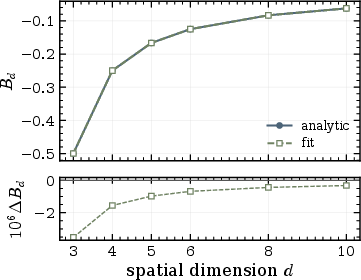
Figure 1: Numerical verification of the corrected logarithmic coefficient in several dimensions, matching the analytic prediction Bd.
The numerical data substantiate that the logarithmic correction's coefficient is strictly determined by dimensionality—tabulated results across Sdisc=N0 to Sdisc=N1 support this analytic extraction with high precision. Deviations are systematically small and stable under variation of the fit interval.
Fixed Charge Sector: Reissner–Nordström Generalization
Expanding the analysis to fixed-charge black holes, the treatment moves to the RN geometry. The discrete step evolution now incorporates the charge as a fixed parameter:
Sdisc=N2
where Sdisc=N3. The seed plus neutral growth framework is introduced: the formation of a charged BH occurs in two stages—a charged "seed" is formed, after which growth proceeds via neutral (uncharged) absorption steps.
Crucially, in the macroscopic, weakly charged regime (Sdisc=N4), the entropy generated during the neutral growth dominates, and the initial seed's contribution is suppressed as Sdisc=N5. The resulting step count features a fundamentally altered logarithmic correction:
Sdisc=N6
thus acquiring explicit dependence on Sdisc=N7. The leading area coefficient remains charge-independent, whereas the Sdisc=N8 term demonstrates pronounced sector-sensitivity for the RN recursion.
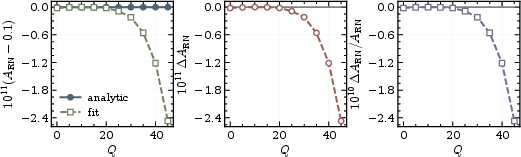
Figure 2: RN leading coefficient Sdisc=N9 and its numerical deviations as functions of charge; d0 remains charge-independent.
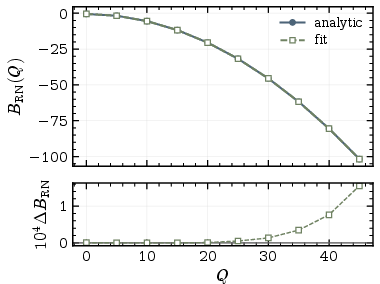
Figure 3: Charge dependence of the RN logarithmic coefficient, numerically following d1.
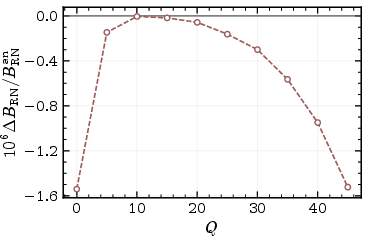
Figure 4: Relative deviation between fitted and analytic RN logarithmic coefficients; discrepancies are minimal and diminish at large mass.
This explicit sector sensitivity implies that extending discrete growth models to include charge, rotation, or other macroscopic quantities necessarily alters the form of subleading corrections and precludes the adoption of a universal logarithmic coefficient across all BH classes.
Combinatorial History, Entropy Decomposition, and Coarse Graining
The paper rigorously distinguishes between dynamical entropy and history entropy arising from ordered (signed) absorption histories. The combinatorial framework considers ordered absorption events labeled by sign (d2) and computes the corresponding history entropy using multinomial distributions. The leading term for unrestricted sign histories is d3—the ternary entropy per step—regardless of microscopic physical realizability.
The analysis emphasizes that coarse grained macroscopic endpoints (d4, d5, d6) necessarily involve degeneracies; multiple microscopic histories (including those with differing label orderings or auxiliary quantum numbers) may map to the same macroscopic state. In a formal sense, history entropy and dynamical entropy can only be equated in non-generic, fully specified protocols. This decomposition is formally written as
d7
where d8 is the Shannon entropy.
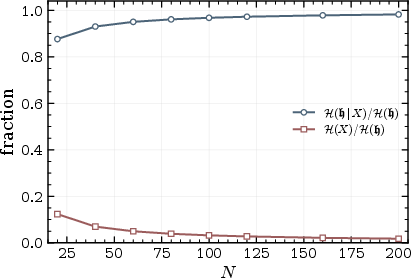
Figure 5: Fraction of total history entropy stored in the macroscopic charge endpoint d9 and in the hidden conditional sector MN+1=MN+KdMN−1/(d−2),0. Most history information is hidden after coarse graining.
The unrestricted combinatorial ensemble further implies that, for large MN+1=MN+KdMN−1/(d−2),1, the charge distribution is Gaussian with variance scaling as MN+1=MN+KdMN−1/(d−2),2. Hence, the typical charge-to-step ratio decays as MN+1=MN+KdMN−1/(d−2),3, resulting in most large black holes being nearly neutral in this ensemble.
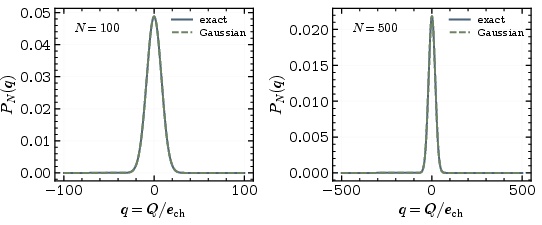
Figure 6: Charge distribution from formal sign-history counting at MN+1=MN+KdMN−1/(d−2),4 and MN+1=MN+KdMN−1/(d−2),5, approaching the predicted Gaussian form.
The work also examines endpoint degeneracy when extra labels such as mass are introduced, demonstrating that while degeneracy is reduced, it is not eliminated, and unique history identification cannot be made absent further physical specification.
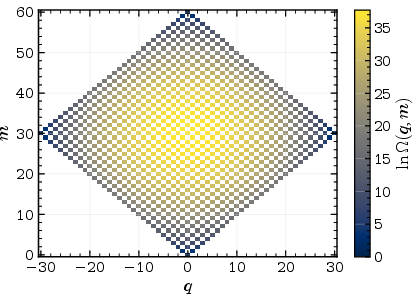
Figure 7: Endpoint degeneracy in an ensemble with both charge and mass labels; degeneracy is reduced compared to pure charge labeling.
Normalization of the Area Law and Stability Analysis
Matching the discrete model to the Bekenstein–Hawking area law requires fixing the microscopic parameter MN+1=MN+KdMN−1/(d−2),6. The model successfully reproduces the structural form of the entropy, but normalization cannot be derived intrinsically and must be set by external input. Stability checks, including variation of fitting windows and analysis of higher-dimensional cases, confirm the robustness of both the area and logarithmic coefficients.
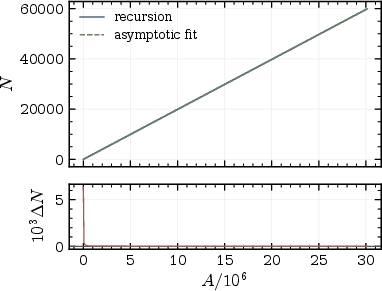
Figure 8: Area-law scaling of the discrete step count in the Schwarzschild sector; fit follows MN+1=MN+KdMN−1/(d−2),7.
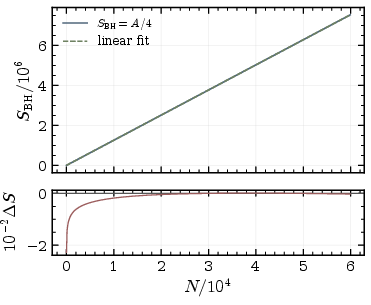
Figure 9: Linear calibration between the discrete step count and Schwarzschild entropy; the slope reflects the microscopic scale.
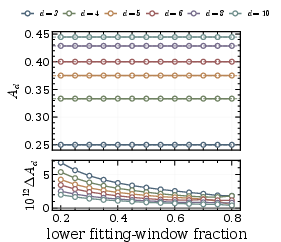
Figure 10: Window stability of the leading coefficient MN+1=MN+KdMN−1/(d−2),8; fitted values are insensitive to window choices.
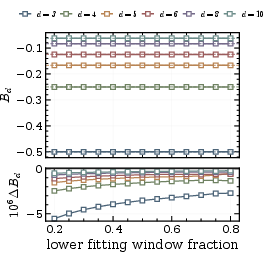
Figure 11: Window stability of the logarithmic coefficient MN+1=MN+KdMN−1/(d−2),9; fitted values consistently yield the analytic outcome.
Theoretical and Practical Implications
The explicit construction and analysis demarcate corrections attributable to discrete kinematics from those necessitating genuine quantum microstate counting. Logarithmic corrections in this framework do not reflect quantum statistical degeneracy but instead encode information about the discrete structure of the growth process. For sector-dependent quantities (e.g., charge), these corrections acquire explicit dependencies at the classical level—future generalizations to angular momentum (rotating black holes) or higher-curvature theories will likely yield further non-universal corrections.
On the practical side, the model provides a tractable laboratory for testing the influence of modified discrete rules and dynamical sector choices on the form of the black hole entropy law, and could be extended to probe more general stationary (e.g., Kerr–Newman) or modified gravity black holes. The authors highlight directions for future research, including dynamically grounded absorption models and the systematic study of near-extremal and multi-parameter black holes.
Conclusion
This work delineates a careful boundary for effective, discrete models of black hole entropy. The framework extends the one bit absorption model to higher dimensions and fixed-charge settings, deriving rigorously a non-universal, sector-sensitive logarithmic correction. The interplay between dynamical bookkeeping entropy and combinatorial history entropy is clarified, demonstrating that coarse graining and microscopic protocol choices critically affect apparent degeneracies. The area law and its first correction are recovered for the discrete model after normalization; further extensions are anticipated to study more complex BH sectors and to bring in realistic absorption channel dynamics. The discrete approach thus offers a transparent, quasiclassical bridge between macroscopic thermodynamic behavior and the still-missing quantum microphysics of black holes.