- The paper introduces a single-parameter, screened-potential framework capturing the Bc meson’s spectrum, precise mass splittings, and state-dependent wavefunctions.
- It computes decay constants and weak transition form factors via QCD three-point sum rules, achieving results in line with lattice QCD and experimental benchmarks.
- Radiative, nonleptonic, and semileptonic decays are analyzed, revealing clear hierarchical channels and highlighting areas for improved QCD corrections.
Framework for Bc Meson Bound-State Dynamics
The study presents a comprehensive phenomenological analysis of the Bc meson, modeling it as a heavy-heavy bound state within a semi-relativistic, screened-potential approach. The Hamiltonian formulation incorporates the full relativistic kinetic energy expanded in powers of momentum up to O(p10) and a central potential, combining a short-distance Coulombic one-gluon-exchange term and a long-range linearly rising, but exponentially screened, confining interaction. Thereby, both spin-averaged masses and fine/hyperfine splittings are described through a consistent treatment incorporating spin-dependent interactions and relativistic corrections.
This single-parameter framework is variationally solved for all orbital and radial excitations. The resulting state-dependent wavefunctions underpin the calculation of spectroscopic masses, decay constants, overlap-sensitive short-distance observables, and wavefunction values at the origin. This approach, while reproducing quarkonium-like features for low-lying states, rationalizes softening at higher excitations, an essential aspect for interpreting Regge phenomenology and upper-level spectroscopy.
Mass Spectrum and Spin Structure
The computed spectrum reproduces ground-state and spin-averaged Bc masses to within a few MeV of lattice-QCD and experimental results, establishing compatibility with existing benchmarks. Excited states, including S-, P-, D-, and F-wave levels, are consistently placed against quark model and relativistic potential model predictions (Table references in the paper). The incorporation of screening is especially evident in the moderate compression of levels for higher excitations, avoiding the overestimation of the mass gap observed in unscreened potentials.
Resolved fine and hyperfine splittings reflect the explicit mass asymmetry of the constituent b and Bc0 quarks—contrasting with the near-degenerate pattern of equal-mass quarkonia—exposing a richer pattern of operator mixings. Parents and daughter Regge trajectories, both in Bc1 and Bc2 planes, demonstrate quasi-linear behavior for higher excitations, with deviations near the ground-state attributable to short-range effects.
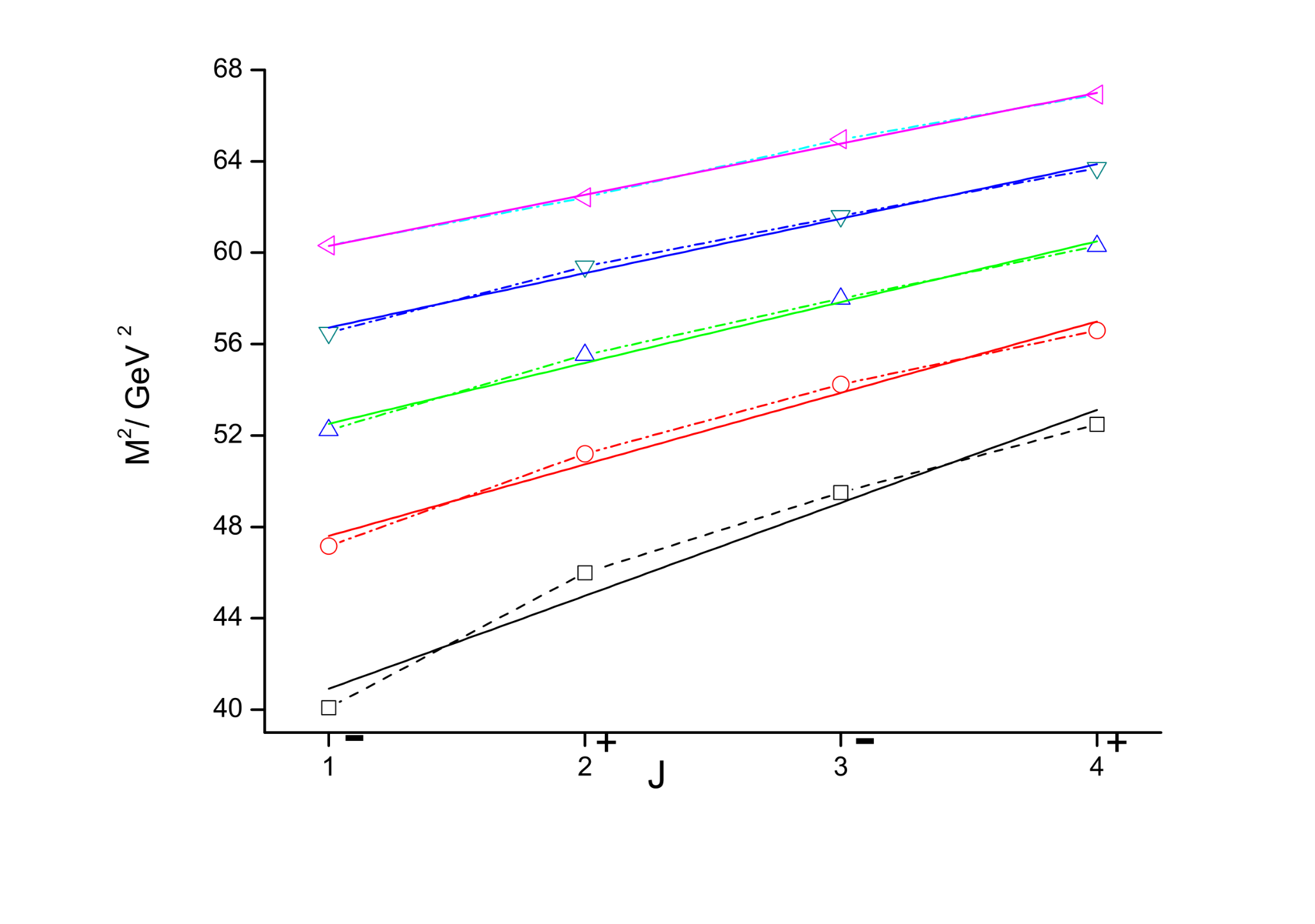
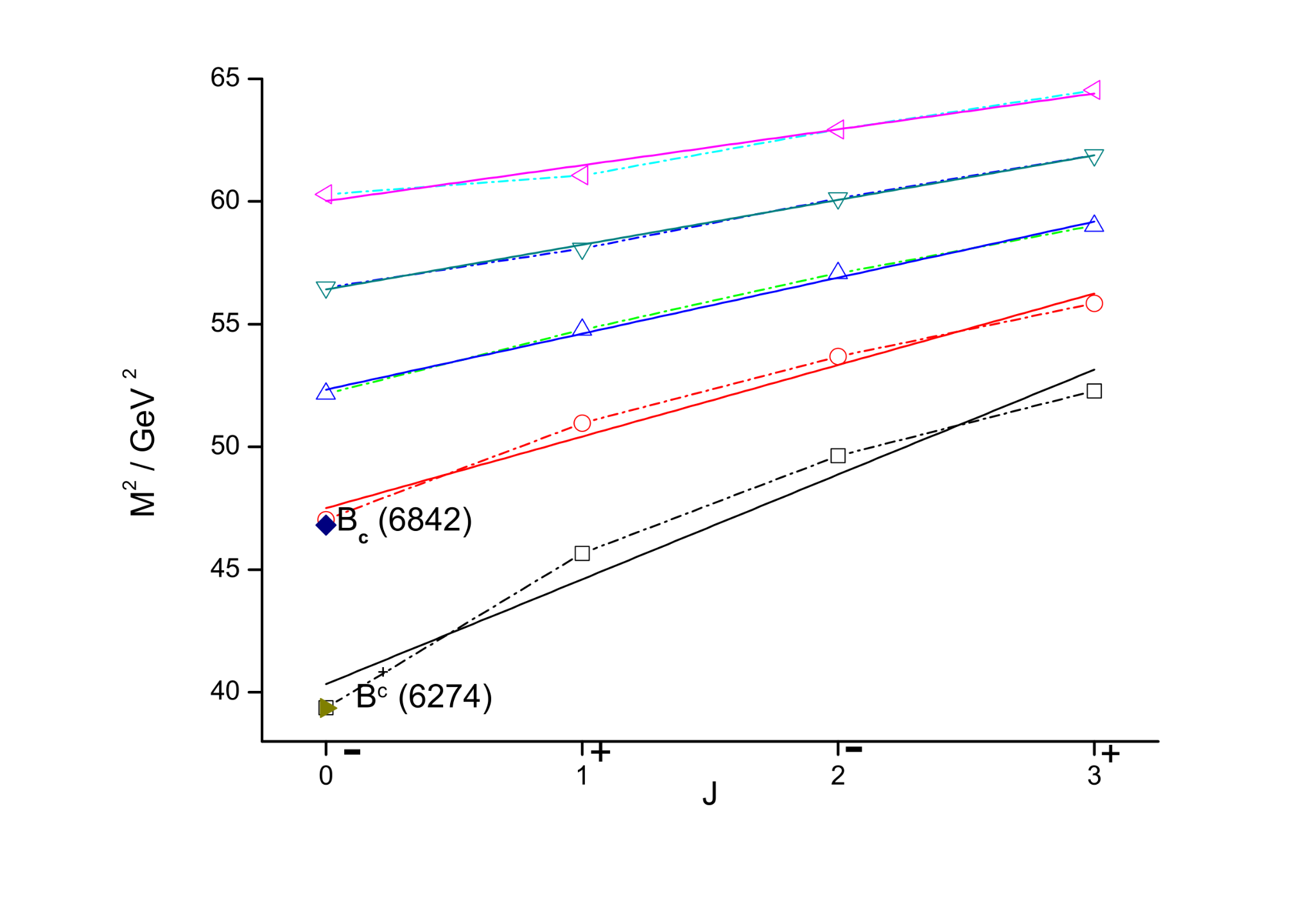
Figure 1: Regge trajectories of the Bc3 meson in the Bc4 plane for natural and unnatural parity states; open and filled symbols distinguish theoretical predictions from observed levels.
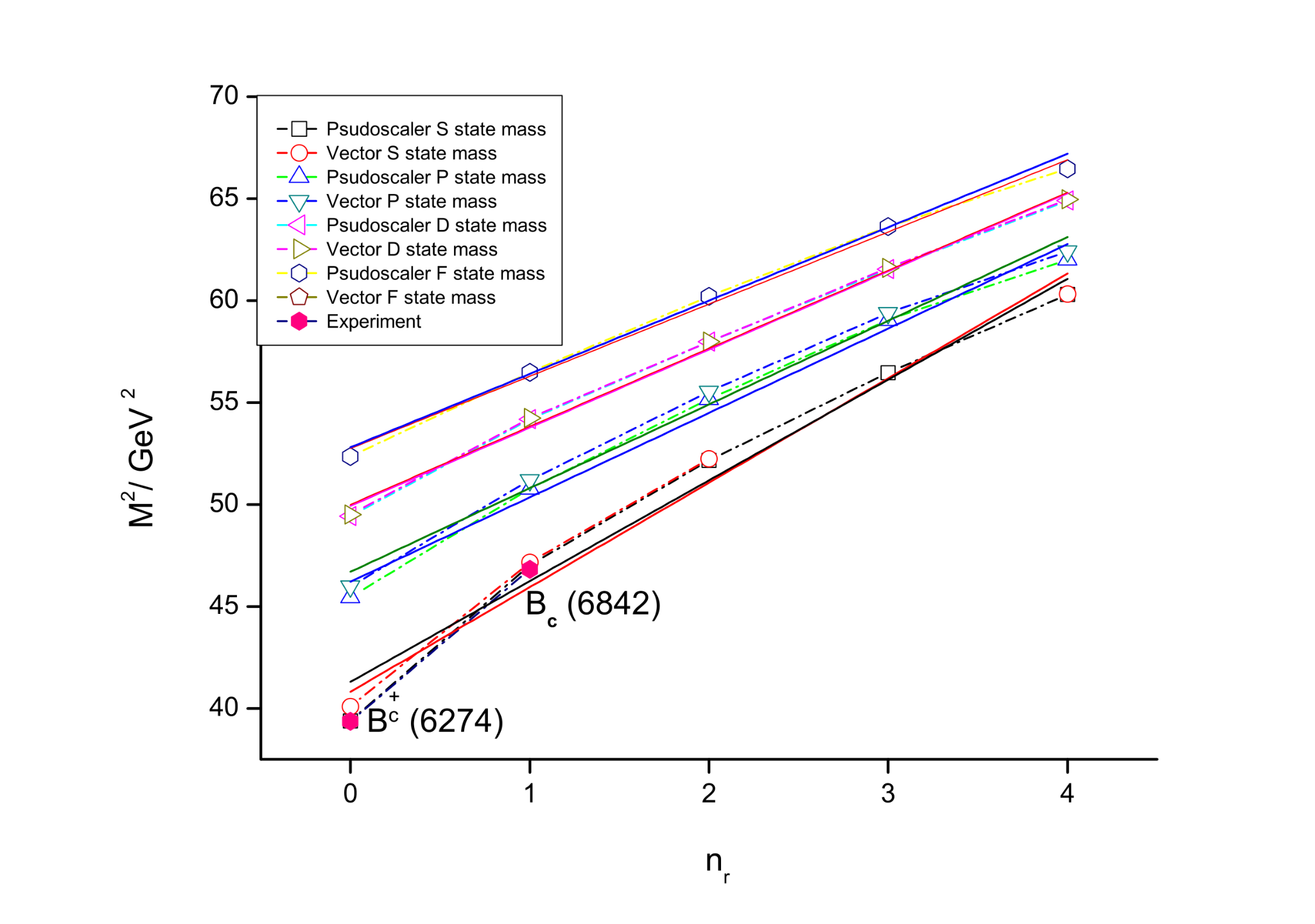
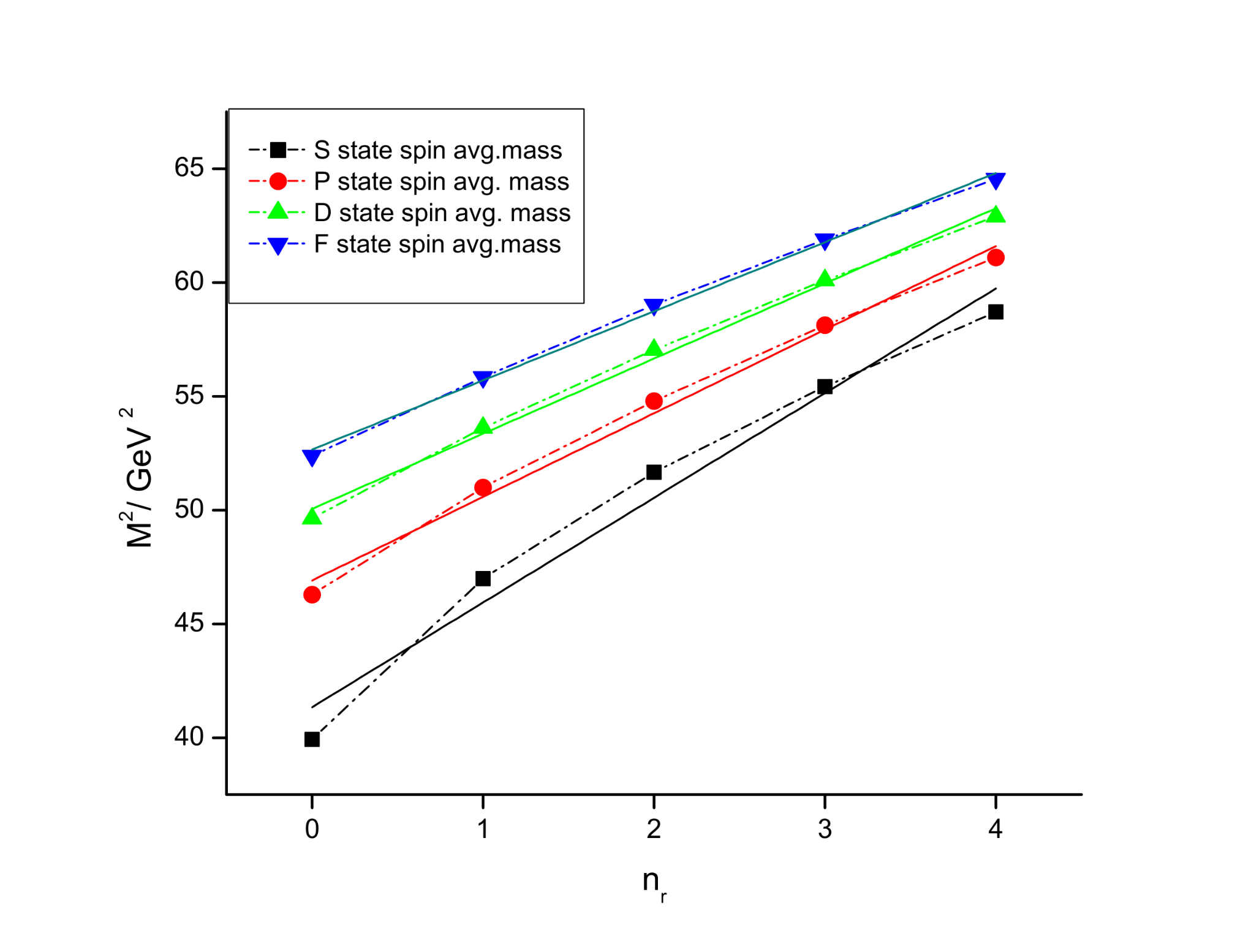
Figure 2: Linear Bc5 Regge trajectories for spin-averaged and flavor-resolved Bc6 states, reflecting uniform radial excitation structure.
Decay Constants and Short-Distance Couplings
Wavefunctions at the origin are exploited, via a relativistically improved Van Royen-Weisskopf relation, to extract leptonic decay constants for both pseudoscalar and vector states. For the ground state, Bc7 converges with lattice and sum-rule estimates, Bc8–Bc9, while radial excitations display the expected monotonic suppression due to increased spatial extension, a direct prediction of the screened potential.
This decay-constant normalization coherently sets the scale for all short-distance observable calculations: weak-annihilation widths, purely leptonic branching ratios, and weak/EM transitions.
Transition amplitudes—pivotal for predicting exclusive weak decays—are calculated using QCD three-point sum rules. These are numerically evaluated in the spacelike domain and then analytically continued to the physical kinematic region via a truncated Bc0-series expansion. The renormalization procedure, including an explicit update of quark masses and normalization constants, is sector-specific to match the spectrum and decay framework.
A robust channel hierarchy emerges: Bc1-wave transitions Bc2, Bc3 dominate, with normalization sensitive to Coulomb and mass corrections. The analysis determines:
- Semileptonic widths: In the corrected scenario, Bc4 widths are the largest, followed by Bc5; Bc6- and Bc7-wave modes are strongly suppressed but hierarchically ordered (see Tables and Figures provided).
- LFU ratios: The results yield Bc8 and Bc9, compatible with the Standard Model and lattice QCD, and well below the original LHCb central value. No significant lepton flavor universality violation is observed given the uncertainties.
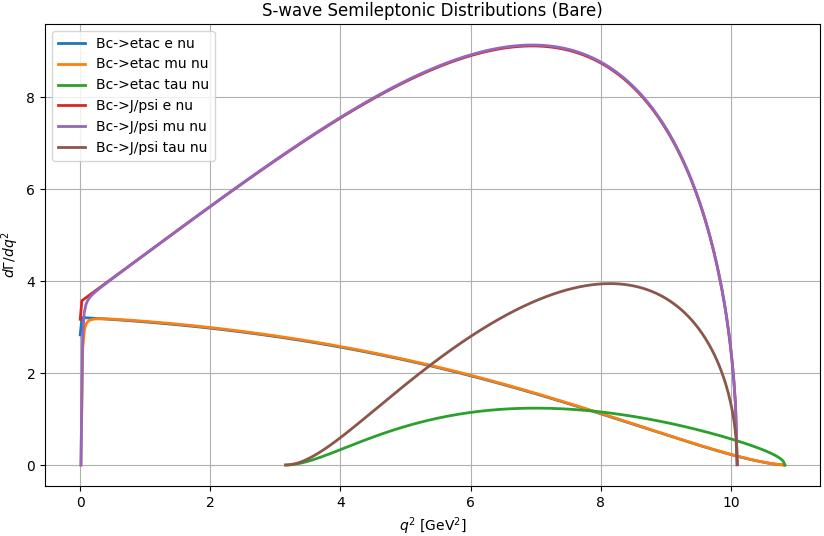
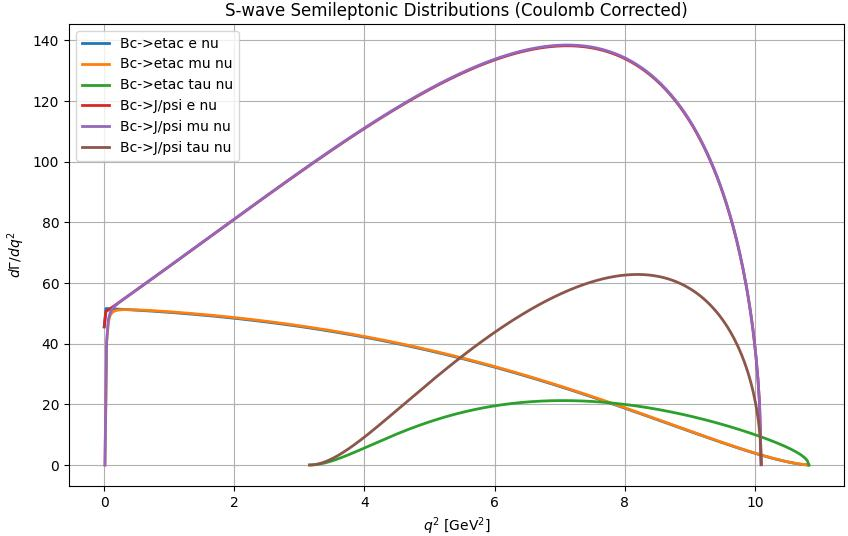
Figure 3: Differential decay widths in the O(p10)0-wave sector for bare and Coulomb-corrected calculations, showing the predominance of O(p10)1 over O(p10)2 transitions.
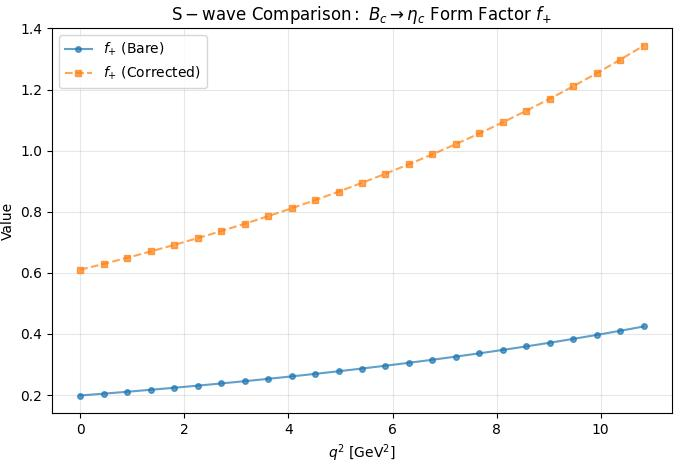
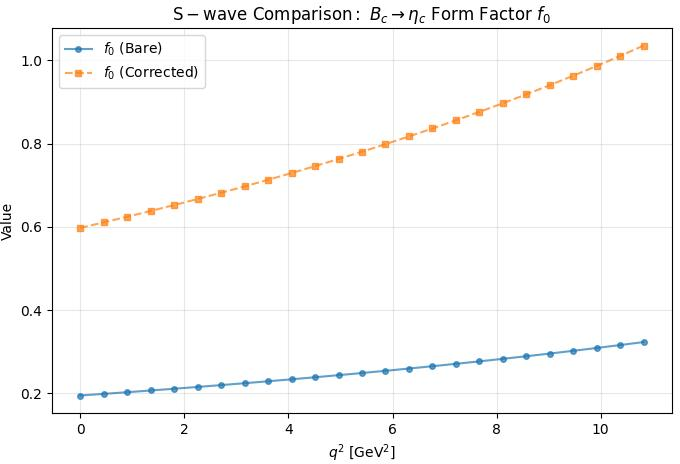
Figure 4: Bare and corrected O(p10)3 form factors O(p10)4 and O(p10)5; corrections systematically elevate normalization and improve theory/data consistency.
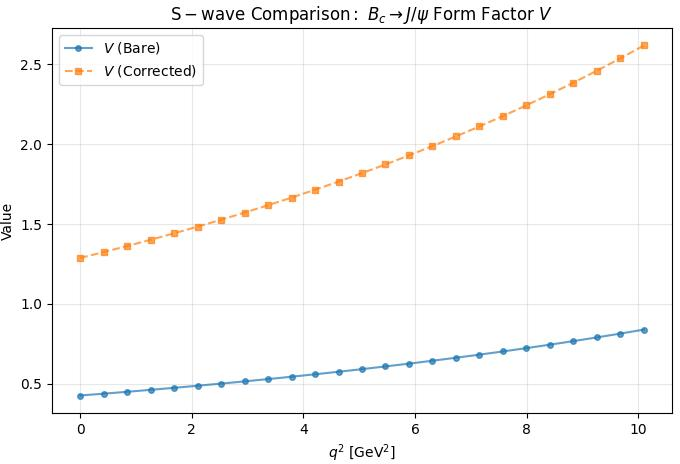
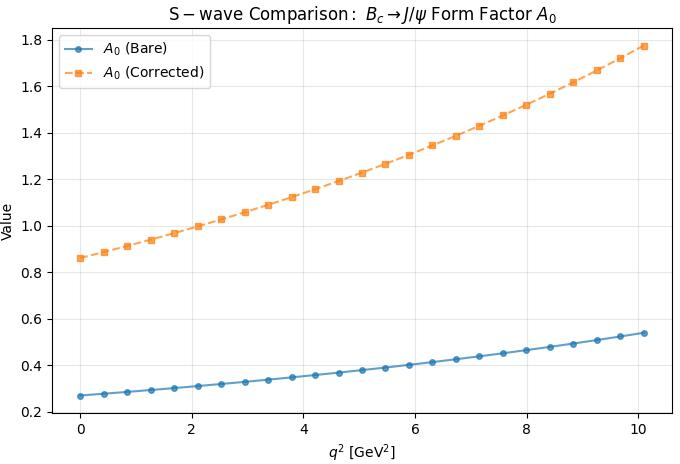
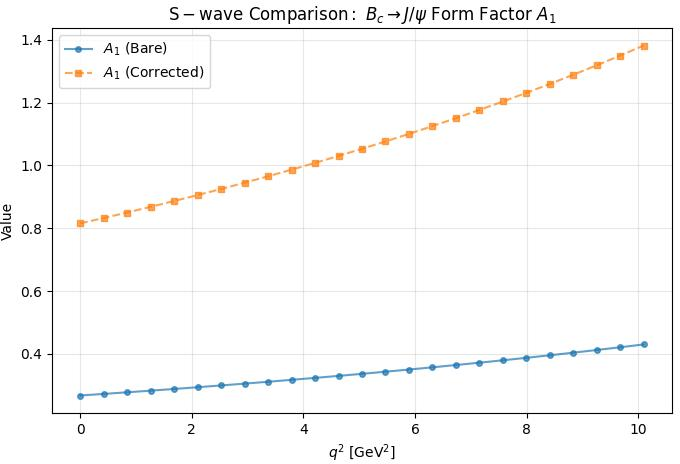
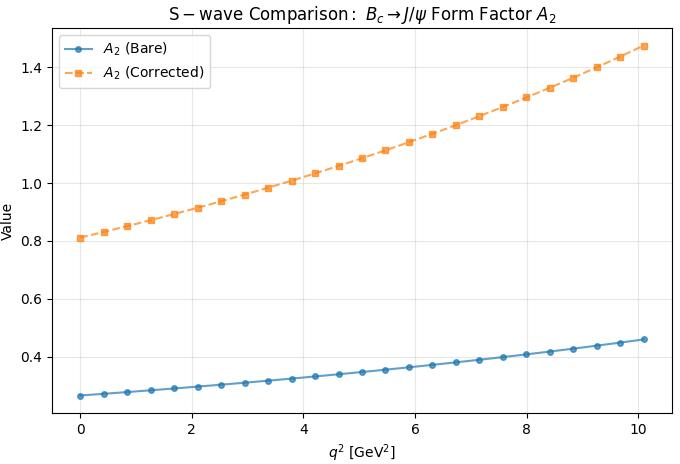
Figure 5: O(p10)6 form factors O(p10)7, O(p10)8, O(p10)9, Bc0 for both calculation variants, controlling distribution shapes for differential widths and angular observables.
For Bc1-wave final states, Bc2-rich channels are singled out as dominant over Bc3, a robust claim supported by sum-rule and Bethe-Salpeter comparanda. Bc4-wave transitions, still accessible only theoretically, present a consistent multiplet ordering with systematic suppression.
Nonleptonic Two-Body Modes
Factorizable nonleptonic decays involving charmonia and Bc5 are computed using the same form factors and modern decay constants. The flavor and spin hierarchy is unambiguous: decays to Bc6 are heavily favored over non-strange Bc7 via CKM and decay constant enhancement. However, the predicted normalization for leading channels is systematically lower than measured Bc8 branching fractions from LHCb/ATLAS, indicating a need for improved non-factorizable QCD effects or higher-order corrections.
Purely Leptonic and Inclusive Widths
Purely leptonic widths for Bc9 and S0 are computed, accounting for weak-annihilation and all-spectator processes. The predicted inclusive lifetime is on the longer side (S1 ps) relative to experimental determinations and recent OPE-based Standard Model calculations, signifying an underestimation of total width—potentially due to missing higher-order effects or unaccounted nonperturbative contributions.
Radiative Transitions
S2 radiative transitions dominate the EM sector, with computed widths matching the established magnitude (S3 keV)), validating the orbital structure of the model wavefunctions. S4 transitions, strictly allowed and hindered, show the anticipated suppression and are consistent with the spread among quark models.
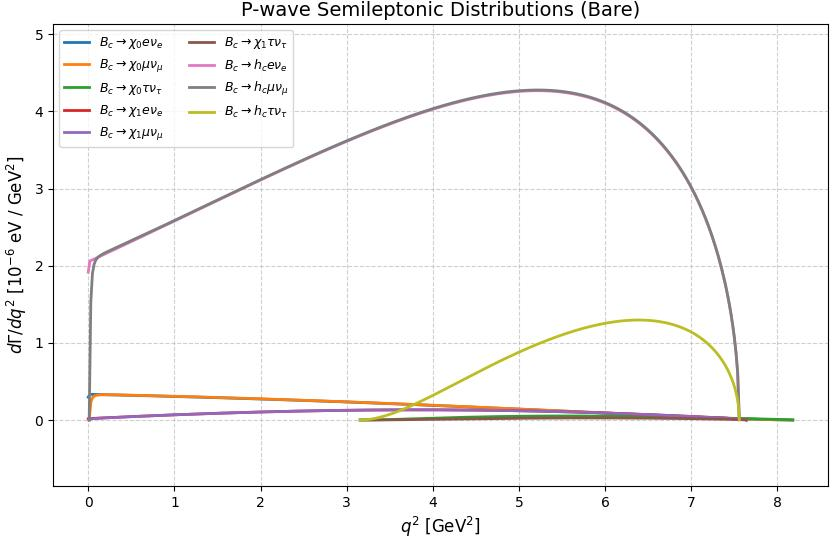
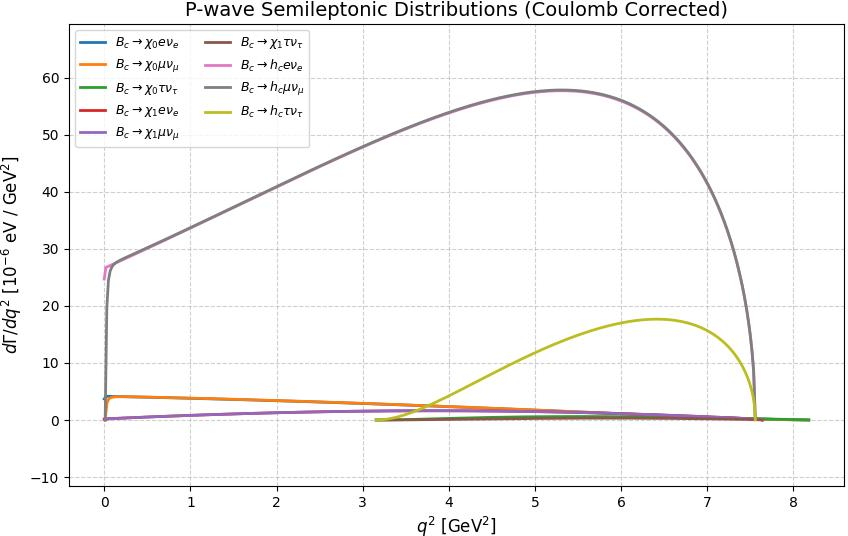
Figure 6: S5-wave sector differential widths, highlighting the dominance of particular tensor and axial-vector channels after Coulomb correction.
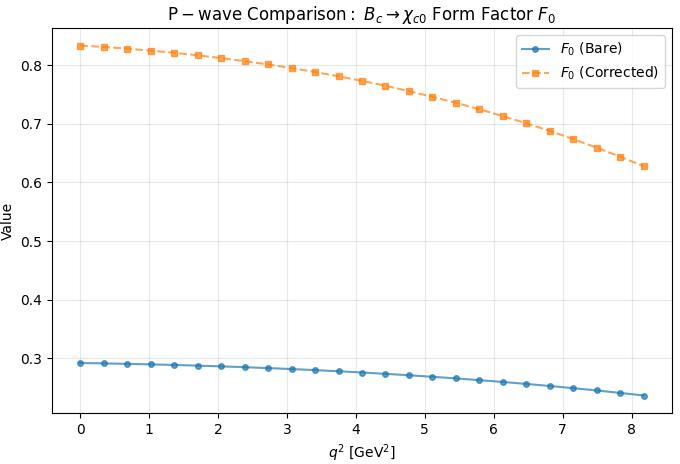
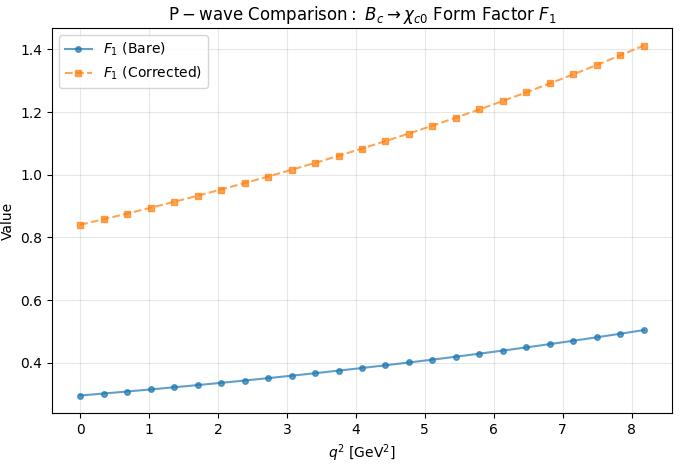
Figure 7: S6 form factors S7 and S8, dictating exclusive width and S9 distributions for these suppressed final states.
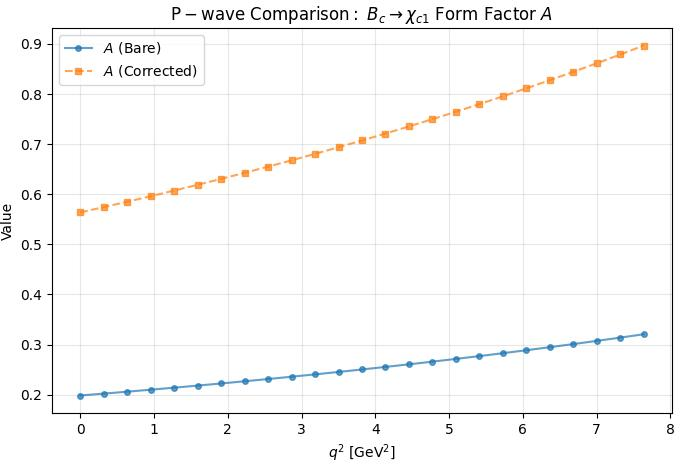
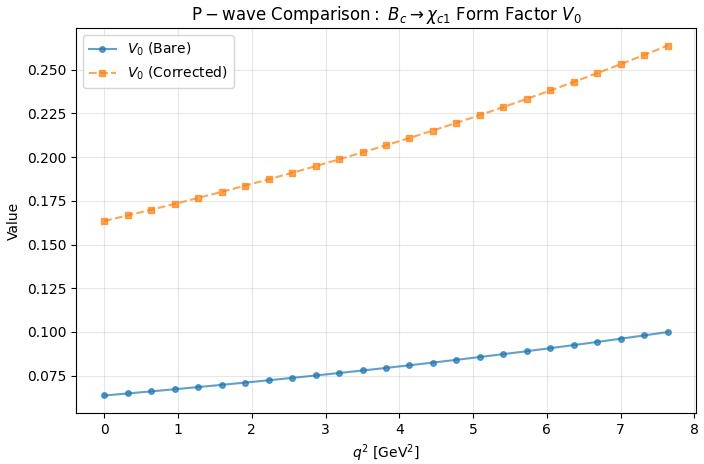
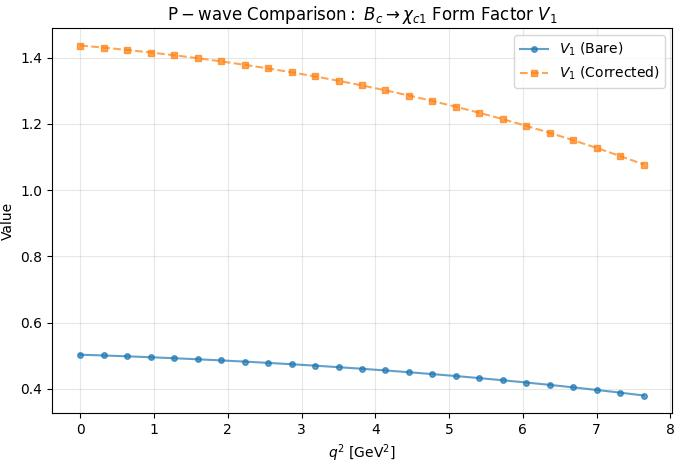
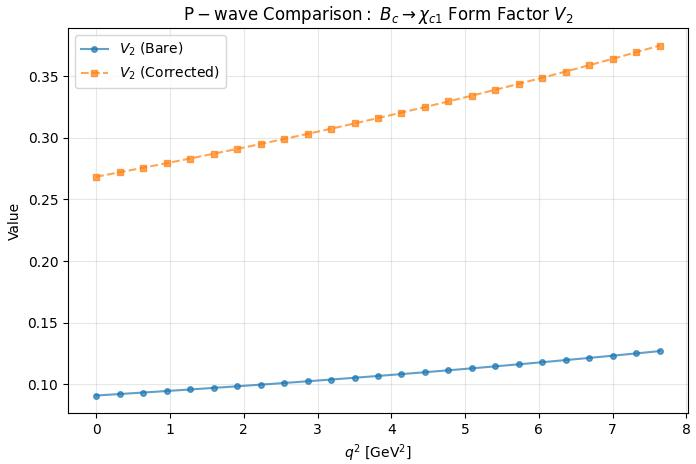
Figure 8: P0, P1 form factors, controlling angular and polarization signatures in the P2-wave sector.
Global Phenomenology and Future Prospects
This work provides a unified and internally consistent phenomenology for the P3 system, where the screened-potential spectrum and state-dependent wavefunctions act as the organizing principle for all decay, radiative, and transition observables. The framework produces key results:
- Quantitative agreement with lattice and PDG for low-lying spectra.
- Channel-hierarchical weak decay predictions: S-wave semileptonic modes are dominant and numerically robust; P- and D-wave hierarchies align with recent sum-rule and lattice analyses.
- Strong numerical enhancement from Coulomb corrections, especially in pseudoscalar-mediated transitions.
- Regge trajectories manifesting approximately linear behavior—and hence consistent with the softening of the potential at high excitation.
- Discrepancies in nonleptonic decay normalization and inclusive lifetime, flagging the need for improved treatments of short-distance coefficients, non-factorizable corrections, and higher-order weak-interaction effects.
Implications for future research in AI-driven hadronic physics include:
- Enhanced modeling of heavy-heavy effective interactions with further systematic inclusion of coupled-channel and QCD corrections.
- Quantitative improvement in nonleptonic two-body modes through explicit QCD factorization and inclusion of power corrections.
- Utilization of Regge-trajectory fits as global consistency metrics for model-building.
- Provision of detailed, channel-differentiated observables as cross-validation targets for forthcoming LHC and Belle II measurements of excited P4 states and rare decay modes.
Conclusion
The screened-potential framework, incorporating relativistic and spin-dependent effects, provides a technically coherent and numerically viable description of the P5 meson from its spectrum up to its weak, radiative, and annihilation-induced decays. While the approach robustly captures the main features and hierarchies of the P6 system, persistent discrepancies in total width and selected exclusive modes highlight the importance of dynamic QCD effects and provide avenues for further theoretical refinement. As experimental data on excited states and rare transitions improves, frameworks such as this will underpin the systematic confrontation of strong- and weak-interaction dynamics in heavy-heavy mesons.