- The paper proposes a novel quantum localization method that rigorously ensures an unclonable quantum state is present solely at a verified spacetime location.
- It introduces quantum anchor states and trajectory verification, employing ideal obfuscation and repeated protocol tests to secure moving quantum information against distributed attacks.
- The work critiques existing protocols like f-BB84 and extends the concept to state and functionality localization, paving the way for advanced position-based cryptographic applications.
Qubit Localization and Trajectory Verification: Technical Summary of "How To Track Qubits Through Space and Time" (2605.30732)
Motivation and Limitations of Prior Work
Position-based quantum cryptography, especially Quantum Position Verification (QPV), seeks to certify that quantum information—such as a secret or a capability—was present at a specific spacetime location. Classical position verification is trivially breakable due to collusion and copy attacks, but quantum versions rely on the no-cloning theorem for security. In prior QPV protocols, the typical guarantee is that at least one party in a distributed coalition must be at the claimed location to accomplish a successful attack. However, this fails to link “being at a location” meaningfully to the indivisible presence of quantum information, especially in settings involving distributed adversaries, trajectory verification, or statements about localization in time as well as space.
Contributions: Strengthening Notions of Quantum Localization
The paper addresses this gap by introducing quantum localization: a stronger, operationally meaningful standard. Instead of merely asserting some adversarial process occurs at a point, quantum localization demands that a specific unclonable state is present at the verified spacetime point, and nowhere else. This entails:
- Entanglement Localization: Localizing one half of a bipartite entangled state at a specific spacetime point, such that no distributed strategy can simulate successful protocol execution without that state being there.
- Trajectory Verification: Verifying not just a static position, but the continuous movement of quantum information along a claimed spacetime path, excluding attacks that distribute the “path” among distinct spatial agents.
Protocol Construction: Quantum Anchor States
Central to the construction are quantum anchor states, which generalize coset states from unclonable cryptography. An anchor state
is composed of an “anchor” (kept by the verifier) and a “vessel” register (sent to the prover). The essential design properties are:
- The anchor and vessel are maximally entangled across a carefully structured subspace, defined by hidden parameters only known to the verifier (e.g., subspaces S≤T≤F23n and random shift vectors).
- The vessel register is structured such that only a prover at the correct spacetime point in possession of vessel and properly timed and located verifier challenges can perform coherent oracle queries and obtain the correct responses.
- After challenge/response, the entanglement is not destroyed, allowing repeated tests as required for trajectory protocols.
Implementation is formulated in the ideal obfuscation (classical oracle) model: All parties share black-box access to an ideally obfuscated classical functionality; in practice, instantiable via indistinguishability obfuscation plus post-quantum cryptography.
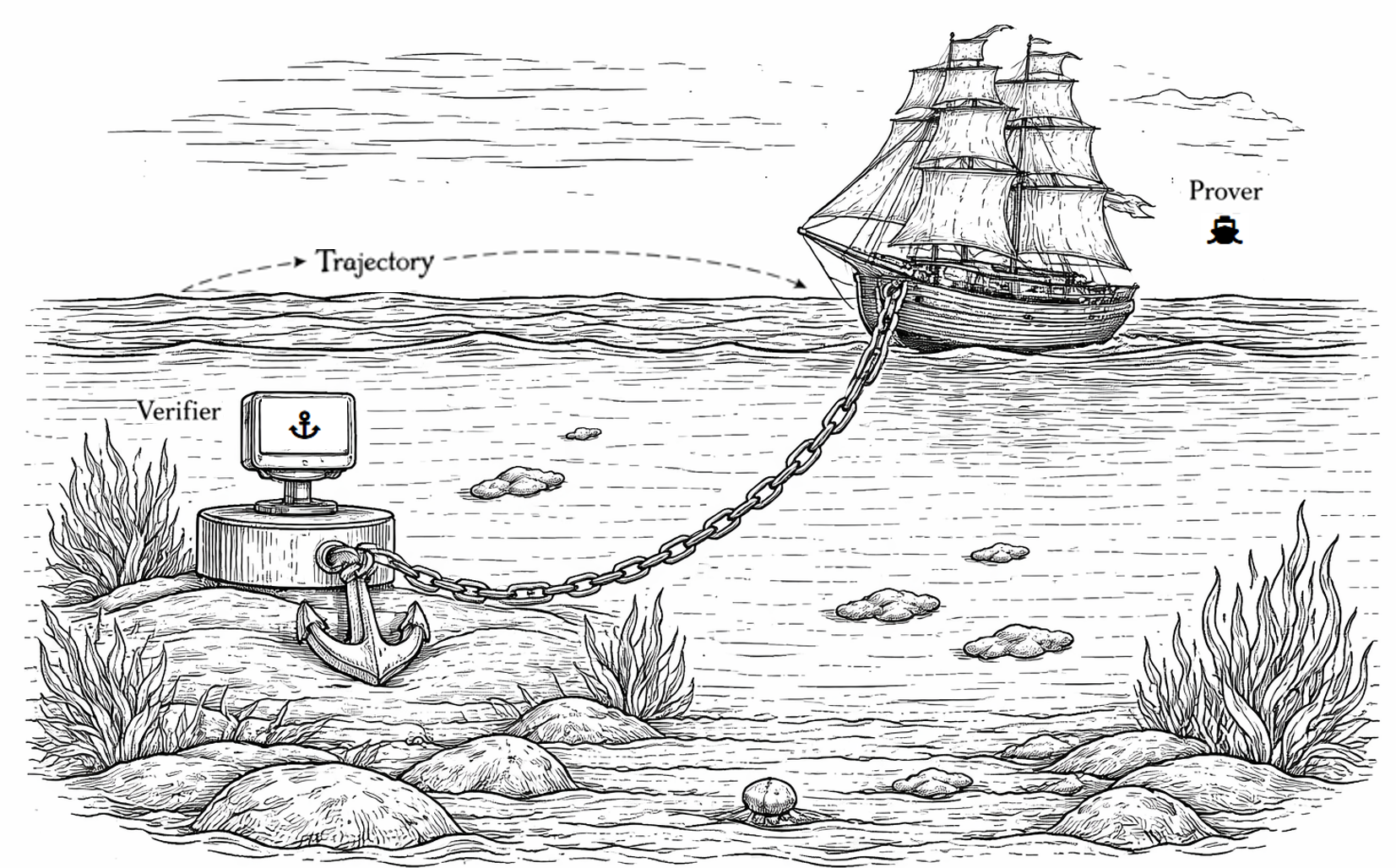
Figure 1: A quantum anchor, with the anchor region held by the verifier and the vessel launched across spacetime, reflecting the persistent quantum correlation enforced in the localization protocol.
For any adversarial strategy passing the protocol with non-negligible probability, there exists an extractor—using the transcript and quantum state (at the claimed spacetime location)—that can recover the vessel register such that the global system (anchor + vessel) remains close in fidelity to the original anchor state. Thanks to monogamy-of-entanglement, this strictly localizes the quantum resource: if it exists at the supposed location, it cannot “also” exist anywhere else.
In the multi-step (trajectory) case, a sequence of such localizations is chained, each tied to a spatial point on the trajectory at the corresponding time. Repeated protocol execution in staggered bases—standard/Hadamard—ensures security against adaptive, distributed attacks, reducing soundness error as a function of protocol repetitions.
Theorems in the work demonstrate completeness (honest protocol acceptance with probability 1), and extraction soundness: If a strategy passes with probability η, fidelity of the extracted anchor state is at least 1−O((log(1/η)/γ)1/4) for repetition parameter γ, with localization holding for each spacetime checkpoint of the trajectory.
Negative Result: Limitations of f-BB84
A significant, bold claim is that widely cited protocols like f-BB84 do not satisfy entanglement localization. The authors exhibit explicit attacks where entanglement is never locally present at the critical spacetime site, but is instead nonlocally distributed among colluding provers—a fundamental information-theoretic limitation even in the quantum regime.
Extensions: State and Functionality Localization
Beyond entanglement, the authors extend the paradigm to:
- State Localization: Localizing an unclonable quantum state (rather than one entangled half), such as coset or BB84 states, where passing the protocol implies the unique presence of the state at the verified point.
- Functionality Localization: Localizing the ability to compute a secret function (not just access to a quantum state), such that it is usable only at the verified spacetime coordinate, and cannot be implemented in a distributed or duplicated fashion elsewhere. This builds upon quantum copy-protection and relies on ideal obfuscators for classical functionalities.
Implications and Future Directions
The work furnishes a more robust foundation for position-based cryptography, highlighting gaps in prior security models and protocol designs. The notion of functionality localization is particularly noteworthy: cryptographic functionalities (and thus computational capabilities themselves) can, in principle, be anchorable in spacetime in an unclonable, unshareable fashion. This unlocks cryptographic primitives such as time/location-gated decryption, computation, or authentication with meaningful localization guarantees.
Potential future directions outlined include:
- Generalization to higher spatial dimensions, and to more flexible/adaptive challenge distributions.
- Extension to protocols with purely classical communication.
- Robustness under noise and allowance for bounded inaccuracy in the claimed trajectory.
- Exploration of zero-knowledge or privacy-preserving trajectory verification variants.
Conclusion
This work proposes and formalizes new operational notions of quantum and computational localization, with secure protocols for both static and continuous (trajectory) tracking of indivisible quantum resources through spacetime. The construction, based on quantum anchor states, achieves rigorous extraction and uniqueness guarantees, advancing the theory of position-based cryptography and unclonable quantum information. Critically, it exposes limitations in existing approaches and provides a blueprint for the next generation of cryptographic schemes that articulate physically meaningful trust assumptions about the spatial and temporal location of information.
Reference:
"How To Track Qubits Through Space and Time (Or: Sailing in a Quantum Boat)" (2605.30732)