Agnosiophobia in a virtual agent: behavioral and dynamical architecture in Lenia
Abstract: All embodied agents are fundamentally patterns in physiological or other excitable media, blurring the distinction between objects and processes. Emergent patterns with complex behaviors, such as Gliders in the Game of Life and virtual patterns in Lenia, are powerful model systems in which to understand the properties and origins of behavioral traits in novel agents. To evaluate the behavior of patterns in Lenia, we introduce regions into their environment from which no sensory information is available - in effect, making creatures blind to parts of their surroundings. Complementing the conventional concept of infotaxis, we find that creatures tend to avoid these regions, a behavior we term agnosiophobia. To explain this behavior, we map each test creature's sensitivity to targeted occlusions and interpret the results in the language of dynamical systems. We observe Lenia creatures taking advantage of their freedom to change heading in order to achieve what appears to be a more fundamental goal: the preservation of their morphology. This work illustrates the beginning of an important roadmap to understand how emergent agents' behavioral propensities interact with the informational, not only tangible, topography of their world.
Paper Prompts
Sign up for free to create and run prompts on this paper using GPT-5.
Top Community Prompts
Explain it Like I'm 14
What is this paper about?
This paper studies “living-looking” patterns in a computer world called Lenia. These patterns, called creatures, keep their shape and move across a grid even though they’re made only of numbers and rules. The researchers asked: if parts of the world are hidden so the creatures can’t “see” them, do the creatures change how they move? Surprisingly, many of them do—they tend to turn away from the unknown. The authors call this behavior “agnosiophobia,” which literally means “fear of not knowing.”
What questions are the researchers asking?
- Do Lenia creatures avoid areas where they can’t sense anything, even though no one programmed them to do that?
- Which parts of a creature’s body are most sensitive to having their “senses” blocked?
- Can we explain this behavior using ideas from dynamical systems (a way of thinking about how things change over time and settle into stable patterns)?
- What does this tell us about “goal-directed” behavior in simple, brainless systems?
How did they test this?
First, a quick picture of Lenia in everyday terms:
- Think of the grid as a flat world.
- Each creature is a moving, self-maintaining blob-shaped pattern.
- Every cell in the blob “looks” around itself using a sensing field (like a fuzzy circular radar). Based on what it senses, it updates itself, helping the creature keep its shape and move.
What the researchers did:
- They created “occluded” regions in the grid—blackout zones where the creature’s sensing field gets no information, like walking near thick fog or a soundproof wall.
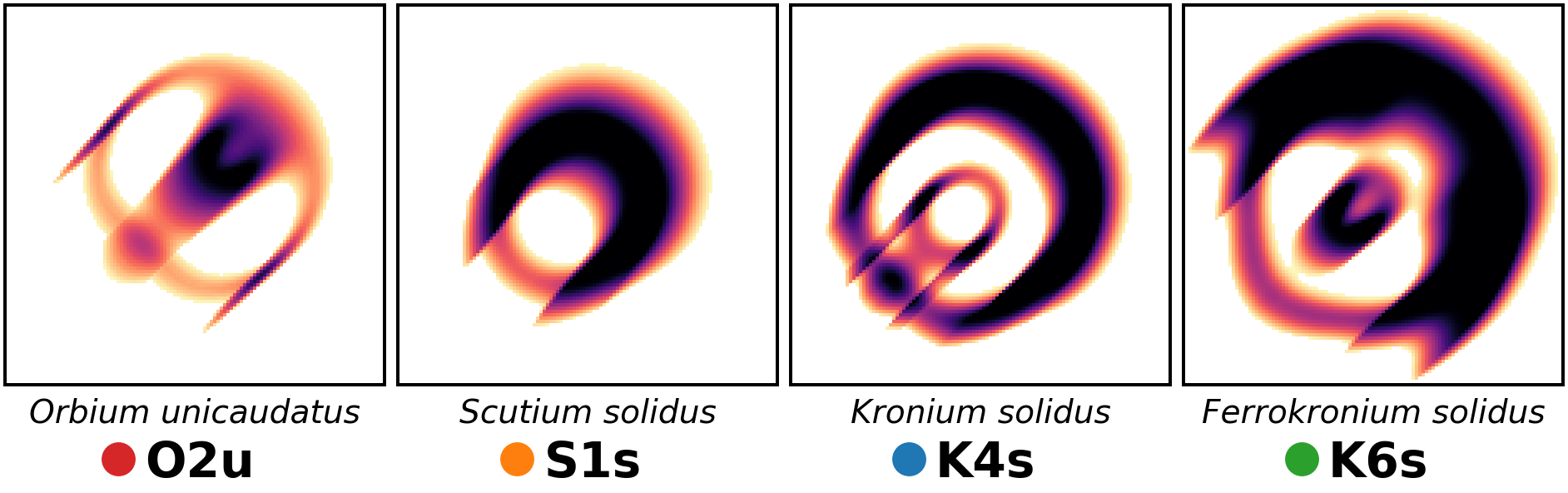
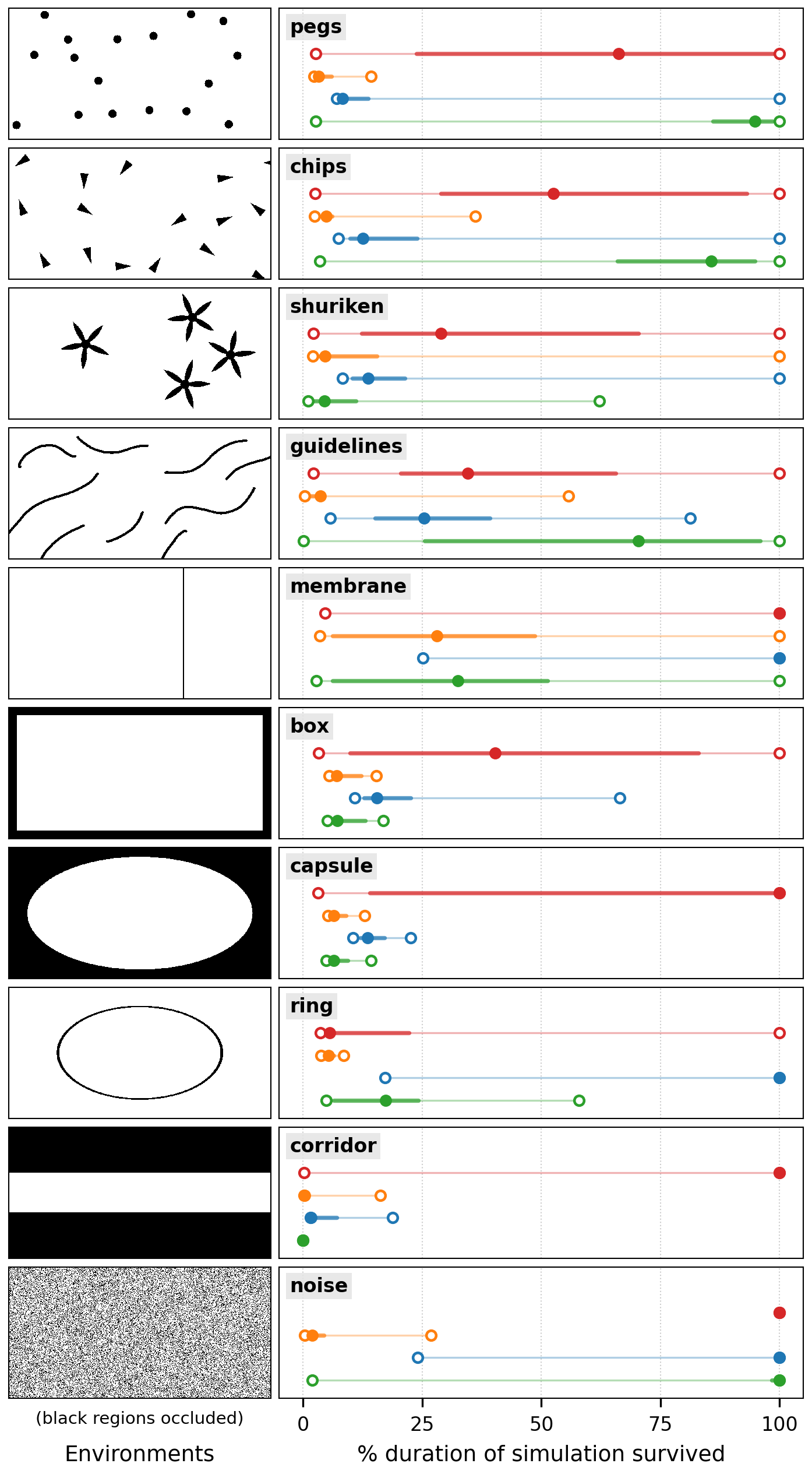
- They placed four different creatures into ten types of worlds with different blackout shapes, started each creature facing 360 different directions, and let them run.
- They tracked whether each creature survived, turned, exploded into chaos, or died.
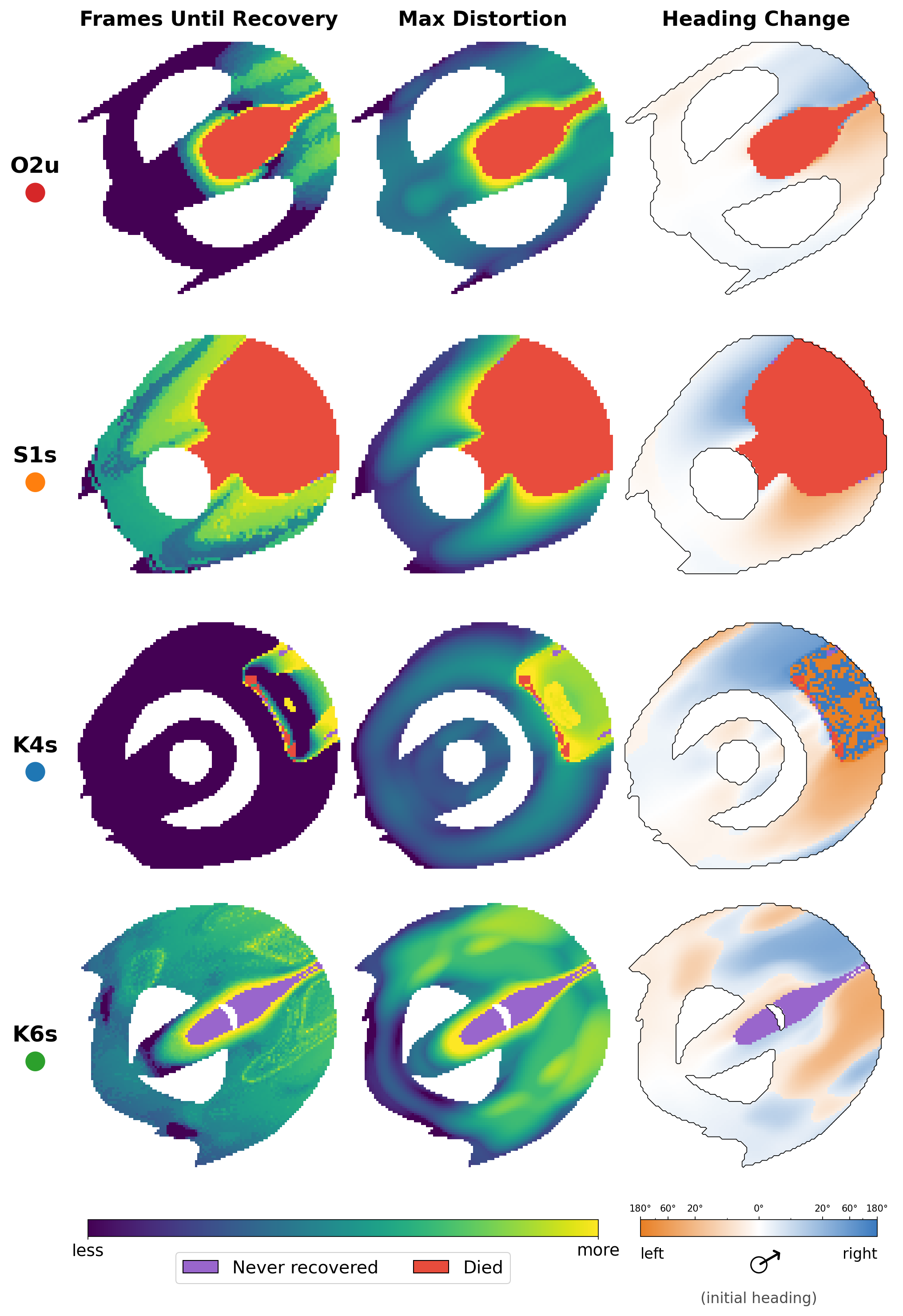
- To understand which body parts matter most, they also placed a tiny 3×3 blackout patch over every location on a creature’s body (one spot at a time) and watched how the creature recovered.
How they measured “same creature” vs. “broken creature”:
- Creatures naturally wiggle a bit from frame to frame. So the team made a simple, shape-focused score that compares how “active” each pixel is, ignoring exact position and facing direction.
- If the creature’s shape returned to its usual “neighborhood” of looks, they counted it as recovered. If its mass vanished, it died. If it grew wildly or changed into a different pattern, it “exploded” or “metamorphosed.”
What did they find?
- Avoidance emerges: Three of the four creatures (O2u, K4s, K6s) tended to turn away from the blackout zones without being explicitly programmed to avoid them. One creature (S1s) was too fragile and often died on contact.
- Different styles of avoidance:
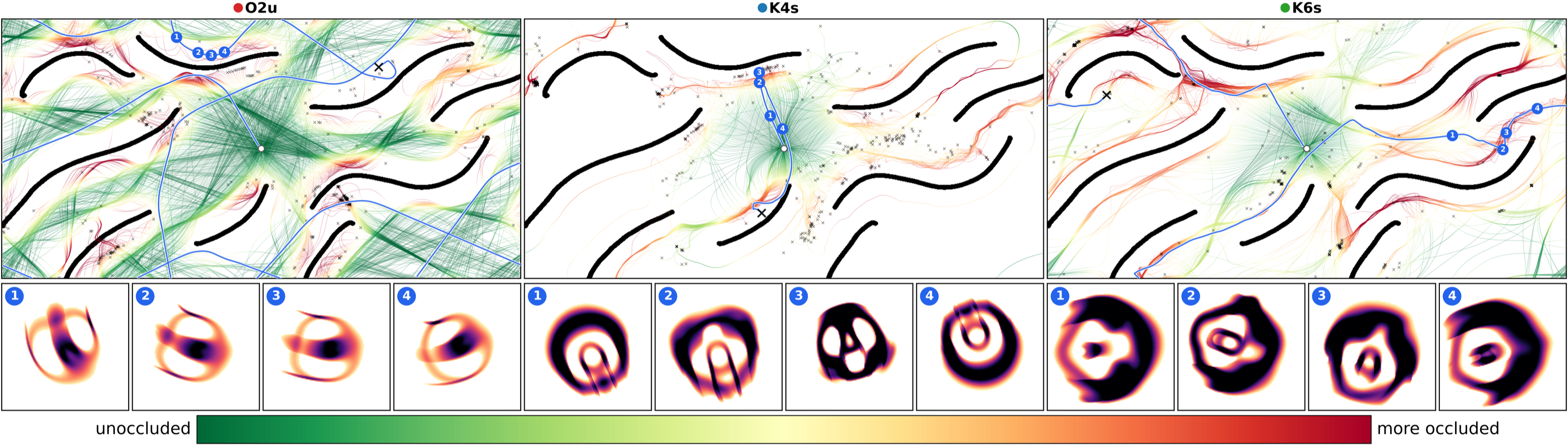
- O2u (Orbium): Strong, smooth avoidance—when the blackout zone appeared on its front-right side, it rotated left, and vice versa, often in time to steer clear.
- K4s: Sometimes slid along the edge, sometimes collapsed into a temporary shape and then “re-emerged” going the opposite way.
- K6s: Often skirted along the edges of blackout regions instead of immediately turning away.
- S1s: Rarely survived; it had little “buffer” to adjust before failing.
- A “map” on their bodies: When the tiny 3×3 blackout was moved over each body spot, the researchers saw clear zones:
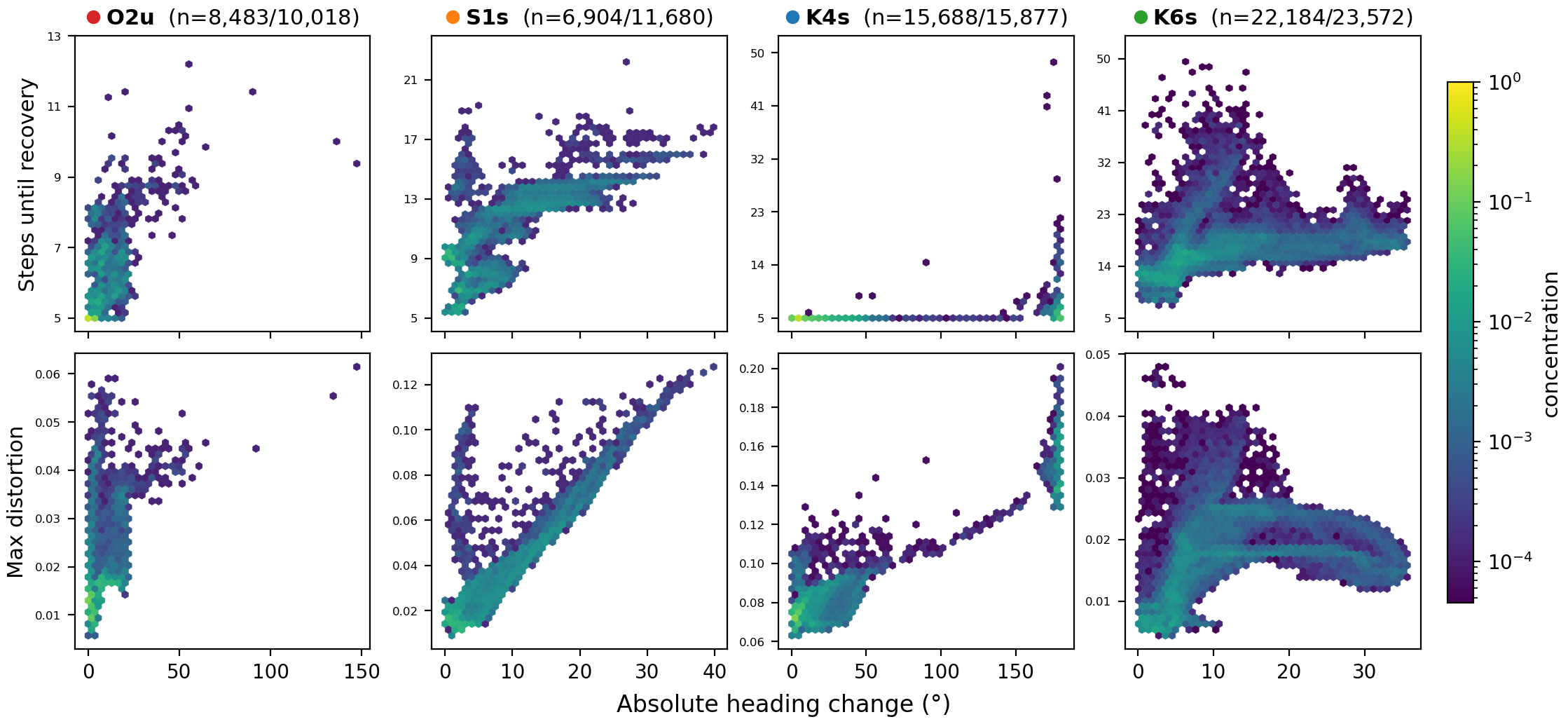
- “Quiet” zones: Small disturbance, fast recovery, little heading change.
- “Reorientation” zones: Disturbance causes the creature to recover by turning a noticeable amount.
- “Lethal” zones: Disturbance pushes the creature into death or chaos.
- Importantly, the strongest turn zones sit right next to lethal zones. That means big turns usually come with big stress and longer, wobblier recovery.
- Big turns need tough recoveries: Large heading changes almost always happened after longer and more distorted recoveries. Quick, clean recoveries rarely changed direction much.
How do the authors explain this?
They use the idea of a dynamical system:
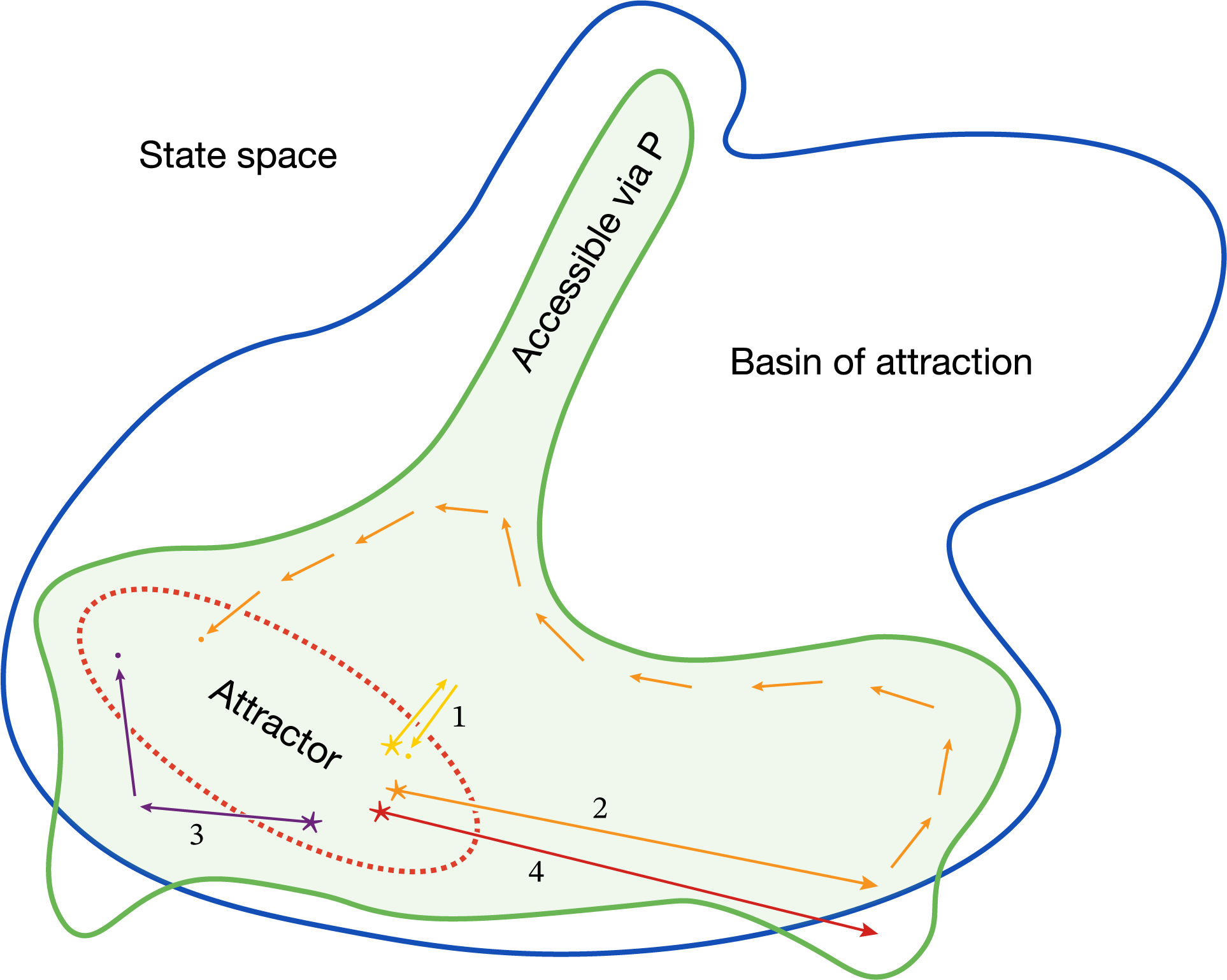
- Imagine a marble rolling inside a bowl. Over time, it settles into a stable place at the bottom. That stable spot is called an attractor.
- A Lenia creature isn’t a single still point, but more like a stable “ridge” of states—the same creature can be in many positions and face different directions while still being “itself.” That “ridge” is the creature’s attractor.
- The basin of attraction is the surrounding area that leads back to that attractor; push the marble a bit and it still rolls back.
- When a creature is disturbed by a blackout, it’s pushed away from its attractor. If it’s still inside the basin, it recovers. Near the edge of the basin, recovery paths can get long and weird—and that’s where big heading changes happen.
Two key ingredients for agnosiophobia (turning away from the unknown):
- Free direction: The creature’s direction (heading) is a “free variable”—it can change which way it’s pointing without stopping being “itself.”
- Coupling: The way disturbances push the creature should naturally “flow” into changes in heading during recovery.
In the successful avoiders, the sensitive “turning” zones on the front come before the lethal zones. That gives them time to turn away before it’s too late. In the fragile creature (S1s), lethal zones are right up front, leaving no room to reorient.
Why is this important?
- Hidden smarts in simple rules: Even with no brain and no explicit “danger map,” some creatures act as if they avoid risky unknowns. Their “goal” seems to be to keep their body shape alive. Turning away is a side effect of how they recover.
- A new way to think about “goals”: The authors suggest that what looks like goal-directed behavior can come from the geometry of stability in a system—not just from energy use or complex programming. If you can keep returning to your stable “self,” and you can do it by changing direction, that can look like purposeful navigation.
- Broader impact:
- Artificial life and robotics: Design agents whose stable patterns and recovery pathways naturally produce useful behaviors (like obstacle avoidance) without hard-coding them.
- Biology and medicine: Understand how pattern-keeping systems (not just brains) can show smart-like responses.
- Searching for alien life or novel agents: Learn to recognize meaningful behavior in unfamiliar systems by studying their stability and recovery, not just their parts.
Takeaway
This paper shows that simple, rule-based creatures in a digital world can behave as if they avoid unknown, information-less regions. They do this because keeping their shape is “what they do,” and the easiest way to keep their shape—when their senses are partly blocked—is often to turn away. Big turns usually come from deeper, riskier recoveries that pass near the edge of failure. This suggests that “goal-like” behavior can arise from the shape of a system’s stability, offering a fresh way to understand agency and intelligence in very simple systems.
Knowledge Gaps
Knowledge gaps, limitations, and open questions
Below is a concise, actionable list of what remains missing, uncertain, or unexplored in the paper.
- Generalization across pattern types: Only four non-oscillating motile creatures were tested; it is unknown whether agnosiophobia appears in oscillators, non-motile patterns, multi-channel Lenia, 3D Lenia, or other continuous CAs and Life-like rules.
- Occlusion operator dependence: The occlusion is implemented via zeroing plus kernel renormalization (Equation 2); it is unclear whether avoidance persists under alternative operators (no renormalization, constant-fill, random-noise fill, partial attenuation, blurring, or adversarial “misinformation” inputs).
- Numerical edge cases in renormalization: Behavior when the denominator in Equation 2 is small (near-total occlusion) is not characterized; numerical stability and clipping effects near such singularities need testing.
- Scale of occlusions: Targeted perturbations use a fixed 3×3 mask; how reorientation and lethality scale with occlusion size, shape, and topology (e.g., thin slits vs blobs) remains unquantified.
- Temporal properties of perturbations: All targeted occlusions are persistent; the effects of transient, intermittent, moving, or stochastically flickering occlusions on navigation and recovery are unknown.
- Environment coverage: Only ten static environments were used; systematic sweeps over obstacle density, curvature, convexity, and spatial frequency spectra are needed to map performance envelopes and failure modes.
- Toroidal boundary effects: All tests assume a torus; whether avoidance generalizes to non-periodic boundaries and finite domains (with walls or absorbing edges) is untested.
- Resolution dependence: Creatures were “upscaled” but resolution effects on sensitivity maps, basin geometry, and measured competencies are not reported.
- Step size and ruleset parameters: The dependence of agnosiophobia on Δt, kernel radius R, growth function G, kernel shape, and other ruleset parameters is not analyzed; parameter-phase diagrams are missing.
- Metric validity for morphology: The profile-based Wasserstein-1 distance is not injective and may conflate distinct shapes; comparisons against rotation/translation-registered EMD, shape descriptors, persistent homology, or learned embeddings are needed to validate recovery labels.
- Neighborhood definition sensitivity: The choice of d_max from 5400 canonical snapshots and the smoothing window k affect “recovered” vs “not recovered” labels; robustness to these hyperparameters is unreported.
- Death and class thresholds: The death criterion (mass < 0.01) and classification of explosion vs metamorphosis are heuristic; sensitivity analyses and confusion audits are needed.
- Heading estimation robustness: Heading derived from mass-weighted centroid paths may be biased by transient distortions; validating against alternative heading estimators (front detection, optical flow, orientation fields) is needed.
- Time horizon limitations: Trajectories are capped at 2000 steps; potential late metamorphoses, delayed recoveries, or long-term drift in heading are not captured.
- Statistics and uncertainty: Survival and reorientation findings are largely qualitative; confidence intervals, effect sizes, and statistical tests for orientation dependence and environment effects are missing.
- Mechanistic causality vs artifact: It is unproven whether avoidance stems from morphology-preservation per se or from the specific renormalization scheme; ablations comparing occlusion implementations and local response linearizations are required.
- Proximity-to-basin-boundary quantification: The paper infers near-boundary dynamics from longer, more distorted recoveries; direct estimates (e.g., finite-time Lyapunov exponents, sensitivity to small added noise, minimal adversarial perturbations to exit the basin) are not provided.
- Basin geometry mapping: A constructive method to approximate the separatrix and local basin curvature (e.g., via controlled nudges along basis directions of a learned tangent space) is missing.
- Free-variable identification: Heading is treated as a free variable but not formally extracted; estimating the attractor manifold, its dimension, and tangent bundle (e.g., via manifold learning or Koopman/SVD modes) would make the symmetry argument testable.
- Predictive theory from ruleset: There is no method to predict agnosiophobia from (K, G, Δt) alone; a theory or surrogate model that maps ruleset parameters to coupling strength between perturbations and free-variable transitions remains an open problem.
- Fragility–competence coupling: The observed adjacency between lethal zones and strong reorientation regions is descriptive; a general theorem or testable inequality linking basin curvature, recovery time/distortion, and reorientation magnitude is lacking.
- Control-theoretic framing: The implicit “self-stabilization with free-variable slippage” is not formalized; a control-theoretic model (e.g., compliance along symmetry directions) could yield quantitative predictions about turn rates vs perturbation magnitude.
- Alternative sensory perturbations: Only information occlusion was considered; how agents respond to additive sensory noise, biased sensory fields, actuation perturbations, or state perturbations is unknown.
- Dynamic coupling to environment: All occlusions are passive; whether interactive or adaptive environments (moving occluders, gradients of occlusion, competing agents) change avoidance strategies is untested.
- Orientation coverage in sweeps: Targeted occlusion sweeps were aggregated over four headings; full orientation dependence of sensitivity maps (and possible anisotropies) has not been exhaustively mapped.
- Skirting vs turning mechanisms: The distinct behaviors (K6s skirting, O2u turning, K4s re-emitting) are described but not mechanistically dissected; identifying morphological subcomponents and local interaction motifs responsible for each would enable causal tests.
- Evolutionary/economic questions: Can agnosiophobia be selected for by evolving rulesets or initial conditions under occlusion-rich environments? What trade-offs (e.g., robustness vs maneuverability) emerge across the competency landscape?
- Cross-substrate generality: It remains open whether the “partial equifinality” mechanism extends to physical robots, chemical media, or bioelectric tissues; minimal exemplars in other substrates are not provided.
- Goal-directedness quantification: The proposal to measure goal-directedness via attractor geometry is not operationalized; concrete metrics (e.g., basin volume, robustness radius, anisotropic compliance along free variables) and benchmarking protocols are needed.
- Data and reproducibility details: While code is linked, full parameter sets (kernels, growth functions, Δt, resolutions), random seeds, and environment generation recipes are not enumerated in-text; complete manifests would improve reproducibility.
- Adversarial tests: No adversarial constructions (designed to produce attraction toward occlusions) were attempted; demonstrating failure cases would bound the claims and clarify when agnosiophobia inverts.
- Multi-scale competency architecture: The paper suggests multi-level competencies but tests a single-level morphology-preservation mechanism; composing agents (e.g., swarms of Lenia creatures) to test emergent navigation and collective avoidance is unexplored.
Practical Applications
Immediate Applications
These items can be prototyped or adopted with existing tools and workflows, leveraging the paper’s occlusion-based perturbation, renormalized masked convolution, recovery metrics, and attractor/basin framing.
- Unknown-aware robustness testing for embodied AI and robots (robotics, autonomy, logistics, drones)
- Use occlusion masks to simulate sensor blackouts and map “cognitive basins” (survivable vs. lethal perturbations) of navigation stacks; measure survival time, heading change, recovery distortion as acceptance criteria.
- Workflow: ROS/Unity/Gazebo plugin that injects spatial masks into perception streams; automated sweep over occlusion locations and sizes with pass/fail thresholds.
- Assumptions/dependencies: Sim-to-real gap; need clear “death/failure” definitions (e.g., collision, loss of localization); compute budget for sweeps.
- Renormalized masked convolution for missing-data sensing (software, perception, IoT, edge AI)
- Adopt the paper’s normalized masked convolution (Eq. 2) to handle dropped or occluded pixels/voxels in occupancy grids, radar/lidar fusion, or CNN pipelines (similar to partial convolutions) to avoid bias from zeros.
- Tools: Library function or PyTorch/ONNX layer for “masked conv with renorm”; plug into SLAM, inpainting, and grid-based filters.
- Assumptions/dependencies: Kernel linearity; careful mask propagation; existing perception stack should expose masks.
- Occlusion sensitivity mapping for safety assurance (AI safety, autonomous vehicles, medical devices)
- Targeted “mask sweeps” to identify lethal/non-recoverable observation gaps and margins of safety, akin to the paper’s spatial sensitivity maps; produce heatmaps for certification and regression testing.
- Tools: “Cognitive Basin Mapper” test harness integrated with CI; report frames-to-recovery, max-distortion, heading change under occlusions.
- Assumptions/dependencies: Must define system-specific attractor/neighborhood (acceptable operating envelope); significant run time for full sweeps.
- Benchmarking emergent agents and A-Life (academia, AI research)
- Release the provided Lenia-Umwelt environments as a standardized benchmark for protocognitive behaviors (e.g., agnosiophobia) and for testing RL controllers in minimal substrates.
- Tools: Open-source suite from the paper’s repository; leaderboard of survival and reorientation under occlusions.
- Assumptions/dependencies: Community adoption; consistent metrics across substrates.
- Course modules and interactive demos for dynamical systems and ALife (education)
- Teach attractors, basins, symmetry breaking, and perturbation-recovery by reproducing figures and experiments; students explore how basin geometry yields “avoidance” without explicit rules.
- Tools: Notebooks, classroom simulations from the GitHub link.
- Assumptions/dependencies: GPU or sufficient CPU for interactive grids; basic Python stack.
- Design heuristic: route perturbations into free variables (controls, aerospace, industrial automation)
- Translate the insight that “heading as a free variable absorbs perturbations” into controller design: explicitly create and exploit non-critical degrees of freedom (e.g., yaw/altitude slack, gait phase) to preserve core objectives.
- Workflow: Controller/co-design pattern—identify free variables, define recovery manifolds, test with occlusion-like disturbances; tune to maximize “recovery without failure.”
- Assumptions/dependencies: Requires system model uncovering free variables; careful hazard analysis to avoid creating new failure modes.
- Morphology comparison via profile-Wasserstein metric (software, materials, pattern analysis)
- Use the paper’s rotation/translation-invariant profile distance to compare evolving patterns (cellular automata, texture evolution, microstructures), detect metamorphoses, or monitor process stability.
- Tools: Lightweight Python library for profile extraction and W1 distance; integrate into simulation monitoring.
- Assumptions/dependencies: Non-injective metric—good for class separation and monitoring, not fine-grained reconstruction.
- Game AI “unknown-averse” behaviors (gaming, simulation)
- Implement agnosiophobia-like navigation that avoids fog-of-war or low-visibility zones by penalizing masked input regions and leveraging fast reorientation behaviors.
- Workflow: Engine plugin that maintains an uncertainty map and adjusts heading based on proximity to “unknown” regions; test with occlusion sweeps.
- Assumptions/dependencies: Balance with exploration; avoid degenerate avoidance in content-poor maps.
Long-Term Applications
These require further research, scaling, or domain transfer from Lenia to physical or complex systems.
- Self-healing soft robots via basin geometry (robotics, soft robotics)
- Co-design bodies and controllers whose attractors include free variables (e.g., heading, gait phase) and whose cognitive basin gradients induce safe reorientation under sensing or actuation loss.
- Potential product: “Basin-aware controller” that learns to route disturbances into benign manifold directions.
- Assumptions/dependencies: Real-world identification and shaping of attractor manifolds; reliable morphology-state estimation.
- Quantitative goal-directedness metrics for AI alignment and certification (AI safety, standards)
- Formalize measures of attractor dimensionality, basin volume, near-boundary dynamics, and selective equifinality as task-agnostic indicators of robustness and goal-directed competence.
- Potential product: “Attractor Fitness Score” for certifying autonomy levels.
- Assumptions/dependencies: Theory maturation; mapping metrics to safety outcomes in complex systems.
- Robust morphogenesis and bioelectric control using basin shaping (healthcare, regenerative medicine, synthetic biology)
- Apply basin-geometry insights to steer tissues away from pathological attractors (e.g., cancerous morphodynamics) and toward desired body plans by tuning control fields (bioelectric, biochemical).
- Tools: In vitro “perturbation sweeps” to map cognitive basins of tissue states; feedback controllers that bias recovery paths.
- Assumptions/dependencies: Ethical/experimental constraints; translational models linking bioelectric dynamics to attractors.
- Uncertainty-aware autonomous planning that avoids low-information zones (autonomous vehicles, UAVs)
- Embed “unknown aversion” costs shaped by proximity to failure boundaries; reconcile with infotaxis to balance exploration vs. safety.
- Product: Planner module with dynamic unknown-cost schedules calibrated by basin-proximity estimates.
- Assumptions/dependencies: Reliable uncertainty quantification; online estimation of recovery margins.
- Exobiology and unconventional life detection (space science, astrobiology)
- Use attractor/basin-based criteria (free variables, partial equifinality, recovery under perturbations) to flag agency in alien or abiotic excitable media without relying on conventional metabolic markers.
- Tools: Data-analysis pipelines for pattern dynamics in planetary probes’ sensor feeds.
- Assumptions/dependencies: Adequate temporal/spatial resolution; minimal false positives from non-agentic patterns.
- Basin-aware resilient networked systems (energy, comms, cyber-physical)
- Design grids and sensor networks with operational attractors that reconfigure along free variables (e.g., routing topology, phase angles) to absorb partial outages while avoiding basin escape (blackouts).
- Product: “Resilience orchestrator” that nudges states along safe manifolds upon faults.
- Assumptions/dependencies: Accurate system models and rapid state estimation; coordinated actuation.
- RL curricula built on targeted occlusions (AI, robotics)
- Train agents with curriculum-based occlusion sweeps to cultivate recovery along benign degrees of freedom and learn agnosiophobia-like avoidance when appropriate.
- Tools: Training environments adopting Lenia-style occlusions with renormalized masked inputs.
- Assumptions/dependencies: Curriculum design to prevent over-avoidance; transfer to real sensors.
- Dynamical-Agent Studio: general-purpose platform for basin analysis (software tools)
- A simulation suite to discover, analyze, and engineer attractors, cognitive basins, and free-variable couplings across substrates (CAs, PDEs, soft-body simulators).
- Features: Automated perturbation sweeps, basin boundary estimation, recovery metrics dashboards.
- Assumptions/dependencies: Significant compute; cross-domain API design.
- Policy and standards for occlusion-robustness testing (policy, regulation)
- Require “unknown-aware” robustness evaluations for safety-critical autonomous systems: report on survivability under structured observation loss and near-boundary behavior.
- Artifacts: Test protocol, reporting format (survival time, maximum distortion, reorientation response).
- Assumptions/dependencies: Stakeholder consensus; alignment with existing ISO/UL standards.
Notes on cross-cutting dependencies:
- Transfer from Lenia to physical systems presumes the presence of attractor manifolds with free variables and perturbation-to-free-variable coupling.
- Accurate definition of “neighborhood/attractor” and “death/failure” is context-specific and critical.
- Computationally intensive sweeps can be amortized via active testing or surrogate models.
- Balancing agnosiophobia with exploration/information-seeking (infotaxis) is application-dependent and may require multi-objective control.
Glossary
- agnosiophobia: Tendency of an agent to avoid regions from which no sensory information is available (fear of the unknown). "we document a behavior we term ``agnosiophobia'' -- fear of the unknown -- across creatures as they traverse environments with varied regions of occlusion."
- attractor: A set of states toward which a system evolves and remains, despite perturbations. "Each of our creatures corresponds to an attractor within a particular ruleset."
- basin geometry: The shape and structure of the set of states that flow into an attractor, which influences how perturbations unfold. "these features suggest that symmetries and basin geometry jointly shape the system’s response to perturbation"
- basin of attraction: The set of all states that converge to a given attractor under the system’s dynamics. "The basin of attraction (also called the `attractor basin') is the set of all states that converge to the attractor"
- barycenter: A representative “center” of multiple distributions; here, the element-wise median profile of creature states. "We compute a barycenter as the element-wise median of their profiles:"
- cognitive basin: The subset of the attractor basin reachable by a specific perturbation type. "We call this the cognitive basin of a perturbation : one slice of the attractor basin"
- cognitive domain: The set of perturbations a system can survive while returning to its characteristic pattern. "This is Maturana and Varela's cognitive domain: the set of survivable perturbations"
- convolution: An operation combining a kernel with a field to produce a local aggregate (e.g., neighborhood potential). "where represents convolution."
- critical slowing down: A phenomenon where recovery from disturbances becomes slower near a transition or boundary. "The associated increase in recovery time and distortion is consistent with critical slowing down"
- dropout: A regularization technique (here, an analogy) where inputs are masked and rescaled to prevent bias. "Some might recognize this operation as analogous to rescaling after dropout"
- dynamical system: A system characterized by a state and deterministic rule that evolves the state over time. "Lenia is a deterministic dynamical system (Figure~\ref{fig:basin})."
- equifinality: Property that many different initial states lead to the same final state. "Equifinality is the property that many different initial conditions converge to the same final state"
- explosion: A failure mode where unbounded growth scatters mass, leaving the creature’s morphology. "‘Explosion’ is the resulting class of grid states achieved after unbounded growth due to perturbation."
- free variables: Degrees of freedom along which the system can change while remaining on the attractor. "These symmetries give rise to free variables: dimensions along which the system can change while remaining in the attractor."
- Heaviside filter: A binary mask that zeros out inputs below/above a threshold; here, suppressing occluded regions. "Formally, multiplying the state by imposes a pixel-wise Heaviside filter defined by the field "
- informational occlusions: Masked regions that withhold sensory input from the agent’s update process. "We subject four Lenia creatures to informational occlusions, assessing the competency of these dynamic patterns as they navigate novel environments"
- kernel: The weighting function defining a cell’s sensory field over its neighborhood. "a normalized, radially symmetric kernel whose entries sum to 1"
- manifold: A low-dimensional, smoothly varying subset of the state space structuring the attractor. "give the attractor the structure of a low-dimensional manifold within the full state space."
- metamorphosis: A transition to a distinct, stable pattern different from the original creature. "Otherwise, we say a creature has not recovered, representing explosion and metamorphosis."
- phase transitions: Qualitative shifts in system behavior as parameters or states cross critical thresholds. "These findings are reminiscent of spontaneous symmetry breaking and phase transitions"
- renormalization: Adjusting quantities to account for missing/occluded mass so estimates remain unbiased. "The denominator renormalizes by the fraction of kernel mass that lands on visible territory"
- ruleset: The specific parameters and functions (K, G, Δt) that define a Lenia system’s update dynamics. "Each of our creatures corresponds to an attractor within a particular ruleset."
- separatrix: A boundary in state space that divides trajectories leading to different outcomes. "consistent with dynamics near a separatrix in state space"
- solitons: Localized, self-preserving traveling patterns that maintain shape while moving. "that propagate like solitons, localized patterns that travel while preserving their approximate form"
- spontaneous symmetry breaking: When symmetric rules yield states that pick out a specific orientation or position. "These findings are reminiscent of spontaneous symmetry breaking and phase transitions"
- toroidal grid: A topology where opposite edges of the grid wrap around, forming a torus. "In Lenia, cells on a toroidal grid take values in "
- Umwelt: The world as experienced from an agent’s own sensory and interactive perspective. "analyzed its Umwelt -- the world as experienced through its own sensory apparatus"
- Wasserstein-1 barycenter: The representative distribution minimizing average Wasserstein-1 distance to samples. "This is the Wasserstein-1 barycenter, an exemplar of the activation profile of a creature."
- Wasserstein-1 distance: An optimal-transport metric measuring the minimal “effort” to transform one distribution into another. "The distance between two states becomes the Wasserstein-1 distance between their profiles"
Collections
Sign up for free to add this paper to one or more collections.