Exploiting Chordal Sparsity for Globally Optimal Estimation with Factor Graphs
Abstract: Robust and efficient state estimation is crucial for perception, navigation, and control in robotics. State estimation problems are conveniently modeled using the factor-graph framework as enabled by modern software packages such as GTSAM or g2o. However, the standard solvers included in such frameworks are local and may converge to poor local minima, posing significant safety concerns. Conversely, techniques based on convex relaxations have been shown to provide a means of globally solving or certifying many state estimation problems. However, these relaxations 1) often require substantial effort to formulate, and 2) may incur significantly higher cost compared to efficient local solvers, as they require solving a large semidefinite program (SDP). In this work, we address both shortcomings by 1) creating a new procedure within the GTSAM framework for automatically constructing convex SDP relaxations for any factor graphs with common factor and variable types, and by 2) exploiting the Bayes tree constructions native to GTSAM to decompose the SDP problem, leading to significant speedup in solver time for chordally sparse problems. We demonstrate the favorable scaling of this structure-exploiting global estimator compared to standard local solvers for two case studies: A 3D pose-graph SLAM problem with a ring factor graph and a 2D localization problem with a chain factor graph. The software framework is available at https://github.com/borglab/gtsam.
Paper Prompts
Sign up for free to create and run prompts on this paper using GPT-5.
Top Community Prompts
Explain it Like I'm 14
Explaining “Exploiting Chordal Sparsity for Globally Optimal Estimation with Factor Graphs”
1) What is this paper about?
This paper is about making robots figure out where they are and what they’ve seen in a reliable, safe, and fast way. The authors show how to turn common robot “mapping and localization” problems into a special kind of math problem that can be solved in a way that avoids getting stuck in bad answers. Even better, they show how to do this automatically inside a popular robotics software library called GTSAM, and how to make the solving process much faster by breaking one huge problem into many small ones.
2) What questions are the researchers trying to answer?
- Can we take the estimation problems that robot engineers already build in GTSAM (called factor graphs) and automatically convert them into a form that can find the best-possible answer, not just a good guess?
- Can we make this “best answer” method fast enough to be practical by taking advantage of the problem’s structure (which variables connect to which), instead of solving one giant problem all at once?
- Will this approach work not only on simple “chain-like” problems, but also on more complex shapes, like loops?
3) How did they do it? (Methods in simple terms)
Think of a robot’s estimation problem like a big network (a factor graph) made of:
- variable dots (things we want to estimate, like the robot’s poses over time), and
- measurement squares (sensor clues that connect those dots).
Common fast methods “climb the hill” to a nearby good solution, but they can get stuck on the wrong hilltop if you start in a bad place. The authors use a different idea: reshape the landscape to be bowl-shaped so there’s only one lowest point. In math, this is called a convex relaxation, and one powerful tool for that is an SDP (semidefinite program).
Here’s the pipeline, using everyday analogies:
- Start with your usual factor graph in GTSAM (the network of dots and squares).
- Lift the variables: add some helpful extra numbers so all the equations become neat “squared” forms. This is like rewriting a messy recipe into one that uses only simple steps. In math, this step turns the problem into a QCQP (a quadratic program with quadratic constraints).
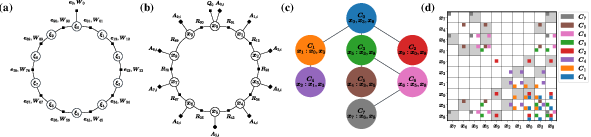
- Build a Bayes tree: GTSAM already knows how to “eliminate” variables in a smart order to make a tree of clusters (called cliques). Imagine dividing a huge jigsaw puzzle into smaller chunks that slightly overlap.
- Chordal decomposition of the SDP: Instead of solving one giant bowl-shaped problem (one huge matrix), solve many small bowl-shaped problems (one small matrix per puzzle chunk) and make sure the overlaps agree. This dramatically speeds things up while keeping the same final answer as the giant version.
Key terms explained:
- Factor graph: a map of unknowns (poses) connected to measurements (sensor clues).
- Local solver (Gauss-Newton/Levenberg–Marquardt): a fast hill-climber; quick but can get stuck if started poorly.
- Convex relaxation/SDP: reshape the problem so there’s a single best answer; you can also get a certificate that it’s globally optimal when the relaxation is tight.
- Bayes tree and cliques: a way to organize the problem into overlapping chunks so you can solve many small problems instead of one huge one.
- Chordal sparsity: a property of the connection pattern that makes this “split into chunks” trick mathematically valid and efficient.
The authors implement all of this inside GTSAM and use a high-quality solver (MOSEK) under the hood. They currently support common 2D/3D pose and rotation variables and typical measurement types.
4) What did they find, and why is it important?
They tested two common robot problems:
- 3D pose-graph SLAM on a ring: the robot moves around a loop and connects back to where it started.
- 2D localization on a chain: the robot moves forward and gets odometry (step-to-step motion) plus occasional absolute position hints.
Main results:
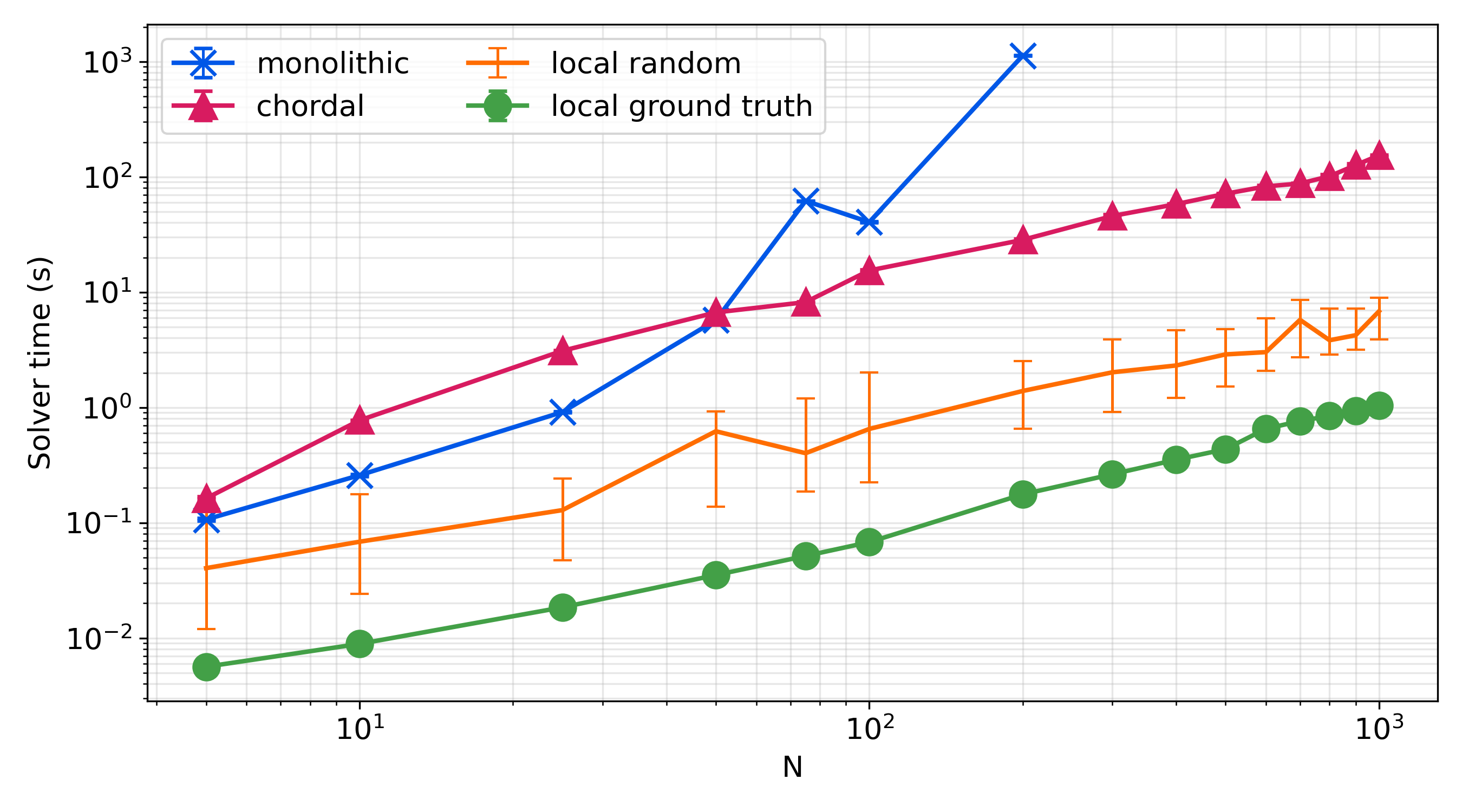
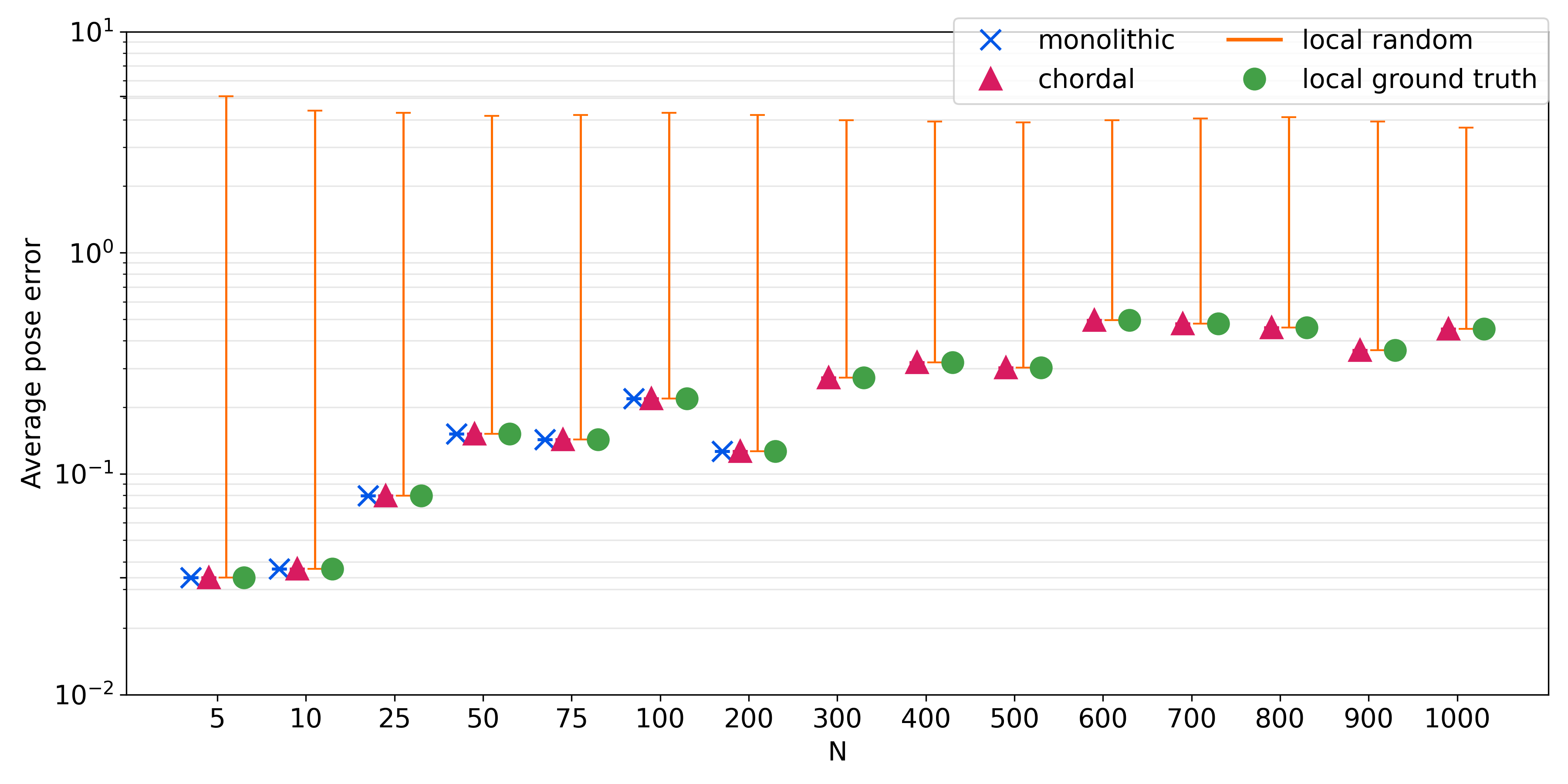
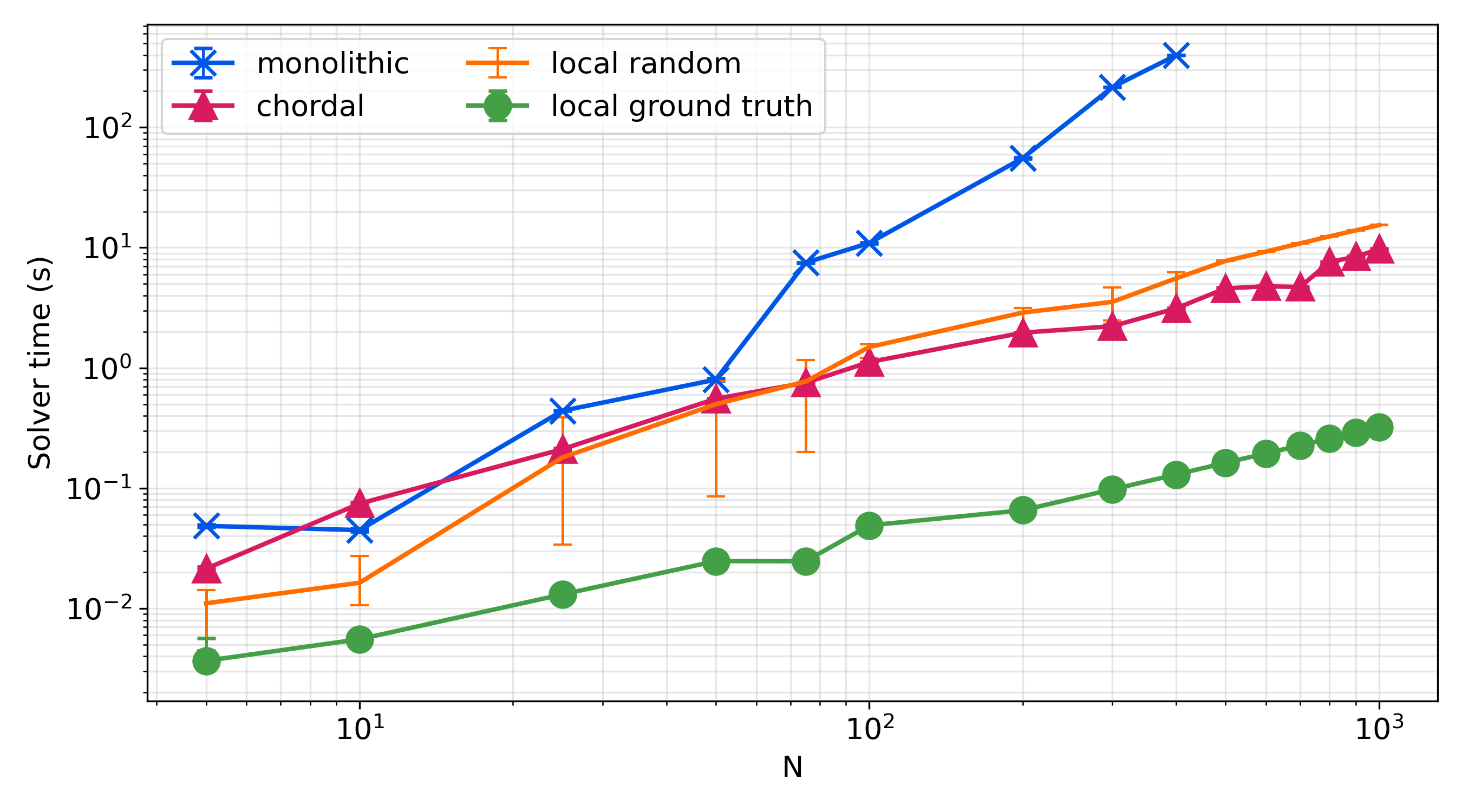
- Speed: The new “chordally decomposed SDP” solver scales roughly linearly with problem size in these tests, similar to the usual fast local methods. It’s much faster than solving one giant SDP, and sometimes even competitive with local solvers started from good guesses.
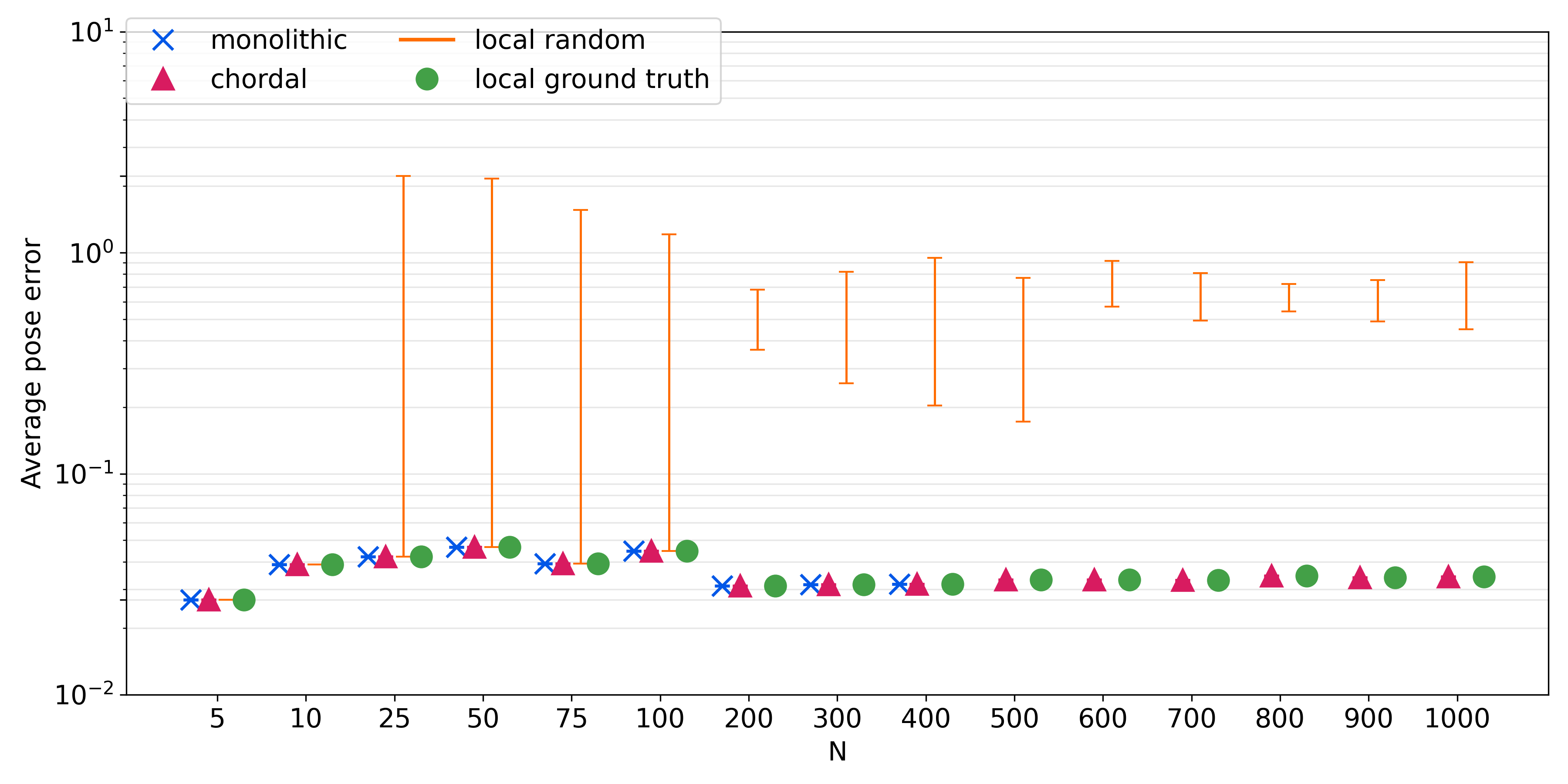
- Reliability: Unlike local solvers that can give very different answers depending on the starting point, the new method is stable and has low variation in both time and accuracy.
- Accuracy and guarantees: In their experiments, the method reached the correct global solution and can provide a certificate of optimality when the relaxation is tight. Local solvers with random starts sometimes landed far from the right answer.
Why it matters:
- Robots in the real world need reliable estimates to be safe. A method that is both fast and can certify the best-possible answer is a big deal for safety-critical tasks.
5) What’s the impact and what could come next?
Impact:
- This work makes “certifiably optimal” estimation much more accessible to everyday robotics users by building it directly into GTSAM. You can keep modeling problems the way you’re used to and get global-level reliability with less effort.
- Because it takes advantage of problem structure automatically, it runs fast enough to be practical on more than just toy examples.
- It works beyond simple chain shapes, handling more complex connection patterns like loops.
What’s next:
- Supporting more types of robot variables and measurements.
- Comparing and combining with other fast global techniques (like Riemannian staircase methods) that are also being integrated into GTSAM.
- Distributing the method across multiple computers using techniques like ADMM, so even larger problems can be solved quickly.
In short, the paper shows a way to turn everyday robot estimation models into fast, reliable, and often provably correct solutions—without making the user become an optimization expert.
Knowledge Gaps
Below is a concise list of knowledge gaps, limitations, and open questions that remain unresolved by the paper. Each item is stated concretely to guide future work.
- Scope of factors/variables: current implementation supports only Rot2, Rot3, Pose2, Pose3 and FrobeniusBetween/FrobeniusPrior/PriorFactor; it is unclear how to extend and validate the pipeline for common SLAM/VIO factors (e.g., bearing-only, range-bearing, projection models, PnP, bundle adjustment, landmark variables in R3, camera intrinsics/extrinsics, time offset).
- Higher-arity factors: although the framework “allows any factor types,” the method and experiments treat unary/binary factors only; the impact of k-ary factors on chordal decomposition, clique sizes, and solver scalability is unaddressed.
- Noise models: experiments assume isotropic Gaussian noise; support, correctness, and performance for anisotropic/matrix-weighted covariances and correlated measurements across factors remain untested (despite related work on matrix-weighted problems).
- Robust losses and outliers: incorporation of robust penalties (Huber, Tukey, Geman–McClure) and outlier-handling mechanisms (switchable constraints, dynamic covariance scaling) in the QCQP/SDP lifting is not discussed; effects on convexity/tightness and performance are open.
- Tightness conditions: no theoretical characterization is provided for when the SDP relaxation is guaranteed to be tight for general SE(d)/SO(d) pose graphs; only empirical evidence on two topologies is shown.
- Certification reporting: the paper does not report duality gaps, rank-1 checks, or other certificates per instance; procedures and thresholds for detecting non-tight relaxations in practice are unspecified.
- Primal recovery when non-tight: no rounding, refinement, or hybrid fallback strategy is provided for cases where the relaxation is not rank-1; guidelines to recover high-quality primal solutions and certify suboptimality gaps are missing.
- Impact of elimination ordering: the choice of ordering (COLAMD, METIS, etc.) critically affects clique sizes and runtime, but there is no study or guidance on ordering selection, adaptive reordering, or sensitivity to ordering.
- Redundant constraints: while suggested to tighten relaxations, there is no principled method to select redundant constraints that improve tightness without inflating sparsity/fill-in; their effect on clique structure and runtime is unquantified.
- Numerical conditioning: there is no analysis of scaling/conditioning of lifted variables, homogenization, or constraint normalization; the effect on solver stability, accuracy, and convergence is unknown.
- Gauge handling: beyond pinning the first pose, handling of gauge freedoms/unobservable modes (e.g., in underconstrained graphs) is not formalized; the impact of weak priors on tightness and numerical conditioning is unclear.
- Inequality constraints: the pipeline targets equality-constrained QCQPs; many robotics problems impose inequalities (contact, joint limits, FoV, obstacle avoidance). How to encode and solve such constraints (e.g., via LMIs or SOC constraints) is unresolved.
- Solver dependence: reliance on MOSEK (commercial) limits portability; performance and robustness with open-source conic solvers (e.g., COSMO, SCS, Clarabel) and first-order splitting methods are not evaluated.
- Scalability limits: experiments are limited to chain and ring graphs on a laptop; there is no evaluation on large real datasets (e.g., city-scale SLAM, BA with thousands–millions of variables), nor memory/peak PSD block sizes and time breakdowns.
- General loopy sparsity: only a ring and a chain are tested; performance on general, highly loopy real-world graphs (many loop closures, heterogeneous sensing, landmark variables) remains an open question.
- Incremental/online operation: the method leverages Bayes trees but does not support incremental updates; mechanisms for warm-starting the decomposed SDP as new factors arrive (akin to iSAM2) are not provided or evaluated.
- Parallelism and GPUs: the solver runs centrally on CPU; opportunities for parallelizing across cliques, GPU acceleration, and the impact of clique scheduling/merging on throughput are unexplored.
- Clique control: there is no strategy for automatic clique merging/splitting to balance the trade-off between PSD block sizes and number of consensus constraints to optimize runtime.
- Comparison to alternative global methods: there is no empirical head-to-head against SE-Sync, Shonan averaging, Burer–Monteiro staircase, or low-rank Riemannian methods on the same instances (including accuracy, certificates, and wall-time).
- Integration with BM/Riemannian methods: open whether chordal decomposition can be combined with Burer–Monteiro factorizations per clique, and how rank selections per clique affect tightness/complexity.
- Higher-order relaxations: only first-order (Shor-like) relaxations are considered; whether chordal decomposition enables tractable higher-order SOS/moment relaxations for tighter bounds is untested.
- Distributed ADMM: a distributed version (ADMM on clique graph) is proposed as future work; partitioning strategies, communication-computation trade-offs, convergence rates, and robustness to network delays/failures are open.
- Real-world robustness: sensitivity to poor loop closures, drift, and trajectory discontinuities (e.g., aggressive motions) is not studied; end-to-end pipelines with data association and outlier rejection are unaddressed.
- Reproducibility details: datasets, ordering settings, solver tolerances, and exact GTSAM integration steps to reproduce figures are not fully specified; standardized benchmarks and performance profiles are missing.
Practical Applications
Immediate Applications
The paper delivers a GTSAM-based pipeline that automatically lifts factor-graph estimation problems to QCQPs and builds chordally decomposed SDPs using Bayes trees, enabling certifiably global estimation with near–local solver scaling for common sparsity patterns. The following use cases can be deployed now, subject to the stated dependencies.
- Robotics: safer pose-graph SLAM and localization with global-optimality certificates
- Sectors: mobile robotics, drones, AGVs/AMRs, industrial automation
- What to do: Use the provided GTSAM integration to run the chordal-SDP estimator as (i) a primary solver for small/medium problems or (ii) a validation/fallback solver alongside Gauss–Newton/Levenberg–Marquardt to diagnose or correct convergence to poor local minima.
- Tools/workflow: Drop-in GTSAM factor graph; automatic QCQP lifting; Bayes-tree driven clique-SDP solve (MOSEK Fusion C++); use standard orderings (METIS/COLAMD) to control clique sizes.
- Assumptions/dependencies: Current support for Rot2/Rot3/Pose2/Pose3 and FrobeniusBetween/FrobeniusPrior/PriorFactor; noise and factor models must be polynomially representable; relies on tightness of the SDP relaxation; MOSEK license or equivalent conic solver; compute budget typically larger than local solvers (though scaling is favorable).
- Warehouse and factory navigation: robust loop-closure in ring-like routes
- Sectors: logistics, manufacturing
- What to do: Apply the chordal estimator to ring-structured pose-graph SLAM (as demonstrated) to certify loop closures and reduce map drift in repetitive warehouse routes.
- Tools/workflow: Batch or time-sliced certification during mission breaks; report certificate and residuals to fleet management.
- Assumptions/dependencies: Ring/richly looped topology; sufficient compute on the robot or at an edge node; relaxation tightness under typical noise.
- Linear-asset inspection: chain-like localization along tunnels, pipelines, power lines
- Sectors: energy, utilities, mining, infrastructure inspection
- What to do: Use the chain-friendly chordal decomposition to deliver fast, certifiable global solutions for 2D/3D chain factor graphs (as demonstrated in 2D).
- Tools/workflow: Run offline certification after sorties; use as a high-confidence initializer for subsequent mapping and defect localization.
- Assumptions/dependencies: Chain (or near-chain) sparsity; measurement models within current factor support; sufficient SNR for tight relaxations.
- Surveying and mapping post-processing with certified outputs
- Sectors: AEC (architecture/engineering/construction), surveying, photogrammetry/LiDAR mapping
- What to do: Post-process pose-graph SLAM with the chordal SDP to certify global optimality of maps before handoff to clients.
- Tools/workflow: Batch solver in a desktop/cloud pipeline; attach optimality certificates and solver logs to deliverables.
- Assumptions/dependencies: Factor graph export to GTSAM; solver runtime acceptable in post-processing.
- AR/VR and consumer robotics: improved reliability of spatial maps
- Sectors: consumer electronics, AR/VR, smart home
- What to do: Use the chordal estimator as an offline auditor for spatial anchors or premium robot vacuum maps to catch gross errors from local solvers.
- Tools/workflow: Background certification on-device or in cloud; flag maps failing certificate for re-localization.
- Assumptions/dependencies: Additional compute budget; limited to pose variables and supported factors.
- Academic benchmarking and teaching
- Sectors: academia, R&D
- What to do: Use the framework as a certifiable baseline to evaluate new factors, robust cost functions, or initialization strategies; teach factor-graph to convex-relaxation pipelines.
- Tools/workflow: Side-by-side comparisons (local vs chordal SDP) on the same GTSAM graph; reproducible experiments.
- Assumptions/dependencies: For robust/non-polynomial factors, approximations or alternative liftings needed.
- Software engineering: CI regression checks with global certificates
- Sectors: software for autonomy
- What to do: Integrate the chordal SDP into CI to detect regressions in estimation pipelines (e.g., unit tests that compare local solver outputs to a certified solution on small graphs).
- Tools/workflow: Automated runs on representative graphs; thresholds for acceptable deviations.
- Assumptions/dependencies: Small graphs to keep CI times reasonable; MOSEK or alternative solver availability.
- Evidence for safety and compliance documentation
- Sectors: regulated autonomy (e.g., industrial mobile robots)
- What to do: Include proof-of-optimality logs from chordal SDP solves as evidence in safety cases or technical files.
- Tools/workflow: Archive KKT conditions/residuals and optimality gap reports per mission.
- Assumptions/dependencies: Regulator acceptance varies; formal arguments about relaxation tightness may be required.
- Robust initialization for local solvers
- Sectors: robotics, 3D vision
- What to do: Run the chordal SDP on reduced subgraphs or coarsened problems to initialize GN/LM on the full graph, reducing sensitivity to poor starts.
- Tools/workflow: Coarsen via keyframes; certify or near-certify subproblem; propagate as initializer.
- Assumptions/dependencies: Coarsening preserves problem structure; tightness on subgraphs.
- Dataset curation and quality control
- Sectors: datasets for robotics/vision
- What to do: Use certified solves to detect implausible measurements, miscalibrations, or bad loop closures in new datasets.
- Tools/workflow: Batch audit; flag scenarios where relaxation fails or the certified solution deviates strongly from local solvers.
- Assumptions/dependencies: Certification failure can indicate either non-tightness or data issues—requires human triage.
Long-Term Applications
These applications require further development, broader factor support, or system integration work (e.g., distributed solvers, robust factors, real-time constraints).
- Real-time, on-board certifiable estimation
- Sectors: autonomous vehicles, drones, AMRs
- What could emerge: GPU-accelerated chordal SDP or Riemannian-staircase variants integrated into GTSAM; warm-started incremental certification for sliding windows.
- Dependencies/assumptions: Integration of fast low-rank methods (e.g., Riemannian staircase) and sparse conic solvers; real-time scheduling; tight relaxations under operational noise.
- Distributed multi-robot SLAM with privacy via ADMM
- Sectors: defense, logistics, exploration
- What could emerge: Bayes-tree–induced clique SDPs solved across robots with consensus constraints (ADMM), maintaining privacy of local submaps.
- Dependencies/assumptions: ADMM-based splitting implementation in GTSAM; communication reliability; convergence and latency budgets.
- Extension to broader estimation problems and factors
- Sectors: 3D vision (bundle adjustment), VIO/INS, calibration, sensor network localization
- What could emerge: Automatic liftings for landmark factors, reprojection errors, inertial factors (polynomialized or approximated), and robust costs; certified BA for small/medium problems.
- Dependencies/assumptions: Polynomial or SOS-friendly reformulations; managing larger cliques from dense measurements; handling outliers (e.g., robustification without breaking tightness).
- Contact-rich motion planning and trajectory optimization
- Sectors: robotics manipulation, legged locomotion, manufacturing
- What could emerge: Chain-sparsity–aware higher-order relaxations (e.g., SOS/Lasserre variants) leveraging chordal decomposition for trajectory problems with contact switches.
- Dependencies/assumptions: Efficient higher-order relaxations; GPU/heterogeneous compute; correctness/tightness on challenging nonconvex dynamics.
- Power systems and infrastructure state estimation
- Sectors: energy, smart grids
- What could emerge: Factor-graph–to–chordal SDP workflow for grid state estimation or OPF-like problems where polynomial constraints and chordal sparsity exist.
- Dependencies/assumptions: Adapting variable types and factors beyond SE(d); domain-specific measurement models; large-scale solver scalability.
- Certified mapping services and “map with proof” products
- Sectors: AEC, geospatial, defense
- What could emerge: Cloud services that return a map plus an optimality certificate and solver diagnostics; SLAs tied to certification outcomes.
- Dependencies/assumptions: Scalable cloud deployment; client acceptance of certification criteria; cost model vs traditional pipelines.
- Standards and regulatory frameworks for certifiable estimation
- Sectors: automotive (ISO 26262), aerospace (DO-178C/DO-333), industrial safety
- What could emerge: Best-practice guidance and standards for recording and verifying global optimality evidence in autonomy stacks.
- Dependencies/assumptions: Community consensus on certification metrics; tool qualification of solvers; formal guarantees on relaxation tightness for specified regimes.
- ROS 2–native “certified estimator” nodes
- Sectors: robotics software ecosystem
- What could emerge: ROS 2 nodes offering chordal-SDP estimation and certification services, with introspection and logging.
- Dependencies/assumptions: Packaging and dependency management (MOSEK or alternatives like COSMO/SCS); API stabilization in GTSAM; benchmarking on typical ROS workloads.
- Digital twins and lifecycle analytics with certified trajectories
- Sectors: manufacturing, logistics, infrastructure
- What could emerge: Trusted trajectory histories feeding digital twins for diagnostics, predictive maintenance, and root-cause analysis.
- Dependencies/assumptions: Data integration pipelines; batch certification at scale; handling non-tight cases gracefully.
- Healthcare and surgical robotics localization
- Sectors: healthcare robotics, medical imaging registration
- What could emerge: Offline certification of critical steps (e.g., instrument/robot pose) to support QA and incident analysis.
- Dependencies/assumptions: Tailored factor models; validation with clinical data; regulatory acceptance.
Notes on feasibility across applications:
- Tightness of the SDP relaxation is the key enabler for global-optimality guarantees; while often observed in practice for typical noise and common SLAM/localization setups, it is not universal.
- Runtime depends strongly on chordal structure and variable ordering (clique sizes dominate); METIS/COLAMD selection and graph design affect feasibility.
- Current implementation depends on MOSEK; open-source conic solvers (e.g., COSMO, SCS) could broaden accessibility with performance trade-offs.
- Robust outlier handling and non-polynomial factors may require alternative liftings or approximations, which can affect both tightness and performance.
Glossary
- ADMM (Alternating Direction Method of Multipliers): A splitting-based optimization method that solves constrained problems by alternating updates on subproblems and dual variables. "splitting methods such as the Alternating Direction Method of Multipliers (ADMM)"
- Bayes net: A directed acyclic graphical model resulting from eliminating variables in a factor graph; here used as an intermediate structure that is chordal. "This yields a Bayes net, which is known to always be chordal"
- Bayes tree: A tree of cliques derived from a Bayes net that organizes factors and variables for efficient inference and factorization. "perform variable elimination to construct a Bayes tree"
- Burer–Monteiro factorization: A low-rank parameterization of semidefinite variables that enables nonconvex optimization as a scalable alternative to generic SDP solvers. "exploits the low-rank structure of SDP solutions through the Burer-Monteiro factorization"
- Chordal completion: The process of adding edges to a sparse graph to make it chordal (triangulated), revealing maximal cliques for decomposition. "the maximal cliques of the chordal completion of the sparsity pattern of the monolithic SDP"
- Chordal decomposition: Decomposing a large PSD constraint into smaller PSD constraints on cliques of a chordal graph, coupled by consistency constraints. "we arrive at a chordally decomposed SDP formulation"
- Chordal graph: A graph in which all cycles of length four or more have a chord; key to enabling clique-based SDP decomposition. "If the aggregate sparsity pattern of cost and constraint matrices corresponds to a chordal graph,"
- Chordal sparsity: A sparsity pattern that is chordal (or can be made chordal), allowing scalable decompositions of SDPs and related problems. "that can exploit chordal sparsity"
- Clique tree: An undirected tree whose nodes are the maximal cliques of a chordal graph, used to organize decomposed computations. "can be listed in an undirected tree called a clique tree (also known as a junction tree)"
- COLAMD: A heuristic for computing a column approximate minimum degree ordering that reduces fill-in during factorization. "using a specific ordering (e.g., COLAMD or METIS)"
- Convex relaxation: A technique that replaces a nonconvex problem with a convex one (e.g., an SDP), enabling global optimality guarantees or certificates. "techniques based on convex relaxations have been shown to provide a means of globally solving or certifying many state estimation problems"
- Factor graph: A bipartite graph connecting variable nodes and factor nodes (measurements/priors), used to model estimation problems. "Factor graphs have emerged as a powerful framework, popular amongst robotics practitioners, for modeling complex estimation and sensor fusion problems"
- Gauss–Newton: A second-order iterative method for nonlinear least squares that approximates the Hessian by JᵀJ; efficient but local. "efficient local optimization solvers such as Gauss-Newton and Levenberg-Marquardt"
- GTSAM: A software library for factor-graph-based optimization in robotics that provides factor types, variable representations, and solvers. "as enabled by modern software packages such as GTSAM or g2o"
- Homogenization: Introducing a constant (e.g., 1) into lifted variables so constant/linear terms can be represented quadratically. "the homogenization constant 1, which allows for constant and linear terms to be represented using quadratic terms as well"
- Junction tree: Another name for a clique tree that organizes maximal cliques of a chordal graph for exact inference. "called a clique tree (also known as a junction tree)"
- Levenberg–Marquardt: A trust-region method that blends Gauss–Newton and gradient descent to handle ill-conditioning in nonlinear least squares. "efficient local optimization solvers such as Gauss-Newton and Levenberg-Marquardt"
- Log-map: The logarithmic map from a Lie group to its Lie algebra, used here to compute pose error norms. "computed using the log-map norm"
- Matrix Lie group: A group of matrices closed under multiplication/inversion with smooth structure (e.g., SO(d), SE(d)), used for pose representations. "for the different matrix Lie group types (currently Rot2, Rot3, Pose2, Pose3 supported)"
- Maximum a posteriori (MAP): The mode of the posterior distribution; optimization-based estimate given priors and measurements. "State estimation involves determining the maximum a-posteriori estimate of the robot state"
- METIS: A graph partitioning and ordering algorithm used to produce sparse elimination orderings for efficient factorization. "using a specific ordering (e.g., COLAMD or METIS)"
- Monolithic SDP: A single large semidefinite program formed on the full lifted variable without decomposition, typically expensive. "We will refer to this formulation as the monolithic~\ac{SDP}"
- Nonlinear least squares (NLS): An optimization problem minimizing the sum of squared nonlinear residuals; common in state estimation. "equivalent to solving a nonlinear least squares optimization problem"
- Odometry factor: A binary factor encoding a relative motion measurement between two poses in a factor graph. "The cost terms of the first and second sum correspond to unary (absolute) factors and binary (odometry) factors, respectively."
- Positive semidefinite (PSD) matrix: A symmetric matrix with nonnegative eigenvalues (X ⪰ 0), used as decision variables in SDPs. "By associating T smaller PSD matrices {C}_t"
- Pose-graph SLAM: A SLAM formulation where nodes are robot poses and edges are relative pose constraints between them. "A 3D pose-graph SLAM problem with a ring factor graph"
- Quadratically Constrained Quadratic Program (QCQP): An optimization problem with quadratic objective and quadratic equality/inequality constraints. "The variables and factors of Problem~\eqref{eq:nls} are lifted to a higher-dimensional space to yield a \ac{QCQP}"
- Rank-one variable: A matrix variable constrained (or originating) to be rank-one, here X = x xᵀ before relaxation. "by forming the rank-one variable \bm{X}=\bm{x}\bm{x}\top"
- Riemannian block coordinate descent: An optimization scheme that alternates over blocks on a manifold (e.g., low-rank factors on a sphere/Stiefel). "via Riemannian block coordinate descent"
- Riemannian staircase method: A strategy that solves a sequence of low-rank factorizations, increasing rank until optimality conditions hold. "by applying the Riemannian staircase method"
- SE(d) (Special Euclidean group): The group of rigid-body motions in d dimensions, often used to represent poses. "with often chosen to be \mathrm{SO}(d) or \mathrm{SE}(d)"
- Semidefinite program (SDP): A convex optimization problem with a linear objective and PSD constraints on matrix variables. "they require solving a large semidefinite program (SDP)"
- Semidefinite relaxation: Replacing a nonconvex quadratic problem with an SDP by lifting and relaxing rank constraints. "for which standard SDP convex relaxations exist"
- SO(d) (Special Orthogonal group): The group of d-dimensional rotations, commonly used to represent orientations. "with often chosen to be \mathrm{SO}(d) or \mathrm{SE}(d)"
- Variable elimination: A factorization process that removes variables in an order to produce a sparse Bayes net/tree structure. "a variable elimination (factorization) procedure is executed"
- Variable lifting: Augmenting original variables with additional terms to make objectives/constraints quadratic in a higher-dimensional space. "The variables and factors of Problem~\eqref{eq:nls} are lifted to a higher-dimensional space"
- Maximal clique: A fully connected subset of nodes not contained in any larger clique, pivotal for chordal decomposition. "The maximal cliques of the Bayes net can be listed in an undirected tree"
Collections
Sign up for free to add this paper to one or more collections.