- The paper presents a model of dark energy stars using a two-fluid approach in Finch–Skea spacetime, highlighting the impact of a cosmological constant on stellar structure.
- It employs the complexity factor formalism to derive a corresponding temporal metric potential and ensures a smooth match with a Schwarzschild–(anti-)de Sitter exterior.
- Numerical analysis on Vela X-1 shows that positive Λ increases star radii while negative Λ enhances compactness and redshift, with large |Λ| leading to instability and acausal behavior.
Dark Energy Stars in Finch–Skea Spacetime with Schwarzschild–(Anti-)de Sitter Exterior
Introduction and Context
This work presents an in-depth study of compact objects modeled as dark energy stars within Finch–Skea spacetime, incorporating the cosmological constant as a key parameter through a Schwarzschild–(anti-)de Sitter exterior (2605.30398). The modeling framework systematically combines ordinary matter and dark energy components, utilizing the complexity factor formalism to derive the temporal metric potential. The analysis explores both the structural and stability properties of such stars, with explicit focus on the impact of both positive and negative values of the cosmological constant (Λ). The canonical neutron star candidate Vela X-1 serves as the sample astrophysical object for all numerical computations.
Model Construction: Interior Solution and Complexity Factor Approach
The analysis begins with Einstein's field equations incorporating a cosmological constant. The internal metric is assumed to be static, spherically symmetric, and anisotropic. The radial metric potential is selected as eλ(r)=1+r2/R∗2. The temporal metric potential eν(r) is then constructed using the complexity factor formalism, following the prescription for zero complexity (vanishing YTF), which imposes physically motivated structure and reduces the arbitrariness of the model.
The two-fluid model introduces both ordinary matter and a dark energy component, with the dark energy assigned a negative equation of state, prde=−ρde. The two components are coupled via a parameter α=1, implying a balanced contribution from both. Analytical, closed-form solutions are derived for all effective thermodynamic quantities, including ρeff(r), (pr)eff(r), (pt)eff(r), with explicit dependence on Λ and the model parameters.
Boundary Conditions and Matching to Exterior Spacetimes
The interior solution is smoothly matched at the surface to an exterior Schwarzschild–(anti-)de Sitter geometry. This ensures the continuity of eλ(r)=1+r2/R∗20, eλ(r)=1+r2/R∗21, and their derivatives on the boundary. The matching conditions yield explicit formulae for the unknown constants eλ(r)=1+r2/R∗22 and eλ(r)=1+r2/R∗23 in terms of eλ(r)=1+r2/R∗24, eλ(r)=1+r2/R∗25, and eλ(r)=1+r2/R∗26, and also provide an algebraic relation dictating the stellar radius for any given mass and cosmological constant.
Variations in eλ(r)=1+r2/R∗27 directly control the equilibrium configuration's size and structural properties: positive eλ(r)=1+r2/R∗28 yields larger radii, while negative eλ(r)=1+r2/R∗29 compresses the star.
Spacetime Structure and Matter Profile Analysis
The radial profiles of the spacetime metric potentials are demonstrated to be monotonic, regular, and positive throughout the interior.
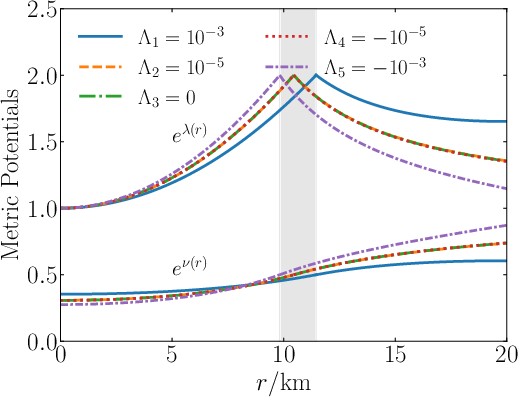
Figure 1: Radial variation of the metric potentials eν(r)0 and eν(r)1 for different cosmological constants eν(r)2.
All matter variables are well-behaved, with the density peaking at the core and decreasing monotonically outwards. The center exhibits finite values for all thermodynamic quantities, and radial pressure vanishes at the stellar surface, defining the physical boundary.
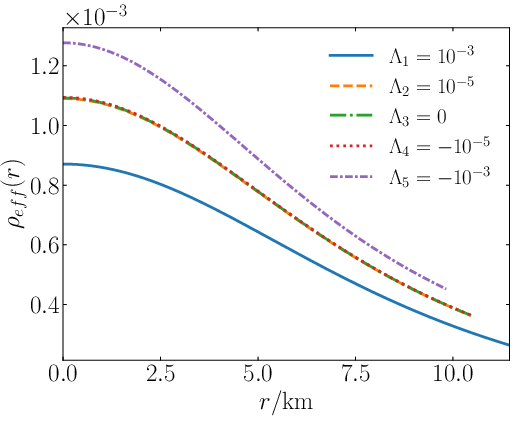
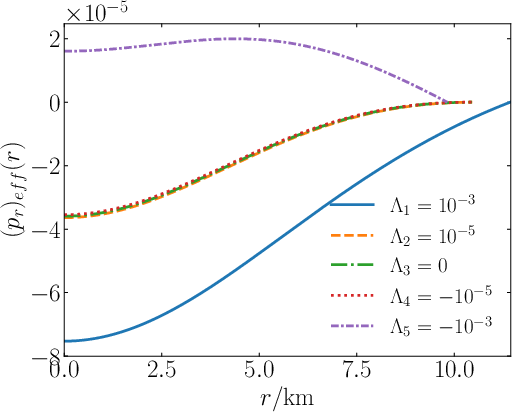
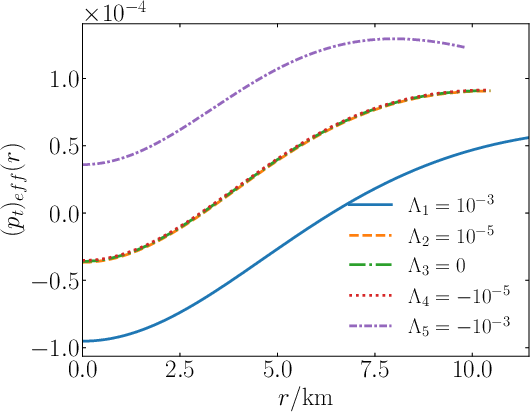
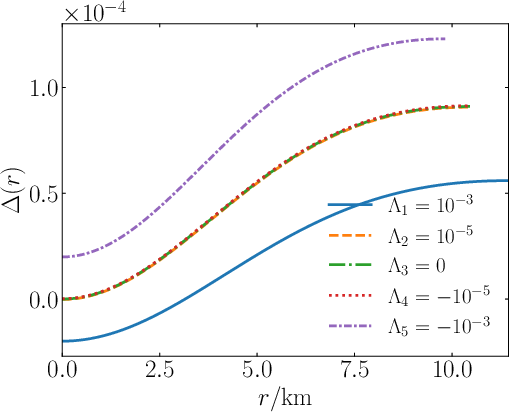
Figure 2: Radial profile of the effective energy density eν(r)3, showing the central concentration and outward decay for various eν(r)4.
Anisotropy, quantified as eν(r)5, is induced exclusively by the cosmological constant. The central anisotropy is nonzero for eν(r)6, vanishing only in the pure Schwarzschild case.
Macroscopic Quantities: Mass, Compactness, Redshift
The effective mass function increases monotonically with radius, attaining its maximum at the surface and serving as a diagnostic for comparing different eν(r)7 scenarios.
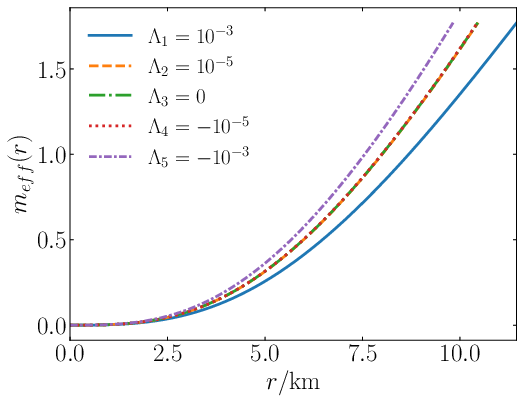
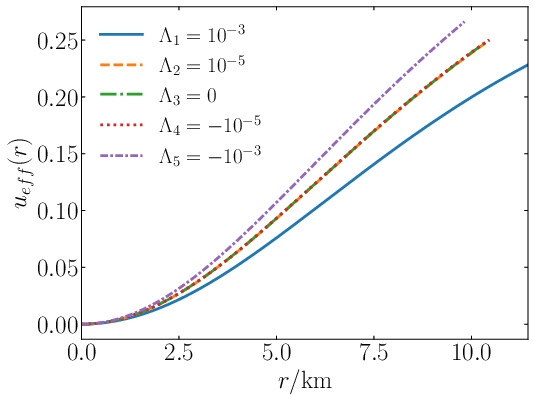
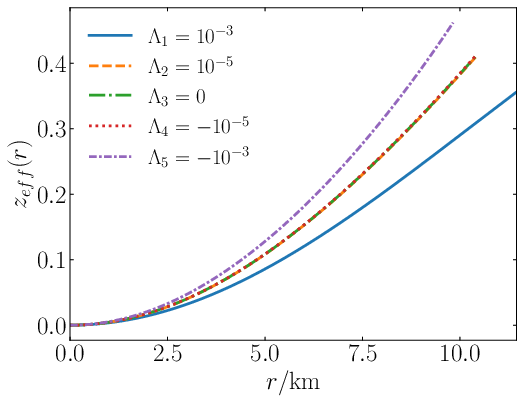
Figure 3: Effective mass function eν(r)8 for several choices of eν(r)9.
The stellar compactness and surface redshift respond distinctly to YTF0:
- Positive YTF1: Decreased compactness and redshift, associated with larger, less dense stars.
- Negative YTF2: Increased compactness and redshift, resulting in denser, more compact configurations.
These findings are robust across parameter variations and are consistent with prior treatments of the cosmological constant's gravitational effects in compact objects.
Energy Conditions and Physical Admissibility
All relevant energy conditions—Weak, Null, Dominant, and Strong—are rigorously verified across the interior for each tested value of YTF3. This ensures that the model maintains physical plausibility in all explored scenarios.
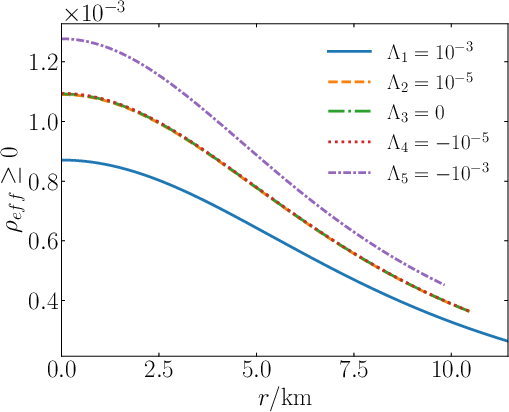
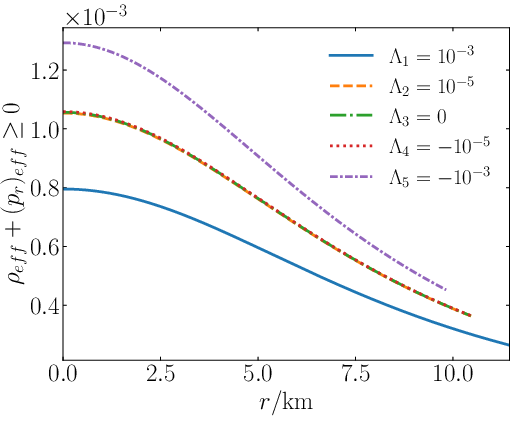
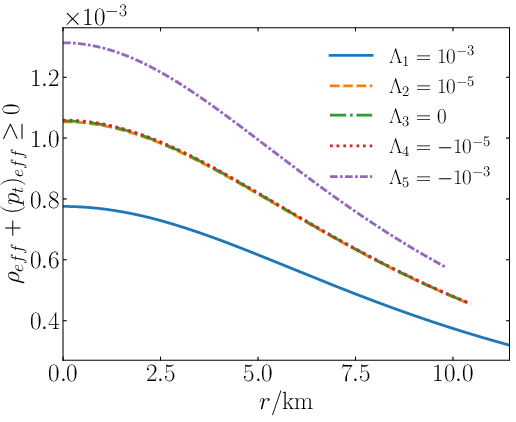
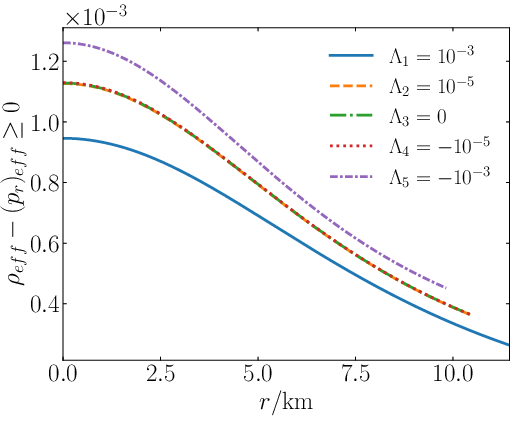
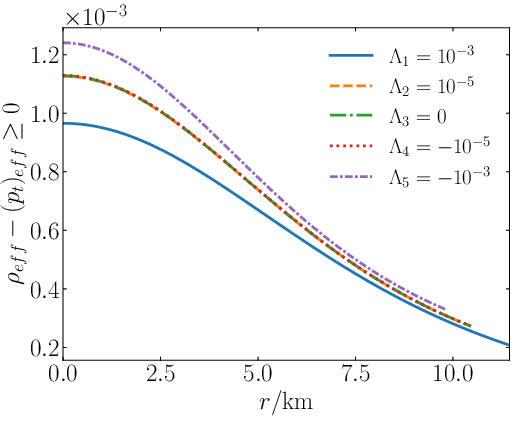
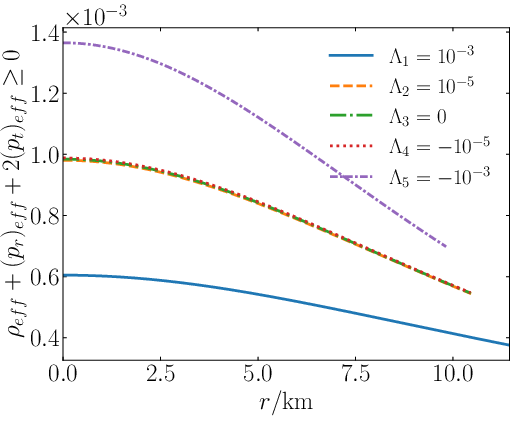
Figure 4: Verification of the weak energy condition (YTF4) as a function of radius for all YTF5 considered.
Hydrostatic Equilibrium, Causality, and Stability Diagnostics
Hydrostatic equilibrium is analyzed via the generalized Tolman–Oppenheimer–Volkoff (TOV) equation, including gravity, pressure, and anisotropic terms. For small magnitudes of YTF6, these forces remain balanced, but substantial positive or negative YTF7 introduces clear deviations, particularly near the core.
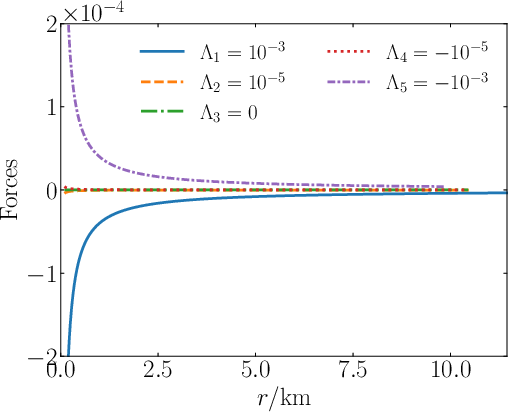
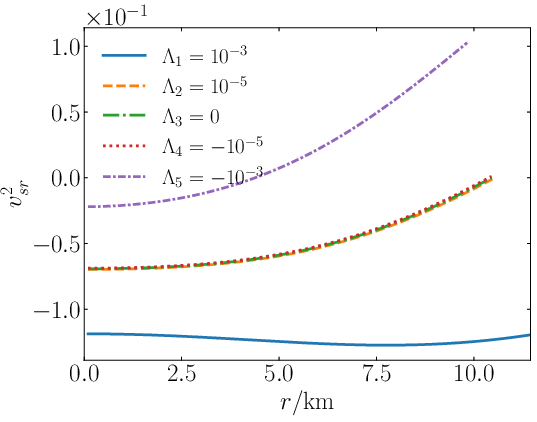
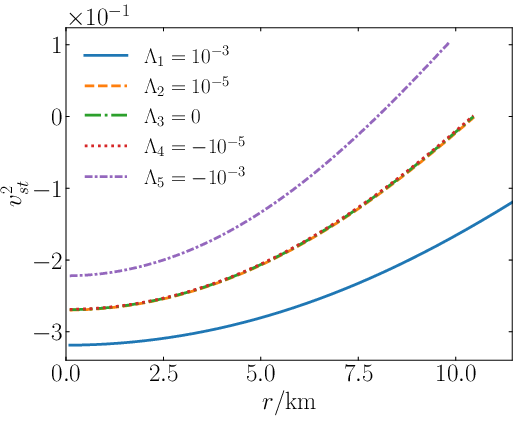
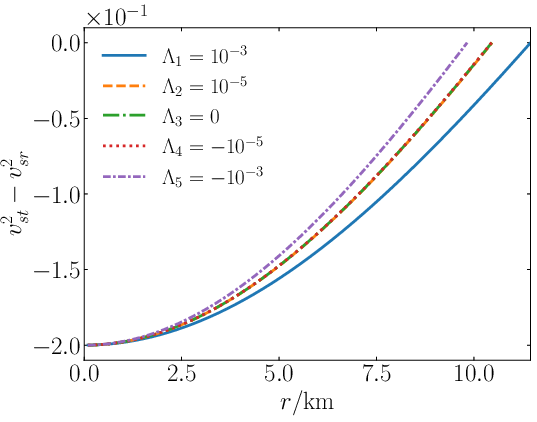
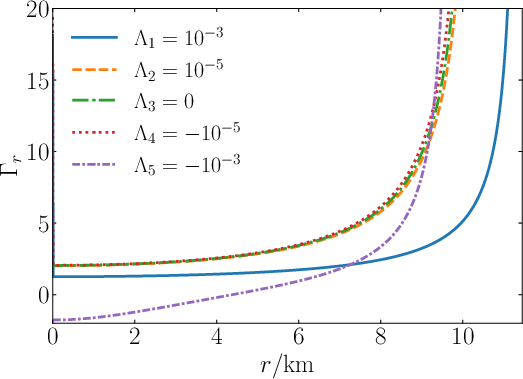
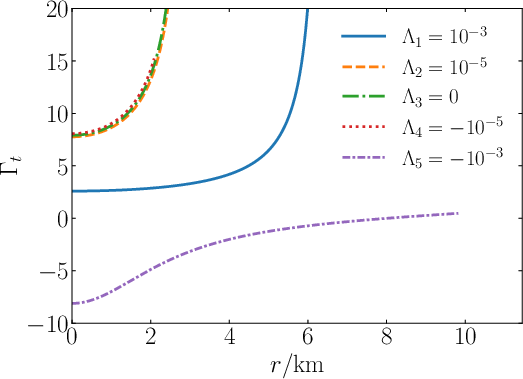
Figure 5: Radial distribution of the net total force including gravity, pressure, and anisotropy, showing deviations from equilibrium at large YTF8.
Causality is checked by computing the squared sound speeds in radial and tangential directions. Explicit violations occur for large positive YTF9 in internal regions, while negative prde=−ρde0 scenarios demonstrate improved causal behavior, with violations confined more centrally.
Stability is further probed via Herrera's cracking criterion, which is always satisfied in these models, and by examining the adiabatic index. For large negative prde=−ρde1, the adiabatic indices fall below the Chandrasekhar limit near the stellar core, indicating a trend toward dynamical instability.
Implications, Contradictions, and Future Directions
Key numerical findings include:
- For Vela X-1 (prde=−ρde2), prde=−ρde3 increases from 9.82 km (prde=−ρde4) to 11.45 km (prde=−ρde5).
- Compactness and redshift are maximized for negative prde=−ρde6 and minimized for positive prde=−ρde7.
- All energy conditions remain satisfied for the entire parameter space explored.
A particularly notable claim, supported by detailed structural analysis, is that "the cosmological constant introduces a central anisotropy of purely geometric origin, not present in standard models without prde=−ρde8." Another substantive result is the demonstration that larger values of prde=−ρde9—especially positive—can lead to unbalanced forces and acausal propagation speeds, thus rendering such configurations physically unviable, despite mathematical solvability.
The study supports the assertion that the cosmological constant modulates equilibrium, compactness, and surface properties of compact stars, and can play a non-negligible 'local' astrophysical role beyond its usual cosmological setting.
Practical implications include new constraints on the allowable values of the effective local cosmological constant within compact objects, with potentially observable consequences for mass–radius relations and redshift signatures. Theoretically, the results suggest that extensions of the dark energy star paradigm must carefully consider both causality and dynamical stability diagnostics when introducing strong vacuum terms.
Future developments may involve:
- Extending beyond static, spherically symmetric metrics to include rotation or strong magnetic fields;
- Considering variable α=10 profiles or further couplings to modified gravity theories for higher astrophysical fidelity;
- Integrating observational constraints from neutron star and quark star measurements, including those from X-ray timing and gravitational wave data, to further bound α=11 in realistic compact objects.
Conclusion
This study establishes that the cosmological constant exerts significant, and in some regimes, destabilizing influence on the structure and stability of dark energy stars constructed within the Finch–Skea metric. While all models retain regularity and physical admissibility for small α=12, large values—especially positive—can trigger acausal and non-equilibrium behavior, tightly constraining the parameter space for viable stars in this framework. The research enhances understanding of the interplay between dark energy components, interior geometry, and global spacetime structure in relativistic astrophysics, and opens pathways for testing such effects in compact star observations and in extended gravitational theories.