- The paper presents a detailed analysis of quantum tunneling-induced vacuum decay using Euclidean bounce methods to compute decay rates and transition dynamics.
- It compares three models—pure QT, QT+DM, and QT+DM+DW—demonstrating how dark matter conversion and domain wall formation influence cosmological expansion.
- The study rigorously confronts these models with DESI, supernova, and CMB data, showing that DM-driven rapid transitions can alleviate tensions in ΛCDM cosmology.
Late-time Quantum Vacuum Decay and Its Cosmological Implications
Overview and Motivation
This work systematically investigates the viability and observational signatures of quantum tunneling (QT)–induced vacuum decay events occurring in the late universe, focusing on redshifts zt=O(1−10). These scenarios are motivated both by the string landscape framework, where a multitude of metastable vacua is expected, and by the potential for such late-time transitions to produce detectable deviations from ΛCDM cosmology. The paper constructs a hierarchy of phenomenological models—ranging from pure QT to scenarios incorporating dark matter (DM) conversion and domain wall (DW) formation—and tightly confronts them with state-of-the-art precision cosmological data, including DESI DR2 BAO, leading supernova (SN) samples, and compressed CMB constraints. Additionally, the work provides a comprehensive analysis of the perturbative signatures of such transitions in the cosmic microwave background (CMB), particularly via ISW-like effects and constraints from induced domain wall networks.
Model Construction
Three classes of models describing late-time QT events are considered, increasing in complexity and physical content:
- QT Model: A pure quantum tunneling transition between nearly degenerate vacua. The potential allows a small vacuum energy difference, and the vacuum decay rate is time-independent and fixed by the Euclidean bounce action calculated within the thin-wall approximation. All released vacuum energy becomes dark radiation (DR).
- QT+DM Model: Incorporates a subcomponent of dark matter (χ) with a Yukawa coupling to the scalar responsible for the transition. Post-transition, this DM component becomes massless and is converted to DR, and the transition rate becomes explicitly DM-density dependent, inducing a sharply time-dependent tunneling rate.
- QT+DM+DW Model: Extends the above with the inclusion of DW formation due to spontaneous breaking of a discrete symmetry during the transition. The DWs redshift as a−1 and contribute both to the late-time energy budget and to CMB anisotropies.
These constructions allow for testing a variety of physically-motivated transition dynamics and signatures, including cases where the decay proceeds rapidly (due to strong density dependence) or slowly (as in truly vacuum-driven transitions).
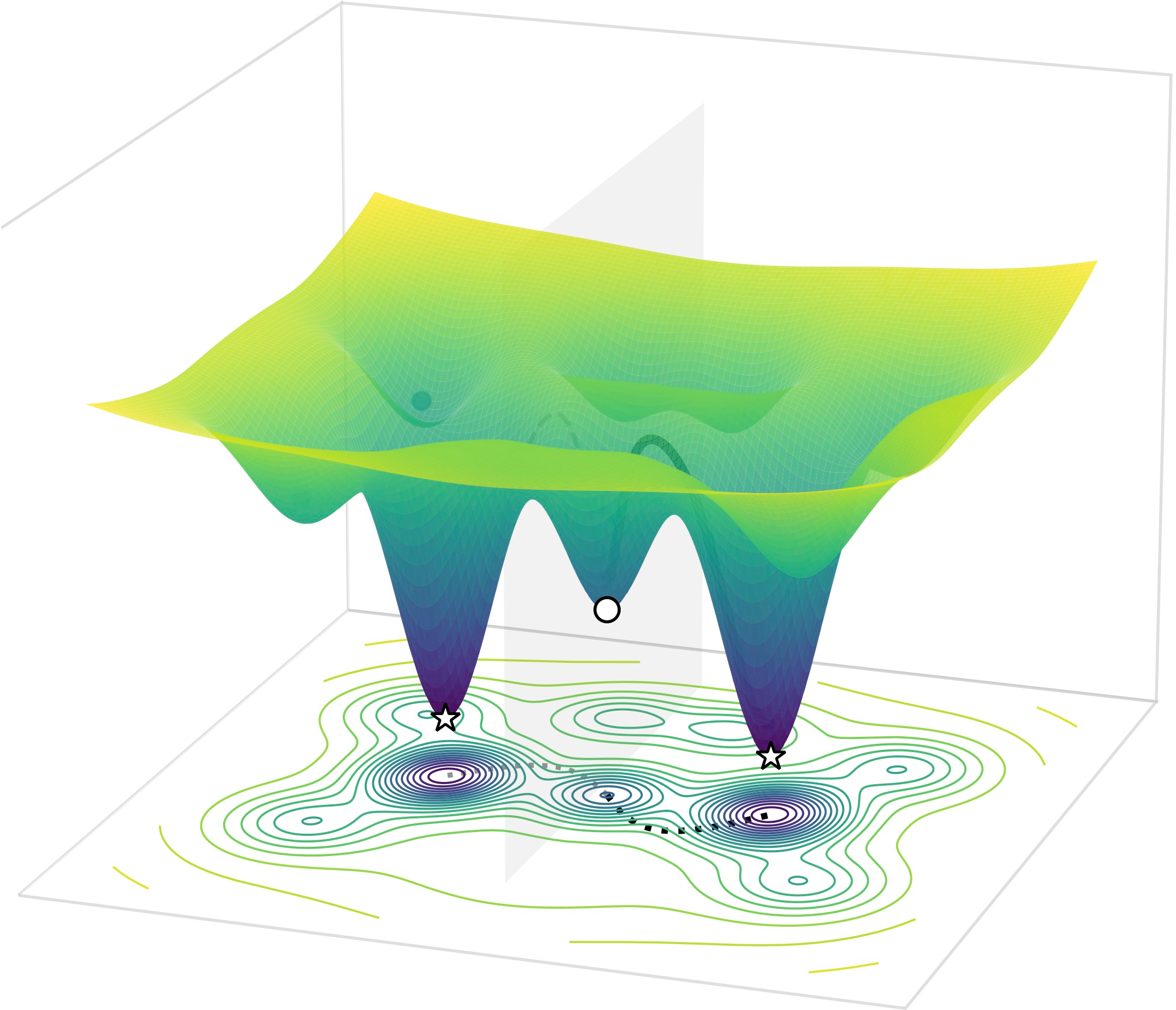
Figure 1: Schematic illustration of quantum tunneling in vacuum decay between metastable vacua, emphasizing the possibility of domain wall production in discrete symmetry-breaking cases.
Quantum Tunneling Dynamics
Detailed computations of the Euclidean bounce action S4 and the decay rate γ∼e−S4 are performed. The transition completion (percolation) criteria, bubble nucleation statistics, and energetics are all worked out for various regimes, including matter- and vacuum-domination. Explicit attention is given to the conditions ensuring the transition both nucleates and completes prior to the present epoch.
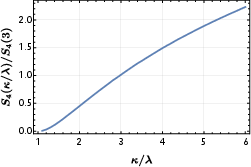
Figure 2: The dependence of the bounce action S4 on potential parameters, demonstrating relative insensitivity to couplings and justifying the use of fiducial choices in cosmological analysis.
For the DM-coupled scenario, the tunneling rate undergoes a rapid increase near a critical density, making the transition nearly instantaneous and increasing the number of nucleated bubbles (and thus decreasing ISW constraints due to enhanced causal self-averaging). The QT+DM+DW model inherits these features and produces a large number of thin domain walls per Hubble patch.
Effects on the Expansion History
The impact on cosmological distances and the background expansion rate is meticulously calculated, accounting for sudden changes in vacuum energy, DM abundance, DR, and—where present—domain wall contributions. The model parameter space includes the transition redshift zt, the fractional change in vacuum energy, DR and DW fractions, and the fraction of DM undergoing conversion.
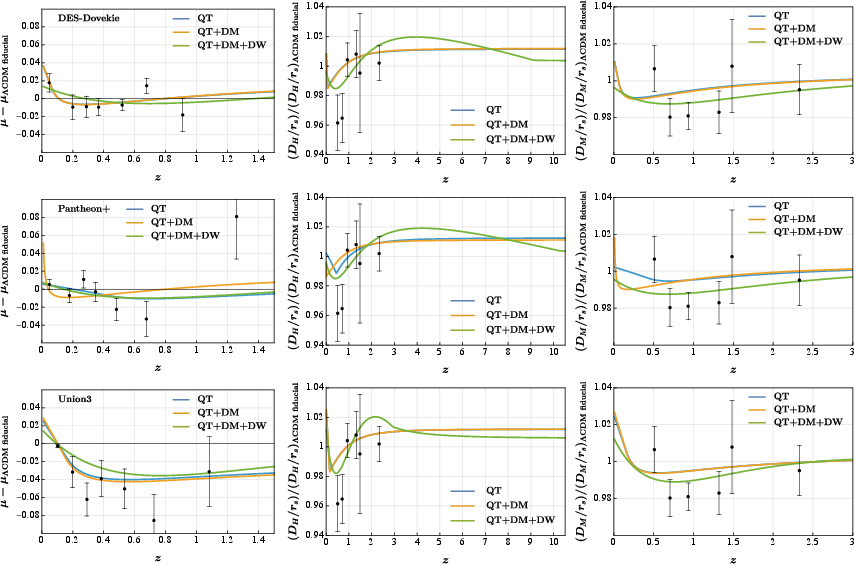
Figure 3: Hubble diagrams (μ, DH/rs, Λ0) showing the QT-involved models' predictions compared to Λ1CDM and various SN and BAO datasets. Note the improved fits, especially in the QT+DM+DW model, to persistent tensions in expansion measurements.
The models are fitted to DESI DR2, DES-Dovekie, Pantheon+, and Union3 SN samples, with a flat universe and compressed CMB priors. Bayesian model selection via Bayes factors, AIC, and DIC is employed to rigorously compare the descriptive power of each scenario versus Λ2CDM and CPL (Chevallier-Polarski-Linder) parameterizations.
Statistical Results and Model Comparison
Posterior distributions for key model parameters are presented. In the pure QT and QT+DM cases, tight constraints on the vacuum energy released are only possible once CMB ISW constraints are included; without these, background data alone allow up to Λ3 reductions in vacuum energy at Λ4, though this is further restricted once perturbation constraints are imposed.
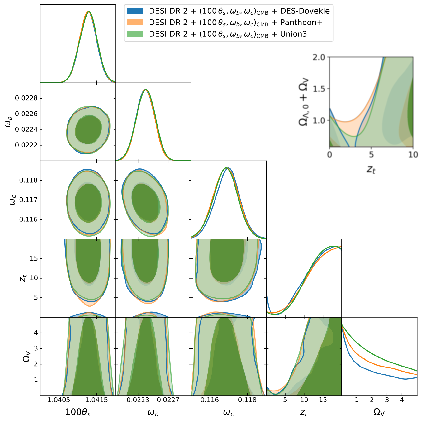
Figure 4: Posterior distributions for the QT model parameters, overlaying three major SN datasets, and elucidating the joint behavior of allowed transition redshifts and vacuum energy release.
The QT+DM+DW model provides notable improvements in fit quality relative to Λ5CDM and CPL, with Bayes factors supporting its inclusion of extra physical mechanisms despite the penalty for additional parameters. This model favors transitions centered near Λ6, with Λ7 of DM participating, and produces a late-time DW component that can reconcile persistent SN/BAO/CMB tensions.
CMB Anisotropy Constraints
The work makes a quantitative analysis of CMB power spectrum constraints emerging from two mechanisms:
- Bubble-Nucleation-Induced ISW: Transition-induced superhorizon perturbations modulate photon geodesics, leading to excess power at low multipoles (Λ8). The two-point correlator of transition times is computed via past-light cone overlap techniques, leading to explicit predictions for Λ9.
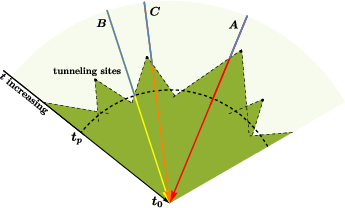
Figure 5: Schematic depiction of how bubble nucleation and domain walls induce temperature anisotropies in the CMB via modifications of photon paths.
- Domain Wall-Induced Anisotropies: DW networks formed in the transition directly source gravitational potential perturbations; the amplitude constrains their energy density to extremely small fractions (χ0 for χ1).
For pure vacuum (time-independent nucleation) cases, the scarcity of bubble nucleation events per Hubble volume enhances superhorizon inhomogeneities, leading to strong CMB constraints: the permissible drop in vacuum energy is limited to χ2 at χ3. Rapid (density- or temperature-driven) transitions—typical in the QT+DM(+DW) models—evade CMB limits due to large bubble numbers and suppressed per-bubble metric impact.
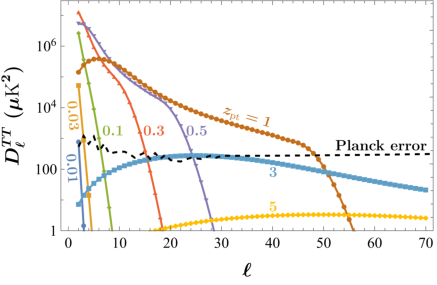
Figure 6: CMB temperature power spectra for varying χ4 and vacuum fraction parameters, illustrating the sensitivity of low-χ5 structure to late-time PTs.
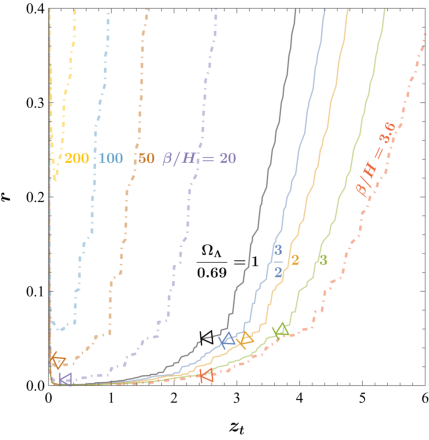
Figure 7: Exclusion curves on fractional vacuum energy release vs. transition redshift, with solid lines indicating vacuum (slow) PTs and dot-dashed lines for rapid, time-dependent ones. Shaded regions are excluded by CMB.
Implications and Theoretical Consequences
Cosmological Expansion Tensions: The QT+DM+DW model is capable of resolving apparent inconsistencies among BAO, SN, and CMB data—specifically, it can realize a dynamically evolving EoS for dark energy matching effective CPL behavior, but rooted in explicit field-theoretic microphysics.
Landscape and Vacuum Stability: Observationally allowed rates and scales for QT provide direct, testable constraints on field theory landscapes and may indirectly inform about the distribution and statistical properties of vacua in high-energy theories, including string theory.
Signatures Beyond Expansion: The framework highlights the potential for rich phenomenology beyond smooth, background expansion—particularly, correlations of transition-induced anisotropies with large-scale structure due to DM-density-dependent tunneling. Future large-scale surveys and CMB measurements (e.g., polarization, ISW cross-correlations) are thus motivated as probes of post-inflationary vacuum structure.
Conclusions
This study demonstrates that late-time quantum vacuum decay is sharply testable and increasingly constrained by precision cosmology. Pure vacuum tunneling scenarios are strongly limited by CMB anisotropy constraints, whereas models incorporating DM-driven rapid transitions and DW production can both evade these limits and yield improved fits to existing tensions in cosmological distance measurements. The predictive power of these models, buttressed by explicit field-theoretic construction and rigorous confrontation with data, establishes a pathway to probing physics of the vacuum structure and its cosmological consequences, with implications for both fundamental theory and future observational campaigns.

