- The paper shows that only broad, compensated CDM curvature peaks yield viable SMBH seeds via direct collapse while avoiding shell-crossing.
- It employs exact LTB and quasi-spherical Szekeres solutions with covariant decompositions to map inflationary perturbations to collapse dynamics, predicting seed masses of 10^3–10^6 M⊙.
- Numerical results confirm anisotropic, Weyl-dominated collapse with core formation at redshifts 10–16 and full horizon formation by redshifts 5–7.
Introduction and Motivation
This paper provides a general-relativistic analysis of black hole (BH) formation from nonlinear Cold Dark Matter (CDM) perturbations during the matter-dominated era, focusing on the emergence of supermassive black hole (SMBH) seeds via the direct collapse of primordial curvature peaks. Utilizing the Lemaître-Tolman-Bondi (LTB) and quasi-spherical Szekeres solutions as exact nonlinear perturbations of global spatially-flat Friedmann-Lemaître-Robertson-Walker (FLRW) backgrounds, the authors rigorously track the causal, dynamical, and kinematic features of collapse seeded by local curvature perturbations, connecting resulting BH formation channels to physically motivated initial data.
Relativistic Collapse and the Role of Curvature Perturbations
The core analytical framework employs both covariant 1+3 and 3+1 decompositions, enabling local treatment of the collapse. The fundamental insight is that, within relativistic dust perturbation theory, all growing modes can be parameterized by the gauge-invariant comoving curvature perturbation Rc. This variable governs the spatial curvature of hypersurfaces orthogonal to the CDM four-velocity, allowing mapping from cosmological initial conditions and the inflationary power spectrum to exact LTB/Szekeres parameters, particularly the active gravitational mass M(r) and curvature function k(r).
These models capture the critical distinctions between collapse in radiation- and matter-dominated regimes. In the latter—the relevant CDM case—the absence of pressure gradients removes the classical threshold for gravitational instability, but tidal shear, angular momentum, and inhomogeneity can generate shell-crossing and delay or prevent horizon formation, demanding a full GR treatment of the causal structure.
The authors proceed with a systematic classification of possible causal structures resulting from collapse, emphasizing the importance of horizon formation before singularity emergence for physical BH seeds. The underlying framework distinguishes covered (horizon-enveloped), locally naked, and globally naked singularities, using both analytical criteria and schematic Penrose diagrams. Only collapse scenarios producing trapped regions prior to singularity formation are considered viable SMBH seed channels.
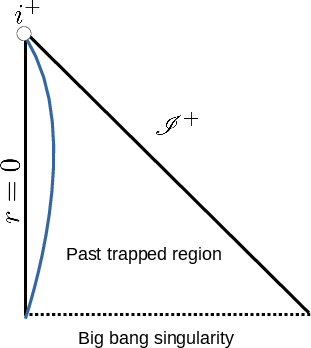
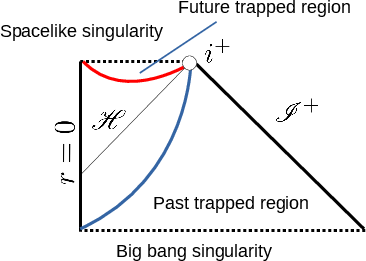
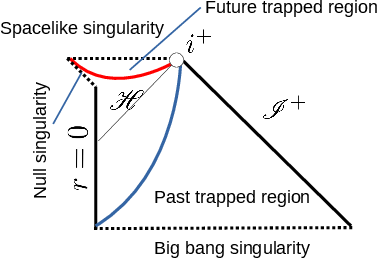
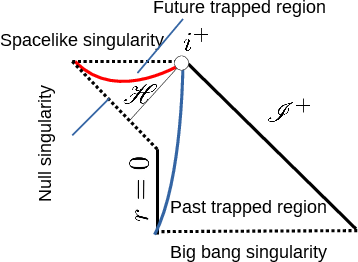
Figure 1: Penrose diagrams summarizing causal outcomes of collapse; only covered and locally naked singularities are physically admissible for BH formation.
Regularity and Singularity Structure: Shear and Anisotropy
The covariant treatment exposes a critical connection between the nature of spatial curvature profiles and the kinematic type of singularity. The paper shows that point-like (isotropic), pancake-like (caustic), and cigar-like (Kasner) singularities emerge depending on initial shear eigenvalues. The generic attractor is cigar-like (Kasner) collapse, where Weyl curvature dominates and matter becomes dynamically negligible.
Strongly, the authors demonstrate that configurations with pancake-like singularities (associated with shell-crossing) are generally subject to breakdown of the dust approximation. BH formation is only robust when shell-crossing is avoided, which requires particular constraints on the radial shape of the comoving curvature perturbation.
Mapping CDM Initial Conditions to Collapse Outcomes
A crucial analytical advance is the explicit mapping from the comoving curvature profile R(r) to LTB/Szekeres parameters and collapse times. The authors derive analytic formulae for turnaround (tta), collapse (tcol), and future apparent horizon (tFH) for individual shells, showing these depend primarily on the steepness and compensation structure of R(r).
Parameter space analysis reveals that simple sinusoidal or Gaussian initial profiles do not yield viable BH formation channels, producing either naked singularities or shell-crossing before horizon formation. Instead, broad compensated peaks—mirroring predictions of peak theory for rare high-amplitude curvature extrema—naturally produce shell-focusing collapses with covered central singularities and delayed shell-crossing.
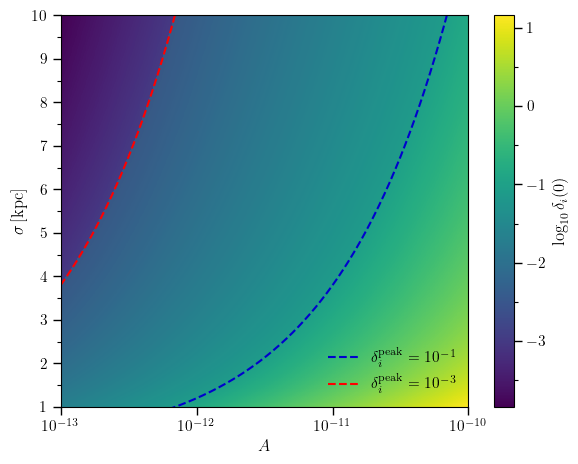
Figure 2: Allowed parameter space for initial curvature amplitudes and widths; dashed contours denote profiles with linear density peaks suitable for collapse.
Dynamical Evolution and Numerical Results
Through explicit construction and evolution of these shells, the authors present strong numerical evidence for direct collapse of compensated curvature peaks yielding seed BHs in the mass range 103–106 M⊙, with core collapse redshifts M(r)0 and full horizon formation by M(r)1–M(r)2.
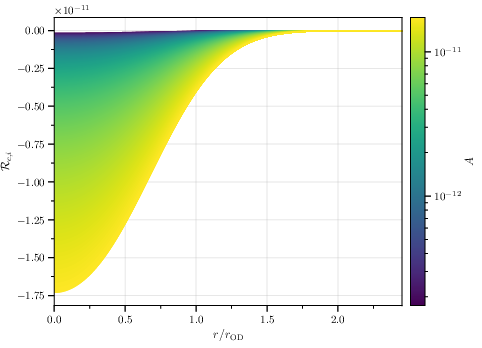
Figure 3: Example compensated curvature profiles M(r)3 for viable collapse.
Analyses of initial density contrast, expansion, shear, and Weyl tensor eigenvalues illustrate the suppression of anisotropy in the core, with strong shear growth only near the boundary between the central overdensity and compensating underdensity.
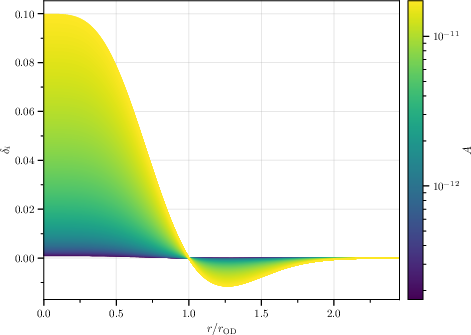
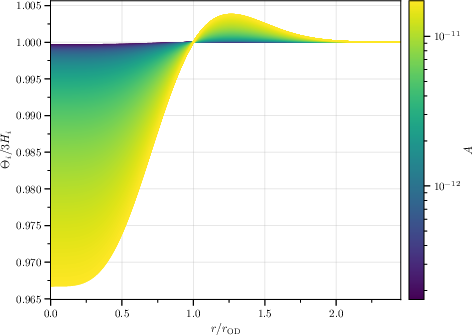
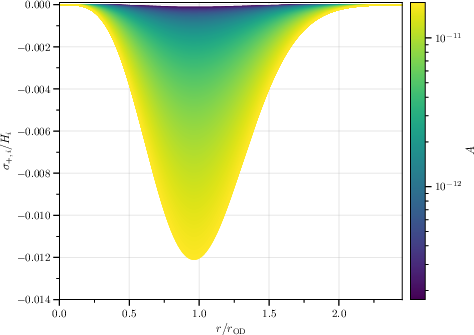
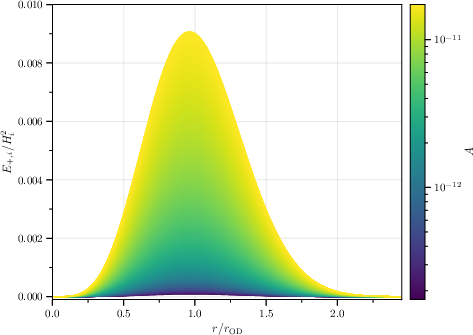
Figure 4: Initial density contrast, expansion rate, and normalized shear/Weyl eigenvalues for selected curvature profiles.
Direct computation of Raychaudhuri equation and Hamiltonian constraint terms shows matter and expansion dominating early evolution, with shear overtaking in the transition region and controlling late-time collapse.
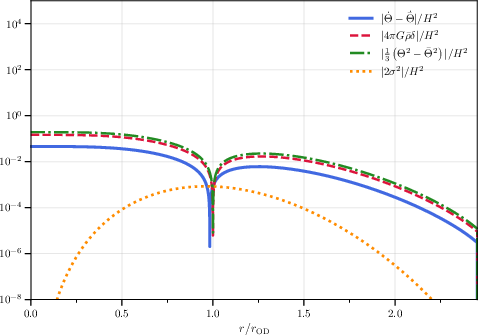
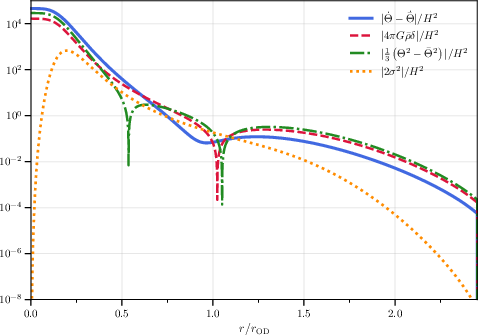
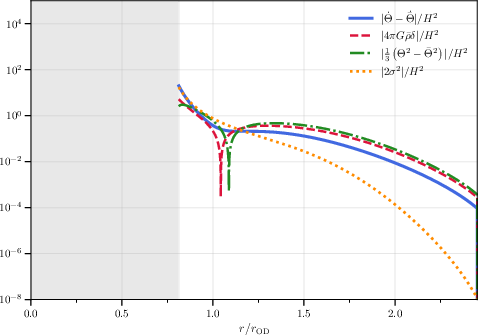
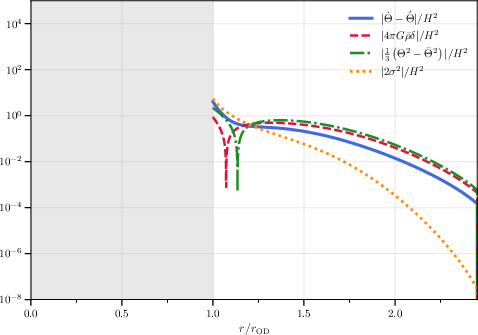
Figure 5: Magnitudes of Raychaudhuri dynamical contributions normalized to the Hubble scale for early and late evolution.
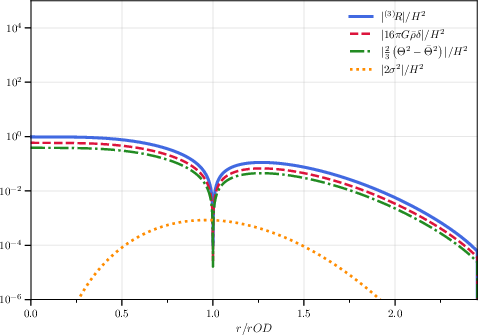
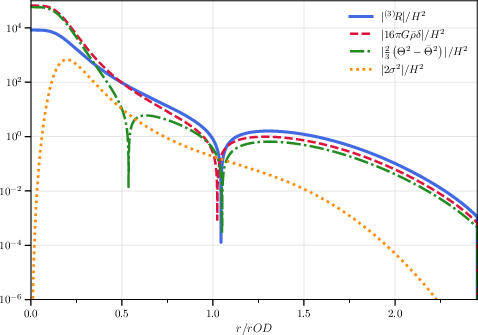
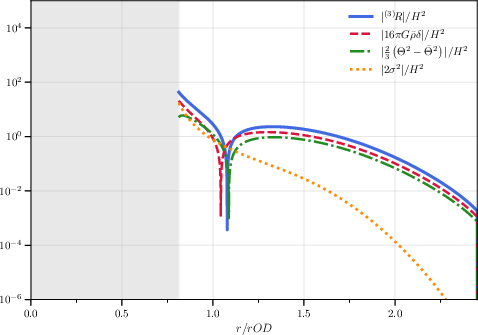
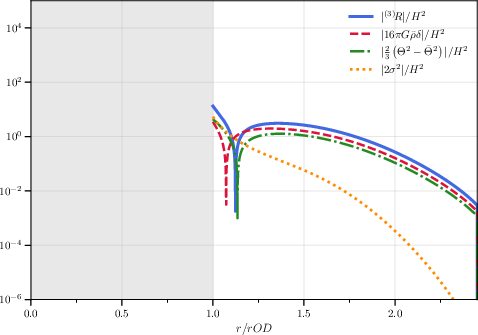
Figure 6: Contributions to the Hamiltonian constraint during collapse, highlighting shear dominance at late times.
Computation of the Kretschmann scalar reveals the transition from Ricci-dominated to Weyl-dominated curvature as collapse proceeds, reflecting the emergence of anisotropy and the approach to Kasner-like singularity formation.
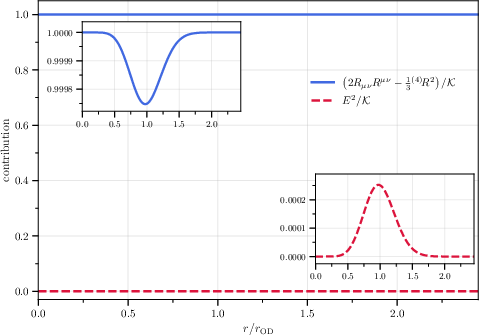
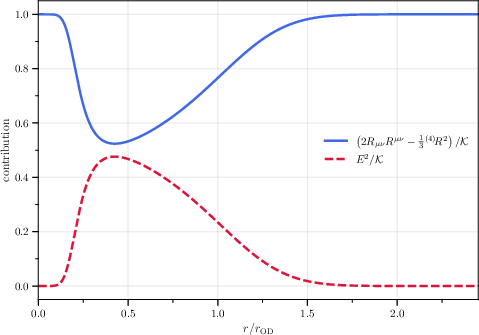
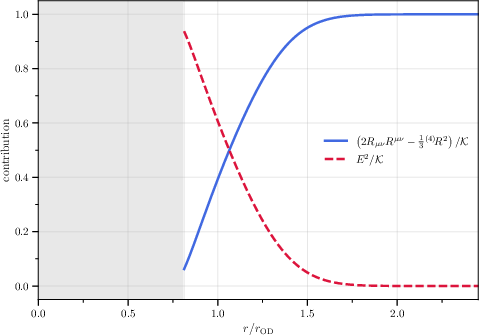
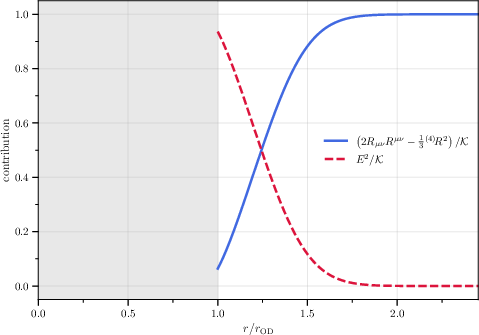
Figure 7: Relative Ricci and Weyl contributions to curvature invariants during collapse evolution.
Figures analyzing the collapse and horizon formation times show that broad compensated peaks covering viable parameter ranges produce seed mass scales of M(r)4–M(r)5 at M(r)6, with the central worldline collapsing at M(r)7–M(r)8. The mass scale is primarily determined by the profile width, not amplitude, as broader peaks collapse earlier—contrary to expectations from naive perturbation theory.
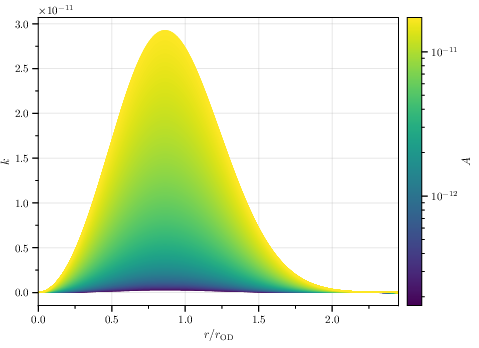
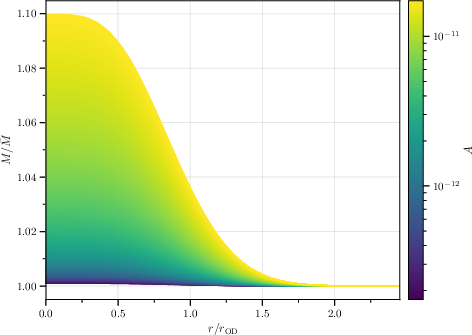
Figure 8: Curvature and mass profile for representative compensated peak configurations.
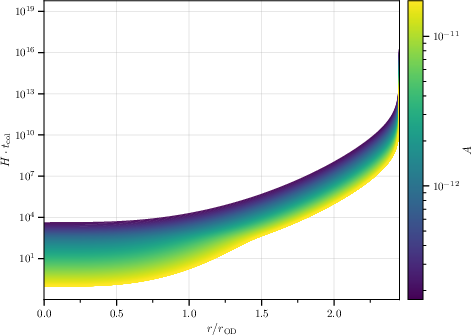
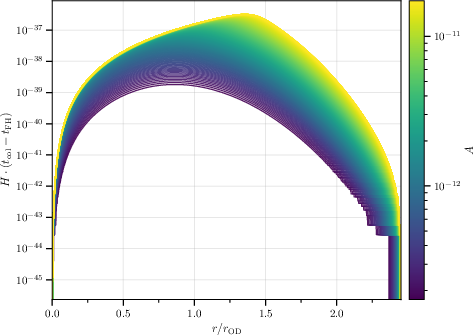
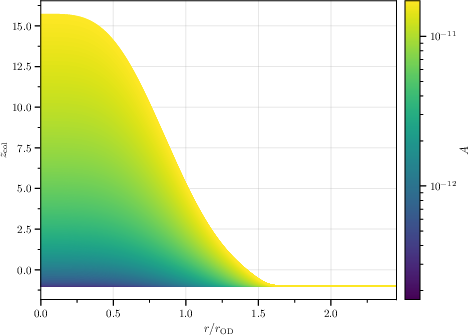
Figure 9: Collapse time and fractional delay between collapse and horizon formation; bottom panel shows corresponding redshift profiles.
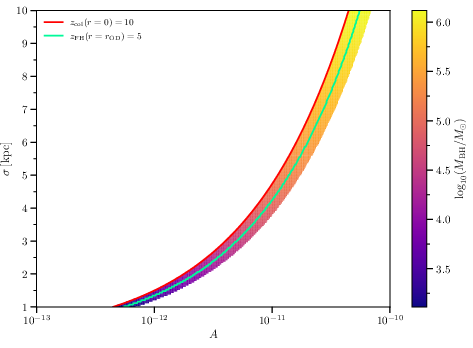
Figure 10: Phase space of collapse outcomes colored by resulting BH mass for models meeting early-collapse and horizon formation criteria.
Contradictory Claims and Implications
Contradictory claim: The study finds that single-mode and Gaussian curvature perturbations, traditionally used for modeling collapse in cosmic structure formation, do not yield physical black hole seeds from matter-era collapse—contradicting prevailing assumptions. Only compensated, broad peaks with core softening consistent with peak theory predictions provide viable channels, demonstrating a more restrictive collapse criterion.
Numerical results: Formation of M(r)9–k(r)0 seeds with core collapse at k(r)1–k(r)2 and full horizon formation by k(r)3–k(r)4, even when initial density contrasts remain in the linear regime (k(r)5–k(r)6), is established. These results have direct relevance for the observed population of early supermassive BH candidates.
Theoretical and Practical Implications
The findings establish a concrete, analytic link between cosmological initial conditions and SMBH formation channels, bridging inflationary and post-recombination physics with observable outcomes. They clarify that only strict classes of initial perturbations will yield self-consistent single-stream CDM evolution up to horizon formation, and that collapse is generically anisotropic (Weyl/Kasner dominated) rather than isotropic, requiring full GR and not simply Newtonian treatment.
The methodology demonstrates the power of mapping cosmological perturbations directly into exact GR solutions for collapse, providing a robust tool for future exploration of seeded SMBH populations, high-redshift AGN, and the statistics of primordial BH formation.
Future developments should generalize beyond the dust approximation—incorporating radiation, Vlasov kinetics, multi-stream dynamics, and primordial non-Gaussianity—and explore PBH channels emerging from non-trivial power spectra and rare-event statistics in the curvature field.
Conclusion
This work rigorously characterizes the conditions for direct collapse of CDM-curvature peaks to form supermassive BH seeds, providing analytic, numerical, and phenomenological mapping from cosmological initial data to practical collapse outcomes. Only compensated broad peaks, in accordance with peak theory, yield viable BH formation channels without shell-crossing or naked singularities. The implication is a naturally predictive mechanism for early SMBH seeds, anchored in CDM and GR, with precise constraints and envelope on their masses and formation redshifts. The methods developed can serve as a basis for cross-disciplinary studies connecting cosmological structure formation, GR singularity theory, and high-redshift black hole phenomenology (2605.30145).