- The paper introduces smooth approximations for singular potentials, enabling MIW simulations to accurately reproduce quantum stationary states.
- It employs adaptive kernel density estimators and velocity Verlet schemes to stabilize the dynamics in both one- and two-dimensional quantum systems.
- Comparisons with matrix Numerov solutions validate the method’s accuracy, highlighting its potential for scalable simulations of complex quantum systems.
Simulation of Smooth Models of Potentials with Singular Points Using the Many-Interacting-Worlds Method
Overview
This paper presents a systematic investigation into the application of the Many-Interacting-Worlds (MIW) method for simulating quantum systems characterized by potentials with singular points, such as the Coulomb potential and finite depth traps. The central advance of the work lies in introducing and analyzing smooth approximations to otherwise singular potentials, enabling the MIW dynamical algorithm to reproduce quantum stationary states beyond the conventional harmonic oscillator regime. The methodology is extended to both one- and two-dimensional systems, accompanied by rigorous comparison against results from the matrix Numerov approach borrowed from standard quantum mechanics.
Methodological Advances
The MIW method replaces quantum wavefunction dynamics with an ensemble of interacting classical-like “worlds,” where quantum effects emerge from an interworld potential derived from empirical or kernel-based density approximations. Two primary computational paradigms are addressed: the ground state solution via numerical minimization in world configuration space and relaxation to stationary states through an energy-decreasing dynamical algorithm. This work focuses on the latter, integrating equations of motion using velocity Verlet schemes while enforcing non-crossing constraints and leveraging adaptive density kernel estimation for improved stability, especially in multidimensional cases.
The pivotal technical contribution pertains to handling singular potentials. Direct application of MIW algorithms fails for singular (e.g., Coulomb-type) potentials due to divergences driving world positions into catastrophic proximity. The proposed solution employs asymptotically smooth models, such as:
- Softened Coulomb: Vμ(r)=−cexp(−α2r2)−rerf(μr), converging to the point-singular form as μ→∞.
- Smoothed finite well: Vν(x)=2L[erf(ν(x−a))−erf(ν(x+a))+2], with ν controlling the steepness.
Kernel density estimators (notably with adaptive bandwidths) are deployed to construct consistent and differentiable quantum forces, mitigating artifacts near boundaries or nodes, and providing stable recursion relations even in the presence of multidimensional grids and excited-state nodes.
Numerical Simulations and Results
Comprehensive simulation studies are presented for both 1D and 2D models. For each scenario, the MIW dynamical algorithm is executed with careful management of grid boundary conditions, adaptive time steps, and kernel bandwidth evolution, ensuring efficient convergence even with a large number of worlds per configuration.
In the 1D smoothed finite well, simulations with N=20 worlds demonstrate convergent evolution to stationary configurations, with ground state densities closely matching those from matrix Numerov calculations. The energy error with respect to parameter ν quantifies the accuracy-resilience tradeoff as the potential sharpness increases.
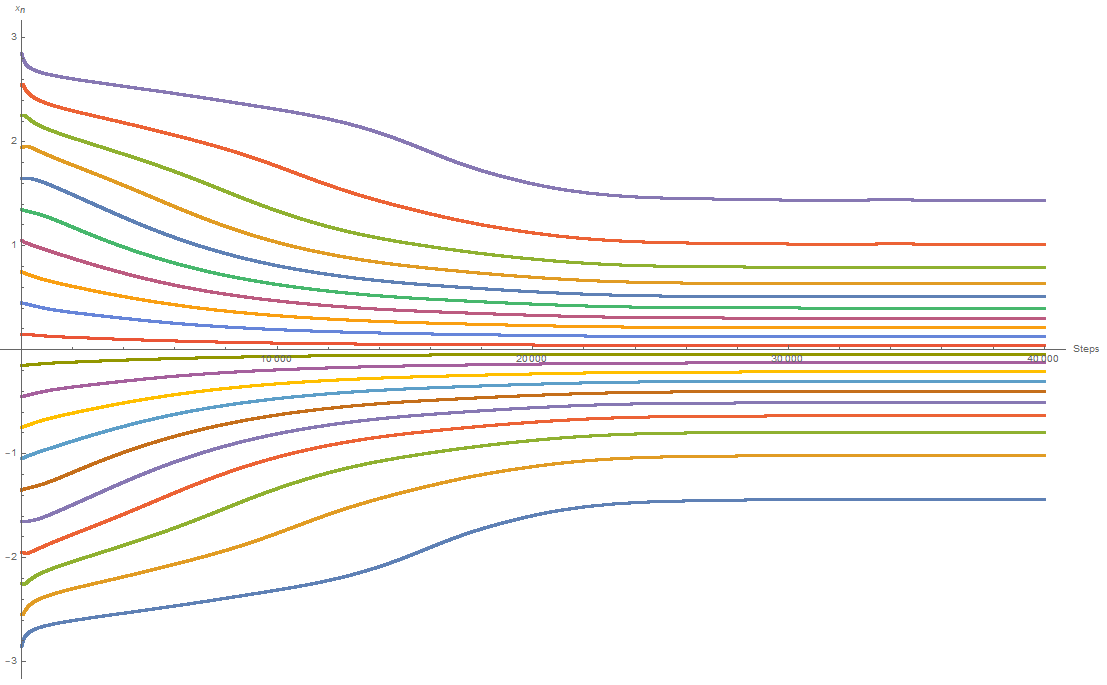
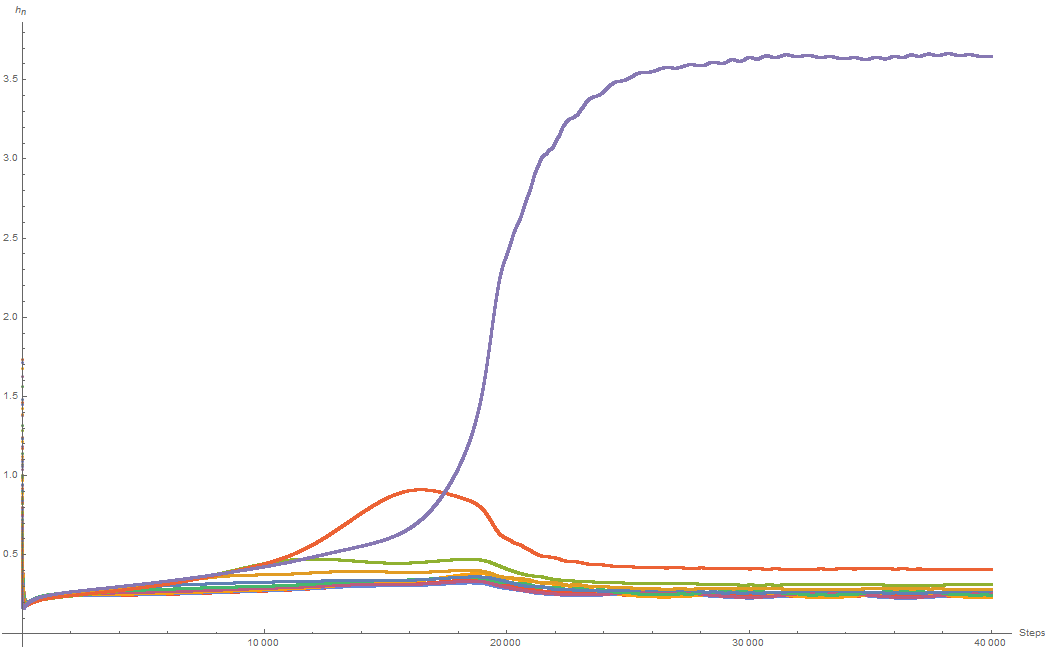
Figure 2: Evolution of N=20 worlds, bandwidth trajectories, kernel density estimator comparison, and energy error versus ν for the 1D finite trap potential smoothed with the error function.
Analogous results are shown for 2D smoothed Coulomb potentials using both error function and hyperbolic tangent regularizations. Ground and excited state energies exhibit strong agreement with Numerov solutions as the smoothing parameter increases, subject to limitations imposed by numerical instability for large μ and coarse grid resolution.
Practical and Theoretical Implications
The demonstrated equivalence of MIW simulations with standard quantum stationary state solutions—using only local world configuration information and smooth potential regularizations—supports MIW as a viable alternative to conventional grid-based quantum solvers for bounded systems. The approach is particularly compelling for extension to higher dimensions and potentially many-body quantum systems, where direct wavefunction-based methods become intractable.
However, several structural limitations are identified:
- The method's accuracy is constrained by finite world populations and the attainable sharpness of the smoothing parameter under realistic computational resources.
- The necessity for explicit node handling in excited-state simulations, via preset grid points and manually engineered boundary bandwidths, restricts the automatic discovery of high-lying states and general multifold nodal structures.
- The absence of direct phase information, inherent to the MIW formulation, precludes rigorous treatment of entanglement entropy and phenomena reliant on wavefunction phase coherence.
The paper suggests that, despite these shortcomings, the MIW method—complemented by adaptive kernel-based estimation and asymptotic regularization of singular potentials—provides a framework well-suited to explorations of stationary states in systems where exact or grid-based quantum mechanics is less feasible.
Future Directions
Potential developments include further refinement of density and bandwidth recursion at nodes to streamline automated excited-state determination, analytical derivations quantifying convergence rates as both world count and smoothing parameter approach their respective limits, and algorithmic integration of multi-particle entanglement diagnostics compatible with the MIW ontology.
The results also motivate hybrid strategies that leverage MIW dynamics for configuration initialization, coupled with standard quantum solvers for global refinement, particularly in high-dimensional and multi-particle systems.
Conclusion
By extending the MIW dynamical algorithm to regularized singular potentials and demonstrating its empirical equivalence to traditional methods for both ground and excited states in one and two dimensions, the paper broadens the practical reach of the MIW interpretation and its computational toolbox. While challenges remain for high-excitation and fully quantum-correlated states, the proposed methodology holds promise for scalable quantum simulation absent complete access to wavefunction amplitudes and phases.