- The paper presents a novel distributed algorithm that leverages point cloud registration to compute optimal formation position sequences (OFPS) for large swarms.
- It employs robust outlier rejection techniques, such as RANSAC, to maintain formation integrity even with abnormal or failing agents.
- Empirical results demonstrate that FLIP achieves sub-0.05 second local planning times and effective scalability to hundreds of agents under dynamic conditions.
Introduction
The paper "FLIP: Real-Time and Resilient Formation Planning for Large-Scale DIstributed Swarms via Point Cloud Registration" (2605.29704) presents a distributed algorithmic framework for high-performance formation trajectory optimization in swarms with agent count in the order of hundreds. The key insight leverages Point Cloud Registration (PCR) with robust outlier rejection to compute Optimal Formation Position Sequences (OFPS), enabling both real-time computation and resilience against abnormal or failed agents.
Conventional approaches—either representing formations with overly simplistic models or with fully-connected collaborative graphs—suffer from scalability bottlenecks due to excessive communication and computation or from brittleness and degraded performance in large heterogeneous environments. The FLIP framework recasts formation planning as distributed, asynchronous PCR problems, where each agent treats the broadcasted trajectories of all others as a temporal point cloud and infers optimal spatiotemporal transforms with respect to the target formation, applying robust iterative methods (e.g., RANSAC) to reject outlier-induced errors. This paradigm allows for scalable, deformation-averse, and failure-resilient formation planning.
Methodology
The core technical contribution is the reformulation of distributed formation planning as a spatiotemporal PCR problem. At each time step, agents assemble the future positions of all other agents (broadcast over wireless links) as a point cloud, to be aligned with the corresponding nominal points in the target formation. Each agent then solves for the Sim(3) transformation (rotation, translation, scale) that best registers the observed swarm configuration to the desired one while robustly discarding outlier points that may correspond to failed or poorly coordinated agents.
This approach allows each agent to independently compute its OFPS, which then forms part of the cost and constraints in its own trajectory optimization. Outlier rejection, based on RANSAC, ensures suboptimal agents do not degrade formation integrity.
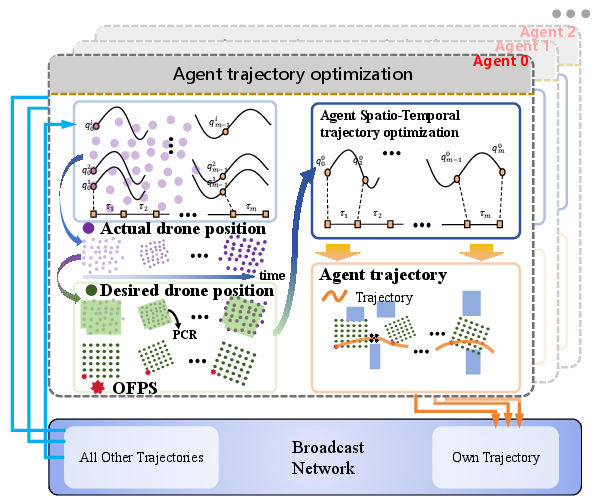
Figure 1: Overview of the FLIP algorithmic loop, where each agent computes OFPS via PCR, optimizes its local trajectory under dynamic and formation constraints, and asynchronously broadcasts updates.
This pipeline avoids the O(N2) complexity and communication bottlenecks of complete-graph Laplacian-based methods, as well as the fidelity loss inherent in sparse or parametric formation representations.
Trajectory Optimization and Execution
The agents employ MINCO-based polynomial representations for trajectory generation, supporting time, energy, dynamic, and obstacle avoidance constraints. The formation constraint is enforced by minimizing squared distance over a horizon between agent positions and their OFPS, as computed from PCR over the current swarm state.
The overall agent planning problem is formulated as an unconstrained optimization, leveraging L-BFGS for computational efficiency. The entire system operates asynchronously and in a distributed manner, supporting robust operation under lossy or delayed communications.
Empirical Evaluation
Extensive experiments demonstrate the FLIP method's capacity for real-time and high-accuracy formation control in dense, obstacle-rich environments with up to 120 agents. Compared to existing SOTA methods (e.g., “Quan's” and “Zhou's”, both Laplacian-based approaches), FLIP achieves a significant reduction in mean local planning time (down to <0.05s for 100 agents), sustaining real-time operation where other algorithms fail due to excessive computation. Formation error eˉdist is consistently lower, notably maintaining integrity as agent counts surpass 80.
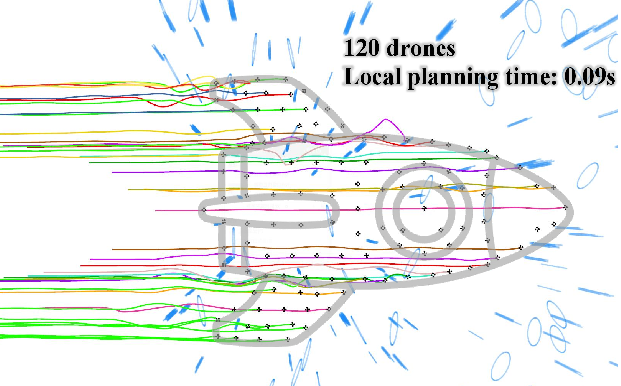
Figure 2: Illustration of a 120-agent rocket-shaped formation in an obstacle field, showcasing robust shape maintenance and obstacle avoidance under the PCR-based planning scheme.
Computation time for OFPS itself (PCR step) remains below 0.06s even for 1000 agents, underscoring scalability.
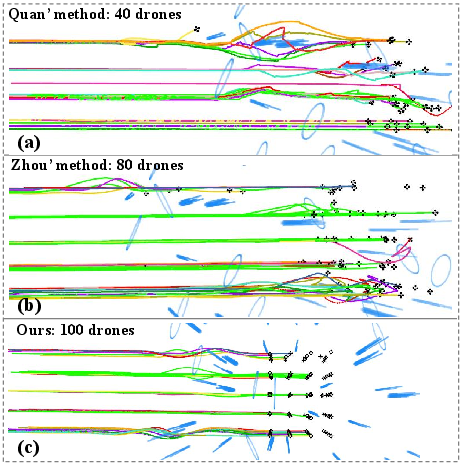
Figure 3: FLIP attains real-time, high-fidelity formation maintenance for 100-agent cubic swarms where competing methods fail due to excessive latency.
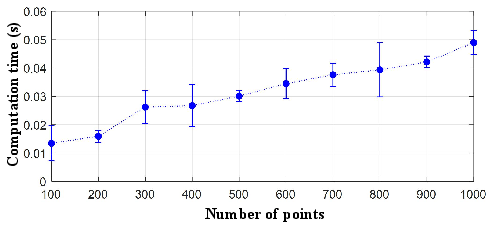
Figure 4: Empirical scaling of mean and standard deviation of PCR (OFPS) computation time with increasing agent/point count.
Resilience to Outliers and Abnormal Agents
FLIP's PCR with outlier rejection demonstrates robust resilience to abnormal agents, preserving global formation even when up to 12% of agents exhibit faulty or adversarial behavior. Competing approaches either fail to filter out cascading trajectory errors (Quan’s) or cannot handle a significant proportion of outliers (Zhou’s, which removes outliers only pre-planning).
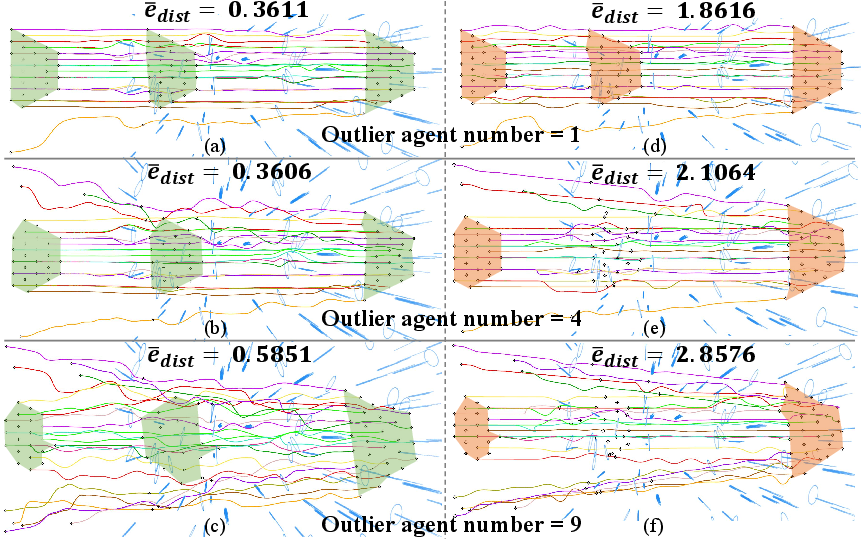
Figure 5: Comparative formation outcomes with 1/3/9 outlier agents (FLIP, left; Zhou's, right), highlighting robust rejection of abnormal behavior in FLIP.
Across various nominal formation shapes (e.g., heart, cube, vertebral, randomized 3D), FLIP consistently matches or closely approaches the best performance of Laplacian-based methods while avoiding axis-dominance and deformation issues endemic to those approaches, particularly in elongated or slender geometries.
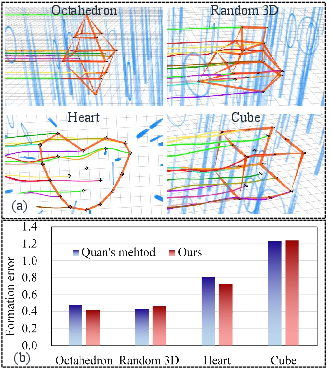
Figure 6: Formation error comparison across four distinct shapes; FLIP closely tracks optimal performance of fully connected methods but with reduced computational cost.
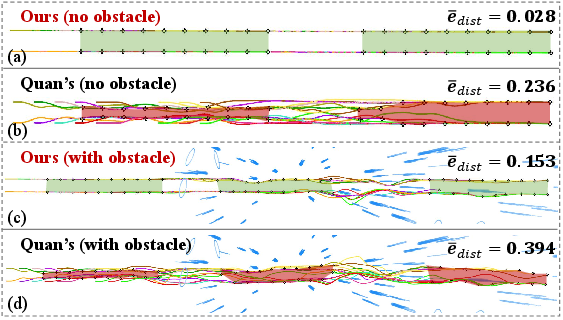
Figure 7: Slender (elongated) formation maintenance, highlighting FLIP’s superior robustness to short-axis deformations versus Laplacian methods, both with and without obstacles.
Implications and Future Directions
FLIP fundamentally advances distributed swarm trajectory optimization by introducing robust PCR as the core coordination mechanism. This allows for high-performance, scalable, and resilient formation maintenance in real-world, communication-limited, and adversarial conditions, addressing long-standing limitations of graph-based and parametric approaches.
Practically, such a paradigm is directly applicable to aerial drone light shows, disaster response swarms, and other large robot collectives requiring shape-morphing and rapid reconfiguration in dynamic spaces. Theoretically, the method opens avenues for further development of group-based or hierarchical PCR strategies to extend the agent scalability limits, as well as integration with global path planners for whole-formation navigation in complex topologies.
The strong empirical results suggest that outlier-robust PCR could inform future multi-agent coordination schemes even beyond formation control, e.g., in distributed SLAM or adaptive coverage scenarios.
Conclusion
FLIP provides a validated, efficient, and resilient approach to distributed swarm formation planning by integrating robust PCR, asynchronous communication, and advanced trajectory optimization. The framework achieves real-time performance across unprecedented agent counts and a variety of spatial constraints, ensuring robustness to both environmental complexity and agent-level anomalies. These innovations set a new standard for scalable multi-agent coordination and trajectory planning architectures.