- The paper introduces a hybrid stabilizer-tensor network method that combines efficient Clifford updates with tensor network techniques to simulate coherent non-Clifford crosstalk in surface codes.
- It demonstrates that coherent crosstalk lowers the error threshold from roughly 1% to about 0.8% and substantially increases logical error rates beyond stochastic approximations.
- The study highlights the importance of noise model fidelity for accurate circuit-level analysis and guides future hardware design, decoder optimization, and resource evaluation.
Non-Clifford Crosstalk Noise in Surface Codes: Hybrid Stabilizer-Tensor Network Simulation
Introduction
Surface codes are among the most promising QEC schemes for scalable quantum computation, offering local stabilizer checks on 2D qubit architectures. Standard analyses typically rely on stochastic Pauli noise and ideal, noise-free syndrome extraction, facilitating classical simulation via Clifford evolution and stabilizer formalisms. However, these approximations fail to capture critical coherent effects and correlated error processes, including non-Clifford crosstalk. This work develops and applies a hybrid stabilizer-tensor network (STN) simulation protocol to address the simulation of surface codes under coherent non-Clifford crosstalk, going beyond Pauli-twirled or purely stochastic noise approximations. The methodology enables direct circuit-level analysis of crosstalk with realistic coherence and correlations, yielding new insight into logical error rates and threshold behavior.
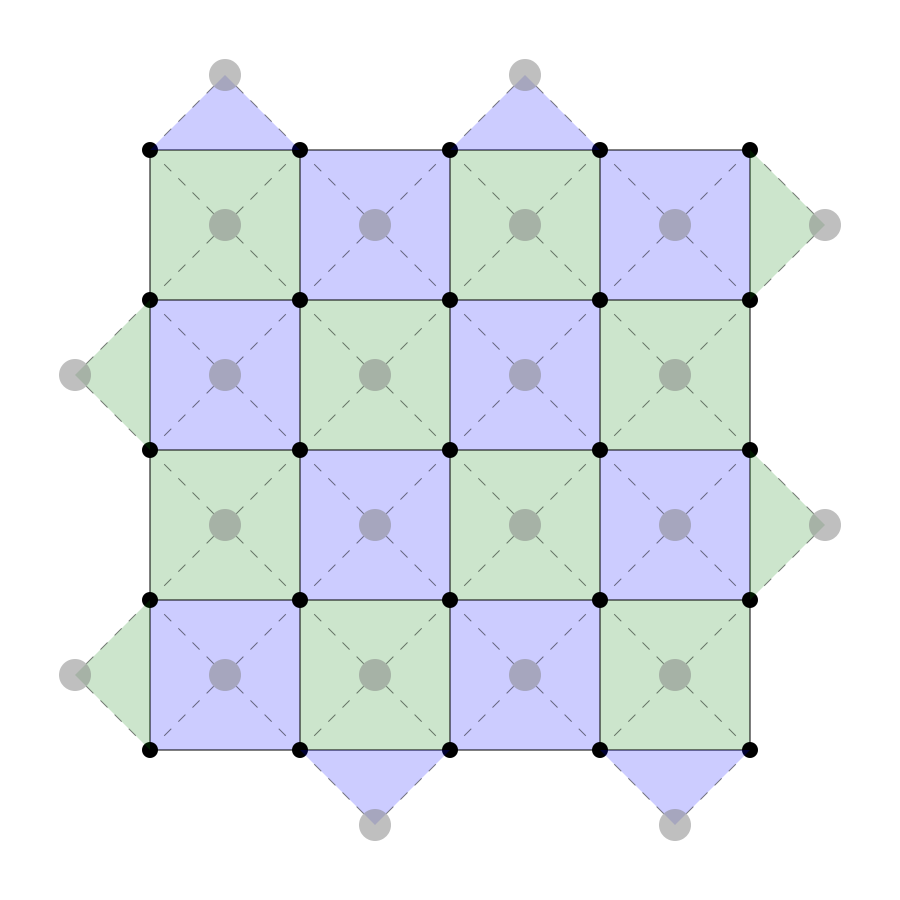
Figure 1: A distance 5 rotated surface code: data qubits (black) reside on grid vertices, while ancillas (gray) are on faces; typical Z (left) and X (right) stabilizer extraction circuits are shown.
Hybrid Stabilizer-Tensor Network Methods
Classical simulation of QEC under general noise is hampered by the exponential complexity of non-Clifford dynamics combined with substantial entanglement growth. Pure state-vector or MPS methods fail at moderate system sizes, but recent hybrid STN simulators [such as GCAMPS (2605.29514)] preserve efficient Clifford update rules while incorporating tensor network representations (e.g., matrix product states) to accommodate non-Clifford gates and non-Pauli errors. In this framework, the code circuit is decomposed as a Clifford "frame" acting on an MPS, with non-Clifford errors introduced as perturbations on the MPS. Coherent evolution and measurement are handled with STN update rules that commute errors through the Clifford layer, effectively capturing the entanglement and magic (non-stabilizerness) profile characteristic of QEC with realistic noise.
A critical performance lever for such methods is tensor network truncation. For surface code circuits, the Schmidt spectrum of the MPS decays exponentially across any cut (Figure 2), justifying aggressive truncation to low bond dimension—boosting simulation efficiency while preserving the relevant logical error statistics.
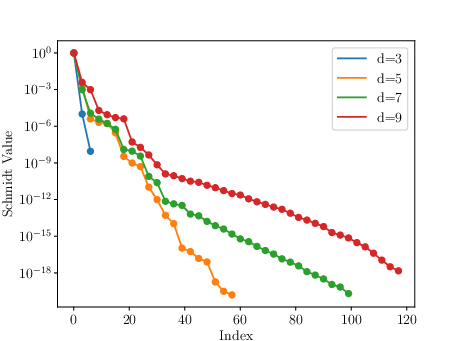
Figure 2: Squared Schmidt values across the central MPS cut for surface code simulations at increasing distance d, highlighting exponential decay and efficient truncation capability.
Convergence of logical error rates is observed even at modest bond dimension (Figure 3), and over-truncation leads to underestimation due to loss of low-probability error events, ensuring reported logical error rates serve as a lower bound in large-scale simulations.
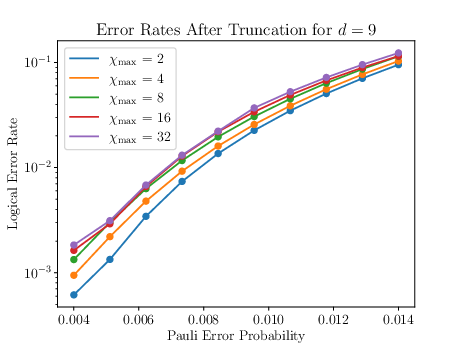
Figure 3: Logical error rate as a function of tensor network truncation for d=9; convergence is achieved rapidly, with excessive truncation leading to underestimation.
Noise Modeling: Baseline, Crosstalk, and PTA
The baseline noise model combines single- and two-qubit depolarizing noise with hardware-inspired error rates. Crosstalk is modeled as coherent nearest-neighbor ZZ rotations with angle θ=JZZtg after two-qubit gates—emulating both residual static coupling and always-on crosstalk in superconducting architectures. For this study, θ∼10−3 is typical of state-of-the-art devices [see also (Zhou et al., 6 Mar 2025)]. The Pauli twirling approximation (PTA) is used as a baseline for comparison; here, coherent noise is stochastically replaced with a probabilistic ZZ error with matching average fidelity loss, but all off-diagonal (coherent) processes are eliminated.
Simulation Results: Crosstalk-Induced Logical Error Rates
Simulation of distance-d surface codes under coherent crosstalk noise demonstrates several key findings. Logical error rates under crosstalk (both Pauli-twirled and coherent) are compared to pure depolarizing noise (Figure 4).
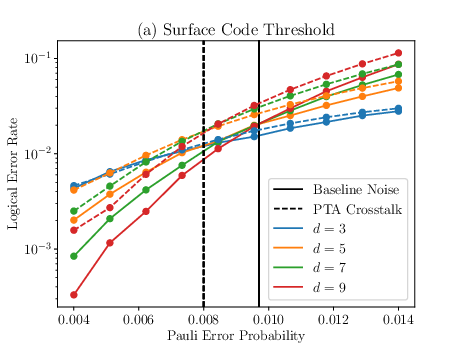
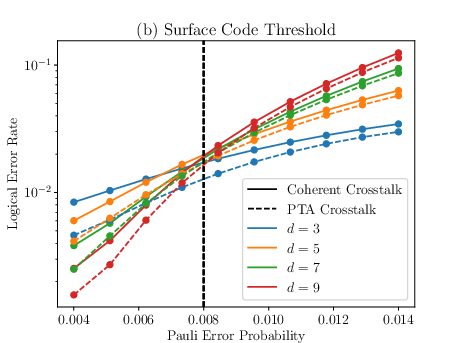
Figure 4: Logical error rates for the surface code with (a) Pauli-twirled and (b) coherent crosstalk. Baseline Pauli noise yields the lowest rate and highest threshold; coherent crosstalk is maximally deleterious.
Critical outcomes:
- Threshold Reduction: Inclusion of crosstalk lowers the logical threshold from ~1% (Pauli noise) to ~0.8%.
- Sub-threshold Penalty: For p below threshold, coherent crosstalk yields logical error rates substantially higher than PTA or purely stochastic approximations.
- Threshold Robustness: While the code threshold remains grossly similar between PTA and coherent noise, the magnitude of logical errors in the operating regime relevant for computation is underestimated unless the full coherence is captured.
Alternative crosstalk field distributions—such as a random-sign X0 rotation per error instance, but with identical PTA—are also considered. Strikingly, the logical error rate profile is altered and, for certain configurations, matches the PTA prediction exactly despite retaining fully coherent noise (Figure 5).
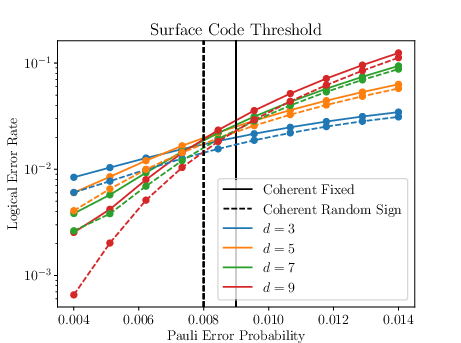
Figure 5: Logical error rates for the surface code with random-sign coherent crosstalk; rates match PTA predictions despite the underlying coherence of noise.
This demonstrates that different noise unitaries with identical Pauli twirled channels can manifest qualitatively distinct logical error behavior for sub-threshold operation.
Detailed analysis at fixed code distance (e.g., X1, Figure 6) shows a strict hierarchy: baseline Pauli noise X2 PTA crosstalk X3 coherent crosstalk with uniform sign X4 random-sign crosstalk, emphasizing the importance of noise model fidelity.
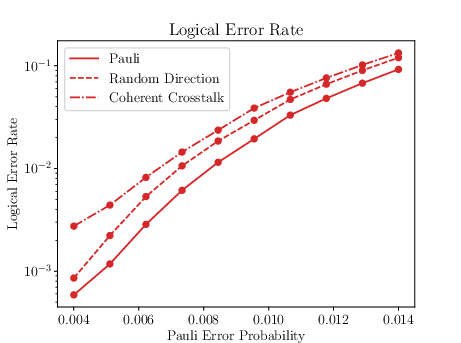
Figure 6: Logical error rates at X5 under all considered noise models. Uniform coherent crosstalk is most harmful; random-sign crosstalk reduces logical error rates.
Theoretical and Practical Implications
The findings in this study have noteworthy implications for both QEC theory and experimental design:
- Noise Model Fidelity: Accurate simulation of realistic hardware noise must retain coherence and spatial correlations, as PTA dramatically underestimates logical error rates and misrepresents the hardware requirements for logical-level suppression.
- Crosstalk Sensitivity: Surface codes are sensitive to the presence and structure of coherent crosstalk; even small coherent interactions between neighboring qubits can degrade performance far more than incoherent approximations would suggest.
- Design and Benchmarking: Thresholds alone are insufficient; sub-threshold operation and "distance boosting" must be evaluated with physically motivated, coherent noise models to optimize error correction resources.
- Methodology: Hybrid stabilizer-tensor network techniques unlock simulation of realistic circuit-level error correction in regimes previously inaccessible, enabling hardware-tailored logical error characterization. These methods complement other approaches including ZX-calculus and advanced sampling [see 134.190602, 133.230601].
Prospects for Future Research
Several avenues for future work are highlighted:
- Extension to Other Noise Models: Incorporation of leakage, amplitude damping, and correlated non-Markovian noise in STN-based simulation frameworks [114512, adebab].
- Alternative QEC Codes: Application to low-density parity-check (qLDPC) codes and other topological codes where spatially correlated noise is prominent [bravyi_high-threshold_2024].
- Decoding Algorithms: Investigation of decoder performance under coherent and correlated noise, potentially integrating machine learning decoders trained on coherent-crosstalk data [gicev_fully_2026].
- Hardware-Informed Simulation: Feedback of simulation results to circuit design, calibration, and control pulse optimization to mitigate coherent crosstalk at the physical layer.
Conclusion
This work establishes that coherent non-Clifford crosstalk is a critical source of logical errors in surface code QEC and that its impact is underestimated by conventional PTA or incoherent stochastic models. The hybrid stabilizer-tensor network simulation provides a scalable and practical solution for analyzing realistic error correction circuits, revealing strong sub-threshold logical error penalties and the necessity of coherence-aware benchmarking. Continued development and deployment of such methods will enable more accurate characterization of hardware requirements and contribute to the realization of fault-tolerant quantum computation in the presence of realistic noise.
References:
- "Non-Clifford Crosstalk Noise in Surface Codes Using Hybrid Stabilizer-Tensor Network Methods" (2605.29514)
- "The Surface Code beyond Pauli Channels: Logical Noise Coherence, Information-Theoretic Measures, and Errorfield-Double Phenomenology" (Behrends et al., 2024)
- "Stabilizer Tensor Networks: Universal Quantum Simulator on a Basis of Stabilizer States" [133.230601]
- "Stabilizer Tensor Networks with Magic State Injection" [134.190602]
- "Surface Code Error Correction with Crosstalk Noise" (Zhou et al., 6 Mar 2025)

