- The paper demonstrates that neural network measures like loss landscape sharpness and RSO reconstruction error reliably track quantum simulation complexity in both MPS and Clifford+T systems.
- It employs a five-layer ReLU energy network with maximum likelihood estimation to quantify learning hardness through detailed analysis of geometric loss landscapes and parameter subspace constraints.
- Empirical findings reveal that increasing entanglement and non-stabilizerness elevate classical learning difficulty, suggesting practical proxies for assessing quantum simulation feasibility.
Learning Quantum System Hardness from Samples: An Expert Analysis of Classical Simulation and Sample-Based Learning Complexity
Motivation and Problem Statement
The paper "Comparing Classical Simulation and Sample-Based Learning of Quantum Systems: Learning the Hardness of Quantum Systems from Samples" (2605.28986) interrogates the empirical relationship between two classical approaches for reproducing quantum behavior: simulating a quantum system from its description (classical simulation), and reconstructing its measurement statistics solely from sampled data (sample-based learning). Although both paradigms yield probabilistic models of the same Born-rule statistics, their relative computational difficulty—or "hardness"—is nuanced, with complexity-theoretic results having established both alignments and separations between simulability and learnability.
Unlike previous studies that parametrized complexity in neural quantum state learning via model size, this work shifts focus to geometric probes of neural network training: specifically, the maximum eigenvalue of the Hessian of the loss ("sharpness") and the reconstruction error attained under a fixed random low-dimensional subspace of parameter space (Random Subspace Optimization, RSO). Through systematically varying quantum resources associated with simulation hardness—entanglement via the bond dimension χ of random MPS, and non-stabilizerness ("magic") via the T-count in Clifford+T circuits—the work empirically explores whether classical sample-based learning difficulty, as evidenced by the neural optimization landscape, aligns with known bottlenecks for classical simulation.
Methodology
Quantum State Families and Complexity Knobs
The experimental design isolates two families of N=10 qubit states:
- Random Matrix Product States (MPS): Here, bond dimension χ modulates entanglement. Classical simulation cost with MPS scales polynomially in χ, with higher entanglement increasing contraction complexity.
- Clifford+T Circuits: Clifford circuits permit efficient classical simulation, but the addition of non-stabilizer T gates (measured by T-count t) induces exponential growth in simulation cost via stabilizer rank.
Both resource knobs are probed independently, with entanglement and non-stabilizerness behaving as largely orthogonal drivers in the explored operational regime.
Energy-Based Model and Learning Protocol
A five-layer fully-connected ReLU energy network, with $128$ units per layer, models the Born distribution via an energy parameterization. The model is trained by exact maximum likelihood estimation using 105 measurement samples; the small system size permits exact computation of the partition function and the loss landscape's full Hessian.
Complexity Probes
- Loss Landscape Sharpness: The maximum Hessian eigenvalue at convergence, T0, quantifies local curvature. Sharp minima (large T1) are empirically associated with higher optimization difficulty and poorer generalization.
- Random Subspace Optimization (RSO): The model is trained while constraining updates to a T2-dimensional random affine subspace. The error under this constraint signals the model's representational demands.
Empirical Findings
Entanglement as a Complexity Driver in MPS
Neural network learning from sample distributions of random MPS manifests a direct relationship between entanglement (as modulated by bond dimension T3) and classical learning hardness. Both probes—reconstruction error at fixed RSO capacity and T4—rise monotonically with T5, mirroring the increase in simulation complexity.
In detail, for fixed RSO subspace dimension T6, the total variation (TV) reconstruction error increases with T7 (Figure 1), signifying that highly entangled quantum states require greater model capacity for faithful classical learning.
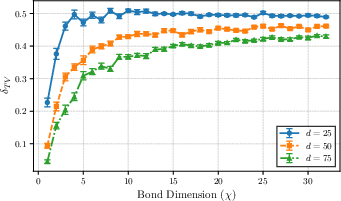
Figure 1: Average TV distance between learned and target MPS Born distributions as a function of bond dimension T8 for different RSO subspace dimensions T9.
Concurrently, the Hessian sharpness at convergence, N=100, grows steadily with N=101, signifying sharper loss landscapes and suggesting reduced generalization robustness as simulation complexity escalates (Figure 2).
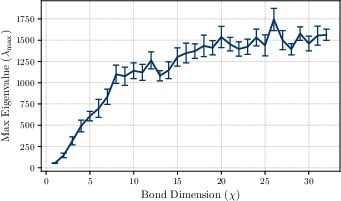
Figure 2: Maximum loss Hessian eigenvalue at convergence as a function of MPS bond dimension N=102, reflecting an increased landscape sharpness with rising entanglement.
Non-Stabilizerness and Magic in Clifford+N=103 Circuits
For CliffordN=104 circuits, augmenting the T-count N=105—injecting more non-stabilizer content—initially increases both learning error and loss curvature, though both signals saturate at N=106. This is consistent with theory: once states reach maximal "magic," further increases in T-count do not significantly increase the structural complexity of the sampled Born distribution.
The N=107 metric increases with N=108, albeit with greater statistical dispersion than in the MPS case (Figure 3). The noisier trend is attributed to heterogeneity in Born distribution profiles for low T-counts across circuit instances.
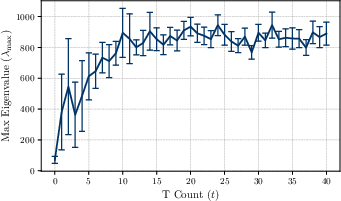
Figure 3: Maximum Hessian eigenvalue at convergence as a function of N=109-count χ0 in Cliffordχ1 circuits.
The RSO probe, when applied with sufficiently large χ2, mirrors the increase in learning error with T-count, up to a similar saturation point (Figure 4).
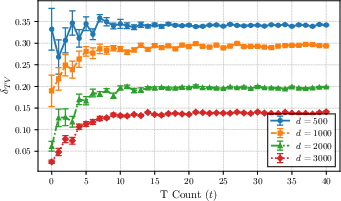
Figure 4: RSO reconstruction error vs. χ3-count, showing error growth with χ4 until saturation.
Capacity Thresholds and RSO Interpretation
An important nuance: for Cliffordχ5 circuits, the monotonic relationship between magic and learning hardness is only reliably observed once RSO subspace dimension χ6 is sufficiently large to resolve the entanglement background established at χ7. At low χ8, all models are bottlenecked by the high base entanglement, obscuring the incremental complexity from non-stabilizerness.
Conversely, for MPS, the entanglement knob is the sole major resource varied, and so even moderate χ9 suffices to expose the learning complexity gradient.
Validation of Quantum Resource Knobs
The underlying assumptions—control of entanglement by χ0 in MPS, and its saturation in deep Cliffordχ1 circuits irrespective of χ2—are corroborated by entanglement entropy analyses (Figures 5 and 6).
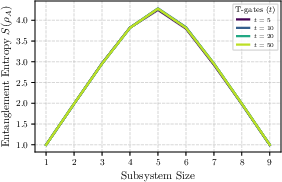
Figure 5: Entanglement entropy vs. subsystem size for Cliffordχ3 circuits, showing volume-law scaling and independence from T-count χ4.
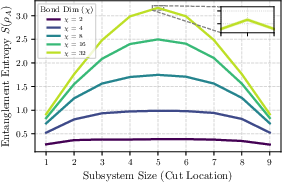
Figure 6: Entanglement entropy vs. bipartition for MPS at varying bond dimension, confirming χ5 as an entanglement knob.
RSO Convergence Behavior
Convergence under RSO constraint exhibits fewer epochs for smaller χ6. The higher error in this regime is not a symptom of poor optimization but rather of intrinsic representational bottlenecks (Figure 7).
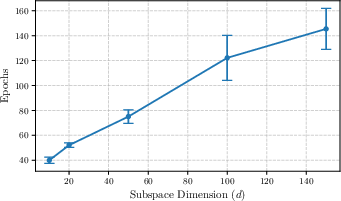
Figure 7: Convergence epochs as a function of RSO subspace dimension χ7 for fixed χ8, highlighting faster convergence but higher error at low capacity.
Implications and Outlook
This empirical study substantiates that, within the studied operational regime and resources, classical learning hardness—as evidenced by both geometric loss landscape probes and capacity-constrained error—systematically tracks established simulation complexity measures. This positive correlation suggests that practical neural network training dynamics can provide an empirical proxy for quantum complexity; rapid classical learnability may serve as a proxy for feasible classical simulation.
However, the observed saturation of learning hardness with T-count, contrasted against the unbounded increase with χ9 in the MPS regime, indicates subtle dependencies on the nature of quantum resources and their manifestation in Born distributions. Further, the probes used—especially +T0—capture only particular facets of the loss geometry; full Hessian spectral analysis, more comprehensive capacity metrics (e.g., intrinsic dimension), and exploration of different measurement bases or resource combinations remain open avenues to comprehensively map the simulability-learnability landscape.
Moreover, these results provide methodological guidance for neural approaches in variational quantum algorithms, quantum state tomography, and the certification of cloud quantum devices: empirical learning diagnostics can offer tractable, operational indicators of classical hardness boundaries as quantum systems scale in entanglement and magic.
Conclusion
The study establishes that, for both entanglement-driven (MPS) and magic-driven (Clifford+T1) state families, classical learnability as operationalized through neural network optimization landscape and RSO-restricted error reflects known simulation complexity scales. The consistent increase in both maximum Hessian eigenvalue and reconstruction error with quantum resource intensification demonstrates that, for accessible system sizes, learning and simulation hardness are closely intertwined. These findings bolster the perspective that classical machine learning can empirically probe the boundary of classically hard quantum regimes, prompting further theoretical and algorithmic exploration as quantum devices push into regimes of maximal coherence and entanglement.