- The paper establishes the unique two-loop NMHV stress-tensor form factor via a cyclic sum over leading singularities and weight-four functions.
- It employs rigorous constraints like parity, dihedral symmetry, and spurious-pole cancellation to reduce 1914 unknowns and determine the symbol alphabet.
- The work confirms the universality of the 88-letter alphabet, providing insights for harnessing analytic bootstrap methods in Higgs-plus-parton amplitude calculations.
Motivation and Context
This paper presents the unique determination, at symbol level, of the two-loop four-point next-to-maximally helicity-violating (NMHV) ratio function for the chiral stress-tensor form factor in planar maximally supersymmetric Yang-Mills theory (N=4~sYM). The motivation arises from the central role of gluon-fusion amplitudes in Higgs boson production and the reduction of Higgs-plus-parton amplitudes to effective gauge-invariant operator form factors in the large-top-mass limit. Supersymmetric half-BPS form factors, especially of the chiral stress-tensor multiplet, serve as essential analogs for analytic techniques, geometric insights, and symmetry structures relevant to Standard Model collider observables.
Prior work has bootstrapped MHV form factors (three-point up to eight loops [Dixon:2022rse], four-point up to four loops [MHV:fourloop]), but the NMHV sector with its nontrivial leading singularity structure and transcendental function space remained unresolved. The present work provides the first multi-loop result for a non-MHV form factor, extending analytic control beyond the MHV sector, and interrogates whether the function space ("alphabet") discovered for four-point MHV form factors is universal.
The four-point NMHV form factor, F4(pi,q,ηi), admits a decomposition in terms of Grassmannian kinematic prefactors—leading singularities or R-invariants—and transcendental scalar functions. At one loop, three distinct classes emerge: box-type R241, boundary R144 (parity conjugate to R241), and algebraic S1=R12,34 from three-mass-triangle cuts (Figure 1 in the paper). The form factor ratio function R4 is, at all-loop order, conjectured to decompose as a sum over cyclic images of these prefactors, accompanied by weight-$2L$ bosonic functions:
N=40
with N=41, N=42, and N=43 as leading singularities and N=44 transcendental coefficient functions. This structure persists in the present two-loop analysis and is foundational for the bootstrap approach.
Function Space and Symbol Alphabet
The transcendental function space is built from the known symbol space for two-loop five-point one-mass Feynman integrals, leveraging the canonical differential equation (CDE) approach [Henn:2013pwa, Abreu:2020jxa]. The relevant integral families are shown in (Figure 2):
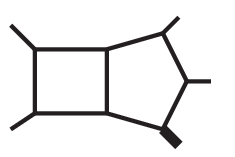
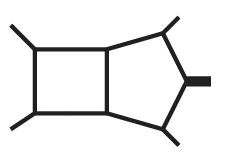
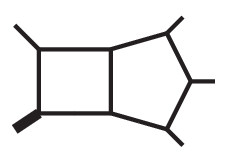
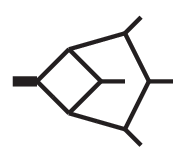
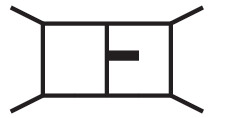
Figure 2: Two-loop five-point one-mass Feynman integral families for form factor bootstrap.
These integral topologies encode both planar and non-planar contributions, with algebraic square-root dependence arising from kinematic invariants and Lorentz odd structures. The initial bootstrap ansatz spans 1914 unknowns, constrained by the symmetries and singularity structure of the prefactors, and is systematically reduced by imposing geometric and physical conditions.
Bootstrap Constraints and Resolution
The full determination proceeds via staged imposition of constraints:
- Galois and Parity Symmetry: Functions are classified as parity-even/odd, and periodic roots impose sign-flip symmetries, reducing unknowns.
- Dihedral Symmetry: Cyclic and reflection symmetries inherited from leading singularities further reduce the functional space.
- Spurious-Pole Cancellation: The requirement that unphysical poles from prefactors cancel in the ratio function restricts allowed combinations.
- Collinear and Triple-Collinear Limits: The form factor must correctly factorize in collinear limits, matching known splitting functions and six-point amplitude limits.
- Soft and Double-Soft Checks: The symbol must vanish or correspond to the double-soft current as dictated by infrared physics.
These constraints sequentially fix all degrees of freedom, uniquely determining the symbol at two loops.
Main Results
The bootstrapped answer is a cyclic sum over leading singularities, with accompanying two-loop weight-four functions. The resulting symbol has 78 letters—all contained within the previously identified 88-letter alphabet for four-point MHV form factors [Dixon:2024yvq], with no new structures despite the increased algebraic complexity and nontrivial prefactor appearance. This demonstrates universality of the 88-letter alphabet for four-point form factors and supports the all-loop decomposition conjecture.
The symbol passes stringent independent checks in soft, double-soft, collinear, and triple-collinear limits. The double-soft limit matches the NMHV current extracted from six-point amplitude data, providing a strong cross-validation.
Implications and Future Directions
The results strongly suggest that leading singularity decomposition persists at all loop orders and that a stable symbol alphabet governs four-point form factors, supporting further bootstrapping at three loops and beyond. Analytic form factor control in the NMHV sector can be exploited to probe deep mathematical and physical structures: antipodal duality, maximal transcendentality in QCD (in Higgs-plus-jet amplitudes), Regge and multi-particle limits for understanding factorization and BFKL evolution, and light-like or self-crossing kinematics for double parton scattering.
Direct connections to QCD amplitudes via the maximally transcendental principle may be analyzed analogously to recent two-loop Higgs-plus-two-jet computations [DeLaurentis:2026brm]. Supersymmetrized splitting functions in collinear and soft limits, and possible extensions of antipodal duality into the NMHV sector, are enticing targets for future research. Additionally, the universality of symbol alphabets (analogous to N=45, N=46, N=47 cases for amplitudes) may point to deep algebraic stability in N=48 sYM.
Conclusion
The paper establishes the unique two-loop four-point NMHV stress-tensor form factor in planar N=49 sYM at symbol level, confirming the universality of the 88-letter function space and the all-loop leading singularity decomposition. The constraints and checks implemented establish robust physical validity. The result supplies new data for further exploration of analytic, geometric, and algebraic properties underlying multi-loop form factors, and sets the stage for both practical calculation of Higgs amplitudes and theoretical advances in amplitude bootstrap methodology.

