- The paper provides an instance-optimal characterization of achievable e-power under ε-DP in both batch and sequential settings.
- The methodology employs a novel variational approach with a clipped likelihood ratio to balance privacy constraints with evidence accumulation.
- Empirical results demonstrate that the proposed DP e-processes outperform traditional DP-SPRT baselines by achieving faster stopping times at realistic privacy levels.
Optimal Rates for Differentially Private Hypothesis Testing with E-values
Overview
The paper "Optimal Rates for Differentially Private Hypothesis Testing with E-values" (2605.28952) addresses the problem of characterizing and attaining optimal statistical power in hypothesis testing under central differential privacy (DP) constraints, using the framework of e-values and e-processes. It provides tight instance-specific upper and lower bounds for power in both batch and sequential settings and constructs practical algorithms achieving these bounds. The analysis leverages a novel variational approach connected to robust statistics and information theory, yielding precise duality results and new tools for privacy-preserving inference.
E-values, Differential Privacy, and Hypothesis Testing
E-values generalize the classical concept of p-values, supporting anytime-valid inference and robust error control under adaptive data collection. An e-variable E for null P must satisfy EP[E]≤1, and hypothesis tests are performed by thresholding E. The e-power EQ[logE] quantifies sensitivity under alternative Q. Differential privacy mandates that outcome distributions be stable under single-record changes, typically quantified by a privacy parameter ε.
The paper's central problem is: Given distributions P (null) and Q (alternative), what is the maximal e-power achievable by any E0-DP e-variable for E1? This encompasses both algorithmic and information-theoretic aspects, requiring analysis of the interplay between evidence accumulation and privacy constraints.
Batch Setting: Tight Characterization and Construction
The authors derive a variational formula for the optimal asymptotic per-sample e-power under DP:
E2
where E3 is total variation distance. The infimum is realized by a distribution E4 defined via an explicit clipping of the likelihood ratio E5 between values E6 and E7 determined by the privacy parameter and the instance.
The analysis involves two principal steps:
- Upper Bound: For any E8-DP mechanism E9, the optimal (post-processed) e-variable achieves P0, leading to an upper bound by optimizing over P1.
- Lower Bound and Construction: A clipped likelihood-ratio e-variable P2 achieves the upper bound, and the paper provides a Laplace-mechanism-based privatization, carefully correcting for convexity bias to ensure it remains a valid e-variable.
This is illustrated in (Figure 1):
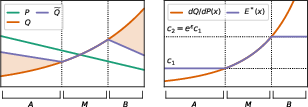
Figure 1: Left: Illustration of the construction of the intermediate distribution P3 for P4, P5, and P6; right: visualization of the difference between the true likelihood ratio and its clipped, calibrated proxy P7.
Strong Duality and Robust Statistics Connections
A core result characterizes the duality between the supremum over P8-DP mechanisms (maximum private KL divergence) and the infimum over "contaminations" of P9:
EP[E]≤10
This connects to robust statistics—optimal tests against contaminated alternatives—and establishes that DP mechanisms dilute power analogously to worst-case adversarial corruptions.
The resulting clipping of the likelihood ratio can be seen as a form of robustification, reminiscent of Huber’s contamination models, but here the extent of "contamination" is not fixed but instance-optimized.
Sequential Setting: Instance-Optimal E-processes
In the sequential regime, where data arrives over time, the authors generalize to e-processes—sequences of e-values with the optional stopping property. The main metric is the expected log-evidence at arbitrary stopping times under EP[E]≤11.
They prove a universal lower bound on the expected stopping time for any EP[E]≤12-DP sequential test that is tight up to constants:
EP[E]≤13
where EP[E]≤14 and EP[E]≤15 are type I and II error probabilities. The construction employs a batch-to-e-process reduction, tuning batch sizes to control the competitive ratio and privacy cost across all stopping times.
The empirical performance of their universal e-process is visualized in (Figure 2):
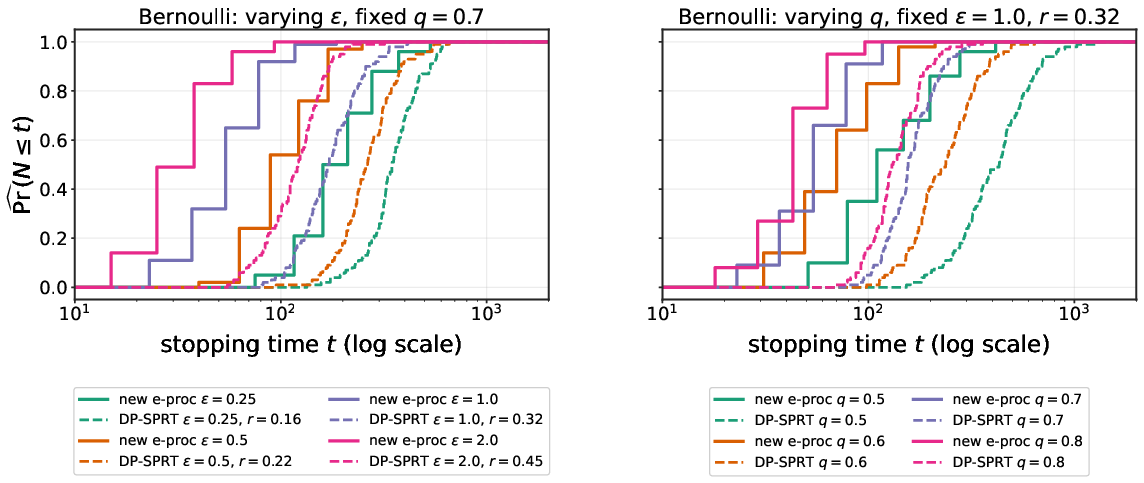
Figure 2: Empirical CDFs of stopping times in sequential tests. The tailored e-process (solid) consistently achieves smaller stopping times than the DP-SPRT (dashed) baseline at the same error probabilities and privacy level.
Algorithmic Contributions and Empirical Results
A concrete algorithm (Algorithm 1 in the text) is given for constructing DP e-processes from non-private e-variables, using batched Laplace noise with analytically calibrated compensators to maintain e-variable validity. The construction ensures simultaneous optimality for all sufficiently large stopping times.
Empirical evaluation on Bernoulli testing (Figure 2) demonstrates that the proposed DP e-processes attain faster (i.e., smaller) stopping times than specialized DP-SPRT baselines for a range of alternatives and privacy parameters, despite making fewer distributional assumptions.
Implications and Theoretical Significance
- Theoretical optimality: The results resolve the instance-optimal rate of DP hypothesis testing with e-values in both batch and sequential regimes, generalizing previous work for classical p-value-based tests and local-DP settings.
- Algorithmic universality: The constructed mechanism is distribution-free in its privatization step and only requires knowledge of the likelihood ratio for batch optimality.
- Robust statistics linkage: The analysis provides a variational framework closely paralleling minimax and adversarial robust hypothesis testing, sharpened for privacy-bounded protocols.
- Practical sequential inference: The batch-to-e-process construction enables anytime-valid sequential analysis with private data, matching non-private efficiencies up to constants at realistic privacy levels.
Open Directions and Future Work
- Composite hypotheses: The extension to composite null/hypothesis pairs via least-favorable pairs remains, and the dual characterizations provided here supply foundational tools for such generalization.
- Approximate DP and alternative privacy relaxations: Whether the exact form of the optimal rate and mechanisms persist under EP[E]≤16-DP or Rényi-DP frameworks is open.
- High-dimensional or implicit models: For cases where evaluating likelihood ratios is intractable, the development of universally near-optimal bounded e-variables (see the paper's discussion of truncated scaled likelihood ratios) invites further exploration.
Conclusion
The paper establishes a precise, instance-optimal characterization of achievable power for differentially private hypothesis testing with e-values and presents practical algorithms that match these theoretical limits. The proposed methodology unifies ideas from optimal testing, robust statistics, and differential privacy, advancing both the theory and practice of privacy-preserving statistical inference.

