- The paper identifies a distinct discrete family of purely imaginary quasinormal modes in the linear-mass Vaidya spacetime, differentiating them from traditional light‐ring modes.
- It employs the Heun equation formalism and spectral Chebyshev methods to derive quantization conditions and numerically validate the mode structure.
- The study reveals that these modes scale with the mass evolution rate, influencing late-time ringdown signals and impacting gravitational wave template accuracy.
Purely Imaginary Quasinormal Modes and Ringdown Spectra of Dynamical Black Holes
Introduction and Motivation
The paper "When the Ringing Stops: Purely Imaginary Modes in the Ringdown Spectrum of Dynamical Black Holes" (2605.28951) addresses the modal structure of ringdown signals from black holes (BHs) with time-dependent mass evolution, specifically employing the linear-mass Vaidya (LMV) spacetime as a model for spherically symmetric, nonstationary BHs. Traditional analyses of ringdown employ stationary backgrounds, where quasinormal modes (QNMs) are damped sinusoids tied to the light ring (LR) structure, with late-time tails attributed to branch-cut artifacts on the imaginary frequency axis. This work uncovers the existence and physical consequences of an additional, discrete family of purely imaginary (PI) QNMs in the LMV spectrum, distinct from LR modes and directly tied to dynamical horizons and the underlying conformally related Schwarzschild-Rindler (SR) geometry.
Geometric Setup and Symmetry Structure
The LMV metric generalizes the standard Vaidya geometry to cases where the mass derivative is constant, M(w)=M0+M′(w−w0). This model allows a conformal mapping to the SR spacetime, which features two horizons—the event horizon and the acceleration horizon—with their locations governed by the mass evolution parameter ∣M′∣. The global structure and symmetry properties depend on the degeneracy of these horizons, resulting in a rich parameter space spanning weak accretion (Schwarzschild limit), strong accretion (nearly-extremal/Nariai limit), and small-BH/Rindler limits.
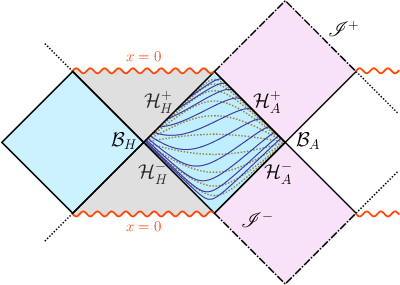
Figure 1: Conformal diagram of SR spacetime, illustrating the causal structure with black hole interior and acceleration horizon.
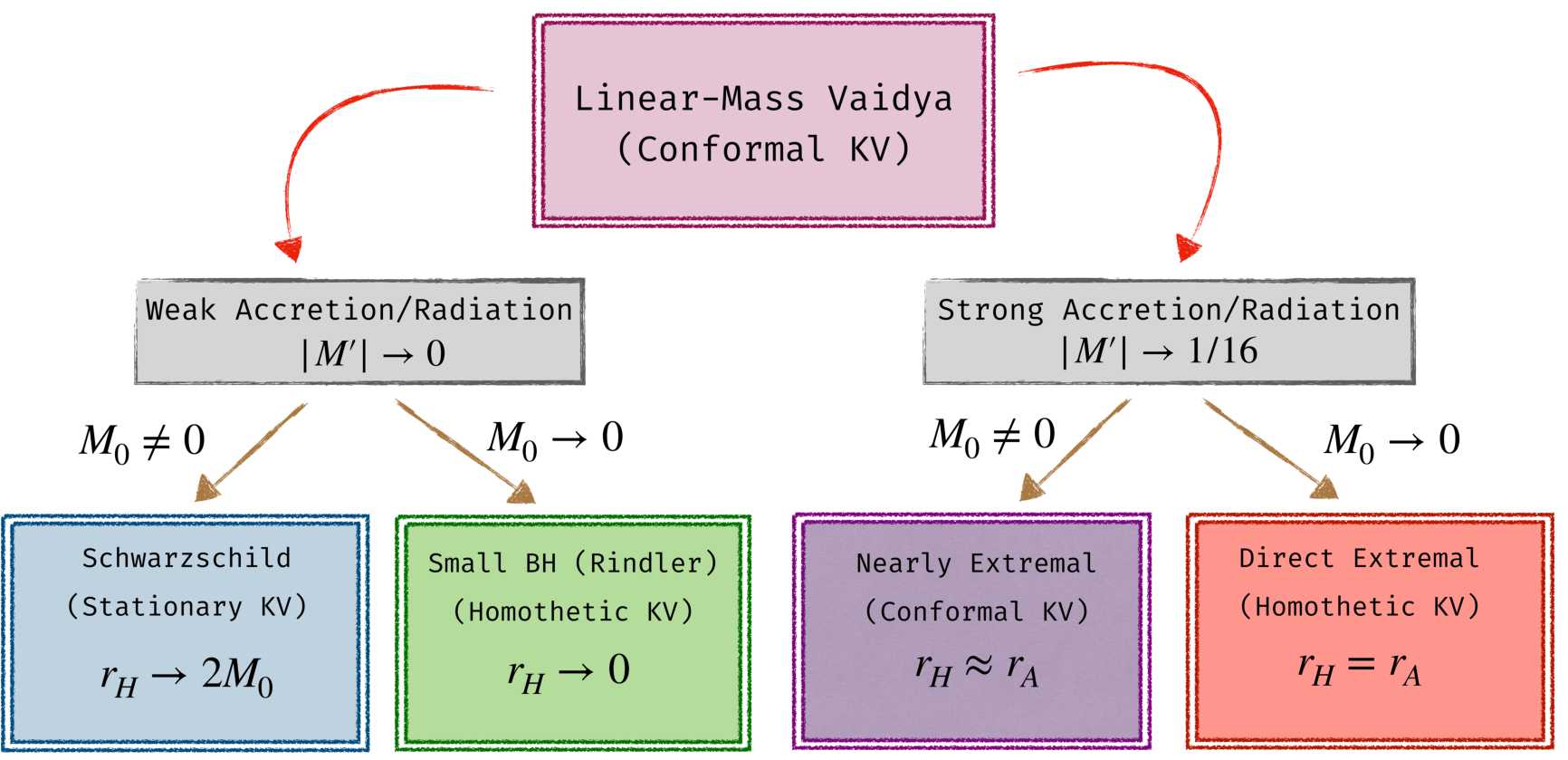
Figure 2: Symmetries and degenerate limits of the LMV spacetime, mapping continuous families and conformal Killing vectors across limits.
Wave Equation, Boundary Conditions, and Modal Decomposition
The perturbation equations for scalar, electromagnetic, and axial gravitational fields reduce to a master wave equation with an effective potential determined by mass evolution and horizon structure. Exploiting the highest degree of symmetry in LMV, the separation of variables is exact, and the Fourier-domain QNM boundary conditions prescribe outgoing solutions at the acceleration horizon and ingoing at the event horizon. A crucial feature is the conformal shift in QNM frequencies for different spin fields, which affects stability and mode excitation thresholds.
The master equation is recast in the form of a Heun equation, with four regular singular points, leveraging results from AGT correspondence and connection coefficient formalism for Heun functions. The quantization conditions obtained predict two distinct families of QNMs: LR modes (complex frequencies) and PI modes (imaginary frequencies). In the weak accretion/radiation regime (∣M′∣→0), the analytic structure demonstrates that PI modes scale linearly with the mass evolution rate: Ω~∼−2i(n+ℓ+1)∣M′∣+O(∣M′∣2)
with corrections computable order by order in an instanton expansion. In the nearly-extremal regime, the spectrum morphs toward the Pöschl-Teller structure, affirming connections to SdS/Nariai limits.
Hyperboloidal Coordinates and Numerical Spectral Approach
A geometric height-function approach is used to construct hyperboloidal slices, ensuring regularity and compatibility with QNM boundary conditions. The spectral Chebyshev method (with mesh refinement) enables full extraction of the QNM spectrum without seed values, avoiding mode-skipping issues inherent to continued fraction methods. This framework confirms, numerically, the coexistence and robustness of PI and LR mode families across parameter regimes and boundary behaviors.
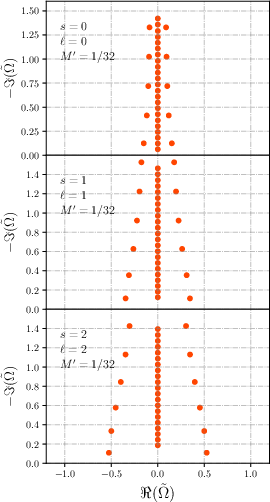
Figure 3: Static QNM spectrum for LMV showing PI (Rindler) modes alongside LR modes for scalar, electromagnetic, and gravitational perturbations.
Limiting Geometries and Spectral Scaling
Analysis of the Schwarzschild and Rindler limits reveals direct connections between PI modes and the branch-cut structure of stationary BHs. In the Schwarzschild limit (t→0), PI modes accumulate near the origin (imaginary axis), reproducing the branch-cut responsible for late-time power-law tails—a feature numerically confirmed by mode counting and density scaling:
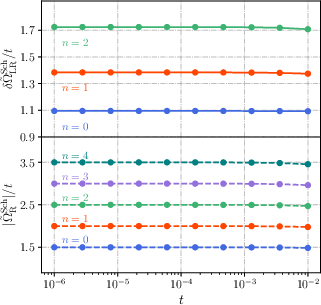
Figure 4: Scaled relative difference between LR modes in the Schwarzschild limit and corresponding Schwarzschild QNMs; scaled absolute values of PI modes for various overtones.
Remarkably, the mode density diverges as d∝1/t, establishing that the discrete PI spectrum approaches continuum branch-cut behavior—a nonunique modal interpretation for the late-time tail.
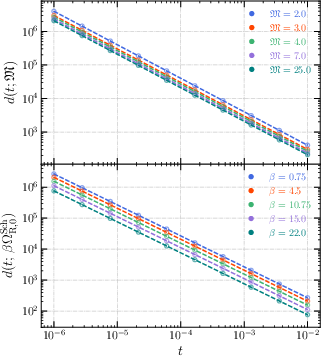
Figure 5: Accumulation of PI QNMs into the Schwarzschild branch-cut as t→0.
Time-Domain Simulations and Physical Consequences
Time-domain finite-difference simulations demonstrate that PI modes can dominate the late-time signal for sub-threshold values of ∣M′∣, producing exponential tails rather than power-law decay. As ∣M′∣ decreases, mode hierarchy emerges: fundamental and overtone PI modes are sequentially visible, reconstructing the power-law tail in the ∣M′∣→0 limit.
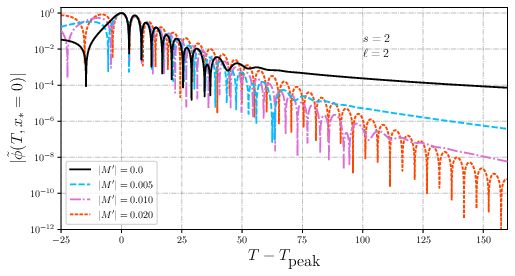
Figure 6: Time-domain signal for axial gravitational perturbations, showing mode decay-time scaling and absence of tail for larger ∣M′∣0.
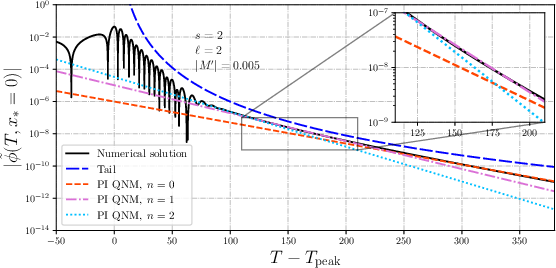
Figure 7: Late-time signal for small mass-evolution rate, illustrating overtone structure and approach to Schwarzschild tail.
Numerical Validation and Analytical Comparison
The spectral method achieves exponential convergence for both LR and PI modes, confirmed across parameter regimes with mesh refinement. Residuals between numerical and analytic predictions (Heun and hypergeometric approaches) show excellent agreement, especially for fundamental modes and lower multipoles; agreement deteriorates for higher overtones, reflecting subtle mode interactions and crossings.
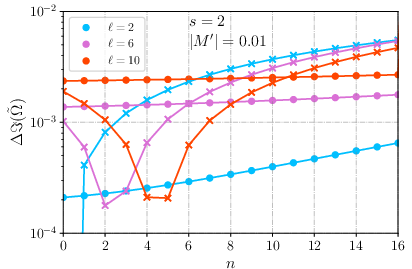
Figure 8: Frequency residuals between numerical and analytic PI mode predictions for varying ∣M′∣1, demonstrating high-fidelity for low overtones.
Implications and Prospects
The existence of PI QNMs in dynamical BH spacetimes suggests that ringdown signals are not exclusively governed by light-ring physics but by additional families regulated by environmental variables (e.g., accretion/radiation rates, horizon structure). This introduces practical consequences for black hole spectroscopy, as deviations from stationary backgrounds may lead to exponential decay signatures and modify GW templates. The modal nonuniqueness of the late-time tail implies selection among discrete spectra is context-dependent, and environmental effects must be included in precise GW modeling.
Phenomenologically, the excitation of PI modes in realistic environments—especially during early ringdown stages after merger or in highly dynamic systems—may lead to observable deviations from canonical power-law tails, with potential impact on parameter estimation and the identification of new physics in BH environments.
Conclusion
This study establishes, analytically and numerically, that the ringdown spectrum of dynamical spherically symmetric BHs supports purely imaginary QNMs alongside conventional LR modes. The PI modes are structurally robust, tied to the global geometry and horizon configuration, and can dominate late-time decay in the time domain for appropriate mass evolution rates. Their infinite accumulation reproduces the Schwarzschild branch-cut in the stationary limit, revealing a nonunique modal underpinning for the late-time tail. These findings expand the theoretical framework for BH ringdown, challenge assumptions about mode excitation, and carry significant implications for GW astrophysics and BH spectroscopy in dynamic environments.
Future Directions
Further research should investigate the excitation and detectability of PI modes in more general dynamical spacetimes, including nonconstant mass evolution, rotating systems, and realistic post-merger scenarios. Quantitative GW data analysis strategies must be developed to differentiate exponential tails from power-law decay in observational signals, and theoretical efforts should clarify whether modal nonuniqueness influences the interpretation of late-time ringdown features.