- The paper introduces SEOBNRv6EHM, an advanced waveform model that eliminates biases in eccentric and unbound binary parameter recovery.
- It validates the model with numerical relativity injections, achieving high-fidelity recovery of mass, spin, and eccentricity across challenging regimes.
- Results reveal significant computational speedups and improved Bayesian inference on LVK catalog events, enabling systematic population studies.
Introduction and Motivation
Orbital eccentricity in compact binaries carries essential clues about the origin and dynamical environment of the progenitor systems. While traditional gravitational-wave (GW) signal modeling and inference have overwhelmingly focused on quasi-circular (QC) binaries, dynamically formed systems can retain measurable eccentricity in the LIGO-Virgo-KAGRA (LVK) sensitivity band. Accurate modeling and parameter estimation (PE) of eccentric signals is thus imperative for reconstructing binary formation channels and constraining astrophysical populations. This work presents a comprehensive analysis utilizing the SEOBNRv6EHM waveform model, providing both an injection/recovery pipeline based on state-of-the-art eccentric numerical relativity (NR) signals and an analysis of the LVK catalog for both bound and unbound binaries (2605.28716).
SEOBNRv6EHM is an aligned-spin effective-one-body (EOB) waveform model for compact binaries in generic planar orbits. Significant innovations compared to SEOBNRv5EHM include:
- Direct phase-space eccentricity parametrization: Eccentricity corrections are encoded via the EOB phase-space variables without auxiliary Keplerian parameters, eliminating equation overdeterminacy and pathologies for high-eccentricity, high-spin, and long-duration signals.
- Sigmoid resummation: Eccentric corrections to the radiation-reaction force and waveform modes employ a resummed form, ensuring robust behavior during strong periastron passages and over full inspiral-plunge trajectories.
- Generic-orbit compatibility: Applicable to both bound and unbound (scattering, direct/dynamical capture) orbits, supporting aligned-spin binaries with six spherical harmonic modes.
- Calibrations: The EOB Hamiltonian and amplitude corrections are recalibrated against extensive NR datasets, including QC, eccentric, and unbound simulations. This recalibration addresses discrepancies found in prior variants, improving accuracy for large-eccentricity systems.
- Computational efficiency: Implementation optimizations yield per-waveform speedups of ∼2−6× over previous eccentric EOB models, empowering catalog-scale PE studies.
NR Injection Studies and Model Systematics
Validation with High-Eccentricity NR Injections
A suite of synthetic injections was constructed from SXS NR simulations spanning egw=0.05 to $0.34$ at M⟨fref⟩=0.01. PE with SEOBNRv6EHM recovers all injected masses, spins, and eccentricities with high fidelity, with systematic uncertainties shrinking at higher eccentricity.
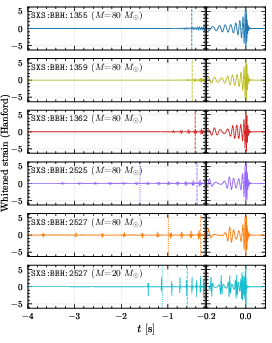
Figure 1: Whitened-strain waveforms in the LIGO Hanford detector for the six NR synthetic-signal injections, ordered by increasing eccentricity.
The model demonstrates robust tracking of GW eccentricity evolution through inspiral, confirmed by wavelet-based eccentricity extraction performed on posteriors mapped to waveform-based definitions.
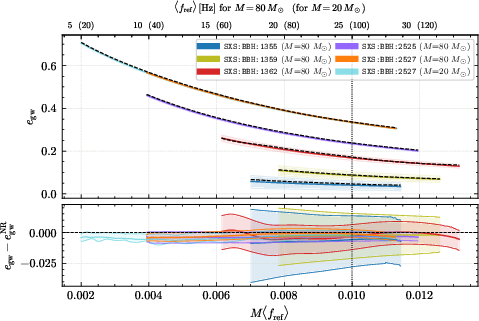
Figure 2: Reconstruction of the gravitational-wave eccentricity egw as a function of the dimensionless orbit-averaged frequency, showing model agreement with NR data across the inspiral.
Model Systematic Evaluation
Comparative PE across SEOBNRv6EHM, SEOBNRv5EHM, and TEOBResumS-Dal analyses was performed using identical priors and frequency choices. For low to moderate egw, all models achieve unbiased recovery. At higher eccentricity and lower total mass (longer in-band inspirals), parameter biases in e, M, and χeff emerge for SEOBNRv5EHM and TEOBResumS-Dal, with SEOBNRv6EHM reliably eliminating these biases.
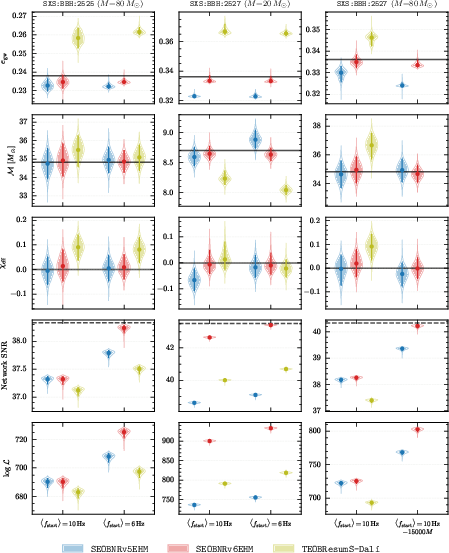
Figure 3: Impact of the waveform starting frequency on recovered parameters for three NR injection configurations and three models. Lowering the starting frequency improves recovery and reduces bias.
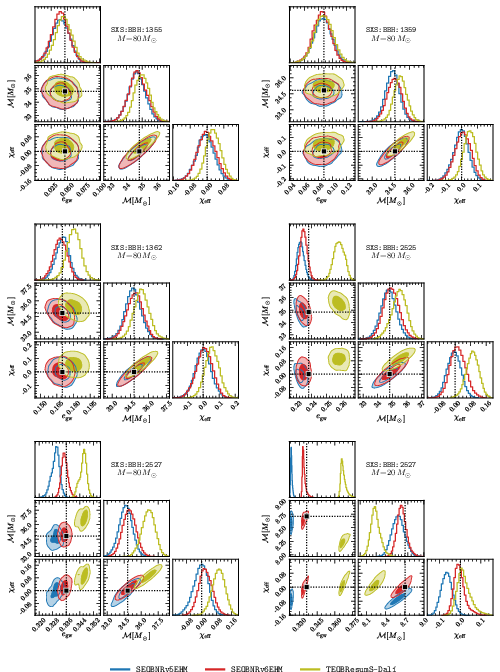
Figure 4: Posterior distributions of GW eccentricity egw and relativistic anomaly egw=0.050 at the orbit-averaged starting frequency for the highest-Bayes-factor events.
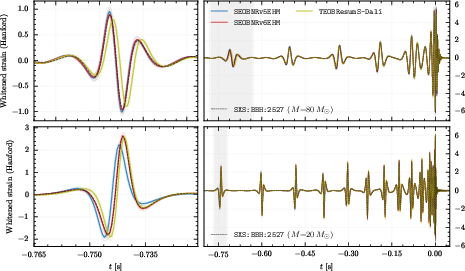
Figure 5: Whitened-strain waveform reconstructions for the highest-eccentricity NR configuration (SXS:BBH:2527). SEOBNRv6EHM tracks the NR signal more closely than alternative models, especially during early periastron passages.
Numerical diagnostics demonstrate statistically significant log-likelihood and SNR improvements with SEOBNRv6EHM, and Bayes factor preferences egw=0.051 in its favor for demanding cases.
Extensive PE analyses with SEOBNRv6EHM, SEOBNRv5EHM, and TEOBResumS-Dal were performed on a range of real GW events (BBH, NSBH, and BNS) with varying durations.
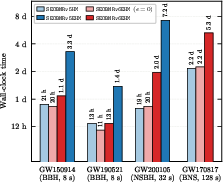
Figure 6: Wall-clock run times for four benchmark events across SEOBNRv5HM, SEOBNRv5EHM, SEOBNRv6EHM (both QC and eccentric settings). SEOBNRv6EHM achieves up to a egw=0.0523.5egw=0.053 speedup versus SEOBNRv5EHM, and parity with SEOBNRv5HM in its QC limit.
For long-duration events (NSBH, BNS), SEOBNRv6EHM is the only eccentric EOB model feasible for practical stochastic PE sampling at full length.
LVK Catalog Application
A Bayesian analysis was performed on 26 events from O1–O4 using SEOBNRv6EHM, leveraging a uniform egw=0.054 prior.
- Eccentric candidates: Six events (notably GW200129_065458 and GW200208_222617) exhibit egw=0.055, indicating mild-to-moderate support for eccentricity.
- Model comparison: For highest-support cases, Bayes factors versus QCP models remain positive but reduced, consistent with eccentricity-spin-precession degeneracies.
- Waveform systematics: Several earlier literature candidates show no significant support in the SEOBNRv6EHM analysis, highlighting the importance of waveform accuracy.
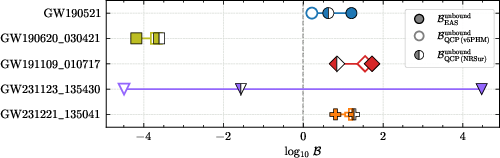
Figure 7: Log Bayes factors egw=0.056 as a function of median posterior eccentricity for catalog events.
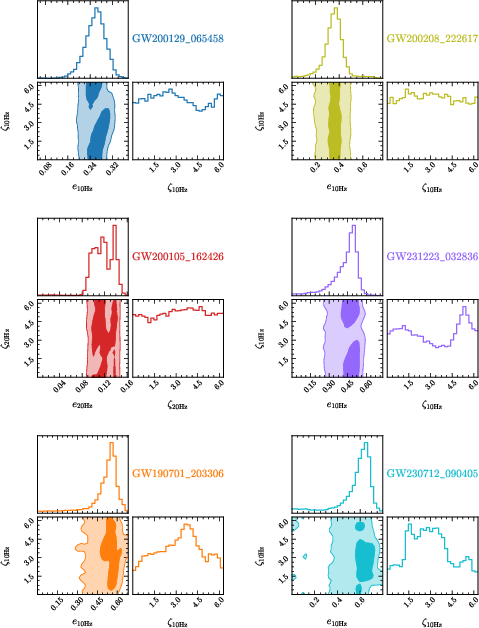
Figure 8: Posterior distributions of eccentricity and anomaly at the waveform reference frequency for the highest-Bayes-factor events.
A subset of high-mass, short in-band events were reanalyzed under the unbound-orbit hypothesis afforded by SEOBNRv6EHM.
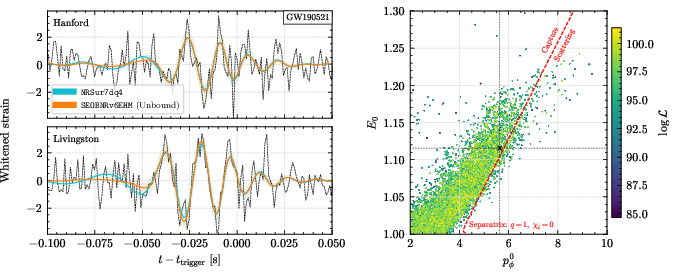
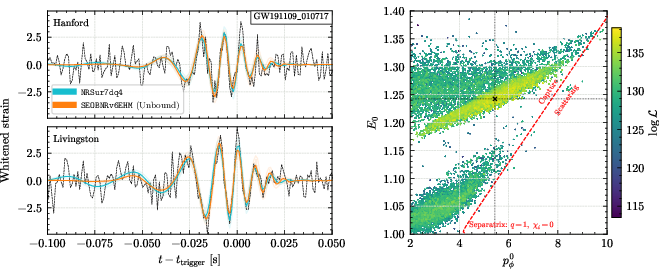
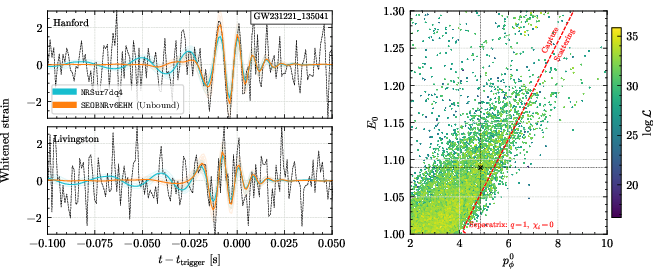
Figure 9: For GW190521, GW191109_010717, and GW231221_135041, waveform reconstructions and posterior distributions in initial energy-angular momentum. These events show the unbound-orbit model is comparably or marginally preferred over both the eccentric and precessing-spin hypotheses.
These unbound solutions correspond to near-radial plunges with relativistic egw=0.057, not realized in known clusters, emphasizing an interpretational caveat—parameter degeneracy between high-egw=0.058 bound and unbound orbits limits confident model selection in the present SNR regime.
Practical and Theoretical Implications
Numerical Results:
- SEOBNRv6EHM achieves unbiased PE for egw=0.059 up to at least $0.34$0 and SNR $0.34$1.
- PE with the most challenging NR signals reveals that previous-generation eccentric EOB models show systematic parameter bias and SNR/log-likelihood deficits exceeding "indistinguishability" thresholds for contemporary detector data.
- Walltime per event is reduced by up to an order of magnitude on long signals versus TEOBResumS-Dal, making population-level and full-length analyses feasible with time-domain models.
Catalog science:
- Subset of GW events present mild evidence for in-band eccentricity, consistent across multiple analyses with SEOBNRv6EHM, reducing concerns regarding waveform-induced artifacts.
- Analysis of high-mass, merger-dominated signals reveals a close degeneracy between high-eccentricity bound and unbound waveforms, but no credible support for realistic unbound (large-$0.34$2) origins.
Theoretical outlook:
- The strong waveform systematics found here underscore the necessity of further advances combining eccentricity and spin precession.
- The parameter degeneracies in short merger-dominated signals highlight the challenge of discriminating dynamical capture versus eccentric inspiral, particularly in the presence of finite SNR and non-Gaussian noise artifacts.
- Empirical Bayes factors for eccentricity are sensitive to analysis priors and should not be immediately interpreted as astrophysical odds.
Conclusion
This study demonstrates that the SEOBNRv6EHM model enables robust, computationally feasible, and unbiased parameter estimation for eccentric and unbound compact binary mergers across the domain of contemporary GW detection. The model achieves superior recovery of source parameters in challenging regimes and enables catalog-scale inference on modest computational resources. These advances pave the way to systematic population studies, inform waveform model design for next-generation detectors and LISA, and motivate ongoing efforts to couple eccentricity and spin-precession in waveform models to break degeneracies intrinsic to the GW measurement problem.
Reference:
Eccentric and unbound compact binaries in the LIGO-Virgo-KAGRA catalog: parameter estimation and waveform systematics with SEOBNRv6EHM (2605.28716)