History-aware adaptive reduced-order models via incremental singular value decomposition
Published 27 May 2026 in cs.LG, cs.CE, math.NA, and physics.comp-ph | (2605.28684v1)
Abstract: Reduced-order models (ROMs) can accelerate high-dimensional dynamical simulations, but their accuracy often deteriorates when online dynamics leave the regime represented by offline training data. We develop a projection-based adaptive ROM framework based on incremental singular value decomposition (iSVD), in which occasional full-order operator evaluations provide correction snapshots for online basis updates. The intrusive ROMs considered here are fully parameterized by the basis, so each update naturally propagates to reduced operators and hyper-reduction machinery. Through its evolving singular structure, iSVD retains an encoded history of the observed dynamics and is history-aware in this sense. We study the method on three nonlinear problems of increasing complexity: the one-dimensional viscous Burgers equation, the Sod shock tube, and a stiff one-dimensional ten-species rotating detonation engine (RDE). The Burgers problem is used to analyze the method and compare iSVD with alternative basis adaptation rules, showing that history-aware updates outperform instantaneous updates and that iSVD gives the strongest overall performance. The Sod and RDE cases demonstrate that these advantages persist in more challenging compressible-flow settings. For the RDE problem, the iSVD adaptive ROM improves upon the current state-of-the-art Direct adaptive ROM baseline in both predictive accuracy and computational efficiency. A cost analysis shows that the dominant online cost comes from interacting with the full-order model to obtain correction snapshots, while the iSVD update itself is negligible. These results identify iSVD as an effective mechanism for online learning of reduced subspaces and suggest a path toward ROMs that remain predictive over horizons several orders of magnitude longer than their initial training window.
The paper introduces a novel history-aware adaptive ROM framework using incremental SVD to update reduced bases for out-of-distribution dynamics.
The method efficiently integrates historical spectral information via exponential weighting, ensuring lower error rates compared to traditional static and windowed approaches.
Numerical experiments on problems like the Burgers equation and Sod shock tube demonstrate that iSVD enhances accuracy and speed in high-dimensional, transient, multi-physics simulations.
History-aware Adaptive Reduced-Order Models via Incremental Singular Value Decomposition
Introduction and Motivation
Projection-based model order reduction (MOR) is fundamental in accelerating high-dimensional nonlinear dynamical system simulations, encompassing applications from fluid dynamics and reacting flows to control. However, traditional ROMs, constructed by offline subspace extraction (POD, SVD), are only reliable for in-distribution trajectories due to their static subspace assumption. Out-of-distribution dynamics—ubiquitous in convection-dominated, shock-dominated, or multi-physics systems—induce rapid accuracy degradation because the solution manifold departs from the initial training snapshot support. Static ROMs are hence limited by the slow decay of the Kolmogorov N-width in such settings, and large offline datasets do not overcome the subspace expressivity bottleneck.
To address this, adaptive ROMs dynamically update their subspace online, ideally supporting predictive extrapolation far from offline training data. While previous adaptive strategies range from direct windowed snapshot updates to instantaneous rank-one corrections, most either lack historical context or are computationally inefficient for long-term prediction. This work introduces a principled, computationally efficient, history-aware adaptive ROM framework based on incremental singular value decomposition (iSVD), designed for both accuracy and throughput in challenging high-dimensional unsteady problems (2605.28684).
Framework: History-aware Online Subspace Tracking
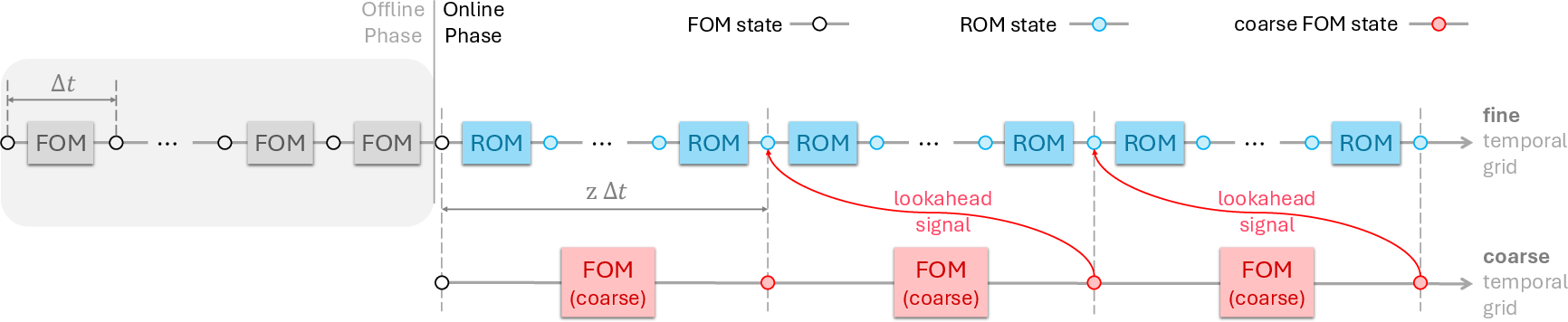
The core of the framework is a projection-based ROM (Galerkin, Petrov–Galerkin, or LSPG variational projection) parameterized by an evolving reduced basis Φk∈RN×r, where N is the FOM state dimension and r≪N is the reduced dimension. Adaptation to evolving solution manifolds is orchestrated by periodically requesting a correction signal—a coarse future full-order solution snapshot—advanced independently from the ROM trajectory with step size zΔt (the adaptation window).
Figure 1: The lookahead correction signal principle—at each adaptation event, the ROM receives an FOM snapshot z steps ahead to inform basis updates, creating a feedback mechanism for model extrapolation.
Upon each adaptation event, this lookahead correction snapshot, after preprocessing (centering, scaling), is used to update the reduced basis via iSVD. The iSVD update integrates the new snapshot with all prior observed data via exponential weighting (forgetting factor λ∈[0,1]), balancing responsiveness to new transients and retention of historical dynamics. This is in contrast to windowed SVD (short memory), direct, or fully instantaneous methods that discard or ignore global system history.
The adaptation process proceeds with this pipeline:
Advance ROM using current basis for z fine steps;
Run coarse FOM forward for one adaptation window to obtain correction signal;
Update basis via iSVD, recompute any basis-dependent ROM operators/hyper-reduction samplers;
Project the current state to the new basis (state transfer) and repeat.
Incremental SVD: Compressed, Spectral Memory
The iSVD update efficiently maintains a rank-r orthonormal basis that tracks the dominant left singular vectors of an exponentially weighted snapshot matrix. The update for a new snapshot yk+1 is:
Project Φk∈RN×r0 onto Φk∈RN×r1 to obtain in-subspace coefficients and orthogonal residual;
Form a small Φk∈RN×r2 core update matrix encoding current spectrum, weighted history, and new information;
Perform SVD on core matrix, rotate and truncate, yielding the new basis.
The evolution of the basis is thus history-aware: each update integrates all previous information (up to Φk∈RN×r3 scaling) rather than overfitting to the latest correction. Only Φk∈RN×r4 work and Φk∈RN×r5 history storage are required per adaptation, vastly lighter than windowed SVD.
Numerical Experiments and Quantitative Outcomes
Viscous Burgers Equation
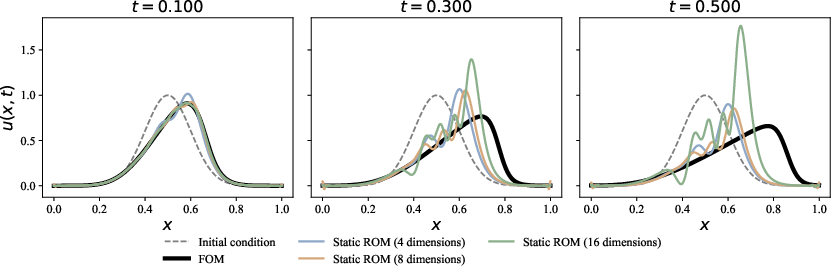
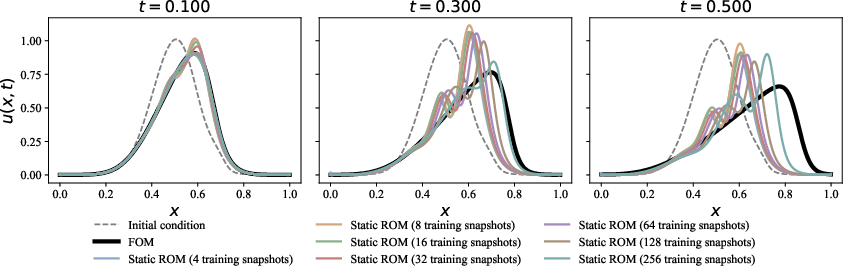
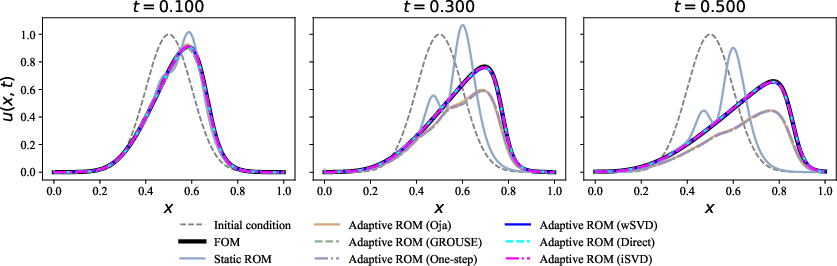
The Burgers equation (periodic, Φk∈RN×r6) illustrates why static ROMs, even with large Φk∈RN×r7 or extended offline data, fail globally predictive tasks—the solution quickly exits the fixed reduced subspace, as shown by divergence in both solution and error history.
Figure 2: Static LSPG–QDEIM solutions for Burgers—enlarging the offline window or Φk∈RN×r8 delays but cannot avert predictive breakdown once the solution leaves the offline manifold.
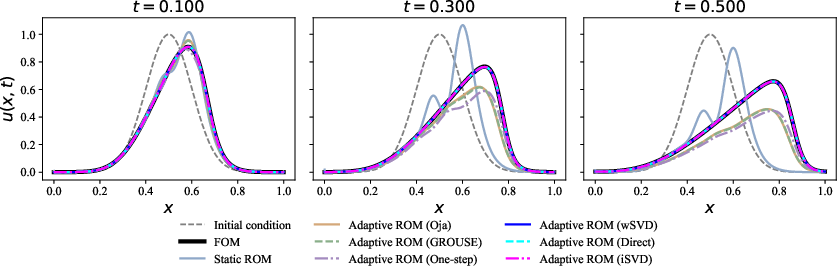
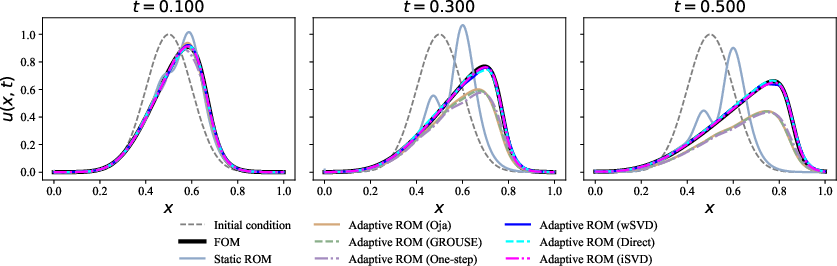
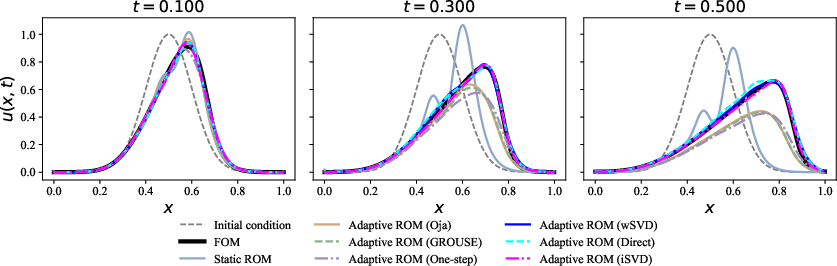
History-aware basis adaptation vastly improves predictive power. For a minimal offline window (Φk∈RN×r9), iSVD and other history-aware updates (windowed SVD, Direct) retain correct tracking of advective-diffusive structures over long horizons. Instantaneous methods (one-step, Oja, GROUSE)—even when hyperparameters are optimized—fail to maintain global accuracy, illustrating the criticality of integrating historical spectral information.
Figure 3: Adaptive LSPG–QDEIM solution fields for Burgers—iSVD (and other history-aware updates) accurately track global structures, unlike instantaneous updates that rapidly degrade or oversmooth.
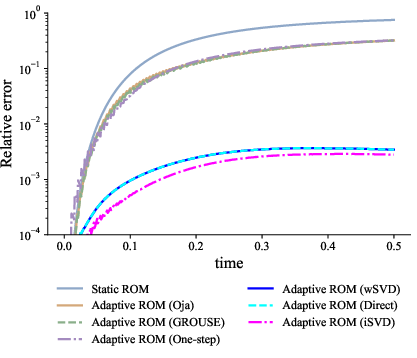
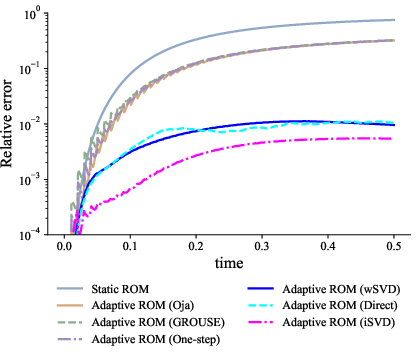
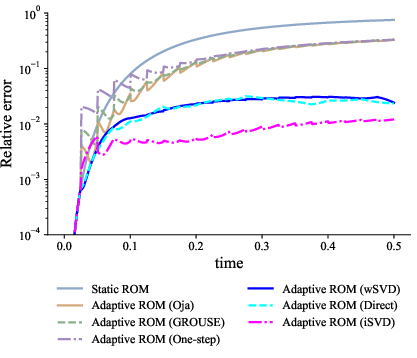
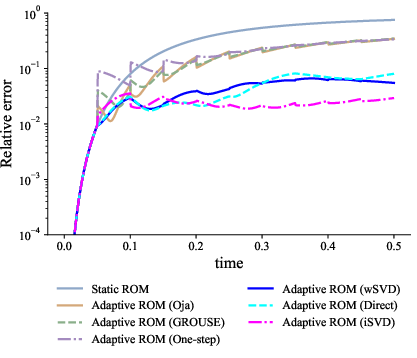
Quantitatively, iSVD delivers the lowest errors across all adaptation windows, robustly outperforming windowed SVD and Direct when adaptation intervals are large Figure 4. The performance is optimized for small forgetting factors (N0), reflecting the need for fast basis rotation in rapidly evolving transport-dominated regimes.
Figure 4: Error history comparison—iSVD exhibits optimal accuracy across all adaptation windows, with error growth slower than other methods.
Sod Shock Tube and RDE: High-dimensional, Multi-physics Validation
For the 1D Sod shock tube (Euler equations, N1, three conserved variables), history-aware adaptation enables accurate long-horizon prediction across all primitive variables, capturing the evolution and interactions of shocks, expansion fans, and contacts. iSVD consistently provides lower errors and more stable predictions than state-of-the-art Direct adaptation and instantaneous methods, regardless of adaptation window.
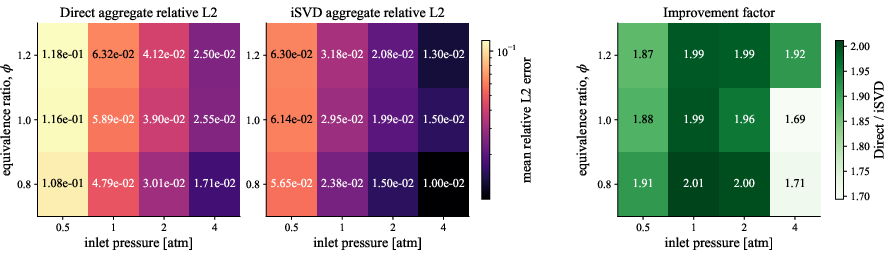
The RDE case (1D, explicit FOM, 10-species detailed chemistry, N2) represents an extreme nonlinear, multi-physics scenario. Here, both iSVD and Direct adaptive ROMs track sharp detonation/deflagration structures, but iSVD is both more accurate and nearly twice as fast (acceleration factor N3) due to its lighter adaptation schedule and compressed history storage. Owing to the reduced basis update frequency, iSVD even outperforms Direct in accuracy despite fewer updates, demonstrating robustness of spectral memory even under strong intermittency and multi-scale transience.
Parametric sweeps over equivalence ratio N4 and pressure N5 confirm that iSVD's superior accuracy is consistent for all flow variables and operating conditions, not limited to a subset of cases.
Computational Complexity
The adoption of iSVD introduces negligible computational overhead compared to the dominant FOM interactions needed for correction signal generation. With adaptation cost scaling as N6, and historical memory of only N7, iSVD is optimal for high-dimensional, frequent-update scenarios. Windowed SVD and Direct methods require full snapshot storage (N8) and are significantly more expensive; instantaneous updates save on computation but lose the accuracy required for reliable extrapolation.
Implications and Future Directions
This work demonstrates that history-aware adaptive ROMs based on iSVD dramatically enhance the predictive capacity and operational efficiency of projection-based ROMs, even in regimes requiring extrapolation across multiple orders of magnitude in time or operating conditions. The iSVD framework enables:
True online learning of reduced subspaces, robust to abrupt dynamical transitions or new features not seen in initial data,
Compressed, mathematically principled retention of spectral system history with negligible storage,
Efficient integration with any intrusive projection framework (Galerkin, Petrov–Galerkin, LSPG) and hyper-reduction method.
Figure 5: Parametric case analysis—iSVD consistently improves error across all variables and operating parameters, with per-variable improvement factors N9 for all species and primitives.
Future research opportunities include dynamic adaptation frequency and memory tuning, generalized correction signal sourcing (e.g., incomplete or partial data), application to higher dimensions and coupled multi-physics, and transfer to non-intrusive operator inference and manifold learning paradigms.
Conclusion
By introducing history-aware, exponentially weighted iSVD updates into ROM adaptation, this framework bridges efficient subspace tracking with high-fidelity extrapolation, positioning adaptive ROMs as practical tools for long-term, reliable prediction in complex physical systems far beyond the classical static regime.
References
"History-aware adaptive reduced-order models via incremental singular value decomposition" (2605.28684)