- The paper introduces a fixed-point algorithm that mathematically certifies the optimal ridge penalty for minimizing out-of-sample error.
- It proposes a sample-based estimation method that efficiently computes regularization parameters, outperforming traditional signal-to-noise approaches.
- Empirical evaluations show that the method achieves near-oracle mean squared error performance across varied sample sizes, noise levels, and data geometries.
Optimal Ridge Regularization Revisited: A Comprehensive Analysis
Introduction
The paper "Optimal ridge regularization revisited" (2605.28679) provides a rigorous investigation into the optimal selection of the L2 (ridge) penalty parameter λ in the context of linear regression with additive isotropic noise. While classical ridge regression and its asymptotic analyses are well-established, recent work has exposed the nontrivial structure of optimal regularization—especially in finite-sample, possibly overparameterized regimes, where λ may even be negative. This paper makes two principal contributions: a mathematically certified fixed-point algorithm for optimal λ computation in the fixed-X setting with provable convergence, and a statistically motivated, computationally efficient sample-based approach for parameter estimation that achieves near-optimal random-X generalization. The authors establish comprehensive empirical validation across diverse noise regimes and data geometry profiles.
Analytical Framework and Fixed-Point Characterization
The authors adopt a generative model in which inputs x∈Rd are drawn from a distribution with mean zero and covariance Σ, and responses are linear, y=xTθ+ϵz, with isotropic noise z. The ridge estimator arises from regularized empirical risk minimization:
λ0
with closed-form:
λ1
For any fixed λ2, the bias and variance of predictions are expressed via the SVD of λ3, enabling decomposition of the expected out-of-sample error as a function of λ4. The core analytical insight is the derivation of a nonlinear fixed-point equation for the optimal λ5 which minimizes expected risk:
λ6
The contractiveness and Lipschitz continuity of λ7 guarantee (for small λ8) the global convergence of the fixed-point iteration.
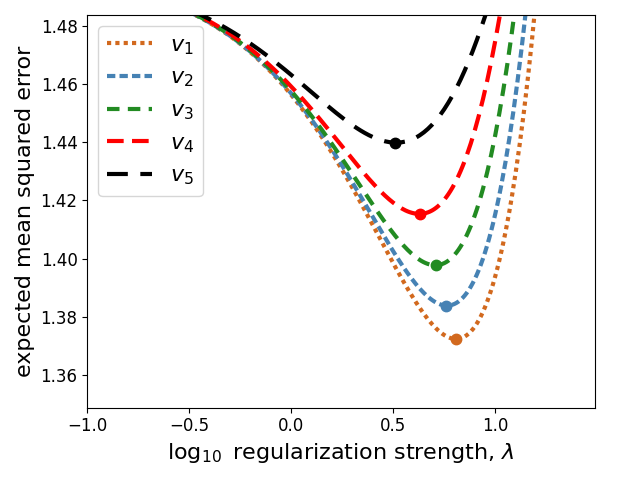
Figure 1: Optimality of ridge penalty λ9 returned by the fixed-point algorithm, demonstrating precise identification of MSE minima across varying λ0 alignments.
The result encompasses both under- and overparameterized regimes, as ensured by the explicit handling of SVD blocks, and is provably robust to data geometry.
Sample-Based Estimation Methodology
In practice, the generative parameters λ1 are not observed. The authors propose a fully sample-based method that proceeds in three steps:
- Parameter Estimation: Obtain an initial λ2 and estimate the effective noise λ3 using regularized projections, with separate procedures for under- and overparameterized regimes.
- Fixed-Point Iteration: Substitute estimates λ4 into the theoretical fixed-point scheme.
- Computational Efficiency: The total cost is dominated by at most two SVD computations; all other operations are λ5.
This methodology provides, for each input dataset λ6, a principled data-dependent λ7 that is computationally tractable even in modern, high-dimensional settings.
Empirical Evaluation
The authors deliver a rigorous empirical investigation using synthetic datasets with both spiked and bulk covariance structures, varying data aspect ratio λ8, sample size, and noise level λ9. They benchmark four regularization approaches:
- Oracle-optimized λ0
- Model-based (true λ1) fixed-point λ2
- Sample-based fixed-point λ3
- Signal-to-noise approach as in [Dobriban & Wager 2018]
- Widely-used fixed default λ4 (e.g., λ5 in scikit-learn)
Key findings:
- The sample-based fixed-point approach yields out-of-sample MSE within 1%-4% of the oracle best across a broad spectrum of problem sizes and aspect ratios, improving significantly over the signal-to-noise-based and default choices for moderate-to-large λ6 and for λ7.
- The empirical gap between the optimal λ8 and the practical fixed-point estimate shrinks as λ9 increases, with sample-based estimation outperforming signal-to-noise for all but the smallest X0 or lowest X1.
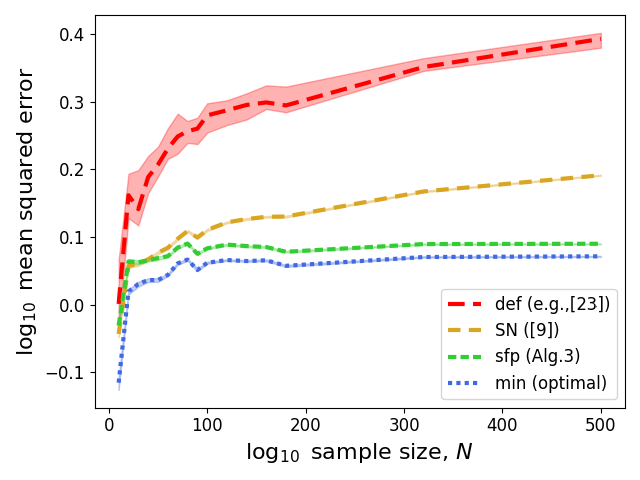
Figure 2: Median estimated out-of-sample MSE as a function of sample size (X2); the sample-based algorithm rapidly approaches oracle optimality as X3 increases.
- Default regularization (X4) is consistently suboptimal, especially in high-noise or high-dimensional settings.
- The signal-to-noise approach underperforms due to the variance inflation in X5, particularly at larger X6—the fixed-point scheme's careful handling of covariance alignment and effective rank estimation yields marked benefits.
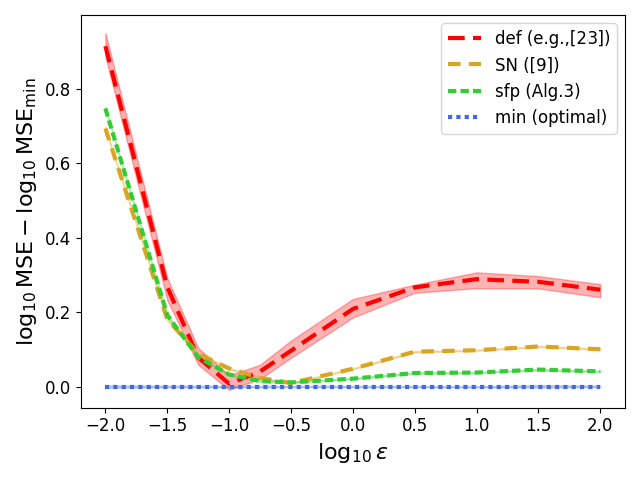
Figure 3: Median relative out-of-sample MSE as a function of noise amplitude X7; the sample-based fixed-point approach dominates at moderate-to-high noise, while signal-to-noise is only competitive for extremely low X8.
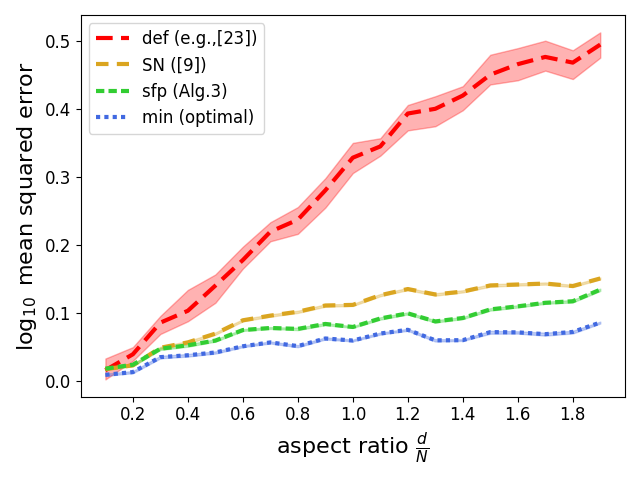
Figure 4: Median out-of-sample MSE versus aspect ratio, showing superiority of the sample-based fixed-point method for X9.
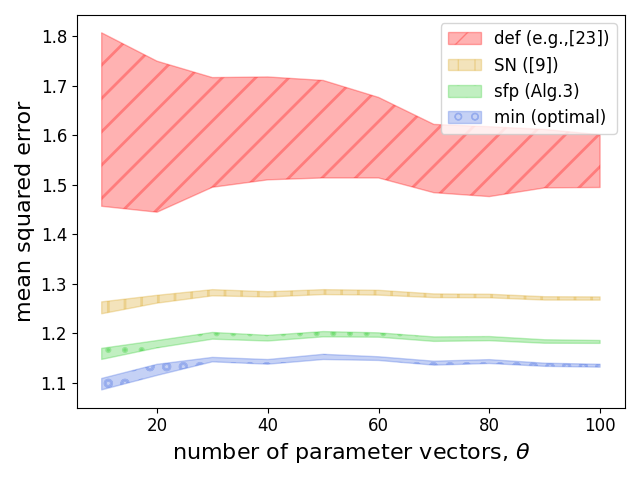
Figure 5: Bootstrap CI convergence for MSE as a function of number of parameter vectors; results stabilize after around 100 generative vectors.
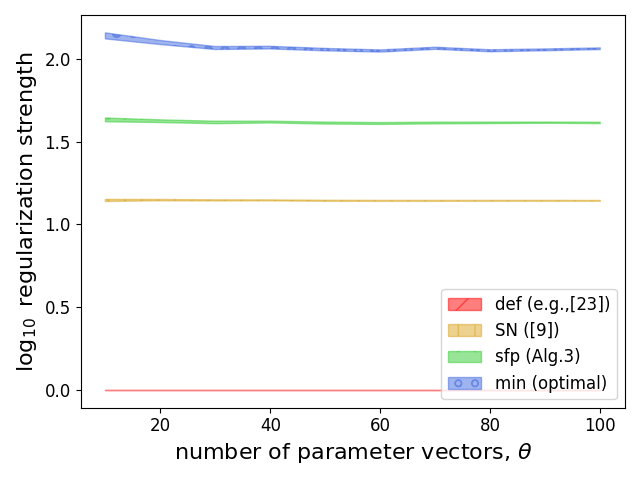
Figure 6: Bootstrap CI convergence for estimated ridge penalty; stability rapidly attained, supporting reproducibility.
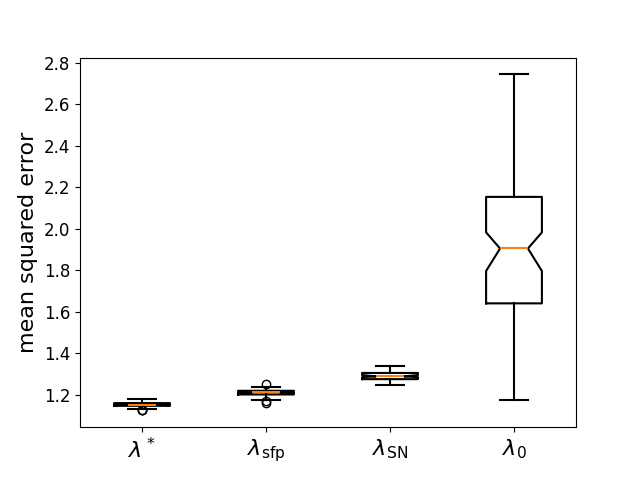
Figure 7: Boxplot of estimated out-of-sample MSE across methods; fixed-point regularization shows visually significant improvements over signal-to-noise and default strategies.
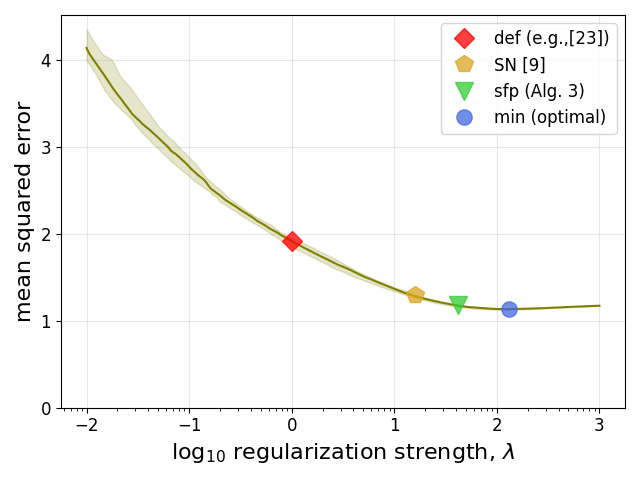
Figure 8: Out-of-sample MSE as a function of X0 for a typical X1; the algorithm's selected value closely tracks the MSE minimum.
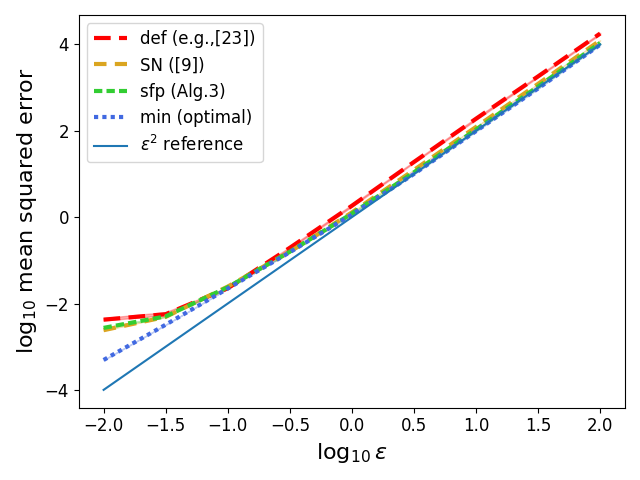
Figure 9: Absolute out-of-sample MSE versus noise level, reaffirming that all methods scale as X2, with the sample-based approach tracking oracle error closely.
Theoretical and Practical Implications
The fixed-point analytical framework fundamentally refines the classical understanding of ridge regularization selection, accommodating model geometry and finite-sample considerations that are absent in asymptotic (signal-to-noise) analyses. The results rigorously establish that optimal regularization is sensitive not just to scale (X3), but also to the alignment of X4 with the eigenstructure of X5, aspect ratio, and intrinsic data geometry.
Practically, the proposed method offers a concrete, efficient alternative to validation-based grid search or naive plug-in rules, with demonstrable advantages in both under- and overparameterized settings. The sample-based fixed-point estimator is robust, scalable, and suitable as a drop-in replacement for empirical regularization routines.
Future Directions
The authors suggest that further research should address:
- Sharper sample-based estimation procedures for X6 and X7
- Asymptotics for extreme X8 regimes and non-Gaussian designs
- Extensions to non-isotropic noise, generalized linear models, and out-of-distribution performance
Moreover, the theoretical contractiveness conditions for the fixed-point method could be extended to broader loss settings and adaptive or multi-stage regularization.
Conclusion
This work delivers a mathematically sound and practically superior method for ridge penalty selection, superseding both heuristic defaults and large-sample signal-to-noise strategies. Its analytical clarity, computational efficiency, and robust empirical results make it a compelling advancement for regularization in linear models—one that should inform both theoretical study and applied machine learning practice.