- The paper introduces a multiphoton interferometric LIDAR system that leverages Dicke-type superradiance to enhance range sensitivity through higher-order correlations.
- It demonstrates significant sensitivity improvements and noise rejection by increasing both the number of thermal light sources and detectors, as confirmed by analytical Fisher information analysis.
- The study offers practical insights into implementing CCD-based setups for robust remote sensing under turbulent atmospheric conditions.
Superradiant LIDAR: Multiphoton Interferometric Enhancement of Range Sensitivity
Motivation and Background
The proliferation of LIDAR technology across geospatial mapping, autonomous navigation, ecosystem characterization, and precision agriculture has been driven by its robust spatial and depth resolution capabilities. However, the performance of traditional intensity-based and coherent interferometric LIDAR is fundamentally capped by limitations imposed by laser power and coherence length, with the latter particularly vulnerable to deleterious ambient phase noise and atmospheric turbulence. Recent research has sought to overcome these constraints, notably through intensity interferometry-based approaches which leverage higher-order correlations, as well as quantum protocols exploiting entangled light and induced coherence.
The foundation for exploiting intensity correlations is rooted in the Hanbury Brown and Twiss (HBT) effect, demonstrating atmospheric turbulence immunity and enhanced spatial coherence for stellar measurements. Second-order correlations from thermal sources have enabled improved noise rejection and sensitivity, with contemporary demonstrations of two-photon LIDAR bypassing coherence length restrictions [2photonLIDAR_Tamma2023], achieving notable sensitivity gains. The emerging frontier involves higher-order multiphoton correlations, which, as shown in superresolution and ghost imaging contexts, dramatically expand resolution and measurement capabilities.
Principle of Superradiant LIDAR
The Superradiant LIDAR paradigm builds upon Dicke’s superradiance concept, simulating collective emission via constructive quantum interference among N statistically independent thermal light sources (TLS). Unlike true quantum superradiance, here multiphoton correlation measurements engineer a directional emission profile reminiscent of collective quantum states [superradianceSetup_Oppel2014]. By correlating photons detected at m spatially separated detectors—with m≫2—in a LIDAR geometry, the system measures the mth-order correlation function GN(m)(δ1,δ2), where phase differences depend on the remote target distance.
Traditional two-photon LIDAR (special case N=m=2) achieves atmospheric turbulence immunity and robust noise rejection. Superradiant LIDAR generalizes this to arbitrary N and m, enabling substantial enhancements in measurement sensitivity. The key outcome is that the Cramér-Rao bound for estimation of the object distance is reduced by a factor scaling minimally as N, and can be further decreased as m increases.
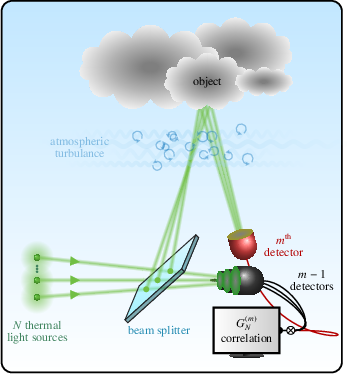
Figure 1: Sketch of a practical implementation of Superradiant LIDAR with m0 equidistant TLS and m1 detectors configured for correlation measurements.
Experimental Realization and Measurement Protocol
A realization employs a laser illuminating a rotating ground-glass disk to generate spatially separated, uncorrelated thermal sources, passed through slits. Output beams are split via a beam splitter, with m2 detectors (or CCD pixels) located at known reference plane distance m3 measuring the direct light, and the m4 detector probing reflected photons after interaction with a remote object at unknown distance m5. Correlation analysis across these detectors yields the m6-order correlation function, the phase of which is sensitive to m7.
In practice, CCD arrays replace single-photon detectors, facilitating massive parallel correlation measurements over pixel ensembles. Each m8-order correlation function is parameterized per column (or pixel group) and fit (or transformed via FFT) to extract m9 with precision determined by the system’s Fisher information.
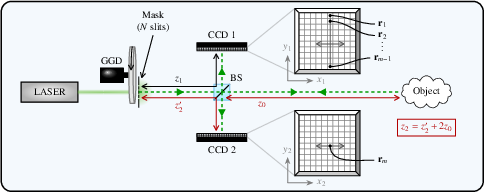
Figure 2: Detailed proposal for a Superradiant LIDAR setup with rotating ground-glass disk, beam splitter, and CCD cameras arranged for multiphoton correlation measurement.
For m≫20 independent TLS, the normalized m≫21-order correlation function is given by
m≫22
with phase differences linked to detector positions and source-target geometry.
Higher m≫23 and m≫24 yield sharper emission patterns in the correlation function, leading to increased sensitivity. This is quantitatively captured by the Fisher information m≫25, which controls the Cramér-Rao lower bound on the attainable estimator variance for m≫26. Analytical expressions confirm that for m≫27, the result matches two-photon LIDAR, but increasing m≫28 or m≫29 causes mth0 to rise nearly three orders of magnitude in the accessible regime.
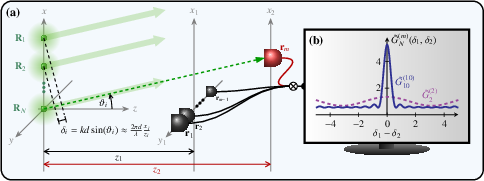
Figure 3: Conceptual scheme illustrating mth1 for mth2 and mth3 highlighting the slope steepening with increased mth4.
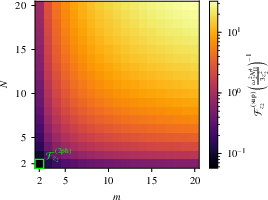
Figure 4: Fisher information mth5 as a function of both mth6 and mth7, showing monotonic improvement over the two-photon baseline with higher-order correlations.
Analytical and numerical evaluation exhibit—
- For mth8: mth9
- For GN(m)(δ1,δ2)0: A more complex but monotonic expression with similar scaling.
- For arbitrary GN(m)(δ1,δ2)1, GN(m)(δ1,δ2)2: The Fisher information lower bound is
GN(m)(δ1,δ2)3
Relative difference between the lower-bound and exact numerical results remains within 9% for GN(m)(δ1,δ2)4, demonstrating that the lower-bound expression is sufficiently tight for practical estimation.
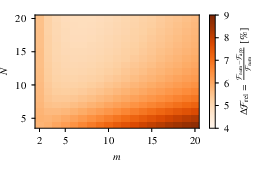
Figure 5: The relative difference GN(m)(δ1,δ2)5 validating the lower bound approximation across a range of GN(m)(δ1,δ2)6 and GN(m)(δ1,δ2)7.
Implications and Outlook
Superradiant LIDAR directly leverages collective quantum optical principles—in particular, multiphoton interference and Dicke-type superradiant emission patterns—to achieve sensitivity enhancement in practical distance measurement. The scheme inherits atmospheric turbulence immunity, robustness to ambient noise, and improved sensitivity scaling from its higher-order interferometric underpinning.
Substantial implications arise for ultra-precise remote sensing, long-range depth imaging, surface characterization under adverse conditions, and quantum-inspired metrology. The substantial Fisher information improvements suggest that Superradiant LIDAR can outperform established quantum and classical LIDAR protocols in settings where photon flux, detector multiplexing, and ambient disturbance rejection are critical.
On a theoretical level, the protocol demonstrates how engineered measurement-induced cooperativity and collective emission can be simulated using purely classical thermal sources, extending Dicke superradiance concepts outside atomic physics into photonic metrology. The adaptation of correlation order as a tunable parameter foregrounds a new axis for sensitivity and resolution control.
As higher-order correlations become tractable via advances in processing and detector technology, further developments may explore real-time 4D mapping, adaptive imaging through scattering media, and integration with quantum illumination protocols. Hybrid classical-quantum inspired schemes hold significant promise for evolving LIDAR technology beyond current limitations.
Conclusion
Superradiant LIDAR constitutes a demonstrably more sensitive multiphoton interferometric range detection protocol, with sensitivity scaling at least as GN(m)(δ1,δ2)8 and further enhanced by correlation order GN(m)(δ1,δ2)9. The scheme is theoretically supported through analytical and numerical results, with practical feasibility established for CCD-based implementations. This approach illustrates that fundamental quantum optical phenomena such as Dicke superradiance can drive substantial advances in classical measurement technology, providing new pathways for high-precision remote sensing and metrological innovation (2605.28378).