- The paper shows that dominant error clusters in language models can be effectively mitigated by learning lightweight, interpretable prefix filters.
- Palla, the proposed pipeline, clusters invalid outputs using oracle feedback before inducing error-specific symbolic patterns to guide constrained decoding.
- Empirical results demonstrate significant validity gains across various domains, offering a scalable, adaptable approach to error control.
Learning the Error Patterns of LLMs: An Analytical Essay
Introduction and Motivation
Despite improved reliability of modern LLMs, outputs for tasks with domain-specific validity constraints frequently deviate from correctness in systematic ways. Traditional constrained generation approaches, such as grammar-constrained decoding and model fine-tuning, exhibit shortcomings: grammars rarely encode all types of semantic invalidity, and reward learning methods are computationally intensive and ill-suited for highly concentrated, domain-specific error modes. "Learning the Error Patterns of LLMs" (2605.28328) critically investigates the non-uniform distribution of LLM error modes and proposes a practical solution that leverages this clustering by learning prefix filters—interpretable, symbolic functions that target frequent error clusters. The authors introduce Palla, an efficient pipeline for extracting these filters, and demonstrate their effectiveness across multiple model and domain settings.
The authors rigorously formalize the notion of errors in LLMs with respect to an external oracle, O, that partitions outputs into valid and invalid sets. The constrained generation problem is then to restrict the output distribution of a given LLM such that the probability of sampling an invalid output is zero. Existing rejection sampling is too costly for practical deployment, while constrained decoding and fine-tuning do not capture the nuanced, distribution-specific error profiles, nor allow for precise and lightweight mitigation.
Prior art in constraint-aligned decoding ([gcd], [chopchop], [vechevtypes]) and RLHF ([rlhf], [ppo], [rafailov2023direct], [bai2022constitutional]) typically operates by overapproximating valid regions or requiring large-scale retraining, but these approaches are shown to be insufficient for fine-grained validity control in highly structured domains.
The Prefix Filter Abstraction
The core proposal is the prefix filter: a lightweight, symbolic classifier with form ϕ:Σ∗→{trigger,not_trigger} that identifies partial outputs which are, with respect to an oracle, destined to result in invalid completions. The crucial design is distributional soundness: rather than demanding logical soundness for all strings, it is sufficient that the filter only (or nearly only) triggers on prefixes that, given the model’s actual generative distribution, almost never extend to valid outputs. This trades precision for efficiency, enabling practical learning and deployment.
The Palla Algorithm
To operationalize error pattern extraction, the paper introduces Palla, a modular algorithmic pipeline:
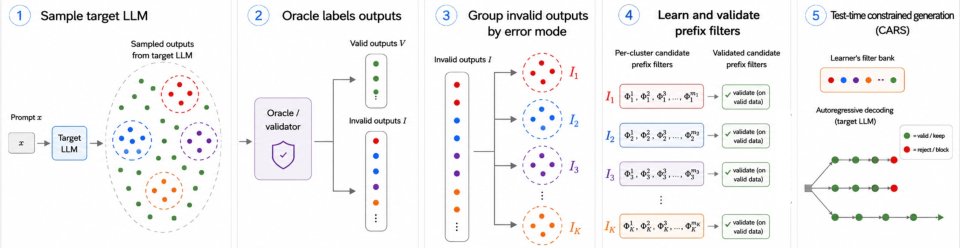
Figure 1: Overall pipeline of Palla: error modes are clustered to learn prefix filters targeting each cluster, then filters are used to avoid clustered errors at test time.
Palla proceeds through the following principal stages:
- Unconstrained Sampling: Gather outputs by executing the LLM on relevant prompts for the desired domain.
- Oracle Evaluation: Use an external oracle to classify outputs as valid or invalid, optionally grouping invalid outputs by detailed error cause.
- Clustering: Group invalid samples according to their failure mode, leveraging fine-grained oracle feedback where available.
- Pattern Induction: Invoke a synthesizer (external LLM or symbolic program synthesizer) to induce prefix filter patterns for each error cluster.
- Filter Validation and Refinement: Validate filters for (distributional) soundness on held-out data, refining if necessary.
- Deployment: Integrate filters into token-level sampling via constrained adaptive rejection sampling (CARS), early rejecting prefixes caught by filters during decoding.
This approach extracts error signatures focused tightly on the generative distribution's failure regions and can be iteratively reapplied to reveal deeper or less frequent clusters that emerge as the original errors are suppressed.
Empirical Analysis and Results
Palla and prefix filters are evaluated on four domains—MLIR compiler IR synthesis, SMILES-based molecular generation, privacy-preserving dialogue summarization, and TypeScript code synthesis—with five LLMs (Qwen2.5-1.5B/7B/14B, Llama3.1-8B, Gemma3-12B) and GPT-5.4-mini as synthesizer. Across these heterogeneous tasks, several strong empirical findings are highlighted:
- Error Mode Clustering: Analysis validates the hypothesis that dominant error clusters exist. For instance, the top three prefix filters for Qwen-7B MLIR generation accounted for 51.7% of errors caught, dramatically compressing the complexity of failure monitoring.
- Strong Validity Gains: For lower-competency models, applying prefix filters yields substantial increases in validity—for example, Qwen2.5-1.5B compile rate on TypeScript increased from 16.0% to 70.0% post-filtering, matching or exceeding larger models like Llama3.1-8B in unconstrained settings.
- Efficiency: Overhead for token-level rejection is modest outside edge cases; mean overhead was 30–60% in most domains, with exceptions in domains (e.g., weak TypeScript models) where error distribution appears at sample tails.
- Domain-Dependent Transferability: Prefix filters, when learned for one model, tend not to transfer effectively across models in structured domains (MLIR, SMILES), but are transferable in domains where a universal pattern dominates (e.g., name leaks in summaries).
- Automatic Interpretability: Extracted filters are concise and human-interpretable, aiding in system diagnosis and LLM auditing.
Theoretical and Practical Implications
The results jointly imply a new regime for output constraint in LLMs:
- Interpretability: By grounding error control in explicit, symbolic filters associated with concrete error clusters, the approach enhances interpretability relative to model-centric fine-tuning or monolithic grammar engineering.
- Scalability and Model Adaptivity: Prefix filter learning is lightweight, requiring only a modest number of invalid samples per model-domain pair, and adapts to the particular quirks of each LLM, in contrast to static grammar-based solutions.
- Oversight and Monitoring: Fine-grained error pattern mining, when applied iteratively, can serve as a monitoring tool for emergent failure modes or for constructing targeted datasets for reward learning.
- Reliability in Constrained Generation: For tasks where “validity-at-all-costs” is required (e.g., code, molecule generation, privacy-sensitive summarization), prefix filters provide a robust mechanism to eliminate major error modes without substantial computational burden or manual engineering.
Limitations and Directions for Future Work
The authors acknowledge intrinsic limitations:
- Diminishing Returns with Competent Models: As LLMs become more accurate, the fraction of invalid outputs shrinks, making it hard to accumulate sufficient training signals for new filter discovery.
- Non-prefix-expressible Errors: Certain error classes cannot be resolved with prefix-only logic (e.g., ambiguous prefixes, mistakes that only become apparent at full sample).
- Filter Generalization: In domains where error modes are not universally shared, domain-adapted learning of filters will remain non-transferable and require per-model optimization.
Potential avenues for further research include integrating prefix filter discovery into training, applying the approach within agentic systems to block recurrent failures, and augmenting error-centric filter learning with coverage metrics or reward shaping to drive further model improvement.
Conclusion
This work demonstrates that LLMs exhibit highly clustered error modes that can be efficiently and accurately suppressed via learned, interpretable prefix filters. The Palla pipeline enables targeted, practical, and scalable validity control across diverse tasks and models, advancing the science of systematic error analysis in LLMs. By moving away from monolithic or fully generic constraint mechanisms, this approach foregrounds the importance of model-distribution-specific error mining and opens new perspectives for both reliability and interpretability in LLM deployment.

