- The paper establishes explicit asymptotic expressions for the DSFF, detailing its behavior across strong, mesoscopic, and weak non-Hermiticity regimes.
- It employs scaling parameters, orthogonal polynomials, and phase diagrams to decode the dip–ramp–plateau structure of spectral correlations.
- Numerical verification supports the analytical predictions, offering valuable insights for understanding open quantum systems and non-Hermitian chaos.
Introduction and Motivation
The paper "Dissipative Spectral Form Factor of the Complex Elliptic Ginibre Ensemble across Various Non-Hermiticity Regimes" (2605.28319) presents a rigorous analysis of the dissipative spectral form factor (DSFF) in the context of the complex elliptic Ginibre Ensemble (eGinUE), explicitly characterizing its asymptotic behavior across multiple non-Hermiticity regimes. The DSFF, a two-variable Fourier transform of the two-point function of complex eigenvalues, is central for understanding spectral correlations in open, dissipative quantum chaotic systems described by non-Hermitian random matrices. This ensemble interpolates between the classical Ginibre regime (strong non-Hermiticity) and the Hermitian regime (GUE), via the tunable non-Hermiticity parameter τ.
This study establishes a systematic classification of the DSFF's asymptotic properties in terms of two scaling parameters: the matrix size N and its time scaling exponent γ (with T=O(Nγ)), and the non-Hermiticity exponent α (with 1−τ=O(N−α)). Through careful asymptotic analysis, the authors resolve the dip–ramp–plateau structure and its transitions, resulting in a multidimensional phase diagram.
(Figure 1)
Figure 1: Phase diagram of DSFF in the (α,γ) plane showing dip, ramp, and plateau regions, and the universality crossover between GUE (Hermitian) and GinUE (strong non-Hermitian) behaviors.
Model Definition and DSFF Decomposition
The eGinUE is parameterized by τ∈[0,1), and for matrix dimension N the non-Hermiticity scaling follows 1−τ=O(N−α). The spectral measure transitions from elliptic (2D) support for fixed N0 to a nearly real spectrum as N1. The DSFF is defined as
N2
where N3.
The DSFF naturally decomposes into disconnected and connected components,
N4
where the disconnected part probes independent one-point statistics, and the connected part encodes genuine spectral correlations.
Scaling Regimes and Phase Diagram
Three regimes are identified:
- Strong non-Hermiticity (N5): The spectrum is genuinely 2D, and DSFF exhibits uniquely non-Hermitian features. The ramp is quadratic, contrasting with the linear ramp in the GUE SFF.
- Mesoscopic non-Hermiticity (N6): Represents a crossover regime with 2D–1D interpolation; statistics transition smoothly between GinUE and GUE.
- Weak non-Hermiticity (N7 or N8): The spectrum becomes nearly real, and all DSFF statistics ultimately converge to those of the Hermitian ensemble.
Within each regime, time scaling N9 demarcates the dip, ramp, and plateau regions. The dip time (γ0) is identified as the scale where the disconnected part dominates, and the Heisenberg time (γ1) is where the DSFF attains its plateau.
Asymptotic Characterization
The main technical results concern explicit asymptotic expressions for both components of the DSFF. The authors derive uniform asymptotics for the relevant orthogonal polynomials (Laguerre and Hermite), enabling precise computations in each regime.
Strong Non-Hermiticity
The quadratic ramp emerges for γ2, with a phase transition at γ3:
- For γ4:
γ5
- For γ6:
γ7
The plateau (γ8) is reached at γ9.
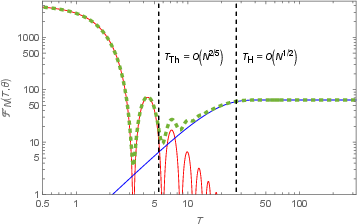
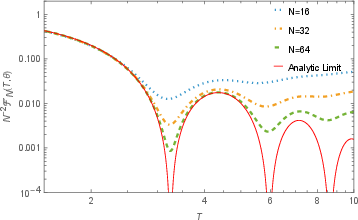
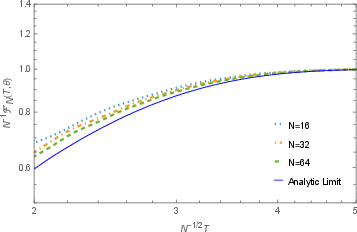
Figure 2: DSFF in the strong non-Hermiticity regime (T=O(Nγ)0), showing numerical agreement with analytic limits for both ramp and plateau.
Mesoscopic Regime and Universality Crossover
In the mesoscopic scaling, the ramp displays either linear (GUE-like) or quadratic (GinUE-like) growth, depending on T=O(Nγ)1 and T=O(Nγ)2. The transition is explicitly mapped:
- For T=O(Nγ)3: Linear ramp dominates.
- For T=O(Nγ)4: Quadratic ramp dominates.
- At T=O(Nγ)5: Plateau onset.
This crossover is codified in the phase diagram; the critical thresholds for dip and plateau times depend explicitly on T=O(Nγ)6.
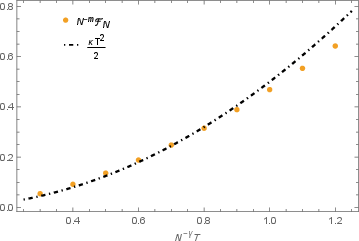
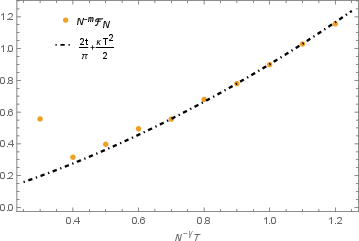
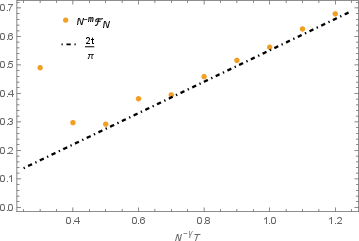
Figure 3: DSFF in the mesoscopic regime (T=O(Nγ)7, T=O(Nγ)8), showing quadratic ramp for T=O(Nγ)9.
Weak Non-Hermiticity
For α0, the DSFF converges to GUE SFF asymptotics regardless of α1. The leading behavior is linear in ramp and plateau regimes, with suppressed non-Hermitian corrections. The scaling thresholds α2 and α3 coincide with those in Hermitian RMT.
Numerical Verification and Analytical Precision
The explicit asymptotic forms are numerically corroborated across multiple scaling regimes. The expansions for DSFF, including higher-order corrections, remain accurate up to the predicted order for both the ramp and plateau regions. The paper also provides identities relating DSFF to known spectral observables and establishes their connections to LUE moments and spectral kernel asymptotics.
Implications and Future Directions
The detailed asymptotic analysis unifies the understanding of spectral statistics for open quantum systems by connecting DSFF behavior to non-Hermiticity scaling. Practically, this yields predictive power for interpreting spectral measurements in dissipative quantum experiments, particularly where eigenvalue statistics interpolate between classical chaos and integrability. Theoretically, the classification of ramp behavior and phase transitions advances the universality paradigm for non-Hermitian RMT observables.
Future developments may include:
- Extending DSFF asymptotics to ensembles with other symmetry classes (e.g., real Ginibre, chiral ensembles).
- Exploring edge statistics, particularly in regimes with critical exponents α4.
- Applying these asymptotic tools to experimental data from non-Hermitian quantum systems (e.g., photonic lattices, open atomic systems).
Conclusion
This work rigorously resolves the asymptotic structure of the DSFF for the complex elliptic Ginibre ensemble, mapping its phase transitions and universality crossover in terms of matrix dimension and non-Hermiticity scaling. The explicit analytical and numerical results clarify the spectral signatures of dissipative quantum chaos, cementing the DSFF as a central probe of spectral statistics in non-Hermitian RMT and open quantum dynamics.

