- The paper reports the generation of a 30-beam squeezed light array in a rubidium vapor cell, achieving an average squeezing of 2.03±0.02 dB per channel.
- It demonstrates a novel dissipative synchronization via shared atomic coherence that lowers the squeezing threshold and extends the squeezing bandwidth up to approximately 890 kHz.
- The array architecture shows robust defect tolerance and rapid recovery from perturbations, paving the way for scalable applications in quantum imaging and quantum information processing.
Large-Scale Array of Squeezed Light and Synchronization in Atomic Vapor
Introduction and Motivation
The generation and scalable multiplexing of squeezed light are central challenges for advancing quantum information processing, quantum metrology, and high-throughput quantum imaging systems. Conventional approaches relying on independent optical parametric oscillators, time/frequency multiplexing, or chip-based photonics face constraints in spatial channel scalability and compatibility with atomic systems. Atomic media—especially warm vapor cells—enable direct interfacing with quantum devices and allow for efficient squeezed-light generation via polarization self-rotation (PSR). However, extending squeezing to large two-dimensional spatial arrays, and elucidating their underlying collective and dissipative dynamics, remains largely unexplored.
This work reports the experimental realization and detailed study of a 30-beam spatial array of polarization-squeezed light generated in a paraffin-coated rubidium vapor cell. A key advance is that all channels share a common ground-state atomic coherence, fundamentally coupling their squeezing dynamics through dissipative, motional-averaged atom-light interactions. This architecture not only achieves scalable, hardware-efficient multi-beam squeezing, but also induces robust synchronization phenomena and collective dynamic effects, including enhanced squeezing bandwidth, improved noise purity, defect tolerance, and rapid recovery after perturbation.
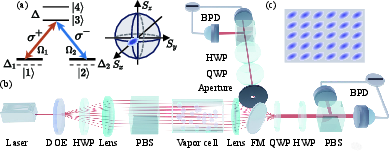
Figure 1: Schematic illustration of the squeezing mechanism, experimental setup, and collective synchronization in the atomic vapor cell.
Experimental Methodology and System Architecture
The experimental system (Figure 1) employs a diffractive optical element to generate 30 parallel, spatially separated beams of linearly polarized light at the 87Rb D1 line. These beams traverse a 7.5 cm long, 2.5 cm diameter vapor cell with an inner paraffin coating. Coherence-preserving diffusion of alkali atoms across the illuminated and dark regions within the cell enables all channels to share and maintain a collective ground-state spin coherence. This atomic reservoir mediates global, dissipative coupling between channels, distinct from mere crosstalk or direct mode overlap in standard optical systems. Quantum noise and squeezing levels are measured via balanced homodyne detection, with channels individually or collectively addressed and phase-locked local oscillators for full quadrature access.
The central quantitative result is the simultaneous generation of polarization-squeezed vacuum in all 30 beams, with an average squeezing of 2.03±0.02 dB per channel at $2$ mW/channel pump power (Figure 2). Notably, for modest per-channel power (∼0.5−1 mW), the collective array supports squeezing where the single-channel case remains excess noise-dominated (≳3 dB above shot noise). The global coupling dynamically lowers the squeezing threshold and extends squeezing bandwidth—up to ∼890 kHz in the 30-channel array, compared to ∼283 kHz for a single channel at fixed per-channel power.
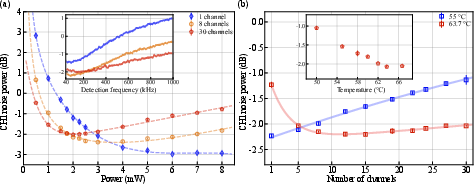
Figure 2: Quantum noise power in the squeezed quadrature for different array sizes, highlighting strong performance at low per-channel power due to collective coherence.
Squeezing enhancement with increasing array size is subject to saturation and partial degradation due to finite optical depth, pump-induced optical pumping to auxiliary hyperfine levels, and spontaneous emission, all of which are treated and corroborated by the authors' five-level atom model. Increasing the cell temperature and, equivalently, the atomic density, partially restores squeezing in larger arrays, as confirmed by both experiment and theory.
A distinctive feature of this platform is dissipative synchronization: despite laser power mismatch or initial variability, all beams converge to nearly identical squeezing levels and squeezing angles when coupled via the global atomic bath. Phase synchronization is evidenced by aligning squeezing angles across independent channels (variation <0.1∘ for seven randomly selected beams) and by observing maximal total squeezing only when all beams' squeezed elliptical directions are aligned (Figure 3).
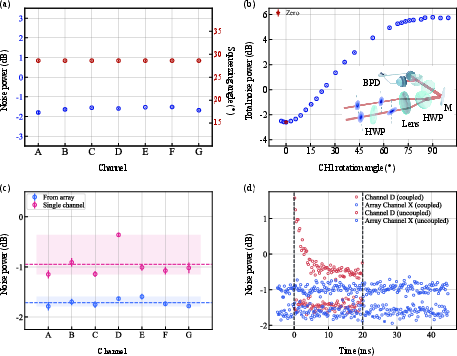
Figure 3: Empirical demonstration of squeezing-level and squeezing-angle uniformity, underlining synchronization across the 30-channel array and robustness to drive variations.
When an extra, lower-power beam is added to the array, its steady-state squeezing matches the others only in the globally coupled regime; in isolation its squeezing is significantly below that of the array. Synchronization is further confirmed in dynamic, time-resolved experiments: following the activation or removal of a mismatched channel, all beams rapidly return to uniform squeezing, with recovery times decreasing as array size increases.
Robustness to Defects and Response to Perturbations
The array architecture exhibits collective robustness to “defect” beams, e.g., channels polarized orthogonally to the array. In small arrays, such defects globally degrade squeezing (through destructive atomic coherence interference); in larger arrays, this sensitivity is strongly reduced, and partial squeezing recovery is observed after defect removal (Figure 4).
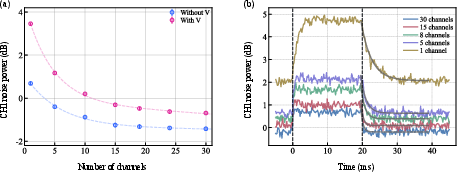
Figure 4: Response of the array to introduction and removal of a polarization “defect” beam, demonstrating collective defect tolerance scaling with array size.
The measured recovery time after removing a defect channel decreases from ∼3 ms (1 channel) to 10 ms (30 channels), indicating that array-mediated atomic coherence dynamics enable fast and robust re-establishment of optimal squeezing.
State Purity and Excess Noise Mitigation
Expanding the array size not only enhances squeezing bandwidth and dynamic tolerance, but also suppresses excess noise in the anti-squeezed quadrature. Experimental and numerical data (Figure 5) show an improvement in squeezed-state purity, as quantified by the approach of the product of squeezed and anti-squeezed noise powers to zero dB—indicative of a nearly unitary squeezing operation.
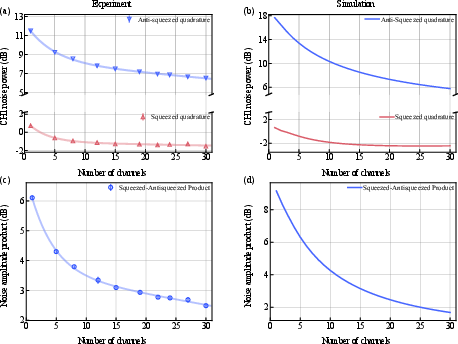
Figure 5: Suppression of anti-squeezing excess noise as array size increases, evidencing improved quantum state purity and reduction of dissipative channels.
This improvement is attributed to more efficient replenishment from the atomic reservoir and lower net absorption-induced noise, facilitated by collective dynamics.
Implications and Prospects
The demonstration of a scalable, spatially multiplexed squeezed light source with inherent global coupling has several immediate and projected consequences. Practically, this architecture realize hardware-efficient sources for high-dimensional quantum imaging, distributed quantum sensing, and spatially-resolved quantum information protocols—especially those requiring matching to atomic quantum memory or sensor platforms. Theoretically, the results establish a new paradigm for large-scale synchronization of quantum oscillators via dissipative, atom-mediated coupling—an avenue of significant interest for exploring quantum many-body dynamics and reservoir engineering.
The work suggests concrete strategies for further improvements: increasing atomic density and cell size, advancing wall coatings, and optimizing pump power and detuning can push squeezing levels and robustness significantly higher, potentially approaching or exceeding 8 dB. The inherent compatibility with linear optical networks opens a pathway to multipartite entanglement generation for quantum networks and distributed metrology (2605.28316).
Conclusion
This study establishes the feasibility and advantages of large-scale, spatially multiplexed arrays of quantum-correlated squeezed light generated in atomic vapor, mediating robust dissipative synchronization across all channels. The system achieves strong squeezing, improved bandwidth and purity, rapid and robust dynamic response, and tolerance to system imperfections, all via a scalable and atomically coherent architecture. These findings position atomic vapor arrays as leading candidates for next-generation quantum networks, imaging, and precision measurement platforms.

