- The paper shows that quantum fluctuations break classical symmetry in high-harmonic generation, allowing forbidden harmonics to emerge in materials like graphene and MoS₂.
- It employs amplitude- and phase-squeezing of the driving light to relax selection rules and achieve broader spectral bandwidth for attosecond pulse synthesis.
- Numerical and analytical results reveal quantum-optical signatures such as superbunching and mixed helicity states, establishing quantum light as a tunable parameter in HHG.
Symmetry Breaking by Quantum Light in Solid-State High-Harmonic Generation
Introduction and Motivation
The paper "Symmetry breaking by quantum light in solid-state high-harmonic generation" (2605.28236) presents a detailed analysis of how quantum fluctuations in light disrupt classical dynamical symmetry constraints in solid-state HHG, thereby relaxing the selection rules on harmonic emission. The study focuses on two prototypical materials, graphene and MoS2, which possess distinct crystal symmetries, and examines the consequences of driving their HHG with circularly polarized quantum states of light—primarily amplitude- and phase-squeezed fields. These quantum states are shown to break the dynamical symmetry of the driving field while preserving the underlying crystal symmetry, enabling the emergence of harmonics previously forbidden by classical selection rules. The results are relevant for realizing engineered spectral and temporal properties of generated harmonics and for the development of quantum-light-driven attosecond pulse synthesis in solids.
Classical Symmetry Constraints in Solid-State HHG
In classical HHG, the selection rules for harmonic emission are a direct consequence of the symmetries of both the crystal and the driving field. Linear drivers yield only odd harmonics due to dipole symmetry, while circular drivers, constrained by angular momentum conservation and crystal point-group symmetry, impose more restrictive rules. For example, graphene with sixfold (C6) rotational symmetry admits harmonics q=6j±1 while MoS2, with threefold (C3) symmetry and a lack of inversion symmetry, allows harmonics q=3j±1 but forbids q=3j. These selection rules arise from a dynamical symmetry operation combining spatial rotation and time translation, ensuring the Hamiltonian remains invariant under Un=R2π/nTτ/n and constraining the frequency components of emitted currents.
Quantum Fluctuations and Dynamical Symmetry Breaking
The central technical advance in this work is demonstrating that quantum fluctuations of the driving field—introduced via squeezing—lead to symmetry breaking at the level of higher-order field correlations, even while the mean field obeys classical symmetry. The authors analyze the quantum field as $\hat{\vb{E}}_Q(t) = \vb{E}_{cl}(t) + \delta \hat{\vb{E}}(t)$ and show that while $\vb{E}_{cl}(t)$ transforms properly under classical C60, the variance term C61, capturing the effect of squeezing, is not invariant under the same symmetries.
This loss of dynamical symmetry modifies the full Hamiltonian, C62, where C63 incorporates the quantum fluctuations. Explicit analytical expressions (including the squeezing parameter C64) show the time-dependent variance carries terms with null helicity not allowed by the classical dynamical symmetry, opening helicity-zero channels. As a result, harmonic orders forbidden in the classical limit (C65 for MoSC66 and C67 for graphene) become accessible in the quantum regime.
Numerical Results: Relaxation of Selection Rules and Harmonic Spectra
Numerically, the paper demonstrates that quantum fluctuations (both amplitude and phase-squeezing) enable generation of harmonics previously forbidden by classical selection rules. For both graphene and MoSC68, the intensity of these forbidden harmonics increases systematically with the squeezing intensity C69, establishing quantum light as a tunable parameter for symmetry engineering in HHG.
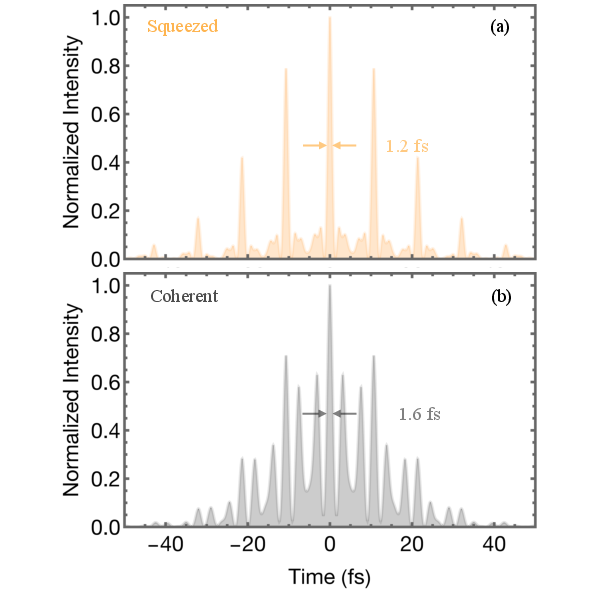
Figure 1: Synthesized pulse trains for the squeezed and coherent drivers show significant reduction in central pulse duration (1.2 fs vs 1.6 fs), reflecting increased spectral bandwidth from quantum-induced harmonics.
The inclusion of forbidden harmonics also affects the temporal structure of the emitted pulse trains. As seen in Figure 1, synthesizing attosecond pulses from the quantum-driven HHG spectra leads to shorter pulse durations and less pronounced satellite peaks compared to classical coherent driving. This arises from a more uniform spectral distribution, reducing spectral gaps and yielding pulse trains that approach the Fourier-limited duration characteristic of flat spectra.
Quantum Optical Signatures: Wigner Functions and Correlation Measurements
Beyond classical observables, the quantum statistics of the generated harmonics are analyzed via Wigner functions and q=6j±10 intensity correlations. Squeezing of the driving field imprints quantum-optical nonclassicality onto the forbidden harmonics, reflected in Gaussian phase-space distributions with degree of squeezing determined by the interplay of intra- and interband electronic currents.
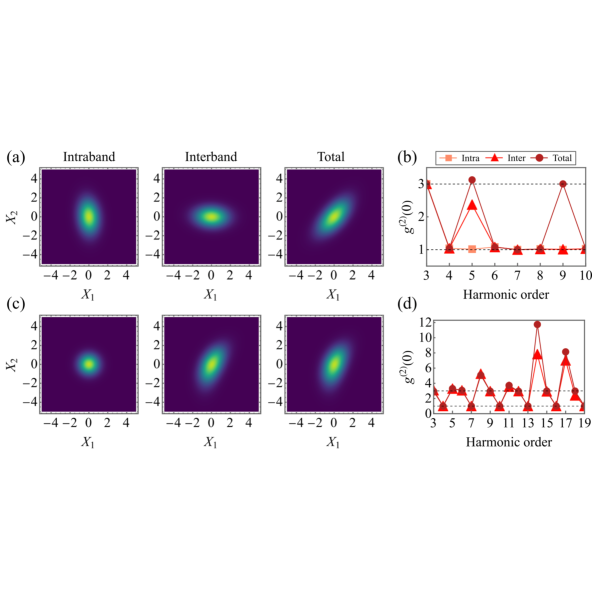
Figure 2: Wigner functions reveal squeezed-like phase-space distributions and q=6j±11 statistics for forbidden harmonics in both graphene and MoSq=6j±12, distinct from Poissonian classical harmonics.
Notably, the q=6j±13 values for quantum-allowed harmonics consistently exceed 2 (superbunching), indicating strong quantum correlations; for Poissonian (coherent) harmonics, q=6j±14. The scaling of forbidden harmonic intensity with squeezing, and the transition of statistics from Poissonian to superbunched, provide a measurable signature of quantum-induced symmetry breaking.
Polarization Effects and Helicity Mixing
The polarization-resolved harmonic spectra further corroborate the symmetry breaking mechanism. Classical harmonics show strict helicity alternation dictated by angular momentum conservation, while quantum-driven harmonics exhibit mixed helicity states, reflecting the opening of null-helicity channels via quantum field correlations.
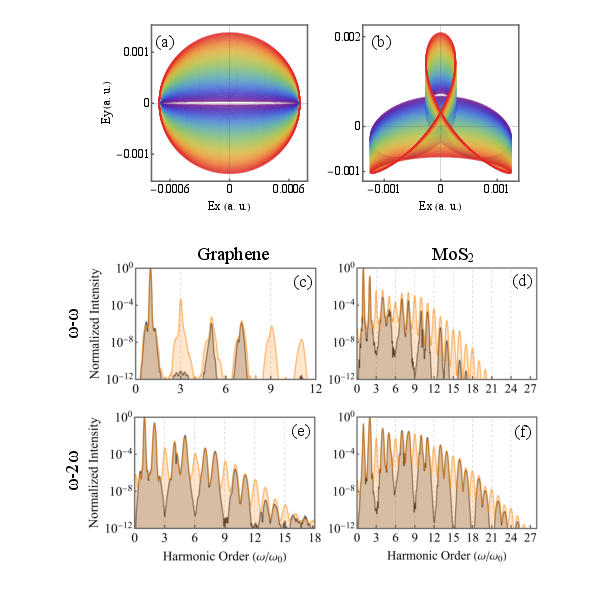
Figure 3: Circular and bicircular quantum drivers yield relaxation and mixing of harmonic polarization components, enabling harmonics with mixed handedness and loss of pure helicity states.
Practical and Theoretical Implications
The demonstration that quantum fluctuations can relax or tune HHG selection rules carries broad implications for condensed-matter strong-field physics:
- Spectral Control: The addition of quantum-induced harmonics expands the effective bandwidth for pulse synthesis, enabling generation of shorter attosecond pulses without single-cycle driving requirements.
- Symmetry Engineering: Quantum states of light offer a new degree of freedom for tailored nonlinear optical responses in low-dimensional materials, enabling all-optical control not only of harmonic order but also polarization properties.
- Quantum-State Sensitive Spectroscopy: The imprint of quantum fluctuations on the statistics of emitted harmonics enables experimental probes of quantum light-matter interaction beyond mean-field observables.
- Material Robustness: The study also references increased damage thresholds in solids for quantum drivers, allowing higher field strengths and expanded operational regimes for HHG.
Looking forward, the quantum control of harmonic spectra may catalyze advances in attosecond science, quantum photonics, and high-speed optoelectronics, and invites further investigation into the role of quantum light in nonlinear processes in topological and strongly correlated materials.
Conclusion
The paper provides a rigorous account of how quantum fluctuations of light break classical dynamical symmetry constraints in solid-state HHG, relaxing selection rules and enabling the generation of forbidden harmonics. This symmetry breaking, arising from the quantum variance of the driving field, translates into expanded harmonic spectra, enhanced attosecond pulse synthesis, and measurable quantum-optical signatures such as superbunching and squeezed phase-space distributions. The results establish quantum states of light as a new control parameter for nonlinear optical phenomena in solids, opening pathways for future applications in quantum-controlled spectroscopy and ultrafast photonics.

