- The paper shows that geometric confinement in a cylindrical cavity suppresses distillable entanglement by attenuating nonlocal field correlations.
- It employs perturbative analysis of Unruh-DeWitt detectors coupled to a massless scalar field with Gaussian switching, quantifying negativity, discord, and mutual information.
- Numerical results reveal that while entanglement abruptly vanishes near the boundary, quantum discord remains robust and can even be enhanced.
Cavity-Induced Suppression of Entanglement and Enhancement of Quantum Discord
Introduction and Motivation
The paper "Cavity-Induced Suppression of Entanglement and Enhancement of Quantum Discord" (2605.28055) presents a systematic study of how geometric confinement modifies the harvesting of quantum correlations from a vacuum field using two Unruh-DeWitt detectors coupled to a massless scalar field inside a perfectly reflecting cylindrical cavity. The analysis is motivated by the role of boundary conditions in quantum field theory, especially in experimentally relevant cavity QED setups, and extends the focus from pure entanglement toward a broader hierarchy of quantum correlations, including quantum discord and mutual information.
The authors specifically address how the mode discretization induced by cavity boundaries suppresses distillable entanglement harvested from the field, while more general quantum correlations can persist and even be enhanced near the cavity boundary, thus challenging the expectation that the free-space limit is straightforwardly recovered by scaling up the cavity radius.
Detector–Field Configuration
The setup consists of two identical, stationary Unruh-DeWitt detectors—modeled as qubits—placed inside an infinitely long cylindrical cavity of radius R. Detector A is placed on the cavity axis, while detector B is located at radial distance ρ0. The detectors interact locally with the scalar field via a time-dependent Gaussian switching profile of width σ and are separated only radially.
Scalar Field Quantization in a Cavity
The massless scalar field satisfies Dirichlet boundary conditions at the cylindrical wall, discretizing the radial modes via the Bessel function zeros while retaining continuous longitudinal momentum. The central field-theoretic observable, the positive-frequency Wightman function, is explicitly computed in terms of Bessel and Hankel functions reflecting the mode decomposition in the cavity geometry.
Harvested Correlations: Density Matrix Structure
Perturbative expansion in the detector-field coupling yields the reduced two-qubit detector density matrix. The relevant off-diagonal and diagonal elements, determined by integrals of the Wightman function against the Gaussian temporal profile, encode the excitation probabilities, field-mediated cross-correlations, and the key nonlocal correlation term MAB responsible for entanglement harvesting:
- XAA, XBB: local excitation probabilities
- XAB: cross correlations
- MAB: nonlocal field-mediated correlation
These elements fully determine the structure of harvested correlations.
Quantification of Correlations
Entanglement Negativity
Negativity, N, provides a necessary and sufficient criterion for two-qubit entanglement. In the weak-coupling approximation, negativity emerges only when ∣MAB∣>(XAA+XBB)/2, directly linking the nonlocal term to distillable entanglement.
Quantum discord ρ00 and mutual information ρ01 measure nonclassical and total correlations, respectively. Discord is determined via an explicit minimization over local projective measurements, with the expressions leveraging the special structure of the reduced density matrix.
Numerical Analysis and Results
Mode Cutoff and Convergence
The evaluation of nonlocal ρ02 terms involves slowly convergent oscillatory sums over high-index Bessel modes, especially in the pointlike detector limit. The authors employ envelope averaging to reliably approximate the series limit, with convergence improving as detector spatial smearing increases.
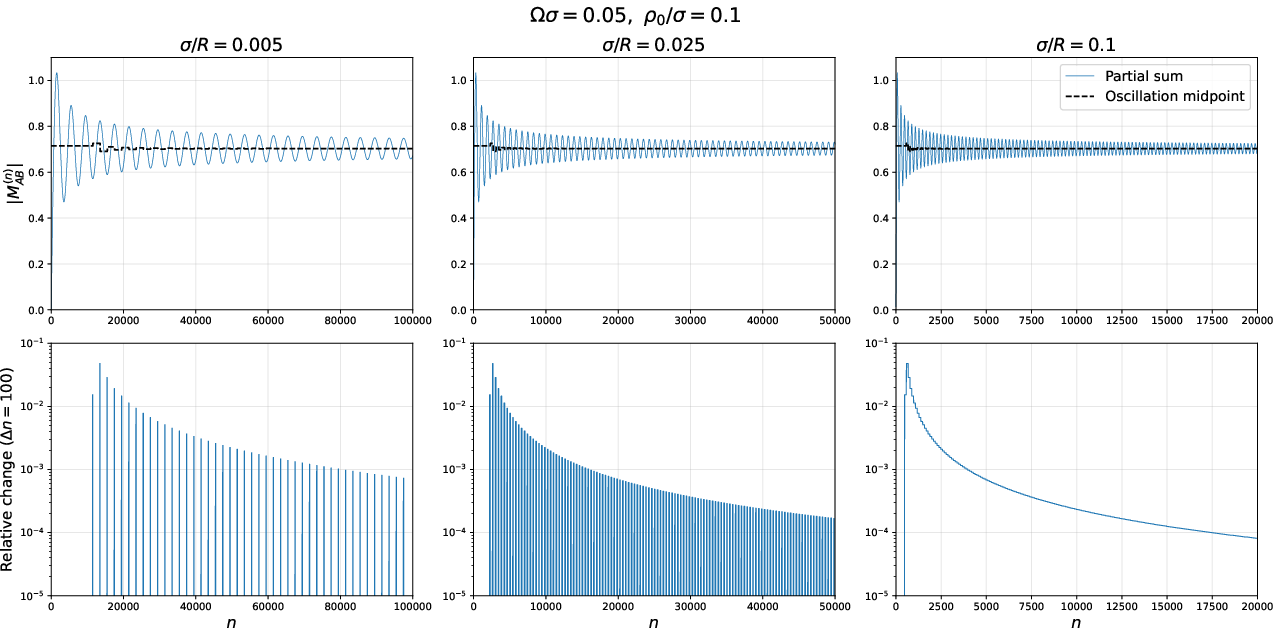
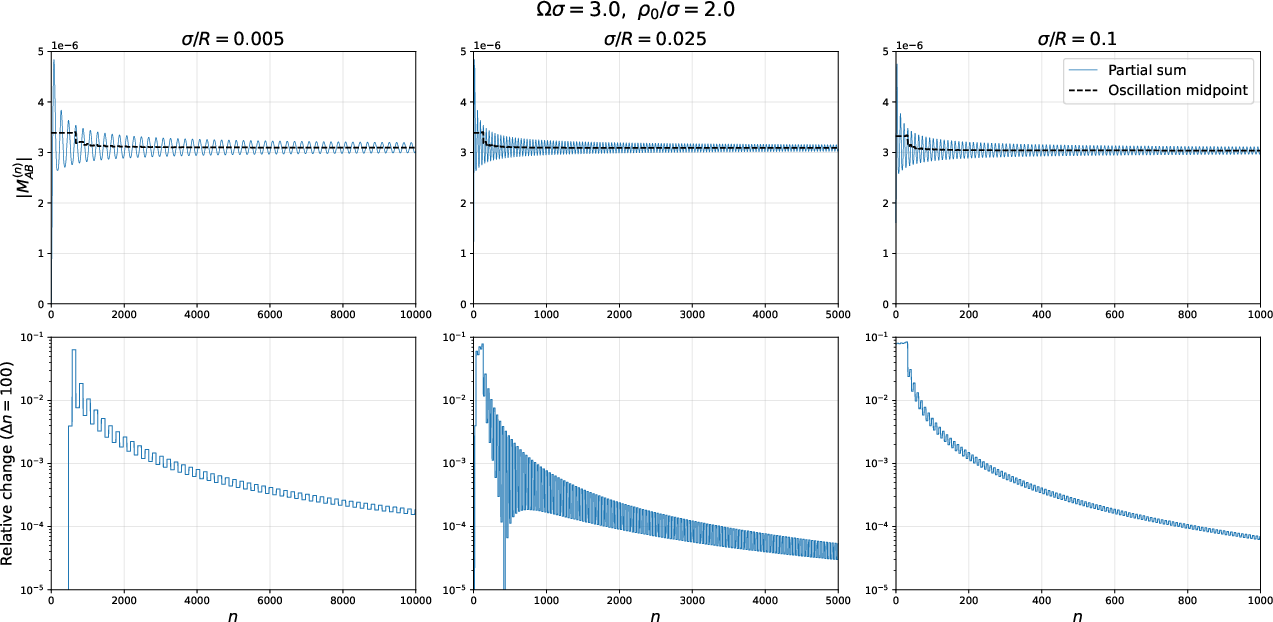
Figure 1: Partial sums of the nonlocal correlation term ρ03 as a function of mode cutoff ρ04 for varying detector size, illustrating the oscillatory yet eventually convergent series structure.
Suppression of Entanglement, Persistence of Discord
Numerically computed correlation components reveal clear trends:
- Entanglement negativity is strongly suppressed by the cavity compared to free space and vanishes at smaller detector separations.
- Increasing the cavity radius does not recover the free-space entanglement region, even as other (local) detector observables do converge, indicating a nontrivial nonlocal impact of boundaries.
- Mutual information and quantum discord remain nonzero over much broader separation regimes, exhibiting distinct decay behaviors.
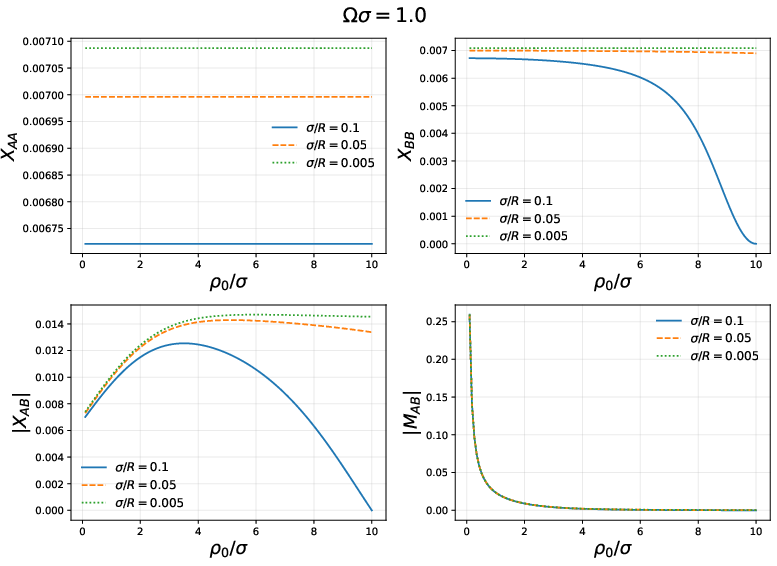
Figure 2: Behavior of ρ05, ρ06, ρ07, and ρ08 as functions of detector separation for various ρ09; σ0 (entanglement driver) is rapidly suppressed near boundaries, while σ1 and σ2 retain robustness.
Parameter Space Analysis
Density plots over normalized separation σ3 and dimensionless energy gap σ4 exhibit a sudden death boundary for entanglement in the cavity that is shifted relative to free space, but broad persistence of discord and total correlations.
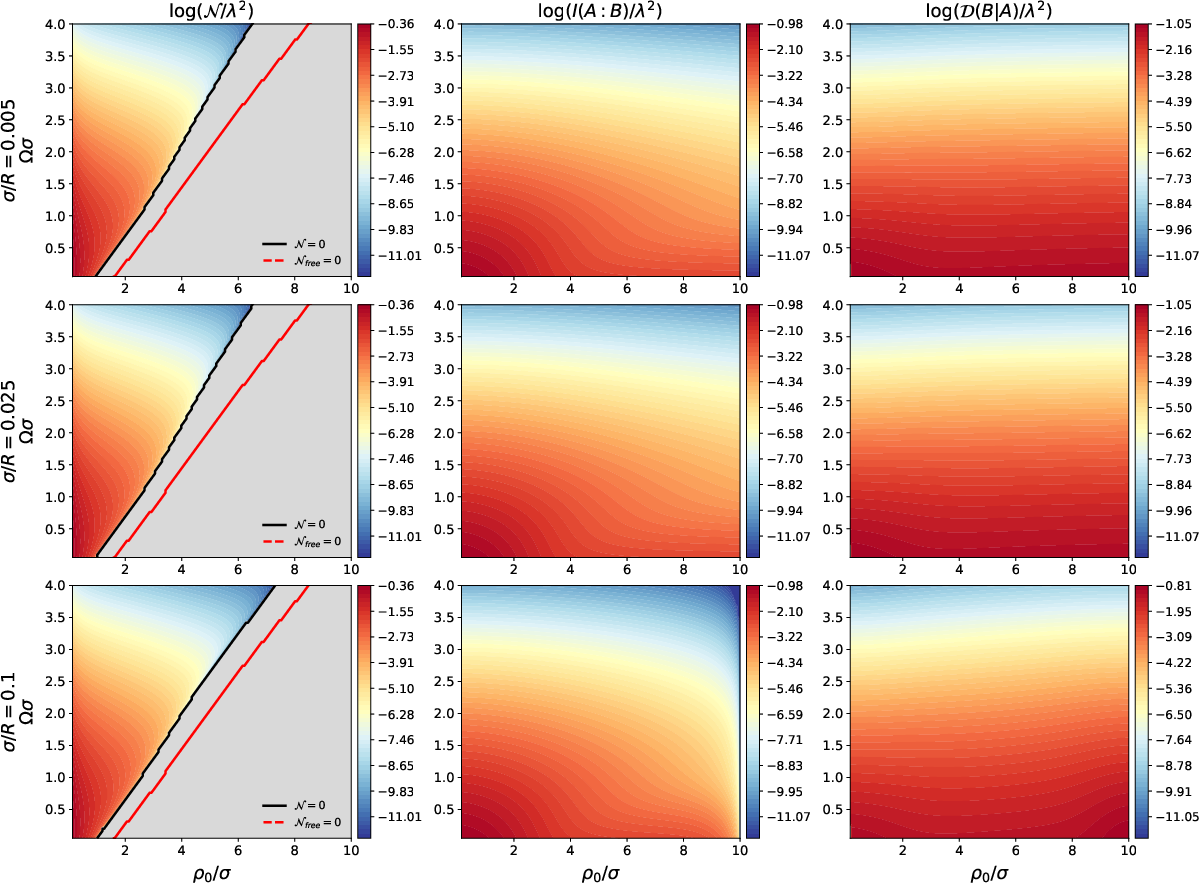
Figure 3: Density plots of negativity, mutual information, and quantum discord as functions of detector separation and gap. Entanglement vanishes beyond a sharply delineated region; discord and mutual information decay more gradually, with discord showing enhancement near the boundary for larger σ5.
Further one-dimensional slices demonstrate that:
- Entanglement drops to zero abruptly with increasing separation or gap, with the boundary shifting with cavity size but never attaining the free-space curve.
- Mutual information decays smoothly with a weak dependence on the cavity radius.
- Quantum discord displays non-monotonic behavior and becomes enhanced as detector B approaches the cavity boundary—indicating that cavity geometry can selectively boost non-distillable quantum correlations.
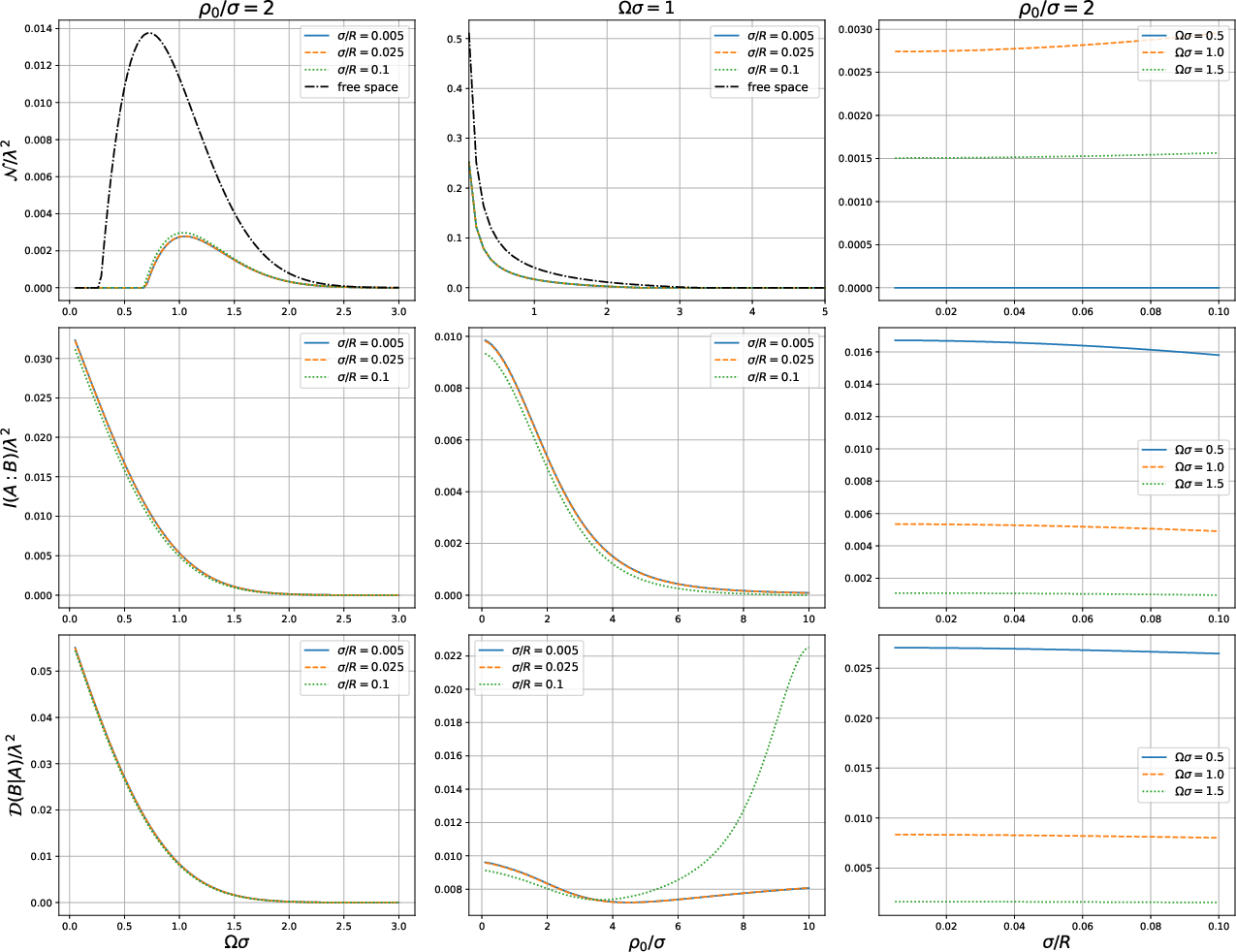
Figure 4: One-dimensional slices through parameter space showing (1) negativity, (2) mutual information, and (3) discord. The discord is notably enhanced near the boundary for larger cavity sizes, while entanglement remains suppressed.
Physical Implications and Theoretical Insights
The study establishes that geometric confinement via cavity boundaries:
- *Selectively suppresses distillable entanglement by attenuating nonlocal field correlations, as encoded in σ6,
- Leaves more general nonclassical correlations (as quantified by discord) robust, and may even enhance them as the boundary is approached,
- Breaks translational symmetry and induces detector asymmetry, notably suppressing local noise near the boundary.
Additionally, the analysis demonstrates that the large-radius limit (σ7 with fixed cavity length σ8) does not generally restore free-space entanglement, in contrast to local detector observables. This challenges conventional expectations and suggests a degree of nonlocal sensitivity to boundary-induced mode structure beyond that encountered in decoherence or local response.
Practical implications include protocols for tuning quantum correlations in cavity QED platforms, and the theoretical framework provides a controlled setting to investigate the operational hierarchy of quantum correlations in QFT, with clear routes for experimental verification in superconducting or optical cavity systems.
Prospects for Future Research
Open directions emphasized by the authors and suggested by this analysis include:
- Investigation of accelerated detectors and the interaction of acceleration, geometry, and boundary-induced effects on the full hierarchy of quantum correlations.
- Systematic study of detector smearing and finite-size effects to manage ultraviolet divergences and connect to physically realistic measurement scenarios.
- Extension to finite-length cavities, multipartite setups, and other boundary geometries, as well as full nonperturbative treatments.
Conclusion
This work demonstrates that boundary-induced mode structure in a cylindrical cavity can profoundly reshape the structure of harvested quantum correlations from the vacuum. While cavity boundaries act as a strong suppressor of distillable entanglement, general quantum correlations quantified by discord can persist or even increase near the boundary. This selective suppression points to new avenues for probing and controlling quantum resources in both theoretical and experimental settings, motivating further studies on the interplay of geometry, relativistic effects, and quantum information measures in quantum field theory.