- The paper proposes a differentiable framework (DQAS) that transforms UCC circuit design into a continuous optimization problem, achieving improved accuracy and hardware efficiency.
- It introduces both global and layerwise search strategies, using gradient-based operator selection to reduce CNOT gate counts and circuit depth.
- Benchmark results on systems like LiH and H2O show up to a 2.7-fold improvement in energy errors and a significant reduction in operator count compared to ADAPT-VQE and truncated UCCSD.
Differentiable Quantum Architecture Search for Automated UCC Circuit Design
Introduction
Variational quantum algorithms, particularly the variational quantum eigensolver (VQE), represent one of the most promising methodologies for ground-state molecular simulation on NISQ-era quantum hardware. The expressibility and compactness of the parameterized quantum circuit (ansatz) are critically important to the efficacy and feasibility of these algorithms. Unitary coupled cluster with singles and doubles (UCCSD) ansätze provide a rigorous foundation for electronic structure problems but are prohibitive in gate depth for NISQ devices due to their combinatorial scaling.
Adaptive methods such as ADAPT-VQE have mitigated this challenge by employing greedy, gradient-guided selection of operators from chemically motivated pools. However, these methods are intrinsically sequential and often fail to capitalize on synergistic effects among operator subsets. The present work introduces Differentiable Quantum Architecture Search (DQAS) as a general framework for global, gradient-based circuit structure search, leveraging continuous relaxations of operator selection to deliver circuits optimizing both accuracy and hardware efficiency.
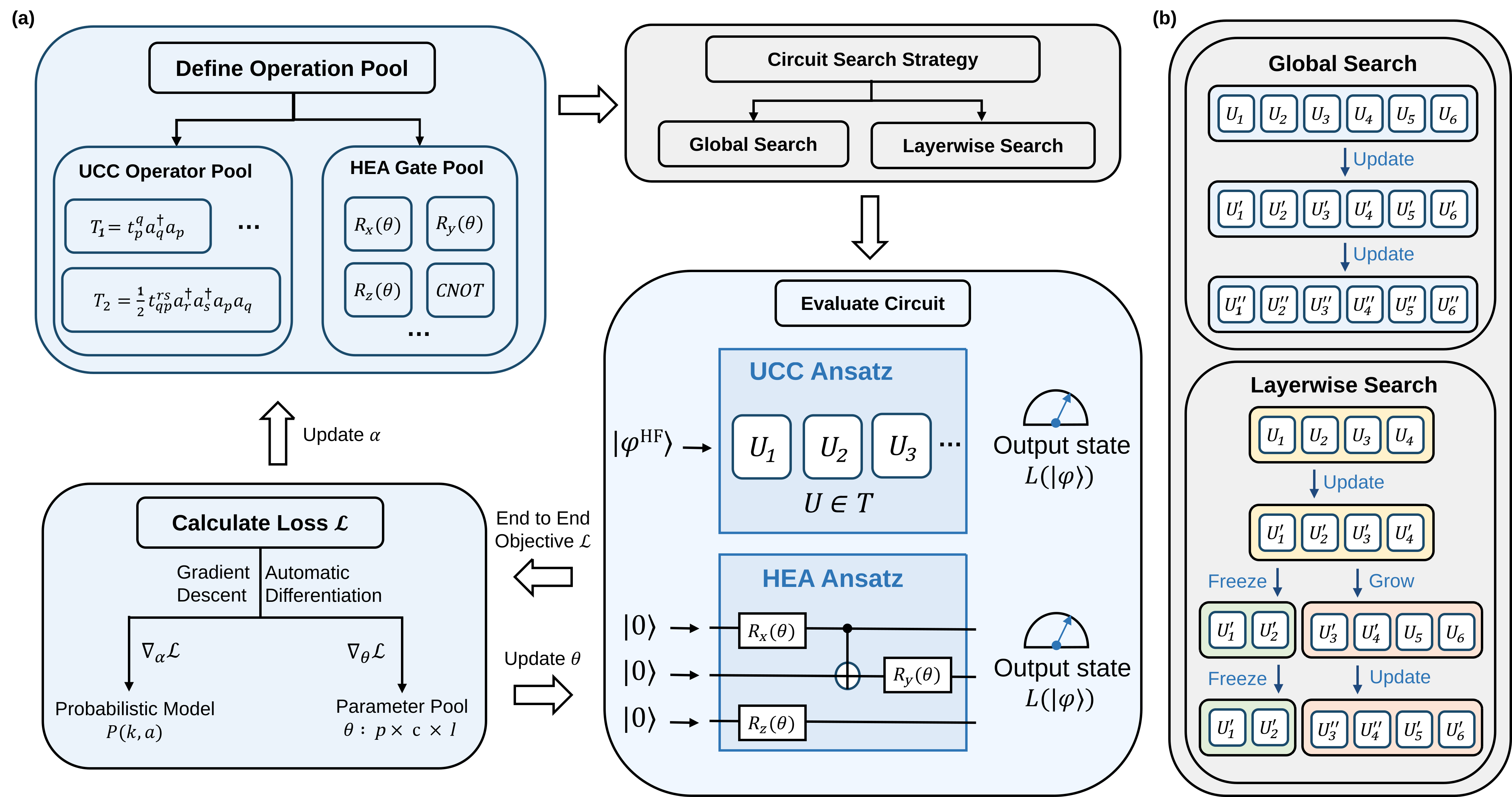
Figure 1: Overview of the DQAS framework for quantum ansatz design, depicting the workflow and the distinction between global and layerwise search strategies.
DQAS Framework: Global and Layerwise Strategies
DQAS recasts the discrete ansatz structure optimization as a joint, differentiable optimization problem over parameter vectors governing layerwise operator group (OG) selection. Continuous architecture parameters α for each layer induce a softmax distribution over candidate OGs, enabling the use of automatic differentiation in the architecture search. This probabilistic model is trained using score-function estimators and the Adam optimizer. After search convergence, a deterministic circuit is extracted by selecting the maximal αk at each layer, followed by BFGS-based variational parameter refinement.
Global DQAS jointly optimizes all circuit layers simultaneously. Layerwise DQAS incrementally grows the circuit via a sliding window, allowing partial freezing of previously optimized layers and improving scalability for larger circuits. Both methods enforce spin symmetry and Fermionic structure via operator grouping.
Search Dynamics and Robustness
An explicit case study with LiH demonstrates the multi-phase search dynamics inherent to DQAS-Global: an initial concentration phase rapidly narrows the operator pool; a subsequent diversity phase explores alternative OG combinations; and, finally, convergence occurs as each layer commits to its optimal OG. The diversity recovery enables DQAS to escape the limitations of greedy heuristics, systematically exploring combinatorial operator synergies.
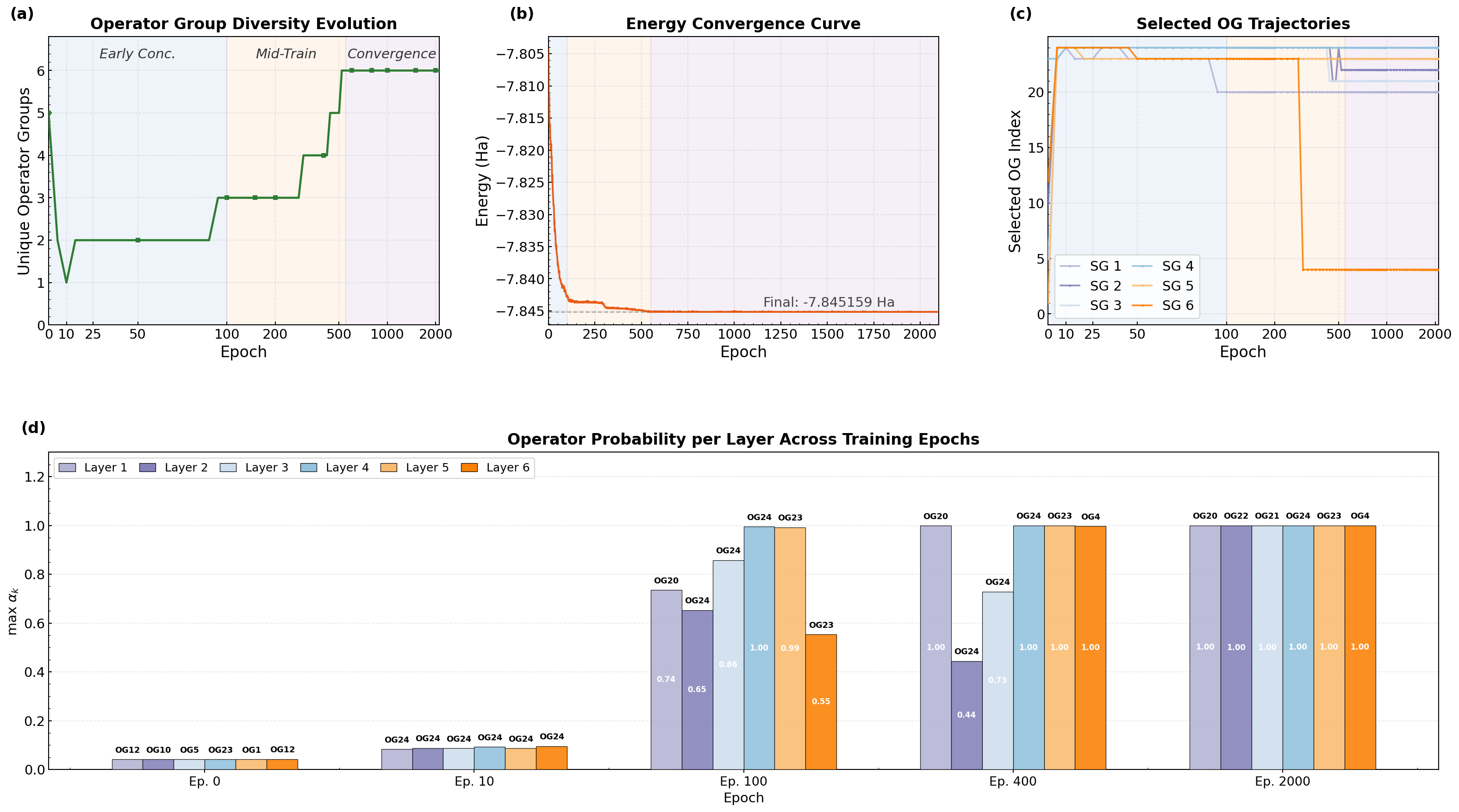
Figure 2: DQAS-Global search dynamics for LiH (d=2.20 \AA), illustrating batch-sampled OG diversity, variational energy convergence, OG assignment trajectories, and softmax concentration over training.
Extensive benchmarks were performed across molecular systems ranging from H4 (8 qubits) to H2O (14 qubits), using both UCCSD and qubit-excitation-based (QEB) operator pools.
Energetic trends: DQAS systematically achieves superior accuracy per operator count in the compact-circuit regime. Specifically, in LiH at 6 OGs, DQAS-Global attains $0.25$ mHa error versus $0.52$ mHa for ADAPT-VQE (a twofold improvement). In larger active spaces such as H2O, DQAS-Layerwise delivers up to a 2.7-fold improvement in energy error compared to ADAPT-VQE at fixed circuit sizes.
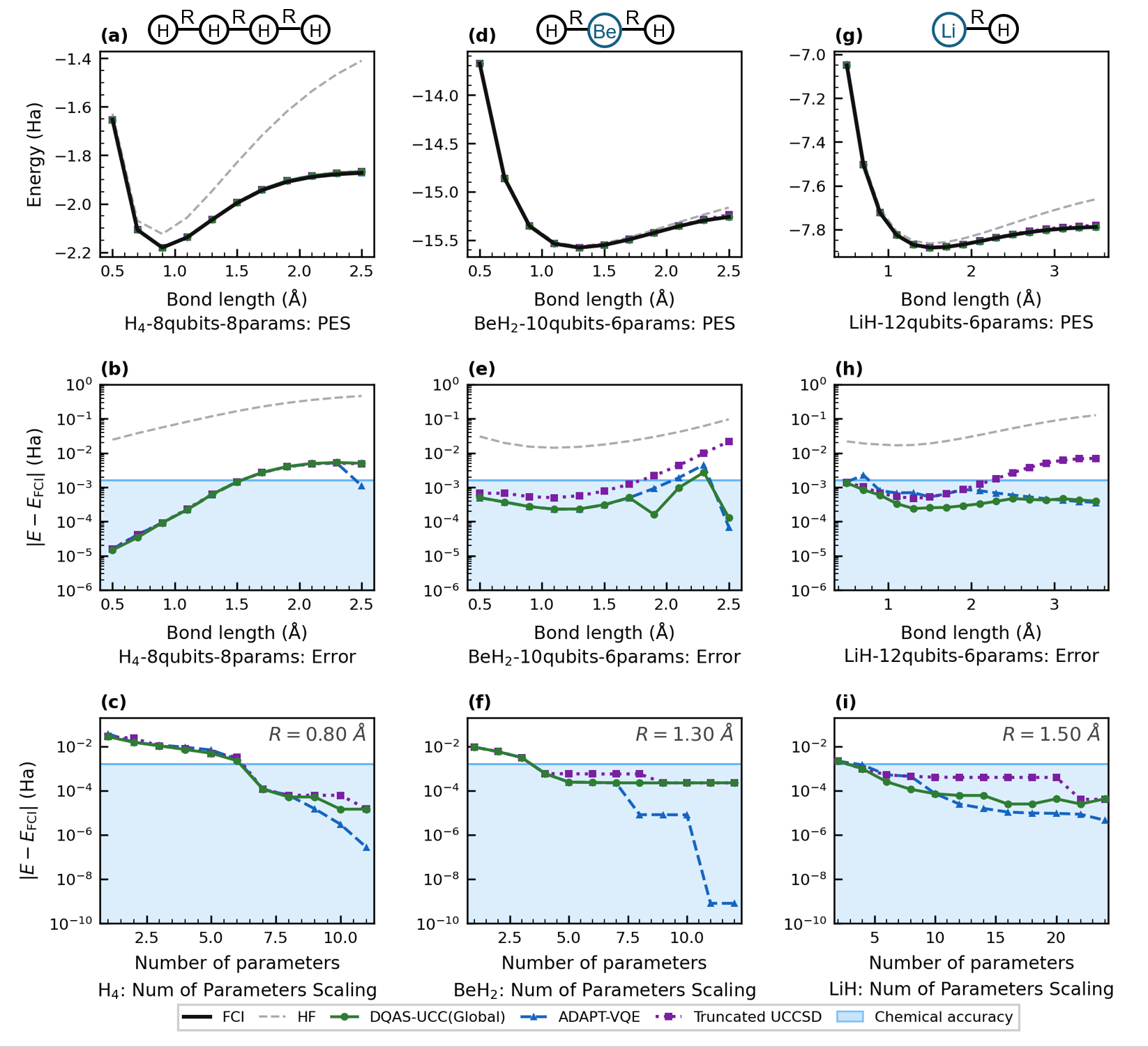
Figure 3: DQAS-Global performance across H4, BeH2, and LiH. Shown are the potential energy surfaces, energy errors relative to FCI, and scaling with operator count.
Operator count scaling: DQAS's global optimization discovers compact operator combinations delivering chemical accuracy at lower circuit depths than either ADAPT-VQE or truncated UCCSD. Notably, the advantage is most pronounced in systems where correlation effects are subtle and inter-operator synergy is significant.
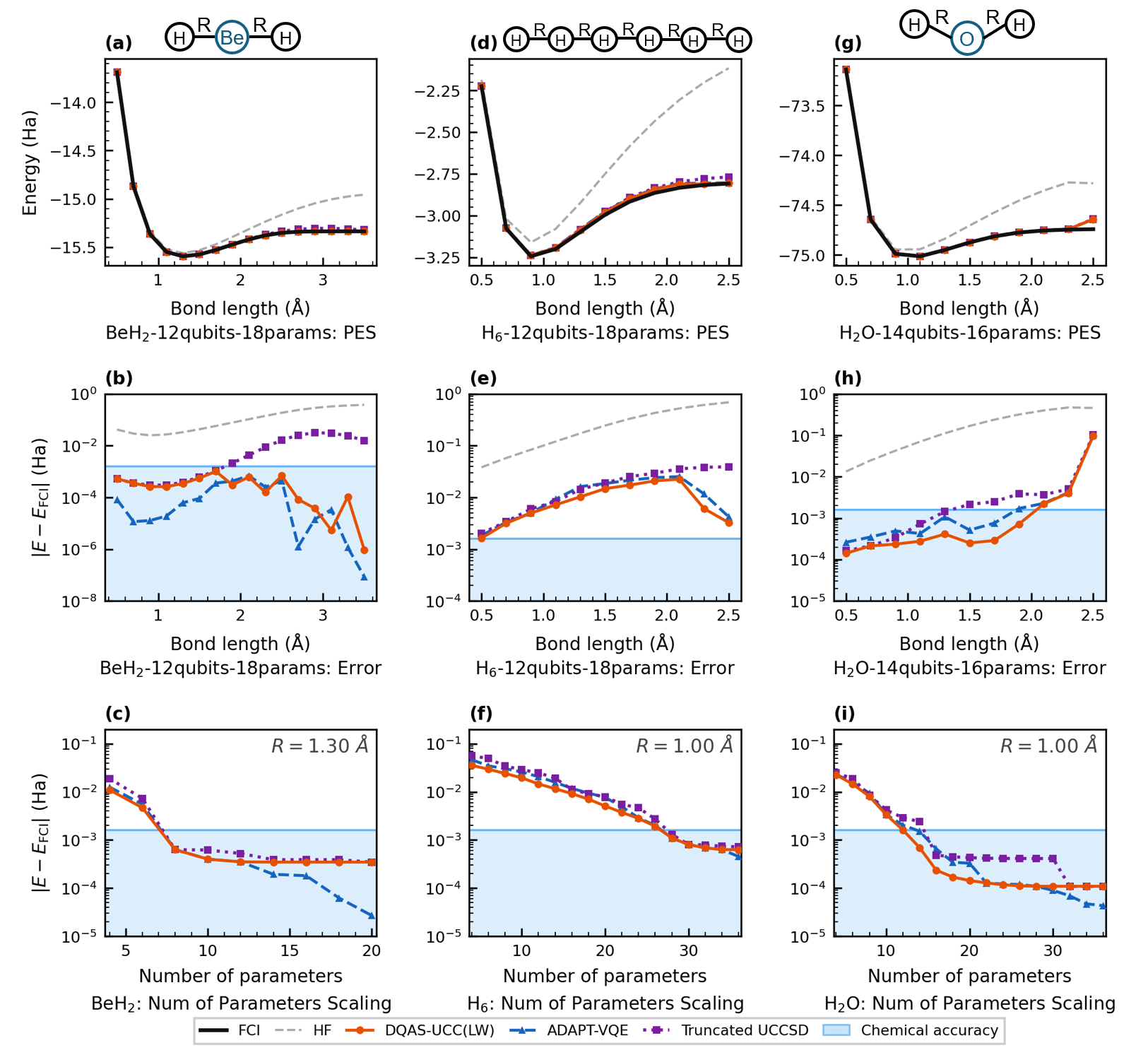
Figure 4: DQAS-Layerwise performance on BeHαk0, Hαk1, and Hαk2O, showing energy surfaces, accuracy, and operator count scaling.
Gate Count Advantages and Circuit Structure
A central result is the reduction in CNOT gate count achieved by DQAS. For Hαk3O at fixed OG count, DQAS-Layerwise circuits require 13--17% fewer CNOTs than ADAPT-VQE, attributed to a bias toward single-excitation operators and avoidance of long-range, high-span double excitations.
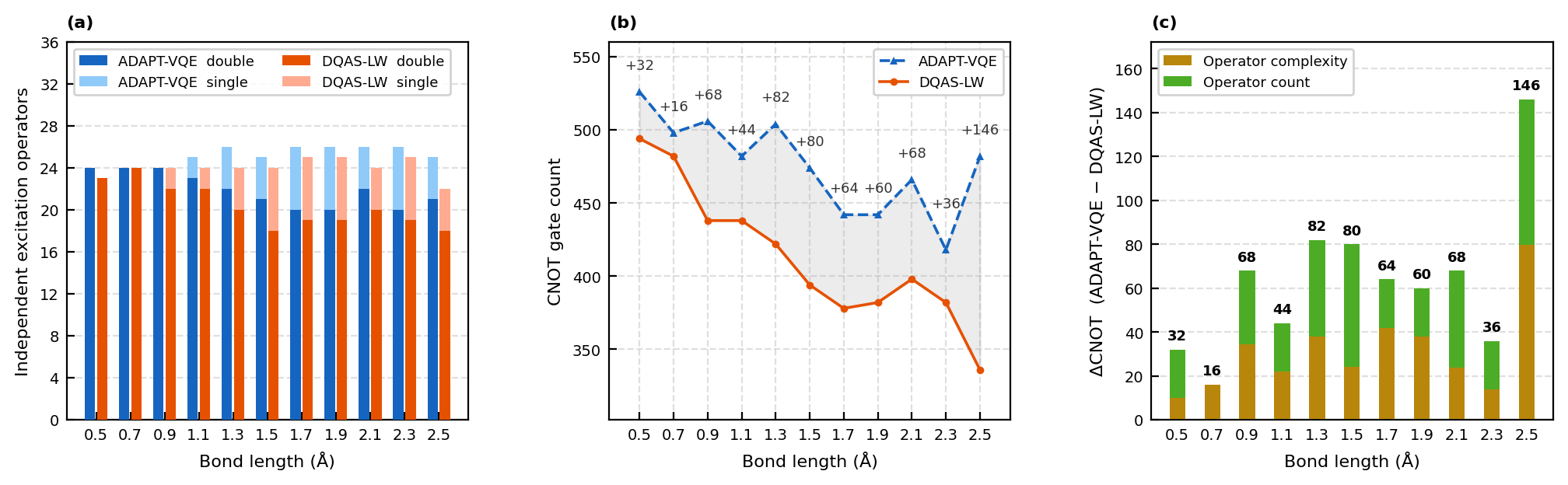
Figure 5: Circuit composition analysis for Hαk4O, highlighting differences in operator type, CNOT count per geometry, and decomposition of CNOT savings into operator count and operator complexity contributions.
This CNOT reduction is robust across both operator pools. In the QEB setting, where per-operator CNOT costs are already minimized, DQAS still preferentially selects CNOT-sparse operator combinations, outperforming ADAPT-VQE and UCCSD truncations in both accuracy and gate efficiency.
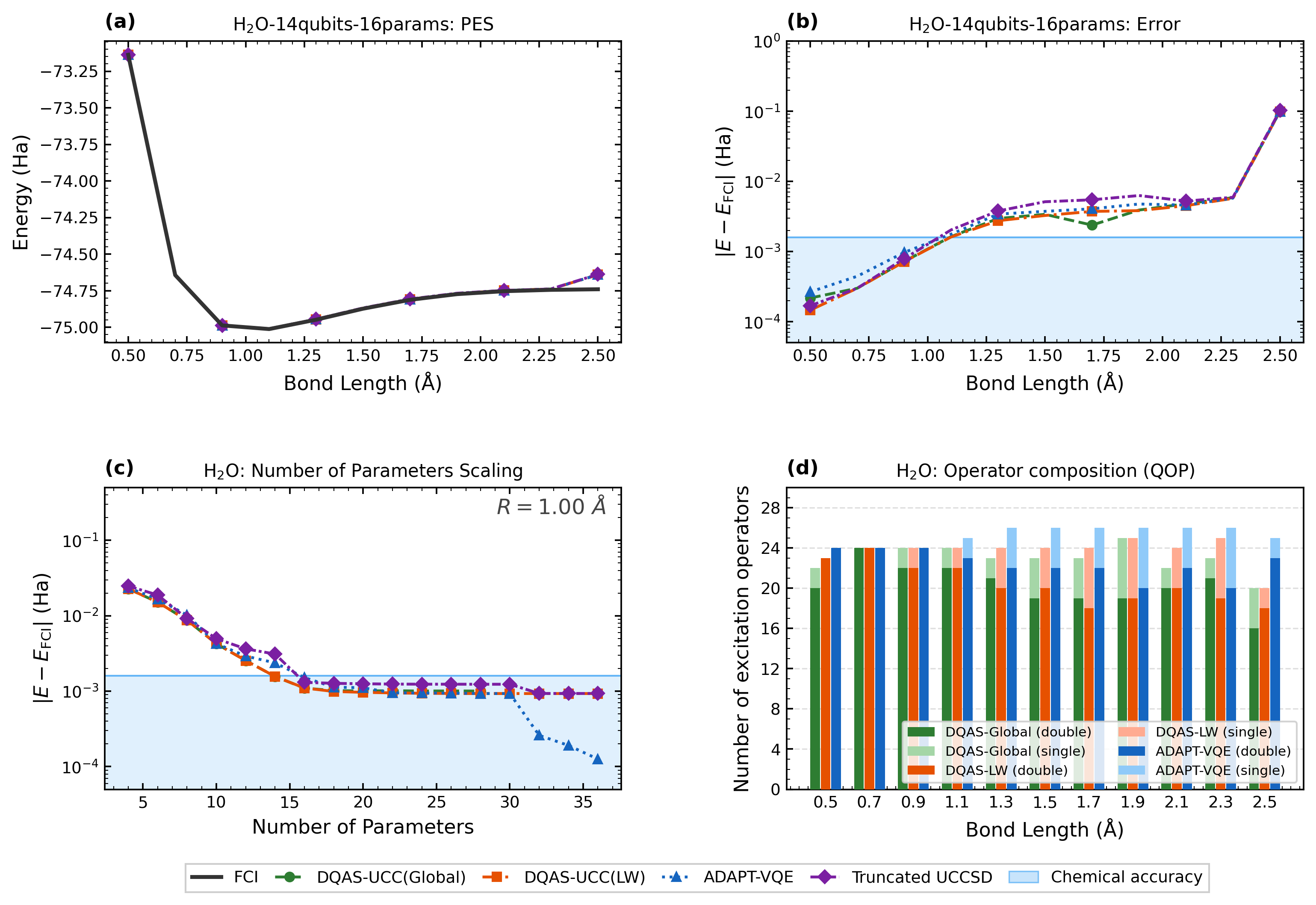
Figure 6: DQAS performance with the QEB pool for Hαk5O, showing PECs, error scaling, parameter counts, and operator type composition as a function of bond distance.
Theoretical and Practical Implications
The work demonstrates that continuous relaxation of circuit architecture enables discovery of ansätze that are both more accurate and more hardware-efficient than those produced by sequential, greedy adaptive schemes. This is particularly salient for quantum chemistry where gate depth and CNOT count are acute limitations for physical hardware. The framework is agnostic to the underlying operator pool, further highlighting the potential for DQAS as a general-purpose quantum circuit design tool.
The consistent CNOT savings stem from DQAS's ability to globally optimize operator selection, avoiding the myopic selections of sequential methods that fail to account for combinatorial coverage of correlation effects. Furthermore, as quantum devices and qubit counts scale, the layerwise DQAS variant offers better optimization tractability via localized search in the circuit growth process.
Future Directions
Potential future developments include leveraging DQAS for hardware-efficient ansätze comprising native gate sets tailored to specific superconducting or photonic architectures. Incorporating device noise models directly into the DQAS objective function could lead to circuits that are robust not only in depth but also in physical error rates. Another avenue is hybridizing physics-informed circuit structure priors with differentiable architecture search, narrowing the search space while retaining global optimization benefits.
Scalability to larger, strongly correlated systems and extending DQAS to ansätze unconstrained by underlying chemical intuition remain compelling open challenges. The integration of DQAS with emerging quantum-classical co-optimization strategies could also further enhance practical relevance.
Conclusion
By relaxing the ansatz structure optimization problem into a differentiable continuous domain, DQAS delivers quantum circuits for molecular simulation that surpass adaptive baselines in both compactness and accuracy. This work establishes the utility of differentiable architecture search for quantum circuit design and motivates widespread adoption across quantum algorithmic paradigms seeking optimal operator composition under resource constraints (2605.28049).

